
Ballast Water Treatment System Market Size, Trends & Demand by 2034
Coverage: By Technology (Mechanical Method, Chemical Method, Physical Disinfection); Type (Tankers, Dry Bulk Carriers, Container Ships, General Cargos), and Geography (North America, Europe, Asia Pacific, and South and Central America)
- Status : Data Released
- Report Code : TIPRE00015318
- Category : Electronics and Semiconductor
- No. of Pages : 150
- Available Report Formats :


- Last update date : July 20, 2026


2025 Market Size
US$ 7.91 Bn
Base year value
2034 Forecast
US$ 15.98 Bn
Projected by 2034
CAGR 2026-2034
8.12 %
Growth rate
Addressable Market
US$ 107.33 Bn
(2026-2034)
The Ballast Water Treatment System Market was valued at US$ 7.91 Billion in 2025 and is projected to reach US$ 15.98 Billion by 2034, expanding at a CAGR of 8.12% during 2026–2034. Demand is anchored in mandatory vessel compliance, rising shipbuilding activity, and the need to prevent invasive aquatic species transfer through ballast discharge.
North America remains a structurally important region, with an estimated CAGR range of 7.4–8.0% supported by U.S. Coast Guard type-approval requirements and recurring retrofits across tanker and bulk carrier fleets. The Ballast Water Treatment System Market size in the region is also shaped by port-state control intensity, Great Lakes traffic, offshore energy logistics, and fleet owners prioritizing reliable lifecycle service networks.
Ballast Water Treatment System Market Assessment and Insights
- North America accounted for 26–29% share in 2025 and is growing at a CAGR between 2026–2034 of 7.4–8.0%, driven by USCG compliance and inspection discipline.
- US represented 72–76% of North America in 2025 and is growing at a CAGR between 2026–2034 of 7.5–8.1%, supported by port calls and fleet renewal.
- Europe held 24–27% share in 2025 and is growing at a CAGR between 2026–2034 of 7.0–7.7%, led by Norway, Germany, the UK, and the Netherlands-linked marine engineering clusters.
- Asia Pacific captured 34–38% share in 2025 and is growing at a CAGR between 2026–2034 of 8.7–9.5%, led by China, Japan, South Korea, and Singapore-oriented vessel programs.
- Largest Segment Mechanical Method held 42–46% market share in 2025, with a CAGR range 2026–2034 of 7.6–8.3%, reflecting broad filtration adoption.
- High Growth Segment Physical Disinfection held 30–34% market share in 2025, with CAGR range 2026–2034 of 8.9–9.7%, supported by UV optimization.
- Key companies analyzed in detail: Alfa Laval AB, Bawat A/S, Calgon Carbon Corporation, Ecochlor, Inc., Evoqua Water Technologies LLC, JFE Engineering Corporation, Optimarin AS, Trojan Marinex, Veolia Environnement S.A., and Wärtsilä Corporation
Source: The Insight Partners' analysis based on proprietary research, government publications, company annual reports, investor presentations, industry databases, and expert interviews.
Technology usage has been shifting away from being deadline-focused to being about lifecycle reliability, reduced power use, and ease of commissioning. Shipbuilders prefer smaller equipment with fewer pipes, cables, and installation time, while owners want equipment that can function well in varying levels of salinity, turbidity, and temperature. Mechanically operated filtration is crucial, but there are innovations in the field of UV, electrochlorination, and hybrid technologies.
In terms of future developments, replacement needs, online monitoring, and post-installation services will dictate supplier strategies. Future demand will be fueled by emerging capabilities for shipbuilding in Asia, increased environmental regulation in North America and Europe, and increased infrastructure in the Middle East. Market growth prospects are more dependent on operational assurances and not merely the installation of equipment.
Ballast Water Treatment System Market Report Scope
| Report Attribute | Details |
|---|---|
| Market size in 2025 | US$ 7.91 Billion |
| Market Size by 2034 | US$ 15.98 Billion |
| Global CAGR (2026 - 2034) | 8.12% |
| Historical Data | 2021-2024 |
| Forecast period | 2026-2034 |
Ballast Water Treatment System Market Analysis
The main driver is fleet compliance, since with the introduction of IMO D-2 regulations, the focus of buyers has moved from the time of installation to consistent biological performance. The operators will need equipment that can guarantee good quality effluent in ports with high sediment concentration, poor ultraviolet transmittance, and water composition. Thus, reliability, automatic cleaning, dosing, and monitoring systems are becoming key purchase criteria in oil tankers, bulk carriers, and container ships.
Ecosystem partners include component manufacturers, shipyards, classification societies, independent laboratories, engineering services, and Port State Control officers. Supply is becoming stable as vendors establish local production in China, South Korea, and Europe for faster deliveries. According to the market research, the importance of vendor selection is increasing since the criteria now include post-sales service, availability of spares, and crew training in addition to approval and price.
Competition is focused on suppliers who have established approvals, global reach, and reliable performance information. Alfa Laval AB, Wärtsilä Corporation, Optimarin AS, Ecochlor, Inc., Bawat A/S, and JFE Engineering Corporation compete on the basis of technology. At the same time, Veolia Environnement S.A., Evoqua Water Technologies LLC, Calgon Carbon Corporation, and Trojan Marinex provide water treatment and disinfection expertise.
Funding is shifting to modular technology, remote diagnostics, services agreements, and energy-efficient reactors. Suppliers are building on low lifecycle cost, compact size, and integration with newbuild design processes. Market strength will probably be achieved by demonstrated uptime, approval in many locations, and the capability to assist shipowners with inspections and difficult water conditions.
● REPORT CUSTOMIZATION
Tailor This Report To Align With Your Specific Business Requirements
This report can be customized to align precisely with your business objectives, scope, and target markets. Customization options include tailored segmentation, geography, competitive analysis, and strategic insights to support informed decision-making.
Customize This Report →WHAT YOU CAN ADJUST
- ● Segmentations
- ● Geography
- ● Competitive Analysis
- ● Language Preferences
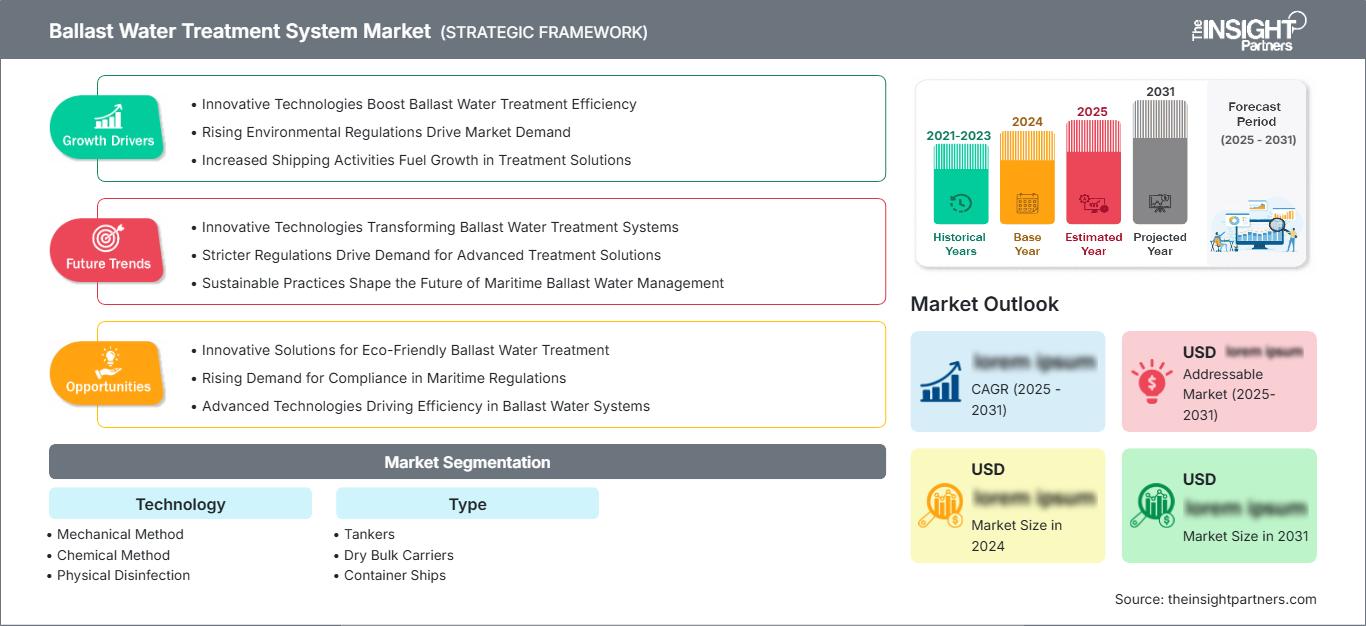
Ballast Water Treatment System Market: Strategic Insights
Regional Insights
North America Ballast Water Treatment System Market
North America accounted for 26–29% of global revenue in 2025, with a CAGR range of 7.4–8.0% through 2034. The region benefits from U.S. Coast Guard type-approval enforcement, high port inspection visibility, and strong replacement demand from internationally trading vessels.
The Ballast Water Treatment System Market share in North America is also supported by Great Lakes movements, tanker activity, and offshore service vessels needing compliant discharge practices. Canada’s coastal trades add steady demand, while U.S. ports reinforce documentation, maintenance, and operational readiness as key purchasing criteria.
U.S. Ballast Water Treatment System Market
The U.S. represented 72–76% of North America in 2025 and is projected to grow at a CAGR range of 7.5–8.1%. Compliance relies on Coast Guard-approved systems, documented operating procedures, and the ability to maintain discharge standards during port operations.
Company presence is strongest around service hubs supporting tankers, dry bulk carriers, and container ships calling at Gulf Coast, Atlantic, and Pacific ports. Demand favors equipment with rapid parts availability, crew-friendly interfaces, and maintenance programs that lower detention risk during inspection campaigns.
Europe Ballast Water Treatment System Market
Europe held 24–27% share in 2025 and is expected to grow at a CAGR range of 7.0–7.7%. Norway leads through marine equipment specialization, offshore vessel expertise, and strong supplier ecosystems, while Germany and the UK contribute classification, ship management, and port compliance capabilities.
France, Italy, and Spain support demand through ferry traffic, naval-adjacent shipyards, cruise activity, and Mediterranean port networks. European buyers emphasize energy use, chemical safety, retrofit flexibility, and documentation quality, making the market a service-led replacement and upgrade opportunity.
APAC Ballast Water Treatment System Market
APAC captured 34–38% share in 2025 and is forecast to grow at a CAGR range of 8.7–9.5%, making it the leading regional growth engine. China, Japan, and South Korea dominate newbuild integration, while Singapore strengthens service and inspection-linked demand.
India and Australia add momentum through port expansion, coastal shipping, LNG movements, and biosecurity priorities. Policy alignment with IMO standards and high shipyard throughput support equipment localization, faster installation cycles, and wider use of compact physical disinfection platforms.
Middle East & Africa Ballast Water Treatment System Market
The Middle East & Africa Ballast Water Treatment System Market is projected to expand at a CAGR of 7.8–8.6% during the forecast period, supported by strong energy exports, increasing tanker traffic, and ongoing investments in port infrastructure. UAE dominates the market due to its status as an important transshipment center and the presence of dry dock services and strong marine services infrastructure.
The other regions of Saudi Arabia, South Africa, and the rest of MEA add demand through refinery logistics, mineral bulk export, commercial maritime transport operations, and increased coastal trading. Adoption of the market is influenced by the availability of vessels for repair yard visits, availability of technicians, and the ship owner’s preference for strong treatment technology systems that can function efficiently in sediment-laden tropical conditions. Moreover, increasing compliance with the international ballast water treatment guidelines and regulations is driving fleet managers to opt for robust treatment systems and after-market services. Growth of the region is further bolstered by increased marine services, increased retrofitting, and strategic shipping routes where compliance with environmental standards is needed throughout the route.
Segmentation Analysis
Technology
- The technology segment is projected to grow at a CAGR range of 7.9–8.7% during 2026–2034. The market scope across technology is defined by filtration reliability, disinfection efficacy, chemical handling, footprint, and operating cost. Buyers increasingly compare total installed cost with long-term inspection readiness rather than selecting systems solely on purchase price.
- Mechanical Method remains the largest technology route, used widely as filtration or separation support before final treatment, especially where sediment control and stable flow are essential.
- Chemical Method serves vessels requiring strong organism inactivation through dosing, neutralization, and monitoring, with adoption influenced by chemical logistics, crew training, and discharge safety.
- Physical Disinfection is gaining preference where UV and related non-chemical approaches reduce handling complexity, support modular installation, and align with digital monitoring requirements.
Type
- The type segment is projected to grow at a CAGR range of 7.8–8.5% during 2026–2034. Demand varies by ballast volume, cargo cycle, vessel age, and trading pattern. Tankers and bulk carriers require high-throughput systems, while container ships prioritize compact integration, fast turnaround, and dependable operation during tightly scheduled port calls.
- Tankers generate sustained demand because ballast operations are frequent, volumes are high, and port inspections are strict across oil, chemical, and product tanker routes.
- Dry Bulk Carriers require robust systems for high-volume ballast exchange, with owners prioritizing clog-resistant filtration and reliable treatment in ports handling minerals, coal, and grains.
- Container Ships favor compact, automated, and energy-efficient treatment platforms that fit space-constrained engine rooms and support rapid cargo turnaround at major hub ports.
- General Cargos adopt systems based on trading flexibility, vessel age, and cost control, with demand strongest where multipurpose fleets serve regulated international routes.
Opportunity Snapshot
| Type | Revenue Contribution | Trend Tag | Adoption Stage |
| Tankers | High | Fleet Compliance | Mature |
| Dry Bulk Carriers | High | High Volume | Scaling |
| Container Ships | Medium | Compact UV | Scaling |
| General Cargos | Medium | Retrofit Fit | Emerging |
Ballast Water Treatment System Market Growth Drivers and Impact Analysis
Regulatory Enforcement Beyond Retrofit Deadlines
Mandatory performance standards for ballast water treatment systems have shifted the focus of the sector from installing the equipment to proving its effectiveness. More often, port-state controllers pay attention to record books, commissioning tests, maintenance reports, and the crew's understanding rather than checking whether the equipment was installed. It leads to the formation of cyclical demand related to services, spare parts, updates, and training. Vendors offering approved technologies and having their field engineers nearby large ports are advantaged because vessel owners are interested in reducing the risk of being detained and getting fast help. Compliance assurance investments of the market, which include not only new builds but also existing ships equipped with the first-generation systems, positively affect the market dynamics. Moreover, the market players can see that vessel owners are paying increased attention to support during the system's lifetime, system reliability, and the level of preparation for regulation. Continuous monitoring, digital reporting, and preventive maintenance become essential for ensuring compliance and reducing disruption risks. Service-oriented business model appears as an important way of generating additional revenues, and service networks of suppliers become an important part of their success in the Ballast Water Treatment Systems Market.
Newbuild Integration in Asian Shipyards
The countries of China, South Korea, and Japan are still important centers for global commercial shipbuilding, and therefore, shipyard integration becomes one of the growth drivers in the business. Modern ships increasingly need treatment systems that are incorporated into the machinery system from the design stage, which reduces installation complexities and makes the entire system more efficient during its lifetime. Suppliers with compact reactors, pre-installed skids, digital connectivity options, and regional manufacturing capabilities may accelerate installations, which is important since shipyards have full-order books and limited engineering resources. In addition, the market benefits from the trend, as owners favor such factory-made systems with documentation and warranty. Moreover, cooperation of the shipyards, equipment vendors, and vessel owners becomes more frequent, and helps to accelerate the commissioning process. Additionally, the market needs systems that are easy to operate, remotely monitored, and low maintenance to allow operators to optimize the costs of their life cycle and comply with international ballast water management standards.
Lifecycle Service and Performance Assurance
Calibration of the system, filter maintenance, changing the lamps, dosage of chemicals, verification of neutralization, software upgrades, and biological compliance support are among the things required by the installed systems. Vendors are more often being assessed based on their uptime and service capabilities since, in case of a system failure, it may affect vessel’s voyage planning and expose the vessel to regulatory authorities. Predictive maintenance and remote monitoring are also key in minimizing the cost associated with unanticipated site visits. It means that the income model will shift from selling equipment to multiyear service agreements.
Ballast Water Treatment System Market Future Trends
Connected Compliance Platforms
The next phase of Ballast Water Treatment System Market trends will center on connected compliance platforms that combine equipment data, maintenance history, sensor readings, and voyage records. Owners will use dashboards to verify readiness before port arrival, identify weak components, and schedule service without waiting for inspection failures. Suppliers can use anonymized fleet data to improve system design and support performance guarantees. As digital logs gain wider acceptance, treatment systems will become part of broader environmental compliance suites covering emissions, biofouling, and wastewater management across commercial fleets.
Lower-Energy Treatment Architectures
The importance of energy efficiency will be greater for ship owners when dealing with carbon intensity targets and fluctuating fuel costs. UV systems with optimized reactor design, enhanced filters, and adaptive power management will compete against chemical systems, which will be developed to minimize dosages and neutralization needs. Hybrid designs might become popular due to changing conditions of the water which makes a single mode system less efficient. In the Ballast Water Treatment System Market, technology solutions that would allow reducing the auxiliary power use, maintenance actions, and operation complexity of the BWTS will be rewarded while ensuring biological efficiency during the whole life cycle of the vessel. Furthermore, the operators of vessels are starting to evaluate the BWTS based on the total cost, energy use, and integration with the environmental strategy of the vessel.
Ballast Water Treatment System Market Opportunities
Upgrade Programs for First-Generation Systems
A large installed base is approaching higher maintenance intensity as filters age, UV lamps degrade, sensors drift, and crew practices vary. Suppliers can target owners with upgrade kits, digital monitoring, service agreements, and replacement modules that extend system life without full refit. This is especially relevant for vessels installed early in the compliance cycle. Ballast Water Treatment System Market Forecasts point to stronger aftermarket value as operators seek predictable inspection outcomes, lower downtime, and improved performance in challenging waters while avoiding the cost of complete machinery-room redesign.
Service Hubs Near Strategic Ports
Service centers closer to Singapore, Rotterdam, Houston, Fujairah, Shanghai, Busan, and Antwerp may be able to capitalize on demand for rapid technical intervention from fleet owners who face situations where voyages offer insufficient downtime for maintenance. The need for spare parts, trained technicians, and documentation will be critical to the owners during such scenarios. There will be an opportunity for suppliers to differentiate themselves with packages that include installation, training, inspection, and diagnostic services. These are not exclusive to equipment suppliers alone, as water treatment experts, maritime repair yards, and marine service providers may enter this business model through authorized channels. Fleet operators increasingly prefer service partners with global coverage, digital maintenance capabilities, and access to approved spare parts that help minimize vessel downtime. As a result, regional service infrastructure is becoming a key competitive factor in the Ballast Water Treatment System Market, supporting long-term customer relationships, recurring service revenue, and regulatory compliance across international shipping operations.
Recent Developments
- July 2025: Euro Tech Holdings announced that its subsidiary, Yixing Pacific, secured a contract to supply advanced water treatment systems for a semiconductor manufacturing facility in China. The project strengthens the company's position in high-purity water solutions for the growing semiconductor industry.
- July 2025: Euro Tech Holdings appointed David So as Chief Executive Officer to lead the company's next phase of growth. The leadership change is expected to strengthen the company's strategic focus on expanding its water treatment and environmental technologies business.
- July 2023: Wärtsilä Aquarius UV launched the Manta Filter, a next-generation ballast water filtration system designed to improve efficiency and simplify maintenance. The new technology enhances ballast water treatment performance while reducing operating costs for shipowners.
Frequently Asked Questions

- Comprehensive Market Sizing and Forecast Analysis
- Detailed Segmentation Analysis
- In-Depth Market Dynamics Assessment
- Regional and Country-Level Insights
- Competitive Landscape and Company Benchmarking
- Strategic Business Intelligence
Recent Reports
Testimonials

The Insight Partners provided valuable market intelligence that supported our global go-to-market strategy. Their team was professional, responsive, and attentive to our feedback, providing thoughtful analysis and helpful methodological clarifications throughout the project.
Junmo Kim Chief Financial Officer (CFO), Enertech Co., Ltd.
The Insight Partners' SCADA System Market report is comprehensive, with valuable insights on current trends and future forecasts. The team was highly professional, responsive, and supportive throughout. We are very satisfied and highly recommend their services.
RAN KEDEM Partner, Reali Technologies LTDs
I requested a report on a very specific software market and the team produced the report in a few days. The information was very relevant and well presented. I then requested some changes and additions to the report. The team was again very responsive and I got the final report in less than a week.
JEAN-HERVE JENN Chairman, Future Analytica
We worked with The Insight Partners for an important market study and forecast. They gave us clear insights into opportunities and risks, which helped shape our plans. Their research was easy to use and based on solid data. It helped us make smart, confident decisions. We highly recommend them.
PIYUSH NAGPAL Sr. Vice President, High Beam Global
The Insight Partners delivered insightful, well-structured market research with strong domain expertise. Their team was professional and responsive throughout. The user-friendly website made accessing industry reports seamless. We highly recommend them for reliable, high-quality research services
YUKIHIKO ADACHI CEO, Deep Blue, LLC.
This is the first time I have purchased a market report from The Insight Partners.While I was unsure at first, I visited their web site and felt more comfortable to take the risk and purchase a market report.I am completely satisfied with the quality of the report and customer service. I had several questions and comments with the initial report, but after a couple of dialogs over email with their analyst I believe I have a report that I can use as input to our strategic planning process.Thank you so much for taking the extra time and making this a positive experience.I will definitely recommend your service to others and you will be my first call when we need further market data.
JOHN SUZUKI President and Chief Executive Officer, Board Director, BK Technologies
I wish to appreciate your support and the professionalism you displayed in the course of attending to my request for information regarding to infectious disease IVD market in Nigeria. I appreciate your patience, your guidance, and the fact that you were willing to offer a discount, which eventually made it possible for us to close a deal. I look forward to engaging The Insight Partners in the future, all thanks to the impression you have created in me as a result of this first encounter.
DR CHIJIOKE ONYIA MANAGING DIRECTOR, PineCrest Healthcare Ltd.Reason to Buy
- Informed Decision-Making
- Understanding Market Dynamics
- Competitive Analysis
- Identifying Emerging Markets
- Customer Insights
- Market Forecasts
- Risk Mitigation
- Boosting Operational Efficiency
- Strategic Planning
- Investment Justification
- Tracking Industry Innovations
- Aligning with Regulatory Trends





 Get Free Sample for