
Band Stop Filters Market Size, Share & Trends by 2034
Coverage: By Type (Notch filter, Cavity filter, Tunable filter, Ceramic filter); Application (Military, Commercial, Space) , and Geography (North America, Europe, Asia Pacific, and South and Central America)
- Status : Data Released
- Report Code : TIPRE00020744
- Category : Electronics and Semiconductor
- No. of Pages : 150
- Available Report Formats :


- Last update date : August 10, 2026


2025 Market Size
US$ 1.32 Bn
Base year value
2034 Forecast
US$ 2.53 Bn
Projected by 2034
CAGR 2026-2034
7.48 %
Growth rate
Addressable Market
US$ 17.34 Bn
(2026-2034)
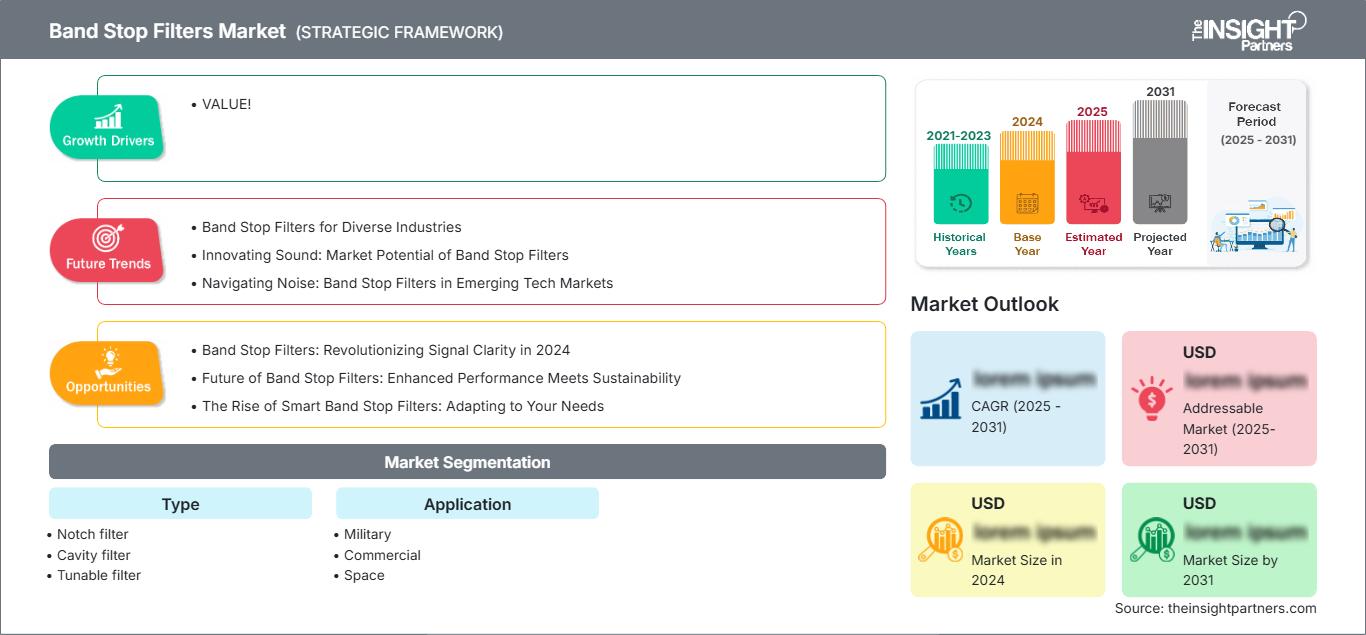
The Band Stop Filters Market size stood at US$ 1.32 Billion in 2025 and is estimated to grow to US$ 2.53 Billion by 2034, exhibiting a CAGR of 7.48% from 2026 to 2034. The market includes frequency selective devices that reduce or filter out certain frequencies bands but permit other frequencies outside the stop band with little loss, used in military communications, commercial wireless communication, satellites, and space. This helps in eliminating interference, harmonics, and other unnecessary signals allowing transmission and reception of the signal without any disturbance.
According to the Band Stop Filters Market report, North America is projected to grow with a CAGR of 6.8–7.5% during 2026-2034, driven by advancements in military communications, development of 5G infrastructure, and satellite communications market. The growth will be influenced by need for managing spectrum congestion, electromagnetic interference and procurement of advanced filtering devices.
Band Stop Filters Market Assessment and Insights
- North America held 29–32% share in 2025 and is growing at a CAGR of 6.8–7.5% during 2026–2034, led by defense spending, 5G deployment, and satellite programs across the US and Canada.
- US represented 80–83% of North American revenue in 2025 and is growing at a CAGR of 7.0–7.7% during 2026–2034.
- Europe accounted for 22–25% share in 2025 and is growing at a CAGR of 6.5–7.2% during 2026–2034, led by Germany, the UK, France, Italy, and Spain.
- Asia Pacific held 34–37% share in 2025 and is growing at a CAGR of 8.0–8.7% during 2026–2034, led by China, India, Japan, South Korea, and Australia.
- Largest Segment Notch filter held 35–38% market share in 2025 and is growing at a CAGR of 7.0–7.7% during 2026–2034.
- High Growth Segment Tunable filter represented 18–21% market share in 2025 and is growing at a CAGR of 8.5–9.2% during 2026–2034.
- Key companies analyzed in detail: Anatech Electronics; ECHO Microwave; KR Electronics Inc.; MCV Microwave; Micro Lambda Wireless, Inc.; Networks International Corporation; Planar Monolithics Industries; Qorvo; Teledyne Microwave Solutions; UIY Technology; Wainwright Instruments; Westell Technologies.
Source: The Insight Partners' analysis based on proprietary research, government publications, company annual reports, investor presentations, industry databases, and expert interviews.
The band stop filter technology has developed from the fixed frequency filters to the tunable filters with cavity filters, having better selectivity, low insertion loss and high power handling capacity. The manufacturing processes have focused on precise machining, advanced ceramic material, surface mount technology and factory tuned filters for performance at extreme temperatures and vibrations. The Band Stop Filters Market is also influenced by system integrators who match the filtering techniques to transceiver chains, antenna systems and signal distribution systems in communications and sensing applications.
Future investments are moving towards Asian, North American and European technological hubs where the developments of 5G network, satellite constellations and electronic warfare systems need advanced filters with improved rejection capacity and smaller dimensions. The regulatory compliance with military, commercial and space standards facilitates the certification process of the components. The buyers look for suppliers with design skills, manufacturing and testing proficiency as well as fast technical support and supply chain reliability.
Band Stop Filters Market Report Scope
| Report Attribute | Details |
|---|---|
| Market size in 2025 | US$ 1.32 Billion |
| Market Size by 2034 | US$ 2.53 Billion |
| Global CAGR (2026 - 2034) | 7.48% |
| Historical Data | 2021-2024 |
| Forecast period | 2026-2034 |
Band Stop Filters Market Analysis
Market growth is driven by spectrum congestion management, 5G infrastructure deployment, military communications modernization, and satellite system expansion. The value chain includes ceramic materials suppliers, precision machining specialists, filter manufacturers, and RF system integrators. Supply dynamics are shaped by material availability, manufacturing precision, and application-driven qualification cycles. The Market analysis indicates that notch filters gain preference for fixed-frequency interference suppression while tunable filters address multi-band requirements. Service capability is decisive because design support, custom configuration, and test documentation affect system performance and certification.
Competition is led by RF filter specialists and defense electronics suppliers. Qorvo, Teledyne Microwave Solutions, Micro Lambda Wireless, Inc., Anatech Electronics, Planar Monolithics Industries, Networks International Corporation, ECHO Microwave, KR Electronics Inc., MCV Microwave, UIY Technology, and Wainwright Instruments compete on filter performance, frequency coverage, packaging options, and application expertise. Investment trends favor tunable designs, integrated filter assemblies, and custom engineering support. Qorvo and Teledyne Microwave Solutions maintain leadership through comprehensive filter portfolios and defense market presence, while Micro Lambda Wireless and Anatech Electronics benefit from specialized design expertise. Strategic positioning depends on certified performance, reliability characterization, and supply chain consistency.
● REPORT CUSTOMIZATION
Tailor This Report To Align With Your Specific Business Requirements
This report can be customized to align precisely with your business objectives, scope, and target markets. Customization options include tailored segmentation, geography, competitive analysis, and strategic insights to support informed decision-making.
Customize This Report →WHAT YOU CAN ADJUST
- ● Segmentations
- ● Geography
- ● Competitive Analysis
- ● Language Preferences
Band Stop Filters Market: Strategic Insights
Regional Insights
North America Band Stop Filters Market
North America accounted for 29–32% of Band Stop Filters Market share in 2025 and is projected to grow at a CAGR of 6.8–7.5% during 2026–2034. Demand is supported by defense communications modernization, 5G infrastructure deployment, satellite communications expansion, and electronic warfare system development. The region's defense spending and technology ecosystem drive consistent demand for high-performance RF filters. Qorvo, Teledyne Microwave Solutions, Micro Lambda Wireless, Inc., Anatech Electronics, and Planar Monolithics Industries support installed bases across defense contractors, telecommunications equipment manufacturers, and satellite system developers in the US and Canada.
U.S. Band Stop Filters Market
The U.S. represented 80–83% of North American revenue in 2025 and is forecast to grow at a CAGR of 7.0–7.7% during 2026–2034. Application demand is concentrated in defense electronics, 5G network equipment, satellite communications, and commercial wireless infrastructure. Company presence is reinforced by Qorvo, Teledyne Microwave Solutions, Micro Lambda Wireless, Inc., Anatech Electronics, and Westell Technologies. Buyers prioritize rejection performance, insertion loss, power handling, and reliability qualifications, plus design support that reduces development cycles and improves confidence in RF system performance.
Europe Band Stop Filters Market
Europe held 22–25% share in 2025 and is expected to grow at a CAGR of 6.5–7.2% during 2026–2034. Germany leads through defense electronics, automotive radar, and industrial RF applications, while the UK supports demand from defense communications and satellite systems. France, Italy, and Spain add demand through aerospace, defense, and telecommunications infrastructure. Defense and telecommunications investments favor suppliers with documented performance certifications. Qorvo, Teledyne Microwave Solutions, Anatech Electronics, and Wainwright Instruments remain visible across commercial and defense projects.
APAC Band Stop Filters Market
Asia Pacific accounted for 34–37% share in 2025 and is projected to grow at a CAGR of 8.0–8.7% during 2026–2034. China leads through telecommunications infrastructure and defense electronics manufacturing, while India expands through defense modernization and telecommunications investment. Japan and South Korea prioritize high-performance filters for consumer electronics and defense applications, while Australia adds defense and communications infrastructure. Policy support for defense indigenization and telecommunications expansion strengthen Band Stop Filters Market adoption where RF performance carries significant operational value.
Middle East & Africa Band Stop Filters Market
The Middle East & Africa market is projected to grow at a CAGR of 6.0–6.7% during 2026–2034. Saudi Arabia leads through defense modernization and telecommunications investment, while the UAE adds aerospace, defense, and communications infrastructure. South Africa and Rest of MEA rely on defense and telecommunications development. Defense spending and infrastructure investments create demand for reliable filtering solutions. Suppliers succeed when they combine product quality, technical support, and supply chain consistency for diverse applications.
Segmentation Analysis
Type
Type is projected to grow at a CAGR of 7.2–7.9% during 2026–2034. Band Stop Filters Market scope covers Notch filter, Cavity filter, Tunable filter, and Ceramic filter. Selection depends on frequency requirements, rejection specifications, and application constraints. Notch filter leads through established performance and widespread deployment in interference suppression applications.
- Notch filter devices provide fixed-frequency rejection for specific interference sources, offering proven performance and cost-effective solutions for defined interference problems.
- Cavity filter designs deliver high-power handling and low insertion loss for demanding applications requiring superior selectivity and minimal signal degradation.
- Tunable filter solutions enable frequency agility across multiple bands, addressing multi-band and reconfigurable system requirements with adjustable rejection characteristics.
- Ceramic filter components offer compact size and cost-effective performance for commercial applications where space constraints and cost considerations drive selection.
Application
Application is forecast to grow at a CAGR of 7.0–7.7% during 2026–2034. Military, Commercial, and Space applications are becoming more strategic as RF system complexity increases across sectors. Application adoption intensifies when interference management and signal integrity drive component requirements.
- Military applications require ruggedized, high-reliability filters for communications, radar, and electronic warfare systems operating across demanding environments.
- Commercial applications encompass wireless infrastructure, broadcast, and industrial systems where cost-effective interference suppression drives component selection.
- Space applications demand highest reliability and radiation-tolerant designs for satellite communications and space-based sensing systems.
Opportunity Snapshot
| Application | Revenue Contribution | Trend Tag | Adoption Stage |
|---|---|---|---|
| Military | High | EW Systems | Mature |
| Commercial | High | 5G Infrastructure | Scaling |
| Space | Medium | Satellite Comms | Mature |
Band Stop Filters Market Growth Drivers and Impact Analysis
Spectrum Congestion Drives Filtering Requirements
The increasing density of wireless communications systems across military, commercial, and consumer applications has created significant spectrum congestion, requiring effective filtering to manage interference and ensure reliable operation. As more systems operate in adjacent frequency bands, the demand for high-performance band stop filters with precise rejection characteristics increases. Network operators and system designers increasingly rely on filters to protect sensitive receivers from out-of-band interference. The practical impact is continued demand for filters with improved selectivity and rejection across telecommunications and defense applications.
5G Infrastructure Deployment Creates Filter Demand
Global 5G network deployment requires extensive filtering to manage frequency bands, suppress harmonics, and prevent interference between adjacent channels. Base stations, small cells, and user equipment all require band stop filters for specific frequency management applications. The transition to higher frequencies and wider bandwidths creates new filtering challenges. This driver benefits suppliers that can deliver filters meeting 5G performance requirements with consistent quality and manufacturing scale supporting volume production.
Defense Modernization Programs Drive High-Performance Filter Adoption
Defense modernization across multiple regions is creating demand for advanced electronic warfare, radar, and communications systems requiring sophisticated filtering capabilities. Modern defense systems operate across increasingly congested spectrum environments, requiring filters with superior rejection, power handling, and environmental tolerance. The expansion of electronic warfare capabilities and spectrum-dependent systems drives consistent demand. The market impact is demand for specialized filters meeting military specifications with documented reliability and performance.
Band Stop Filters Market Future Trends
Tunable and Reconfigurable Filters Enable Spectrum Agility
Band Stop Filters Market trends point toward tunable and reconfigurable filter designs enabling spectrum agility for multi-band systems and adaptive interference management. The next product cycle will combine tunable elements with control electronics for frequency-agile filtering supporting dynamic spectrum access. This shift matters because system designers increasingly value flexibility as spectrum environments become more dynamic. Vendors with tunable filter expertise and control interface capabilities will be better positioned as systems require adaptable filtering.
Integrated Filter Assemblies Reduce System Complexity
Integrated filter assemblies combining multiple filtering functions with switching and control are emerging as solutions for complex RF systems requiring reduced footprint and simplified integration. Next-generation products will incorporate band stop functions with other filtering and RF components. This evolution enables more compact, higher-performance RF front ends. Suppliers that can deliver integrated assemblies with established filter performance will gain credibility with system developers seeking integration advantages.
Band Stop Filters Market Opportunities
Defense Filter Qualification for Modernization Programs
Band Stop Filters Market Forecasts support investment in defense-qualified filters for electronic warfare, radar, and communications modernization programs requiring reliability and performance for military applications. Manufacturers need filters meeting military specifications with documented testing and qualification. Providers can create opportunities by developing and qualifying filters for defense applications. The opportunity is strongest where defense spending creates demand for specialized filter solutions.
5G and Wireless Infrastructure Filter Supply
5G network expansion and wireless infrastructure investment create demand for cost-effective, reliable filters supporting base station and small cell deployments. Suppliers with manufacturing scale and quality systems can capture opportunities in commercial infrastructure markets. This opportunity rewards companies that can deliver consistent quality and volume while maintaining performance specifications for commercial applications.
Recent Developments
- June 2025: Qorvo (Nasdaq: QRVO), a leading provider of innovative RF solutions, introduced two high-performance S-Band switched filter bank (SFB) modules designed to meet the rising demand for agile, compact and efficient radar systems in defense and aerospace applications. As radar platforms evolve to support multi-function capabilities in compact form factors, designers need faster frequency agility and tighter spectral control. Qorvo’s new QPB1034 and QPB1036 modules meet these needs with integrated BAW filtering and fast-switching logic in a compact 6 x 6 mm package—reducing size while enhancing performance.
- January 2025: KYOCERA AVX, a leading global manufacturer of advanced electronic components engineered to accelerate technological innovation and build a better future, released two new series of compact, thin-film band-pass filters engineered to deliver excellent RF performance in a wide range of high-power applications with crowded PCBs. Designed to satisfy cross-market customer demand for small, high-power band-pass filters, the new BP1206 and BP2816 Series band-pass filters leverage the company’s proven, multilayer integrated thin-film (ITF) technology to deliver highly repeatable and reliable RF performance with low insertion loss, steep attenuation, sharp roll-off, low-noise, and high temperature stability. Both series also enable the quick and easy adjustment of RF parameters and feature ruggedly constructed compact, low-profile cases equipped with lead-free, solder-coated-nickel land grid array (LGA) terminations and compatible with automated assembly processes, including reflow, wave, and vapor phase soldering.
- October 2024: Ranatec, a part of Qamcom Group and progressive creator of test and measurement equipment for RF and microwave applications, introduced the digitally tunable RI 282 band pass filter. The new active band pass filters, a variant of Ranatec’s series of tunable band reject filters, provide exceptional performance and are digitally tunable between 600-6000 MHz. The RI 282 band pass filter is the latest addition to Ranatec’s broad product offering. It is part of the next generation of band pass filters, and is their latest innovation empowering leading electronics manufacturers to perform the enhanced testing that places their most advanced products in pole position for market.
Frequently Asked Questions

- Comprehensive Market Sizing and Forecast Analysis
- Detailed Segmentation Analysis
- In-Depth Market Dynamics Assessment
- Regional and Country-Level Insights
- Competitive Landscape and Company Benchmarking
- Strategic Business Intelligence
Recent Reports
Testimonials

The Insight Partners' SCADA System Market report is comprehensive, with valuable insights on current trends and future forecasts. The team was highly professional, responsive, and supportive throughout. We are very satisfied and highly recommend their services.
RAN KEDEM Partner, Reali Technologies LTDs
I requested a report on a very specific software market and the team produced the report in a few days. The information was very relevant and well presented. I then requested some changes and additions to the report. The team was again very responsive and I got the final report in less than a week.
JEAN-HERVE JENN Chairman, Future Analytica
We worked with The Insight Partners for an important market study and forecast. They gave us clear insights into opportunities and risks, which helped shape our plans. Their research was easy to use and based on solid data. It helped us make smart, confident decisions. We highly recommend them.
PIYUSH NAGPAL Sr. Vice President, High Beam Global
The Insight Partners delivered insightful, well-structured market research with strong domain expertise. Their team was professional and responsive throughout. The user-friendly website made accessing industry reports seamless. We highly recommend them for reliable, high-quality research services
YUKIHIKO ADACHI CEO, Deep Blue, LLC.
This is the first time I have purchased a market report from The Insight Partners.While I was unsure at first, I visited their web site and felt more comfortable to take the risk and purchase a market report.I am completely satisfied with the quality of the report and customer service. I had several questions and comments with the initial report, but after a couple of dialogs over email with their analyst I believe I have a report that I can use as input to our strategic planning process.Thank you so much for taking the extra time and making this a positive experience.I will definitely recommend your service to others and you will be my first call when we need further market data.
JOHN SUZUKI President and Chief Executive Officer, Board Director, BK Technologies
I wish to appreciate your support and the professionalism you displayed in the course of attending to my request for information regarding to infectious disease IVD market in Nigeria. I appreciate your patience, your guidance, and the fact that you were willing to offer a discount, which eventually made it possible for us to close a deal. I look forward to engaging The Insight Partners in the future, all thanks to the impression you have created in me as a result of this first encounter.
DR CHIJIOKE ONYIA MANAGING DIRECTOR, PineCrest Healthcare Ltd.Reason to Buy
- Informed Decision-Making
- Understanding Market Dynamics
- Competitive Analysis
- Identifying Emerging Markets
- Customer Insights
- Market Forecasts
- Risk Mitigation
- Boosting Operational Efficiency
- Strategic Planning
- Investment Justification
- Tracking Industry Innovations
- Aligning with Regulatory Trends





 Get Free Sample for