
Battery Power Tools Market Growth, Trends & Demand by 2034
Coverage: By Type (Brushed Motor, Brushless Motor); Tool (Drills, Saws, Lawn Mower, Impact Wrench, Others); Application (Industrial, DIY) , and Geography (North America, Europe, Asia Pacific, and South and Central America)
- Status : Data Released
- Report Code : TIPRE00008392
- Category : Electronics and Semiconductor
- No. of Pages : 150
- Available Report Formats :


- Last update date : July 21, 2026


2025 Market Size
US$ 30.53 Bn
Base year value
2034 Forecast
US$ 53.57 Bn
Projected by 2034
CAGR 2026-2034
6.45 %
Growth rate
Addressable Market
US$ 380.49 Bn
(2026-2034)
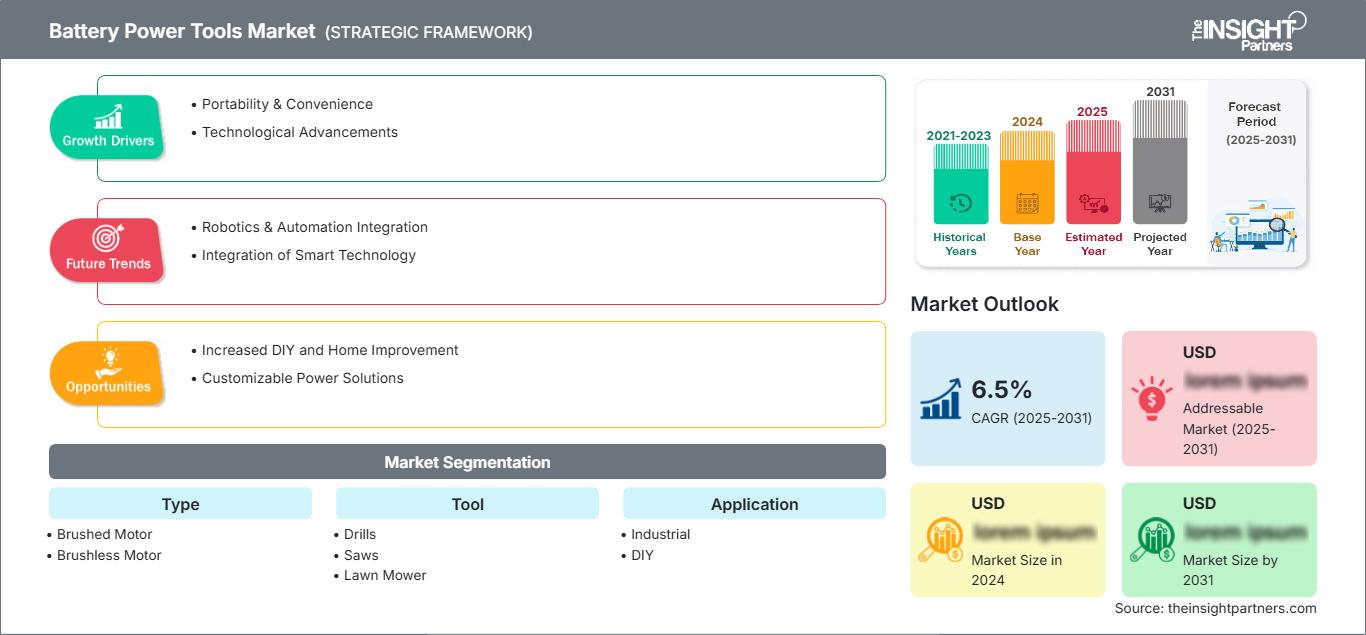
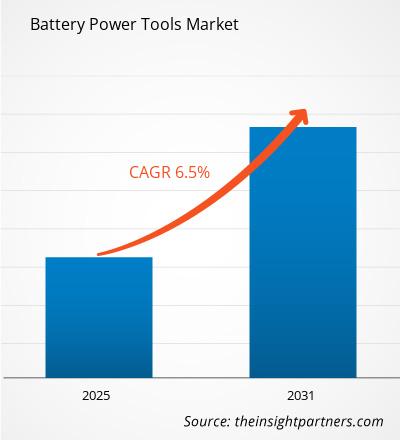
The value of Battery Power Tools market size is estimated to be at US$ 30.53 Billion in 2025, which is expected to increase to US$ 53.57 Billion in 2034, growing at a CAGR of 6.45%. The demand for this market is influenced by cordless jobsite processes, increased power density of lithium-ion batteries, use of brushless motors, and replacement of pneumatic/corded equipment used in construction, manufacturing, maintenance, landscaping, and household improvements.
The market in North America is projected to record a CAGR of 5.9–6.8% in 2026–2034, driven by renovation activity, professional trades replacement process, and quick adaptation of battery platforms in landscaping. Compatibility with the platform, smaller design due to the use of brushless motors, and safety regulations on jobsites will keep the cordless tools more preferred due to reduced trip hazards.
Battery Power Tools Market Assessment and Insights
- North America held 28–32% Battery Power Tools market share in 2025 and is growing at a CAGR of 5.9–6.8% during 2026–2034, led by replacement demand, remodeling, and trade migration from pneumatic systems.
- US represented 78–82% of North American revenue in 2025 and is growing at a CAGR of 6.0–6.9% during 2026–2034, supported by professional construction and DIY retail penetration.
- Europe accounted for 24–28% share in 2025 and is growing at a CAGR of 5.4–6.2% during 2026–2034, with Germany, the UK, France, Italy, and Spain leading adoption.
- Asia Pacific held 33–37% share in 2025 and is growing at a CAGR of 7.1–8.0% during 2026–2034, led by China, Japan, South Korea, India, and Australia.
- Largest Segment Brushless Motor held 54–58% market share in 2025 and is growing at a CAGR of 7.0–7.9% during 2026–2034 as efficiency and durability become baseline requirements.
- High Growth Segment Lawn Mower represented 10–14% market share in 2025 and is growing at a CAGR of 7.8–8.8% during 2026–2034, helped by gas-to-battery outdoor equipment conversion.
- Key companies analyzed in detail: Atlas Copco AB; Stanley Black & Decker, Inc.; Emerson Electric Co.; Hilti Corporation; Ingersoll Rand Inc.; Koki Holdings Co., Ltd.; Makita Corporation; Robert Bosch GmbH; Snap-on Incorporated; Techtronic Industries Co. Ltd.
Source: The Insight Partners' analysis based on proprietary research, government publications, company annual reports, investor presentations, industry databases, and expert interviews.
Market dynamics have moved from corded product replacement into competitive platforms that are based around batteries, chargers, motors, attachments, and connected services tools. The use of lithium-ion battery packs enabled mobility, while brushless motors provided better torque control and runtime performance. Current considerations in manufacturing consist of battery standardization, modular tool body, local manufacturing and sourcing for electronics, battery cells, durable plastics, and gears.
Future needs will include infrastructure upgrades, factory automation, building repair, and electrifying landscapes within both emerging and mature markets. Contracting companies need cordless tools that allow easy setup, limited generator dependence, and fleet management. Increasing pressure on noise, emissions, and labor safety regulations will lead to greater use of battery-powered tools in outdoor and industrial markets, especially where municipalities or major property owners prefer lower-emission maintenance equipment.
Battery Power Tools Market Report Scope
| Report Attribute | Details |
|---|---|
| Market size in 2025 | US$ 30.53 Billion |
| Market Size by 2034 | US$ 53.57 Billion |
| Global CAGR (2026 - 2034) | 6.45% |
| Historical Data | 2021-2024 |
| Forecast period | 2026-2034 |
Battery Power Tools Market Analysis
Battery Power Tools market growth is fueled by consumers opting to swap their corded drills, saws, wrenches, grinders, and smaller outside machinery for battery-driven versions that offer adequate energy and minimal setup inconvenience. The biggest need is in situations where workers travel from site to site, work at heights, or in occupied structures. Battery switching cuts downtime, as does fast charging and high capacity batteries.
The market consists of cell manufacturers, motor producers, electronic assembly companies, tool brands, distribution firms, rental companies, e-commerce outlets, and service providers. The supply chain relies on lithium ion battery supply, power electronics, thermal technology, and rigorous qualification testing. Purchasers are now comparing platform offerings, battery warranties, charging times, consistent torque, comfort, and post-sale service as opposed to evaluating individual tools
Battery Power Tools competition shows the strength of competitive advantage based on platform and brand strength. Competition includes Stanley Black & Decker, Inc., Robert Bosch GmbH, Makita Corporation, and Techtronic Industries Co. Ltd. Hilti Corporation and Atlas Copco AB have an edge in industrial and construction productivity tools, and Snap-on Incorporated, Ingersoll Rand Inc., Emerson Electric Co., and Koki Holdings Co., Ltd. offer specialized solutions.
Capital allocation is being directed toward developing brushless platforms, durable battery packs, electronic components protection, smart chargers, and connected assets management. Competitive positioning of companies depends on their ability to transform customers into a whole ecosystem through drilling, cutting, fastening, outdoor and specialty products. The best-positioned companies have diversified product offering, industry-specific accessories, reliable service and distribution that guarantees availability of replacement batteries and chargers.
● REPORT CUSTOMIZATION
Tailor This Report To Align With Your Specific Business Requirements
This report can be customized to align precisely with your business objectives, scope, and target markets. Customization options include tailored segmentation, geography, competitive analysis, and strategic insights to support informed decision-making.
Customize This Report →WHAT YOU CAN ADJUST
- ● Segmentations
- ● Geography
- ● Competitive Analysis
- ● Language Preferences
Battery Power Tools Market: Strategic Insights
Regional Insights
North America Battery Power Tools Market
North America accounted for 28–32% of Battery Power Tools market share in 2025 and is projected to expand at a CAGR of 5.9–6.8% during 2026–2034. Professional trades continue to upgrade from corded and pneumatic systems because cordless platforms improve mobility, reduce hose management, and simplify work in renovation, electrical, plumbing, HVAC, and jobsite maintenance.
Strength of distribution network is another regional advantage, where the distribution network is supported by home centers, industrial distributors, rentals, and Internet-based marketplaces for replacement batteries and accessories. There is an adoption advantage due to battery powered lawn equipment, restrictions on noise pollution from cities, and contractors’ preferences for platforms with compatibility. Leading demand is from the U.S., followed by Canada and Mexico.
U.S. Battery Power Tools Market
The USA was responsible for generating 78-82% of revenues from North America in 2025, and will have a CAGR of 6.0-6.9% from 2026 to 2034. Demand will be driven by residential remodels, professional construction, automotive repairs, and outdoors maintenance. The proliferation of retailers will drive DIY growth, while the relationship with distributors will drive industrial and trade demand.
Corporate presence includes Stanley Black & Decker, Inc., Snap-on Incorporated, Emerson Electric Co., as well as strong North American presence of multinational corporations. Product trends include drills, impact wrenches, saws, and mowers. Contractors increasingly demand small brushless tools, high power batteries, dust extraction capability, and tool tracking in multi-subcontractor job sites.
Europe Battery Power Tools Market
The Europe region accounted for a share of 24% to 28%, and it is predicted to increase with a CAGR of 5.4% to 6.2% from 2026 to 2034. The major contributor is Germany since its deep-rooted manufacturing industry, premium-grade construction equipment, and trade-based distribution support the use of brushless systems and high voltage systems.
The UK also makes contribution by means of repair works, renovations, rental services, and efficient DIY markets. Countries like France, Italy, and Spain make contribution in terms of building renovations, car maintenance, wood working, and public sector maintenance. European consumers focus on vibration suppression, dust prevention, battery safety, and reduced pollution in the work site.
APAC Battery Power Tools Market
The Asia-Pacific region holds a market share between 33%-37% in 2025 and is expected to achieve a CAGR of 7.1-8.0% during the period from 2026 to 2034. The country will continue to dominate due to manufacturing size, construction, export of tools, and rapid growth of battery ecosystem.
Innovation in small motors, electronics, and reliable professional tools is witnessed by Japan and South Korea. While India and Australia add value through infrastructure, housing, mining, and landscape electrification. Support for manufacturing, energy efficiency, and worksite safety policies will ensure that the region remains ahead of global trends.
Middle East & Africa Battery Power Tools Market
MEA region’s market growth rate is expected to be between 4.8%-5.8% CAGR during 2026-2034. Saudi Arabia dominates the region because of increasing demands due to infrastructure projects, energy, tourism, and Smart City projects.
Premium building services, facility management, and landscaping in the UAE encourage acceptance whereas mining applications in South Africa still play an important role. Demand for the rest of MEA will rise if distributors can offer batteries, chargers, training, and service in extreme working environments.
Segmentation Analysis
Type
Type is projected to grow at a CAGR of 6.2–7.0% during 2026–2034. The Battery Power Tools scope covers brushed and brushless motor architectures, but value is shifting toward brushless systems because they improve runtime, reduce heat, and support advanced electronic controls. Brushed tools remain important in cost-sensitive DIY applications where simple maintenance and lower upfront pricing guide purchase decisions.
- Brushed Motor tools remain relevant in entry-level kits, repair tasks, and occasional-use DIY applications where price sensitivity outweighs runtime optimization, electronic control, and long service life.
- Brushless Motor tools lead professional migration because electronic commutation improves efficiency, torque response, durability, and battery utilization across drilling, cutting, fastening, and outdoor applications.
Tool
Tool is forecast to grow at a CAGR of 6.4–7.3% during 2026–2034. Drills and saws continue to anchor platform adoption, while impact wrenches strengthen demand in automotive, assembly, and heavy repair environments. Lawn mowers create incremental growth as battery platforms extend from handheld tools into outdoor equipment where noise, emissions, and storage convenience influence purchasing.
- Drills hold a central position because they are the first cordless purchase for many users and support continuous replacement through trade kits, retail bundles, and accessory ecosystems.
- Saws are strategically important as higher-output batteries allow circular, reciprocating, and miter formats to compete with corded models in construction, carpentry, and renovation tasks.
- Lawn Mower demand is rising as homeowners, landscapers, and municipalities shift from gasoline equipment toward quieter battery systems that reduce maintenance, fuel storage, and local emissions.
- Impact Wrench adoption benefits from automotive service, industrial maintenance, equipment repair, and construction fastening, where torque consistency, portability, and reduced compressor dependence improve workflow productivity.
Application
Application is projected to grow at a CAGR of 5.8–6.7% during 2026–2034. Industrial users prioritize uptime, safety, torque repeatability, and fleet standardization, while DIY buyers emphasize affordability, light weight, and compatibility with household or garden tools. The segment mix is widening because professional-grade features are moving into mid-tier retail products.
- Industrial demand is sustained by construction, manufacturing, maintenance, automotive, and utility workflows that require reliable torque, rugged housings, battery visibility, and service support.
- DIY demand benefits from home improvement, online tutorials, affordable kits, compact design, and the appeal of one battery platform serving repair, hobby, and garden tasks.
Opportunity Snapshot
Application | Revenue Contribution | Trend Tag | Adoption Stage |
Industrial | High | Fleet Standardization | Mature |
DIY | Medium | Home Renovation | Scaling |
Battery Power Tools Market Growth Drivers and Impact Analysis
Brushless platforms raise professional replacement demand
The use of brushless motors has influenced replacement economics, as they offer longer operating hours, reduced maintenance, improved thermal regulation, and even higher torque output with the same battery pack. It influences most trades that regularly drill, cut, fasten, and grind throughout the day. As the fleet begins to align themselves with high-quality platforms, they will be disinclined to swap individual units with inexpensive corded tools. The result is that it influences average selling prices positively and helps improve accessory sales through attachments like batteries and chargers.
Cordless outdoor equipment expands addressable use cases
Battery-powered lawn mowers, blowers, trimmers, and pruning tools are extending cordless adoption beyond workshops and jobsites. Users are motivated by lower noise, simpler storage, reduced fuel handling, and fewer engine-maintenance tasks. The market impact is meaningful because outdoor equipment increases seasonal battery utilization and encourages larger-capacity packs. Brands that can connect handheld tools and outdoor products through one charging ecosystem gain higher wallet share from homeowners, facility managers, and landscaping crews. This also opens distribution partnerships with garden centers, rental companies, municipal buyers, and property maintenance providers seeking low-emission operating choices.
Jobsite safety and productivity favor battery systems
Contractors increasingly assess tools by total workflow impact rather than purchase price alone. Battery systems reduce extension cords, air hoses, compressor setup, and generator use, which can improve movement in congested or occupied environments. The impact is visible in renovation, mechanical, electrical, plumbing, and maintenance work where crews change locations frequently. Cordless adoption also supports dust extraction, cut control, lighting, and tool tracking features that improve safety compliance. Suppliers able to quantify labor savings, downtime reduction, and reduced setup complexity can justify premium kits and longer platform commitments with professional buyers.
Battery Power Tools Market Future Trends
Battery intelligence becomes a platform differentiator
Battery Power Tools market trends indicate that packs will become smarter assets rather than simple energy sources. Future batteries are likely to carry better thermal sensing, charge history, fault detection, and compatibility controls to protect tools under high-load applications. For fleets, battery data can help schedule charging, reduce loss, and identify packs nearing replacement. This trend favors suppliers that combine cell engineering, electronics, chargers, and software into a trusted system. It should also increase the importance of battery warranties, recycling pathways, and service visibility as customers standardize around fewer platforms.
Compact high-voltage tools move into heavier applications
Higher-output batteries, improved cooling, and stronger motor controls will push cordless tools into applications once reserved for corded, pneumatic, or gasoline equipment. The future opportunity is not only more power; it is delivering that power in compact tools that reduce fatigue and maintain runtime under real loads. Heavy-duty saws, breakers, grinders, and mowers will become more credible for professional crews as charging infrastructure improves. Manufacturers will need to balance performance with safety, pack weight, vibration control, and cost so users can adopt cordless systems without sacrificing productivity.
Battery Power Tools Market Opportunities
Industrial fleet standardization programs
Battery Power Tools Market Forecasts support investment in industrial fleet standardization because multi-site operators need fewer platforms, controlled battery inventories, and consistent safety procedures. Suppliers can target manufacturers, utilities, transport maintenance teams, and facility managers with audited tool programs, battery labeling, repair SLAs, and training bundles. The opportunity is action-oriented because standardization reduces procurement complexity and supports measurable uptime. Vendors that integrate asset tracking, charger placement, and periodic performance reviews can move beyond product sales into managed productivity relationships, creating stickier contracts and stronger replacement visibility.
Battery-powered landscaping for municipal and commercial buyers
Municipalities, campuses, hotels, hospitals, and commercial property managers represent a practical opportunity for battery-powered outdoor equipment. These buyers value quieter operation near occupied spaces, reduced fuel storage, and simplified maintenance for distributed crews. Suppliers can act by offering mower, blower, trimmer, charger, and spare-pack bundles designed around shift length and site size. Financing, leasing, and trade-in programs can reduce adoption barriers where gasoline fleets remain depreciated. Service coverage and battery recycling should be built into proposals because institutional buyers increasingly expect environmental and lifecycle accountability.
Recent Developments
- July 2026: Alfred Kärcher SE & Co. KG and ANDREAS STIHL AG & Co. KG have announced the launch of their joint battery alliance. The aim of this strategic partnership is to offer professional users a common, high-performance and future-proof battery standard. At the heart of the alliance is the ALLPRO battery system developed by STIHL, which will be used in the professional equipment of both brands in future.
- September 2025: Greenworks® Commercial, the pioneer and proven leader in battery-powered outdoor power equipment, has received 10 Pro Tool Innovation Awards and three finalist honors in recognition of its groundbreaking design and exceptional performance. Celebrating its 13 th year, Pro Tool Review’s annual competition showcases best-in-class innovations shaping professional trade industries.
- October 2025: Hilti is broadening its portfolio by extending its groundbreaking Nuron battery platform with a new lineup of more than 60 products for heavy-duty applications. The first products will be launched in Q4 2025. This marks a significant step forward in increasing efficiency and resilience on the construction site. The expanded range extends cordless capabilities into areas once considered beyond the reach of battery-powered tools.
Frequently Asked Questions

- Comprehensive Market Sizing and Forecast Analysis
- Detailed Segmentation Analysis
- In-Depth Market Dynamics Assessment
- Regional and Country-Level Insights
- Competitive Landscape and Company Benchmarking
- Strategic Business Intelligence
Recent Reports
Testimonials

The Insight Partners' SCADA System Market report is comprehensive, with valuable insights on current trends and future forecasts. The team was highly professional, responsive, and supportive throughout. We are very satisfied and highly recommend their services.
RAN KEDEM Partner, Reali Technologies LTDs
I requested a report on a very specific software market and the team produced the report in a few days. The information was very relevant and well presented. I then requested some changes and additions to the report. The team was again very responsive and I got the final report in less than a week.
JEAN-HERVE JENN Chairman, Future Analytica
We worked with The Insight Partners for an important market study and forecast. They gave us clear insights into opportunities and risks, which helped shape our plans. Their research was easy to use and based on solid data. It helped us make smart, confident decisions. We highly recommend them.
PIYUSH NAGPAL Sr. Vice President, High Beam Global
The Insight Partners delivered insightful, well-structured market research with strong domain expertise. Their team was professional and responsive throughout. The user-friendly website made accessing industry reports seamless. We highly recommend them for reliable, high-quality research services
YUKIHIKO ADACHI CEO, Deep Blue, LLC.
This is the first time I have purchased a market report from The Insight Partners.While I was unsure at first, I visited their web site and felt more comfortable to take the risk and purchase a market report.I am completely satisfied with the quality of the report and customer service. I had several questions and comments with the initial report, but after a couple of dialogs over email with their analyst I believe I have a report that I can use as input to our strategic planning process.Thank you so much for taking the extra time and making this a positive experience.I will definitely recommend your service to others and you will be my first call when we need further market data.
JOHN SUZUKI President and Chief Executive Officer, Board Director, BK Technologies
I wish to appreciate your support and the professionalism you displayed in the course of attending to my request for information regarding to infectious disease IVD market in Nigeria. I appreciate your patience, your guidance, and the fact that you were willing to offer a discount, which eventually made it possible for us to close a deal. I look forward to engaging The Insight Partners in the future, all thanks to the impression you have created in me as a result of this first encounter.
DR CHIJIOKE ONYIA MANAGING DIRECTOR, PineCrest Healthcare Ltd.Reason to Buy
- Informed Decision-Making
- Understanding Market Dynamics
- Competitive Analysis
- Identifying Emerging Markets
- Customer Insights
- Market Forecasts
- Risk Mitigation
- Boosting Operational Efficiency
- Strategic Planning
- Investment Justification
- Tracking Industry Innovations
- Aligning with Regulatory Trends





 Get Free Sample for