
Battery Strap PTCs Market Size, Trends & Demand by 2034
Coverage: By Type (AC, DC); Application (Consumer Electronics, Power Supply, Others), and Geography (North America, Europe, Asia Pacific, and South and Central America)
- Status : Data Released
- Report Code : TIPRE00015481
- Category : Electronics and Semiconductor
- No. of Pages : 150
- Available Report Formats :


- Last update date : July 20, 2026


2025 Market Size
US$ 185.27 Mn
Base year value
2034 Forecast
US$ 299.97 Mn
Projected by 2034
CAGR 2026-2034
5.50 %
Growth rate
Addressable Market
US$ 2,200.15 Mn
(2026-2034)
The Battery Strap PTCs Market is projected to grow from US$ 185.27 Million in 2025 to US$ 299.97 Million by 2034, registering a CAGR of 5.50% during 2026–2034. Demand is supported by resettable overcurrent protection requirements in compact rechargeable battery packs, where welded strap formats help protect cells against short circuits, overcharging events, and thermal stress without requiring replacement after each fault.
Across North America, the Battery Strap PTCs Market size is expected to advance at an estimated 4.8–5.4% CAGR, supported by electronics assembly, power module qualification, and safety documentation requirements. Growth is reinforced by battery-powered medical devices, industrial handheld tools, and resilient distribution networks that reduce supply risk for component buyers.
Battery Strap PTCs Market Assessment and Insights
- North America: The region held 28–32% share in 2025 and is projected to grow at 4.8–5.4% CAGR between 2026–2034, led by qualified electronics suppliers and safety-driven procurement.
- US: The country accounted for 78–82% of North America in 2025 and is forecast to grow at 4.9–5.5% CAGR between 2026–2034.
- Europe: Europe represented 22–26% share in 2025 and is expected to grow at 4.6–5.2% CAGR, with Germany, the UK, and France leading demand.
- Asia Pacific: APAC captured 34–38% share in 2025 and is likely to grow at 5.8–6.5% CAGR, supported by China, Japan, South Korea, and India.
- Largest Segment: DC products held 58–62% market share in 2025 and are projected to grow at 5.4–6.0% CAGR between 2026–2034.
- High Growth Segment: Consumer electronics held 62–66% market share in 2025 and is expected to grow at 5.7–6.4% CAGR between 2026–2034.
- Key companies analyzed in detail: Bel Fuse Inc., Littelfuse, Inc., OptiFuse, Panhao, Shanghai Songshan Electronics Co., Ltd., Fuzetec Technology Co., Ltd., Bourns, Inc., Eaton Corporation plc, TE Connectivity Ltd., SCHURTER Holding AG, E-T-A Elektrotechnische Apparate GmbH.
Source: The Insight Partners' analysis based on proprietary research, government publications, company annual reports, investor presentations, industry databases, and expert interviews.
Battery pack protection has moved from basic replaceable fusing toward resettable polymer protection that supports tighter pack layouts and improved field reliability. The Battery Strap PTCs Market growth reflects this shift, as OEMs require components that can be resistance welded to cell straps, maintain low resistance during normal operation, and respond predictably under fault conditions.
Future demand will be shaped by manufacturing localization, supplier qualification discipline, and electrified portable systems across emerging economies. Regulations on battery safety, airline transport, and product recalls continue to influence engineering decisions. The market is therefore positioned around dependable thermal response, documentation quality, and scalable production for high-volume battery applications.
Battery Strap PTCs Market Report Scope
| Report Attribute | Details |
|---|---|
| Market size in 2025 | US$ 185.27 Million |
| Market Size by 2034 | US$ 299.97 Million |
| Global CAGR (2026 - 2034) | 5.50% |
| Historical Data | 2021-2024 |
| Forecast period | 2026-2034 |
Battery Strap PTCs Market Analysis
The demand is fueled by the use of rechargeable battery packs in smartphones, tablets, portable media players, mobile radios, cameras, power tools, and miniature power units. The market depends on cell manufacturers, pack makers, distributors, and design engineers who need to specify hold current, trip current, voltage ratings, and time-to-trip values before qualifying their products.
Supply considerations continue to be determined by the uniformity of the polymers used, the availability of nickel straps, weldability using automation, and agency approvals like UL and TÜV. Specified products of suppliers have working ranges that include 1.2A – 13A and 6V – 30V.
Market analysis is characterized by the presence of competition between general circuit protection suppliers and specific Asian manufacturers. Competition between Littelfuse, Inc. and Bel Fuse Inc. lies in catalog depth, automotive compliance, and distribution capabilities. Competition between Fuzetec Technology Co., Ltd. and Shanghai Songshan Electronics Co., Ltd. is determined by battery strap specialization.
Investments are made in low resistance compounds, quick trip speed, and wider voltage current range for mini packages. OptiFuse, Panhao, Bourns, Inc., Eaton Corporation plc, TE Connectivity Ltd., SCHURTER Holding AG, and E-T-A Elektrotechnische Apparate GmbH reinforce their positioning with application engineering and authorized distribution capabilities.
● REPORT CUSTOMIZATION
Tailor This Report To Align With Your Specific Business Requirements
This report can be customized to align precisely with your business objectives, scope, and target markets. Customization options include tailored segmentation, geography, competitive analysis, and strategic insights to support informed decision-making.
Customize This Report →WHAT YOU CAN ADJUST
- ● Segmentations
- ● Geography
- ● Competitive Analysis
- ● Language Preferences
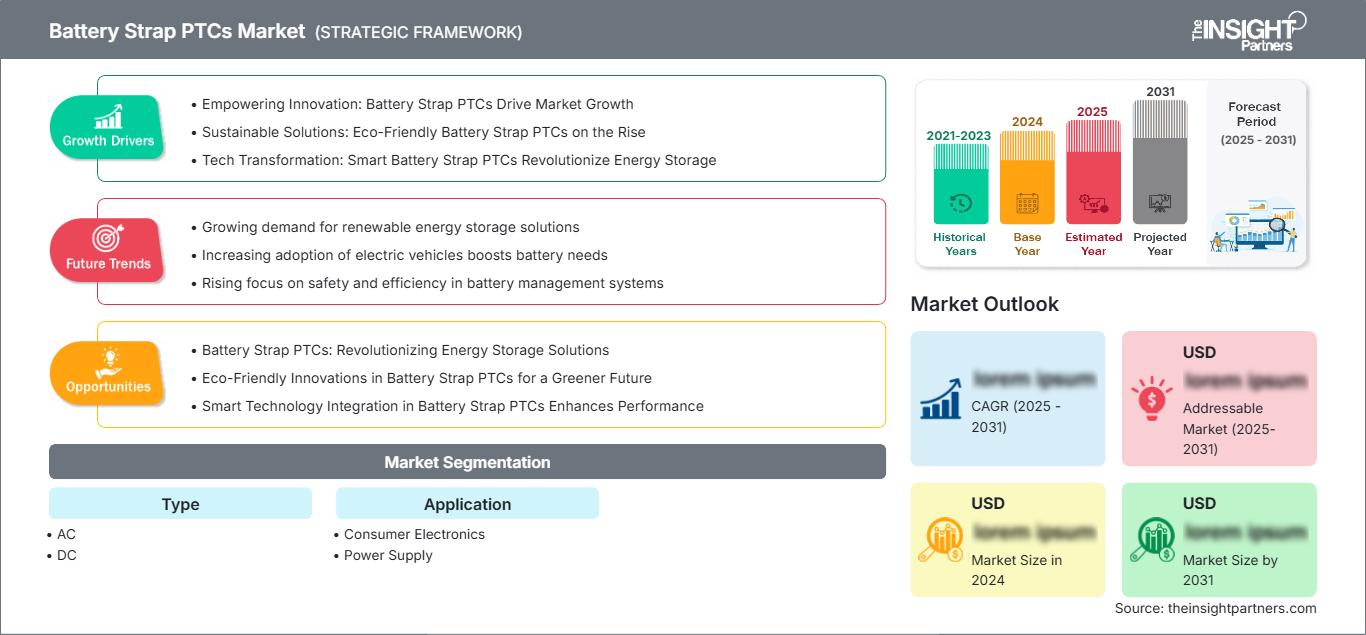
Battery Strap PTCs Market: Strategic Insights
Regional Insights
North America Battery Strap PTCs Market
North America accounted for 28–32% share in 2025, with growth expected at 4.8–5.4% CAGR through 2034. The Battery Strap PTCs Market share in the region is supported by safety-critical battery pack design, strong distributor inventory, and steady use in medical electronics, communication devices, and industrial handheld systems.
Battery pack assemblers prioritize components with predictable reset behavior, agency recognition, and stable resistance after tripping. The region benefits from suppliers offering engineering support and multi-channel availability, which helps OEMs manage design validation and continuity planning. Demand is also reinforced by product liability concerns around overheating and rechargeable battery abuse.
U.S. Battery Strap PTCs Market
The US represented 78–82% of North America in 2025 and is forecast to grow at 4.9–5.5% CAGR during 2026–2034. The demand centers around consumer electronics design, defense communications equipment, medical battery packs, and power supplies with modules for resettable overcurrent protection.
Market presence is highest in the form of Littelfuse, Inc., Bel Fuse Inc., Bourns, Inc., OptiFuse, and distributors who help with the design-in process. The application trends revolve around low-profile strap solutions, AEC-Q200 compliant solutions when necessary, and package documentation to reduce qualification time.
Europe Battery Strap PTCs Market
Europe held 22–26% share in 2025 and is projected to expand at 4.6–5.2% CAGR. Germany leads regional demand through industrial electronics, automotive-adjacent battery systems, and strict supplier qualification. The UK contributes through medical devices and instrumentation, while France, Italy, and Spain support diversified electronics assembly.
European buyers emphasize RoHS compliance, traceability, and thermal derating documentation because battery failures create warranty and safety exposure. SCHURTER Holding AG and E-T-A Elektrotechnische Apparate GmbH strengthen regional credibility, while global vendors serve multinational OEM platforms. This makes the Battery Strap PTCs Market comparatively quality-led rather than purely price-led.
APAC Battery Strap PTCs Market
APAC accounted for 34–38% share in 2025 and is expected to grow at a CAGR of 5.8–6.5%, the fastest regional pace. China leads through battery pack manufacturing scale, followed by Japan and South Korea with their advanced electronics quality systems. At the same time, India and Australia contribute additional demand from consumer devices, power tools, renewable energy systems, and energy storage applications.
Strategies promoting localization of electronics production, electric vehicle production, supply chain management, and smart energy production equipment have resulted in an increase in sourcing activities in the region. An increase in investment in lithium-ion battery production facilities, electronics production, and energy storage facilities has contributed to rising demand. Companies like Panhao, Shanghai Songshan Electronics Co., Ltd., and Fuzetec Technology Co., Ltd. enjoy proximity to battery pack assembly plants and electronics production factories. This makes delivery easier and faster. Foreign companies are competing by being reliable, having comprehensive testing procedures, certification services, and strategic partnerships with global OEMs. There is also more manufacturing capacity, favorable government policies, and the use of battery-operated products in the region.
Middle East & Africa Battery Strap PTCs Market
The Middle East & Africa is projected to grow at a CAGR of 4.3–4.9%, led by the UAE and Saudi Arabia through investments in infrastructure, electronics, logistics systems, smart energy deployments, and digital transformation initiatives. South Africa contributes through industrial maintenance activities, backup power equipment, telecommunications infrastructure, and distribution-driven component demand.
While regional adoption is less compared to APAC and North America, demands for battery safety standards are growing due to rising penetration levels of telecom back-up solutions, portable medical devices, smart metering systems, and grid monitoring systems. Increasing investments in renewable energy initiatives, energy storage solutions, and infrastructures have contributed significantly to the growth in demand for circuit protection solutions. Importing and purchasing of certified products through approved channels is still key due to counterfeiting concerns. Technical support and certified products remain key purchase criteria for buyers in the region.
Segmentation Analysis
Type
The type segment is expected to grow at 5.2–5.9% CAGR during 2026–2034. Battery Strap PTCs Market scope by type is defined by AC and DC device requirements, with DC formats dominating rechargeable pack integration and AC-rated devices serving power supply protection where resettable safety is valuable.
- AC: AC products serve power supply interfaces, industrial controls, and line-side circuits where resettable protection reduces service intervention while maintaining compact design and compliance-oriented selection.
- DC: DC products held 58–62% market share in 2025 and remain central to rechargeable battery packs, where low resistance and fast response protect cells during short-circuit events.
Application
The application segment is projected to grow at 5.5–6.2% CAGR during 2026–2034. Consumer electronics lead because compact battery packs require repeatable protection in high-volume devices. At the same time, power supply applications expand as equipment makers integrate resettable fault protection to reduce service cost and downtime.
- Consumer Electronics: Consumer electronics held 62–66% market share in 2025, supported by smartphones, tablets, cameras, portable tools, and wearable devices requiring small, welded, resettable battery protection.
- Power Supply: Power supply applications use strap PTCs where compact resettable protection improves reliability in adapters, backup units, control boards, and distributed power modules.
Opportunity Snapshot
| Application | Revenue Contribution | Trend Tag | Adoption Stage |
| Consumer Electronics | High | Compact Packs | Mature |
| Power Supply | Medium | Fault Reset | Scaling |
Battery Strap PTCs Market Growth Drivers and Impact Analysis
Rising Rechargeable Battery Pack Safety Requirements
Rechargeable packs are becoming denser, thinner, and more difficult to service, which raises the value of resettable protection. Battery strap PTCs limit current during short circuits and overcharge events, then return toward normal resistance after the fault clears. This reduces replacement needs, lowers maintenance requirements, and supports warranty control. The Battery Strap PTCs Market benefits because consumer electronics, medical devices, and portable tools increasingly require protection that fits directly into welded cell assemblies without adding bulky holders or consuming valuable board space. As battery-powered products continue to prioritize compact form factors and higher energy density, manufacturers are placing greater emphasis on integrated protection solutions that combine reliability, space efficiency, and long operational life. The ability of battery strap PTCs to support automated assembly processes while enhancing battery safety further strengthens their adoption across a growing range of rechargeable applications.
Miniaturization of Portable Electronics and Power Modules
There is a continuous shrinking of internal space by device manufacturers in addition to the introduction of higher-capacity batteries, fast-charging capability, and more complex processing needs. There is a need for battery strap PTC devices since they assist designers in ensuring protection in circuits where normal fuses cannot be used due to either inefficiency or the consumption of limited space. The thin profile of such devices makes it easy to integrate these devices close to the battery cell in order to improve their thermal performance and increase the efficiency of protection.
However, there are changes in terms of sourcing and qualifying the component suppliers as the manufacturers consider the aspects of trip profile, stability in resistance, welding capability, durability in its lifespan, and heat resistance compared to merely looking at the costs involved. With denser energy storage becoming common in batteries, the manufacturers are concerned about the performance of the safety device under fault conditions. Those manufacturers that provide good performance, compactness in packaging, and compatibility with automated production processes will become stronger players as the market for batteries develops.
Supplier Qualification and Safety Documentation Discipline
Battery failures can trigger recalls, transport restrictions, and brand damage, so buyers increasingly demand recognized approvals, thermal derating curves, and stable post-trip resistance data. Vendors with catalog transparency and regional technical support gain an advantage. The Battery Strap PTCs Market is affected by this shift because procurement teams are consolidating suppliers around proven quality systems, dual sourcing, and authorized distribution, especially for medical, industrial, and high-volume consumer electronics programs.
Battery Strap PTCs Market Future Trends
Lower Resistance Materials for Longer Runtime
Battery Strap PTCs Market trends point toward lower resistance materials that reduce voltage drop and heat generation during normal operation. This is important for compact devices where runtime and thermal comfort influence user experience. Suppliers are expected to refine polymer formulations, strap geometry, and reset behavior to support higher current density without sacrificing fault response. The trend will favor companies that can document resistance stability after repeated thermal events and provide consistent lots for automated battery pack assembly.
Closer Integration with Battery Management Design
Protection circuits are expected to be viewed by design teams as an integral part of the overall protection architecture rather than a standalone piece of hardware. The future battery packs would be increasingly integrating electronics, cell balancing, temperature sensing, and resettable overcurrent protection into a more tightly knit system that will be safer, more reliable, and functional. This will create chances for manufacturers who can offer application notes, validation support, testing data, and collaboration on protection systems in order to assist OEMs in maximizing their protection solutions through the design process. It will also be especially true for applications in medical electronics, robotics, energy smart devices, and compact industrial tooling, where safety needs and size considerations become highly critical.
Battery Strap PTCs Market Opportunities
Localized Battery Pack Assembly Partnerships
Battery Strap PTCs Market Forecasts indicate that suppliers can gain share by partnering with regional battery pack assemblers that need faster samples, technical support, and stable lead times. Localization matters as OEMs reduce dependence on single-country sourcing and seek qualified alternatives near production hubs. Component makers should prioritize distributor training, welding-process guidance, and rapid cross-reference support. Such actions improve design wins, especially in APAC, North America, and Europe, where pack validation cycles can decide long-term sourcing relationships.
Application-Specific Protection for Power Supply Platforms
Designers of power supplies require resettable protection that is capable of handling repetitive faults, small boards, and complicated mixed AC-DC structures. Suppliers can generate value for their customers by producing product series that target adapter modules, backup power supplies, smart meters, telecommunication equipment, and distributed control systems. The Battery Strap PTCs Market can take advantage of the above-mentioned trends with well-defined application notes, verified derating information, and full reliability documentation that will facilitate the process of selecting components and qualifying systems. With shrinking sizes and increased performance demands, more and more engineers try to find protection technologies that will provide high levels of safety and efficiency within tight space limitations. Those suppliers who offer customers design and simulation services, test capabilities, and specialized application knowledge will build better customer relationships and prolong the lifecycle of their products compared to those competitors that have their products available in the catalogs.
Recent Developments
- March 2026: Bourns, Inc., a leading manufacturer and supplier of electronic components for power, protection, and sensing solutions, announced the expansion of its Multifuse MF-LSMF High-Power Surface Mount Polymeric Positive Temperature Coefficient (PPTC) Resettable Fuse Series. Providing additional design options, the nine new models offer broader hold current (Ihold) ranges up to 7.0 A and increase the maximum voltage range up to 72 V. Specifically, the Model MF-LSMF600/16X (16 VDC, 6.0 A) is available in space-saving 2920 SMD packaging.
- December 2025: Bourns, Inc., a leading manufacturer and supplier of electronic components for power, protection, and sensing solutions, announced that it is adding 35-part numbers to the Company’s Multifuse MF-MSMF High Power Surface Mount Polymer Positive Temperature Coefficient (PPTC) Resettable Fuse family. The additional models give designers a broader selection of overcurrent and overtemperature protection design options with hold currents (Ihold) up to 3.0 A and maximum voltage (Vmax) up to 60 VDC.
- July 2025: Bourns, Inc., a leading manufacturer and supplier of electronic components for power, protection, and sensing solutions, announced the expansion of its Multifuse MF-MSMF Series high-power surface-mount Polymer Positive Temperature Coefficient (PPTC) resettable fuses. Bourns has added 32 part numbers and has increased the number of models with 60 VDC capability. The latest additions are in response to customer demands for broader hold current (Ihold) ranges (from 100 mA to 2.6 A) and the need for increased maximum voltage (Vmax) to 60 VDC. These components are designed as superior overcurrent and overtemperature protection solutions to safeguard applications within their specified parameters.
Frequently Asked Questions

- Comprehensive Market Sizing and Forecast Analysis
- Detailed Segmentation Analysis
- In-Depth Market Dynamics Assessment
- Regional and Country-Level Insights
- Competitive Landscape and Company Benchmarking
- Strategic Business Intelligence
Recent Reports
Testimonials

The Insight Partners' SCADA System Market report is comprehensive, with valuable insights on current trends and future forecasts. The team was highly professional, responsive, and supportive throughout. We are very satisfied and highly recommend their services.
RAN KEDEM Partner, Reali Technologies LTDs
I requested a report on a very specific software market and the team produced the report in a few days. The information was very relevant and well presented. I then requested some changes and additions to the report. The team was again very responsive and I got the final report in less than a week.
JEAN-HERVE JENN Chairman, Future Analytica
We worked with The Insight Partners for an important market study and forecast. They gave us clear insights into opportunities and risks, which helped shape our plans. Their research was easy to use and based on solid data. It helped us make smart, confident decisions. We highly recommend them.
PIYUSH NAGPAL Sr. Vice President, High Beam Global
The Insight Partners delivered insightful, well-structured market research with strong domain expertise. Their team was professional and responsive throughout. The user-friendly website made accessing industry reports seamless. We highly recommend them for reliable, high-quality research services
YUKIHIKO ADACHI CEO, Deep Blue, LLC.
This is the first time I have purchased a market report from The Insight Partners.While I was unsure at first, I visited their web site and felt more comfortable to take the risk and purchase a market report.I am completely satisfied with the quality of the report and customer service. I had several questions and comments with the initial report, but after a couple of dialogs over email with their analyst I believe I have a report that I can use as input to our strategic planning process.Thank you so much for taking the extra time and making this a positive experience.I will definitely recommend your service to others and you will be my first call when we need further market data.
JOHN SUZUKI President and Chief Executive Officer, Board Director, BK Technologies
I wish to appreciate your support and the professionalism you displayed in the course of attending to my request for information regarding to infectious disease IVD market in Nigeria. I appreciate your patience, your guidance, and the fact that you were willing to offer a discount, which eventually made it possible for us to close a deal. I look forward to engaging The Insight Partners in the future, all thanks to the impression you have created in me as a result of this first encounter.
DR CHIJIOKE ONYIA MANAGING DIRECTOR, PineCrest Healthcare Ltd.Reason to Buy
- Informed Decision-Making
- Understanding Market Dynamics
- Competitive Analysis
- Identifying Emerging Markets
- Customer Insights
- Market Forecasts
- Risk Mitigation
- Boosting Operational Efficiency
- Strategic Planning
- Investment Justification
- Tracking Industry Innovations
- Aligning with Regulatory Trends





 Get Free Sample for