
Bio-Plasticizers Market Growth, Key Strategies, Trends, and Forecast by 2034
Coverage: by Type (Epoxidized Soybean Oil (ESBO), Castor Oil, Citrates, Succinic Acid, Others); Application (Wires and Cables, Films and Sheets, Floorings and Wall Coverings, Medical Devices, Packaging Materials, Others) , and Geography (North America, Europe, Asia Pacific, and South and Central America)
- Status : Data Released
- Report Code : TIPRE00004506
- Category : Chemicals and Materials
- No. of Pages : 150
- Available Report Formats :


- Last update date : August 27, 2026


2025 Market Size
US$ 2.86 Bn
Base year value
2034 Forecast
US$ 5.86 Bn
Projected by 2034
CAGR 2025-2034
8.3 %
Growth rate
Addressable Market
US$ 39.17 Bn
(2025-2034)
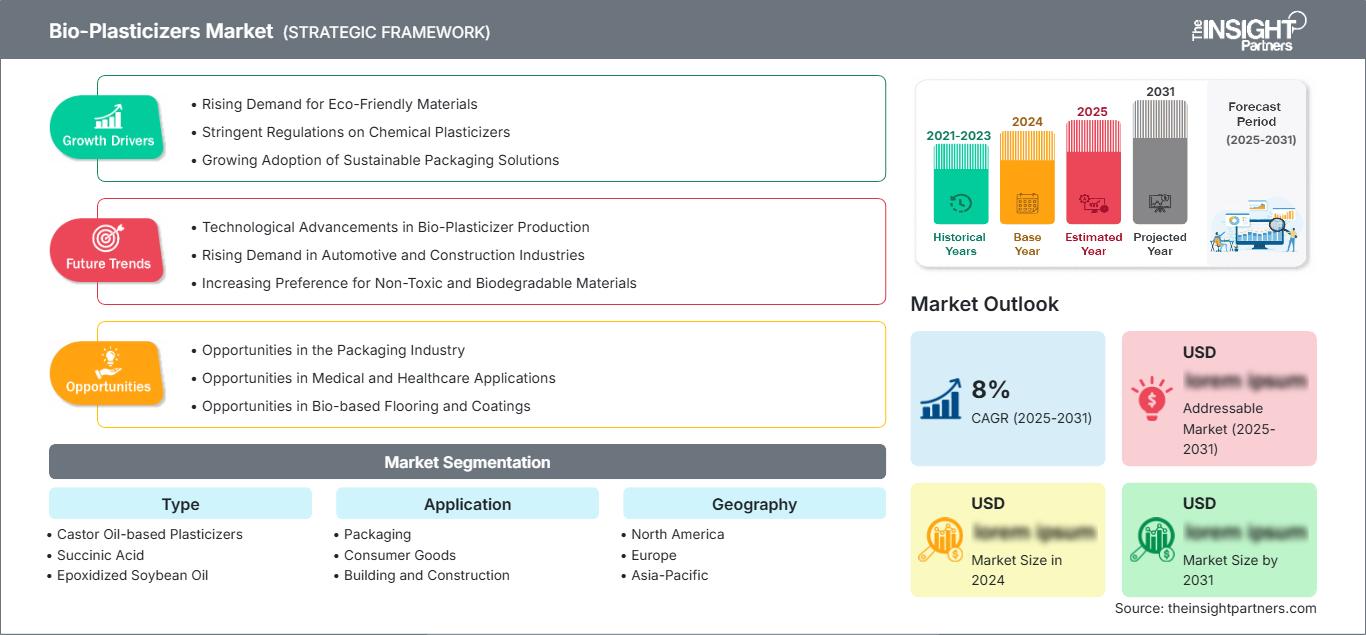
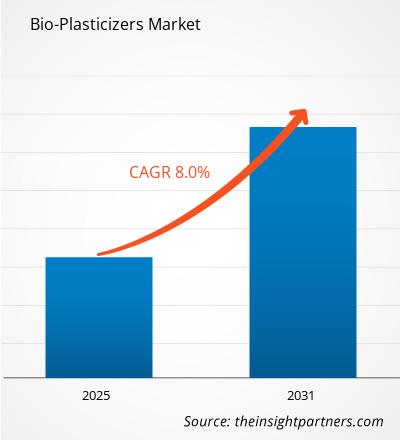
The Bio-Plasticizers Market was valued at US$ 2.86 Billion in 2025 and is projected to reach US$ 5.86 Billion by 2034, registering a CAGR of 8.3% from 2026 to 2034. The market will expand as the producers switch their traditional petroleum-based additives to feedstock-based additives that facilitate flexibility, durability, low dependency on fossil fuels, and safety standards of products.
North America is forecasted to maintain itself as an important market due to the demand for non-phthalate additives, sustainable flexible polymers, and formulations of renewable content. The Bio-Plasticizers Market size growth drivers include regulation of chemical exposure, company carbon reduction efforts, and investments into the production of polymers and additives within the region. The adoption of bio-plasticizers is anticipated to proceed at a predicted CAGR of 7.4-8.2% between 2026 and 2034, with the U.S. being the primary contributor to regional demand.
Bio-Plasticizers Market Assessment and Insights
- North America: North America represented a modeled 18–22% share in 2025 and is expected to grow at a 7.4–8.2% CAGR between 2026 and 2034, supported by sustainable packaging, medical polymers, automotive interiors, and demand for certified lower-carbon additives.
- U.S.: The U.S. accounted for a modeled 14–17% share in 2025 and is projected to expand at a 7.3–8.1% CAGR between 2026 and 2034, driven by packaging, healthcare, construction, and regulatory substitution of conventional plasticizers.
- Europe: Europe held a modeled 24–28% share in 2025 and is expected to register a 7.8–8.6% CAGR between 2026 and 2034, led by Germany, France, Italy, and the UK, where chemical-safety, circularity, and carbon-reduction initiatives influence material selection.
- Asia Pacific: Asia Pacific represented a modeled 42–46% share in 2025 and is expected to record an 8.7–9.5% CAGR between 2026 and 2034, led by China, Japan, South Korea, and India through expanding packaging, construction, automotive, and electronics manufacturing.
- Largest Segment: Epoxidized Soybean Oil held a modeled 28–33% market share in 2025 and is projected to grow at a 7.8–8.5% CAGR between 2026 and 2034, supported by established compatibility and broad polymer use.
- High Growth Segment: Medical applications represented a modeled 8–11% share in 2025 and are projected to grow at a 9.1–10.0% CAGR between 2026 and 2034, supported by safety-focused material substitution.
- Key companies analyzed in detail: BASF SE, Emery Oleochemicals LLC, Galata Chemicals LLC, LANXESS AG, Avient Corporation, Dow Inc., Cargill, Incorporated, Evonik Industries AG, DIC Corporation, and Roquette Frères S.A.
Source: The Insight Partners' analysis based on proprietary research, government publications, company annual reports, investor presentations, industry databases, and expert interviews.
Bio-Plasticizers have developed from niche renewables into formulation-ready options that can provide alternative materials for proven polymer processing methods. Innovations in technology are centered around epoxidized vegetable oil, succinic acid technology, renewable alcohol, and balanced feedstock. Manufacturers are enhancing the thermal stability, anti-migration property, compatibility, and processability while minimizing the number of formulation modifications necessary for converters. Such innovations are enhancing the substitution possibilities in flexible PVC, packaging film, wire insulation, automobile parts, and consumer goods.
Future growth will be contingent upon the feedstock sources, certification framework, and manufacturing economics in regions. Asia Pacific would benefit from high polymer processing capabilities, whereas Europe would prioritize renewable inputs, chemical safety, and circularity. North American bio-plasticizers producers are increasingly incorporating biomass-balanced feedstocks in the current production processes. These initiatives should help the customers minimize their fossil resource utilization without reconfiguring their proven polymer processing techniques.
Bio-Plasticizers Market Report Scope
| Report Attribute | Details |
|---|---|
| Market size in 2025 | US$ 2.86 Billion |
| Market Size by 2034 | US$ 5.86 Billion |
| Global CAGR (2026 - 2034) | 8.3% |
| Historical Data | 2021-2024 |
| Forecast period | 2025-2034 |
Bio-Plasticizers Market Analysis
Bio-Plasticizers Market demand will be directly linked to the shift away from plasticizers made using phthalates to more sustainable and safer alternatives. In addition, packaging manufacturers are demanding plasticizers that fit into the realm of sustainability and food contact expectations, whereas the automotive and construction industries are looking for low-carbon plasticizers but still need them to be durable. The bio-plasticizers' value chain includes agricultural feedstocks, their chemical conversion, production of plasticizers, polymer compounding, and product manufacture. Thus, the supply depends on the availability of vegetable oils, succinic acid production, feedstocks' prices, certification, and regional processing facilities.
The advantage of utilizing renewable feedstocks comes from the possibility of incorporating them into the existing polymer system without any substantial changes in the equipment. For instance, BASF produces biomass-balanced plasticizers through certified mass balance approach. This shows how the use of renewable feedstocks can be included into the current production process.
Competitive differentiation is moving from mere renewable content claims into metrics that involve measurable performance, certification, feedstock availability and formulation by application. Bio-Plasticizers Market Report reveals that BASF SE, LANXESS AG, Emery Oleochemicals LLC, Galata Chemicals LLC, Dow Inc., and Evonik Industries AG compete based on comprehensive chemistry and formulation capability customized to the customers. On the other hand, Cargill, Incorporated and Roquette Frères S.A. have unique renewable feedstock and biorefinery capability, while Avient Corporation specializes in additive technology for bio-polymer systems.
Investments are being made into renewable feedstocks and drop-in solutions, but not into new downstream processing facilities. The biomass balanced portfolio of BASF shows the commercial viability of certified substitution, while the biorefinery portfolio of Roquette showcases renewable raw material integration. Therefore, competitive positioning must rely on feedstock security, certification, formulation performance, technical assistance and serving regulated applications.
● REPORT CUSTOMIZATION
Tailor This Report To Align With Your Specific Business Requirements
This report can be customized to align precisely with your business objectives, scope, and target markets. Customization options include tailored segmentation, geography, competitive analysis, and strategic insights to support informed decision-making.
Customize This Report →WHAT YOU CAN ADJUST
- ● Segmentations
- ● Geography
- ● Competitive Analysis
- ● Language Preferences
Bio-Plasticizers Market: Strategic Insights
Regional Insights
North America Bio-Plasticizers Market
North America held a modeled 18–22% Bio-Plasticizers market share in 2025 and is expected to grow at a 7.4–8.2% CAGR from 2026 to 2034. The U.S. represents the dominant regional demand center, supported by flexible PVC, packaging, medical products, automotive components, and wire and cable applications. Mexico adds manufacturing demand through exported automotive and consumer products, while Canada contributes through packaging, construction, and industrial polymer processing.
The use of regional products is gradually becoming associated with certifications for renewable content and carbon accounting within companies. In 2025, BASF launched new sustainable plasticizer products in North America using biomass-balanced and Ccycled products from Pasadena, Texas, and Cornwall, Ontario, with ISCC PLUS certification. It shows that there is a growing trend towards the use of drop-in products where converters can continue with their normal processes without depending on fossils.
U.S. Bio-Plasticizers Market
The US accounted for roughly 76–79% of North America's total demand in 2025, translating into a projected 14–17% share globally, with the CAGR of 7.3–8.1% expected up to 2034. Opportunities arise in packaging and healthcare due to the growing relevance of the material's safety and traceability in terms of application.
Certified mass-balance systems for renewable-based plasticizers are becoming increasingly sought after among producers and consumers in the US. An example includes the launch of biomasses-balanced and Ccycled plasticizer grades by BASF in North America in 2025. It is strategically significant for the US as the region with a strong polymer-conversion capacity and established regulation of chemical additives.
Europe Bio-Plasticizers Market
Europe holds a modeled 24-28% market share in 2025 and is anticipated to grow at a CAGR of 7.8-8.6% from 2026 to 2034, with Germany being the largest regional consumer. The automotive, construction, electrical, and industrial polymers segments of Germany have wide-ranging requirements for green plasticizer solutions, while France and Italy contribute major packaging and consumer goods demand.
The UK remains committed to promoting sustainable materials and chemicals in packaging, construction, and consumer end-use markets. The strengths of Germany lie in its robust automotive and manufacturing industries, while those of France, Italy, and Spain come from packaging, construction materials, flooring, consumer products, and automotive sectors. Green buyers in Europe now judge the bio-content and sustainability of materials along with the migration properties and impact on life cycle together.
APAC Bio-Plasticizers Market
APAC was forecasted to have a modeled share of 42–46% in 2025 and is projected to grow at a CAGR of 8.7–9.5% up until 2034. China is leading consumption in the region through manufacturing PVC, packaging, construction, automobiles, and electronics. Japan and South Korea focus on high-performance materials, whereas India and Australia offer growth prospects through packaging and infrastructure investment.
Industry growth, polymer manufacturing capabilities, and sustainability trends are factors which will drive regional uptake. China will continue to lead, while India is well-positioned for strong incremental consumption growth with growing packaging and automobile manufacturing activities. Bio-Plasticizers will enjoy strong growth due to regional manufacturers looking for renewable plasticizers which are compatible with existing compounding/conversion processes.
Middle East & Africa Bio-Plasticizers Market
Middle East & Africa region is predicted to grow in the CAGR range of 7.0-8.0% during 2026-2034. The two countries in the Middle East, namely Saudi Arabia and UAE, are making developments in their downstream materials industries, whereas in the African region, South Africa is aiding demand in the segment via packaging, construction, automotive, and consumer manufacturing applications. Rest-of-MEA demand, although small, is benefiting from infrastructure development and use of polymer-processing technology imports.
UAE and Saudi Arabia are the lead markets in the region due to the diversification of their industry sectors and investments made in the manufacturing of non-oil products. The South Africa market has a broader consumer base. Adoption of Bio-Plasticizers is price and supply-dependent; however, the demand could improve due to the renewable content requirements for export products.
Segmentation Analysis
Type
The Bio-Plasticizers market scope covers Type and Application segments, with market dynamics influenced by renewable feedstock availability, formulation performance, regulatory requirements, and the substitution of conventional plasticizers. Type segmentation includes Castor Oil-based Plasticizers, Succinic Acid, Epoxidized Soybean Oil, and Epoxidized Linseed Oil, while application demand spans Packaging, Consumer Goods, Building and Construction, Medical, Wire and Cables, and Automotive. The Type segment is projected to expand at a modeled 7.8–8.6% CAGR from 2026 to 2034. Product selection depends on compatibility, migration resistance, thermal stability, renewable-content requirements, and feedstock economics. Epoxidized oils remain commercially established, while succinic acid and castor-oil systems offer opportunities for differentiated renewable chemistry.
- Castor Oil-based Plasticizers: These materials benefit from renewable feedstock availability and compatibility with selected polymer systems. Their strategic value increases where formulators seek plant-derived plasticization with performance requirements beyond conventional vegetable oils.
- Succinic Acid: Succinic-acid-based systems offer a route toward renewable chemical intermediates and can support applications requiring controlled performance. Their importance should increase as bio-based chemical production becomes more integrated with industrial biorefineries.
- Epoxidized Soybean Oil: ESBO is a major commercially established category because soybean-derived feedstock is widely available, and the epoxidized structure can provide plasticizing and stabilizing functionality in PVC formulations.
- Epoxidized Linseed Oil: Epoxidized linseed oil provides renewable-content advantages and functional compatibility in selected polymer systems. Demand is supported by applications requiring plant-derived additives with oxidation-related performance benefits.
Application
The Application segment in the Bio-Plasticizers Market is expected to register a modeled 8.1–8.9% CAGR from 2026 to 2034. Adoption is moving beyond conventional flexible polymer uses toward regulated and sustainability-sensitive products, with packaging and consumer goods supplying volume while medical and automotive applications create higher-value opportunities.
- Packaging: Packaging represents a major demand center because converters increasingly evaluate renewable additives alongside food-contact suitability, migration performance, recyclability, and carbon-footprint objectives.
- Consumer Goods: Consumer products provide expanding opportunities for bio-based additives in flexible components, household products, toys, and lifestyle goods, where material safety and environmental positioning influence purchasing decisions.
- Building and Construction: Construction applications include flooring, wall coverings, flexible components, and seal-related polymer systems. Demand depends on durability, low migration, regulatory compliance, and green-building material specifications.
- Medical: Medical applications require stringent control over migration, extractables, compatibility, and biocompatibility. These requirements make the technical qualification longer but can support premium positioning for suitable bio-based formulations.
- Wire and Cables: Wire and cable producers require flexibility, electrical performance, thermal stability, and long service life. Bio-based plasticizers can gain share where renewable-content requirements align with required insulation performance.
- Automotive: Automotive applications increasingly evaluate sustainable interior materials while retaining requirements for heat resistance, durability, low fogging, and low migration. This combination supports specialized bio-based plasticizer development.
Opportunity Snapshot
| Application | Revenue Contribution | Trend Tag | Adoption Stage |
|---|---|---|---|
| Packaging | High | Safe Packaging | Scaling |
| Consumer Goods | Medium | Non-Toxic Materials | Scaling |
| Building and Construction | Medium | Green Flooring | Scaling |
| Medical | Medium | Low Migration | Emerging |
| Wire and Cables | Medium | Renewable Insulation | Emerging |
| Automotive | High | Sustainable Interiors | Scaling |
Bio-Plasticizers Market Growth Drivers and Impact Analysis
Replacement of Conventional Plasticizers Through Safety Requirements
Restrictions and scrutiny surrounding certain conventional plasticizers are encouraging formulators to evaluate alternatives with improved safety profiles and renewable feedstock credentials. The impact is strongest in packaging, medical products, toys, consumer goods, and applications where migration or chemical exposure receives close regulatory attention. Bio-Plasticizers can therefore gain adoption even when their material cost remains above conventional alternatives, provided they satisfy performance and compliance requirements simultaneously. This dynamic is shifting purchasing decisions from simple price comparison toward total formulation suitability. Suppliers that demonstrate migration performance, regulatory documentation, consistent quality, and traceable feedstocks can reduce qualification barriers. Over time, the replacement cycle should encourage converters to test multiple bio-based chemistries, increasing competitive pressure around formulation efficiency, technical support, and certification.
Expansion of Sustainable Packaging and Flexible Polymer Applications
Packaging manufacturers face simultaneous pressure to maintain material performance and reduce dependence on fossil-derived inputs. Bio-Plasticizers can support this transition by improving flexibility and processability in selected polymer systems while contributing renewable-content attributes. The commercial effect extends from films and flexible packaging to closures, consumer containers, and specialty packaging components. Demand should remain strongest where sustainability claims are supported by recognized certification and where additive migration remains within applicable requirements. Packaging converters also favor solutions that can operate through existing extrusion, compounding, and conversion infrastructure. Consequently, suppliers with drop-in products have an advantage over technologies requiring extensive equipment modification. Continued development of renewable feedstocks and certified mass-balance systems should further broaden the range of packaging applications suitable for bio-based plasticization.
Growth of Renewable Feedstock Integration in Chemical Manufacturing
Chemical producers are increasingly integrating renewable feedstocks into established manufacturing systems rather than relying exclusively on dedicated new production assets. Biomass-balanced approaches can attribute renewable feedstock through certified mass-balance chains while preserving conventional manufacturing performance. BASF's sustainable plasticizer portfolio illustrates this model, with certified biomass-balanced grades designed to maintain the properties of conventional products. Such integration can lower adoption barriers because downstream processors do not necessarily need to redesign equipment or alter processing conditions. It also creates opportunities for agricultural and biorefinery companies to participate further upstream in the value chain. The resulting ecosystem can strengthen supply reliability, improve traceability, and support differentiated product portfolios based on renewable carbon content.
Bio-Plasticizers Market Future Trends
Expansion of Certified Mass-Balance Plasticizers
Bio-Plasticizers Market trends are increasingly moving toward certified mass-balance production because manufacturers want measurable reductions in fossil-resource consumption without disrupting established polymer-processing systems. Instead of requiring completely new chemical routes, producers can integrate renewable or circular feedstocks into existing production networks and attribute their use through recognized certification. BASF's ISCC PLUS-certified biomass-balanced plasticizer portfolio illustrates this direction. Future products are likely to provide more transparent renewable-content documentation, carbon-footprint information, and chain-of-custody evidence. This approach can be particularly relevant for multinational converters that need consistent materials across multiple regions. As procurement teams incorporate lifecycle and carbon metrics into supplier qualification, certified mass-balance plasticizers should become increasingly important alongside physically bio-derived products.
Development of Higher-Performance Renewable Plasticizer Systems
Future formulations will increasingly target applications where conventional bio-based additives have historically faced limitations in heat resistance, migration control, durability, or polymer compatibility. Research and commercial development are likely to combine renewable feedstocks with molecular design strategies that improve performance rather than treating renewable origin as the primary product attribute. This shift can open opportunities in automotive interiors, medical components, wire insulation, construction products, and demanding consumer applications. Suppliers are expected to differentiate through application-specific formulations, controlled molecular structures, and improved long-term stability. The result should be a broader portfolio extending beyond established vegetable-oil products. As performance gaps narrow, procurement decisions can increasingly emphasize lifecycle impact, regulatory documentation, reliability, and total formulation economics rather than renewable content alone.
Bio-Plasticizers Market Opportunities
Scaling Renewable Feedstock Supply Through Integrated Biorefineries
Bio-Plasticizers Market Forecasts indicate an opportunity to strengthen upstream feedstock security by connecting plasticizer producers with integrated biorefineries. Succinic acid, castor-derived intermediates, soybean oil, and other renewable inputs can benefit from vertically coordinated supply arrangements that improve traceability and reduce exposure to fragmented sourcing. Roquette's integrated biorefinery model, which processes renewable crops and cellulose into industrial ingredients, demonstrates how upstream integration can support consistent bio-based chemical production. Investments in regional feedstock conversion can further reduce logistics exposure and improve supply responsiveness. Companies that establish long-term sourcing partnerships can create more predictable economics for downstream converters while improving renewable-content verification. This opportunity is particularly relevant in the Asia Pacific and North America, where large processing bases can support localized supply networks.
Targeted Expansion into Medical and Automotive Applications
Medical and automotive applications offer attractive opportunities because both require differentiated performance rather than commodity-level pricing. Medical manufacturers prioritize migration, extractables, biocompatibility, and regulatory documentation, creating room for qualified bio-based formulations with consistent specifications. Automotive producers increasingly evaluate renewable materials for interiors while maintaining demanding requirements for heat resistance, fogging, durability, and odor. Suppliers can target these applications through specialized grades rather than broad commodity substitution. Strategic development should focus on application testing, long-term aging performance, regulatory qualification, and compatibility with existing polymer compounds. Partnerships between additive suppliers, compounders, OEMs, and component manufacturers can accelerate validation. Successful qualification in these sectors could establish higher-value demand and diversify revenue away from packaging and general consumer applications.
Recent Developments
- July 2025: Pirelli — Pirelli launched a standard-production P Zero tire containing more than 70% bio-based and recycled materials, including FSC-certified natural rubber, recycled steel, rice-husk-derived silica, and plant-based materials. Developed for Jaguar Land Rover, the tire is intended for selected 22-inch Range Rover applications. Pirelli stated that all natural rubber used in its European factories will be FSC-certified by 2026.
- November 2025: I G Petrochemicals Limited — I G Petrochemicals extended the completion timeline for its plasticizer plant to March 2026 and approved a ₹100 crore investment in I G Biofuels Limited, its wholly owned subsidiary, to explore biofuels and compressed biogas opportunities. The development indicates parallel investment in plasticizer capacity and bio-based feedstock-related businesses.
Frequently Asked Questions

- Comprehensive Market Sizing and Forecast Analysis
- Detailed Segmentation Analysis
- In-Depth Market Dynamics Assessment
- Regional and Country-Level Insights
- Competitive Landscape and Company Benchmarking
- Strategic Business Intelligence
Recent Reports
Testimonials

The Insight Partners provided valuable market intelligence that supported our global go-to-market strategy. Their team was professional, responsive, and attentive to our feedback, providing thoughtful analysis and helpful methodological clarifications throughout the project.
Junmo Kim Chief Financial Officer (CFO), Enertech Co., Ltd.
The Insight Partners' SCADA System Market report is comprehensive, with valuable insights on current trends and future forecasts. The team was highly professional, responsive, and supportive throughout. We are very satisfied and highly recommend their services.
RAN KEDEM Partner, Reali Technologies LTDs
I requested a report on a very specific software market and the team produced the report in a few days. The information was very relevant and well presented. I then requested some changes and additions to the report. The team was again very responsive and I got the final report in less than a week.
JEAN-HERVE JENN Chairman, Future Analytica
We worked with The Insight Partners for an important market study and forecast. They gave us clear insights into opportunities and risks, which helped shape our plans. Their research was easy to use and based on solid data. It helped us make smart, confident decisions. We highly recommend them.
PIYUSH NAGPAL Sr. Vice President, High Beam Global
The Insight Partners delivered insightful, well-structured market research with strong domain expertise. Their team was professional and responsive throughout. The user-friendly website made accessing industry reports seamless. We highly recommend them for reliable, high-quality research services
YUKIHIKO ADACHI CEO, Deep Blue, LLC.
This is the first time I have purchased a market report from The Insight Partners.While I was unsure at first, I visited their web site and felt more comfortable to take the risk and purchase a market report.I am completely satisfied with the quality of the report and customer service. I had several questions and comments with the initial report, but after a couple of dialogs over email with their analyst I believe I have a report that I can use as input to our strategic planning process.Thank you so much for taking the extra time and making this a positive experience.I will definitely recommend your service to others and you will be my first call when we need further market data.
JOHN SUZUKI President and Chief Executive Officer, Board Director, BK Technologies
I wish to appreciate your support and the professionalism you displayed in the course of attending to my request for information regarding to infectious disease IVD market in Nigeria. I appreciate your patience, your guidance, and the fact that you were willing to offer a discount, which eventually made it possible for us to close a deal. I look forward to engaging The Insight Partners in the future, all thanks to the impression you have created in me as a result of this first encounter.
DR CHIJIOKE ONYIA MANAGING DIRECTOR, PineCrest Healthcare Ltd.Reason to Buy
- Informed Decision-Making
- Understanding Market Dynamics
- Competitive Analysis
- Identifying Emerging Markets
- Customer Insights
- Market Forecasts
- Risk Mitigation
- Boosting Operational Efficiency
- Strategic Planning
- Investment Justification
- Tracking Industry Innovations
- Aligning with Regulatory Trends





 Get Free Sample for