
Biometric Payment Card Market Share, Demand & Growth by 2034
Coverage: By Card Type (Credit Card, Debit Card); End Use (Retail, Transportation, Healthcare, Hospitality, Government, Others) , and Geography (North America, Europe, Asia Pacific, and South and Central America)
- Status : Data Released
- Report Code : TIPRE00027325
- Category : Electronics and Semiconductor
- No. of Pages : 150
- Available Report Formats :


- Last update date : July 21, 2026


2025 Market Size
US$ 483.0 Mn
Base year value
2034 Forecast
US$ 25,793.67 Mn
Projected by 2034
CAGR 2026-2034
64.42 %
Growth rate
Addressable Market
US$ 107,028.44 Mn
(2026-2034)
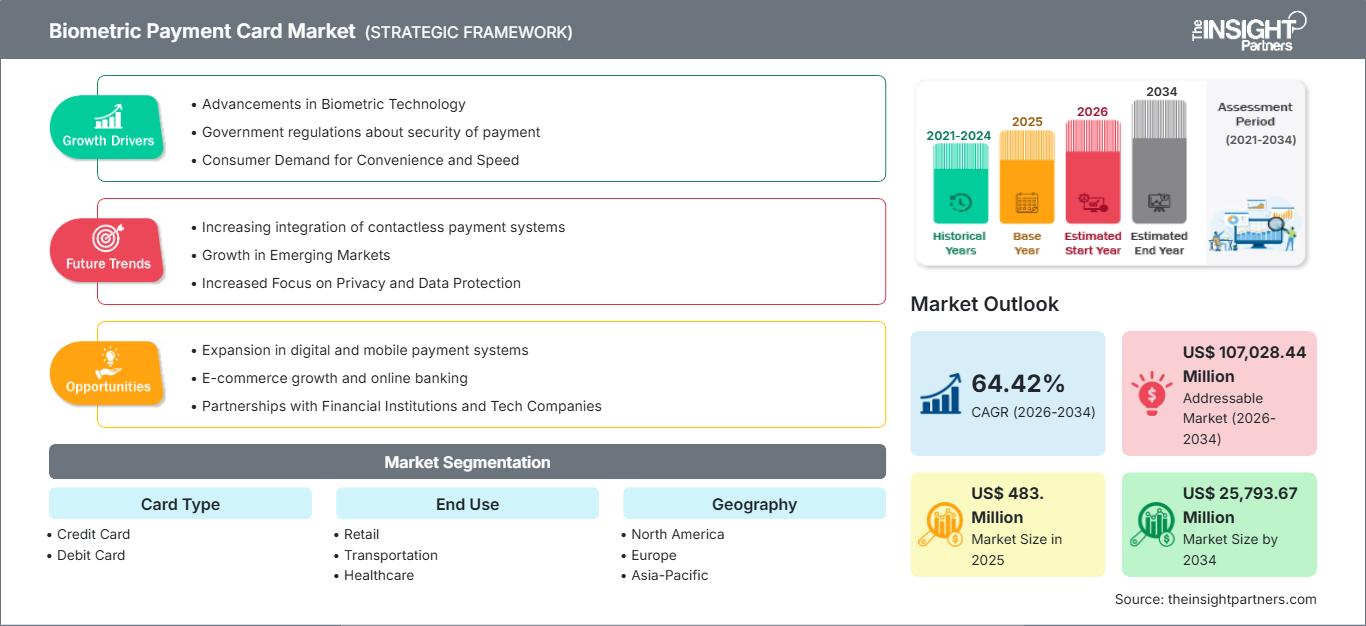
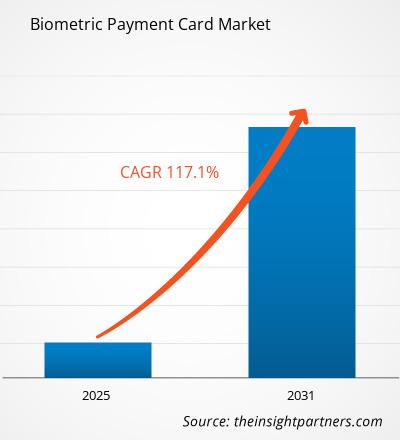
The global Biometric Payment Card Market size was worth US$ 483. Million in 2025 and is estimated to grow to US$ 25,793.67 Million by 2034 with a CAGR of 64.42% from 2026 to 2034. The market is driven by the fast-moving shift away from PIN-enabled card verification towards fingerprint-enabled payment credentialing, owing to demand for increased transaction security, convenience of contactless transactions, and lower risk of card-present fraud.
The North American region continues to be a crucial target market for the development of biometric cards with tests being conducted on various payment solutions like premium credit, transit, and government payment-related use cases. The market in North America is anticipated to witness significant growth at a 58-62% CAGR between 2026-2034.
Biometric Payment Card Market Assessment and Insights
- North America held 28–32% Biometric Payment Card Market share in 2025 and is growing at a CAGR range of 58–62% during 2026–2034, driven by contactless card use, issuer fraud controls, and network-led certification pathways.
- US represented 78–82% of North America in 2025 and is growing at a CAGR range of 57–61% during 2026–2034, led by premium banking and retail pilots.
- Europe accounted for 24–28% share in 2025 and is growing at a CAGR range of 56–60% during 2026–2034, with the UK, Germany, and France leading bank-led authentication upgrades.
- Asia Pacific captured 30–34% share in 2025 and is growing at a CAGR range of 66–70% during 2026–2034, led by China, Japan, South Korea, India, and Australia.
- Largest Segment Debit Card held 52–56% market share in 2025, with CAGR range of 62–66% during 2026–2034, supported by mass banking issuance and everyday contactless payments.
- High Growth Segment Healthcare held 8–10% market share in 2025, with CAGR range of 68–72% during 2026–2034, reflecting secure patient-payment and identity-linked payment requirements.
- Key companies analyzed in detail: bio-idz, Ethernom, IDEX Biometrics ASA, Infineon Technologies AG, Mastercard Incorporated, NXP Semiconductors N.V., Thales S.A., Visa Inc., Wisecard Technology Co., Ltd., Zwipe AS.
Source: The Insight Partners' analysis based on proprietary research, government publications, company annual reports, investor presentations, industry databases, and expert interviews.
Technology is progressing towards card platform certification which incorporates fingerprint sensors, secure elements, card operating system, and enrollment peripherals. Manufacturing capabilities are being refined by semiconductor vendors, card manufacturers, and payment companies as they converge on dual-interface cards with on-card transaction authentication. Cost savings in sensors, improved energy efficiency and scalable personalization are making the business case more attractive for issuers without having to store biometric templates on remote servers.
Progress will be fueled by new banking markets, elite card schemes, and regulated payment markets in which authentication adds commercial value. Digital identity policies, open banking security regulations and growing card fraud are other market drivers for the Biometric Payment Card Market. Investments will be allocated for certified reference designs, issuer readiness programs and collaborations which will speed up the transition from pilots to commercial rollout.
Biometric Payment Card Market Report Scope
| Report Attribute | Details |
|---|---|
| Market size in 2025 | US$ 483.0 Million |
| Market Size by 2034 | US$ 25,793.67 Million |
| Global CAGR (2026 - 2034) | 64.42% |
| Historical Data | 2021-2024 |
| Forecast period | 2026-2034 |
Biometric Payment Card Market Analysis
Demand will be influenced by the desire to minimize the threat of card-present fraud, while at the same time maintaining the swift process of contactless transactions. The development of the Biometric Payment Card Market will also be driven by issuers seeking step-up authentication without relying on their smartphones, particularly among senior citizens, high-end customers, and users in geographies where smartphone penetration as wallets has not been even.
Ecosystem comprises sensors, secure elements, card makers, payment networks, banks, and enrollment kits makers. The supply situation has been getting better with the number of certified platforms increasing integration risks, but the volume production is still influenced by wafer availability, module yield, and personalization capabilities.
Competitive positioning revolves around four factors; certification, module performance, relationship with issuers, and manufacturing capabilities of cards. Analysis reveals that IDEX Biometrics ASA, Infineon Technologies AG, Mastercard Incorporated, Visa Inc., and Thales S.A. play an instrumental role in the commercialization process, as they influence the authentication framework, applet approval, and issuer acceptance.
The investment strategy leans towards those organizations that have the capability to evolve from demonstration level to certified and manufacturing platform. NXP Semiconductors N.V., Ethernom, Wisecard Technology Co., Ltd., bio-idz, and Zwipe AS are the other players who cater to related needs.
● REPORT CUSTOMIZATION
Tailor This Report To Align With Your Specific Business Requirements
This report can be customized to align precisely with your business objectives, scope, and target markets. Customization options include tailored segmentation, geography, competitive analysis, and strategic insights to support informed decision-making.
Customize This Report →WHAT YOU CAN ADJUST
- ● Segmentations
- ● Geography
- ● Competitive Analysis
- ● Language Preferences
Biometric Payment Card Market: Strategic Insights
Regional Insights
North America Biometric Payment Card Market
North America accounted for 28-32% share in 2025, and the regional share demonstrates early adoption, premium card economics, and favorable acceptance of contactless technology. High growth rate at 58-62% CAGR derives from fraud prevention funding, payment networks’ certification, and consumer experience in fingerprint authentication.
The deployment of biometric cards is mainly driven by banks, which can charge higher card fees for affluent-segment customers, corporate cards, and government payment schemes. Canadian market creates additional demand through the contactless technology linked to transit schemes, while U.S. issuers create volume through card reissues and better customer authentication.
U.S. Biometric Payment Card Market
The United States constituted 78-82% of North America in 2025 and will experience a CAGR of 57-61% till 2034. The adoption of the technology will be based on premium credit cards, bank fraud analytics, and the merchant capability to process higher-value contactless payments with fingerprint verification lowering disputes.
The companies' presence is widespread across networks, semiconductor providers, and authentication companies, with Mastercard Incorporated, Visa Inc., IDEX Biometrics ASA, and Infineon Technologies AG driving industry impact through their technology pilots. Early commercial deployments can be expected from retail, healthcare payment points, and hospitality loyalty programs.
Europe Biometric Payment Card Market
Europe contributed to 24–28% share in 2025 and is expected to exhibit 56–60% CAGR growth driven by stringent regulations on customer authentication and high contactless acceptance rate. United Kingdom takes lead with premium banking offerings, where issuers adopt biometric cards to provide differentiated payment experience to their affluent and tech-savvy customers.
In Germany, the focus on privacy, security of hardware, and bank-level authentication makes local storage of biometric data highly relevant. In France, Italy, and Spain, there is additional momentum due to card renewal efforts, hospitality payments related to tourism, and partnerships between banks and certified card makers.
APAC Biometric Payment Card Market
The APAC region has a market share of 30–34% in 2025, and it will grow by 66–70% CAGR to become the most rapidly growing regional base. The combination of big numbers of card users and innovations in the field of payments in China, Japan, South Korea, India, and Australia, along with government regulations favoring digital authentication, will help issuers gain confidence.
Japan and South Korea have strong card manufacturing and consumer electronics manufacturing facilities, whereas the Indian government's support for biometric authentication will help start pilot projects based on RuPay.
Middle East & Africa Biometric Payment Card Market
MEA is expected to register a CAGR of 63-67%, driven by the UAE and Saudi Arabia with their premium banking, tourism and smart city infrastructures fostering safe contactless payment systems. South Africa adds another demand component with its card fraud reduction and growing digital payment infrastructure.
Funds from energy sector, digitization of government services and infrastructure development drive adoption in Gulf countries. Rest of MEA is expected to stay pilot-focused. However, opportunities may arise in cases where biometric cards help avoid memorizing PIN codes and address the lack of mobile devices.
Segmentation Analysis
Card Type
Card Type is projected to grow at 62–66% CAGR during 2026–2034 as issuers evaluate biometric authentication across both credit and debit portfolios. The Biometric Payment Card Market scope within card type is shaped by cost sensitivity, cardholder value, and the business case for replacing PIN verification with fingerprint-based confirmation.
- Credit Card: Premium credit programs provide early adoption potential because issuers can link biometric security with loyalty, travel, and affluent customer retention strategies.
- Debit Card: Debit cards represent the largest segment, supported by daily transaction frequency, broad bank issuance, and strong relevance for PIN-free low-value and mid-value purchases.
End Use
End Use is expected to grow at 64–68% CAGR during 2026–2034 as biometric cards move from bank pilots into transaction environments requiring speed, identity assurance, and low-friction authentication. Retail and transportation offer high transaction frequency, while healthcare, hospitality, and government applications provide stronger identity-linked payment relevance.
- Retail: Retail demand is anchored in contactless checkout speed, fraud reduction, and customer confidence for higher-value tap transactions across grocery, apparel, electronics, and specialty stores.
- Transportation: Transportation use cases benefit from rapid validation at gates, buses, parking systems, and mobility hubs where biometric cards can combine fare payment and identity assurance.
- Healthcare: Healthcare is the high-growth segment as providers require secure patient billing, controlled pharmacy payments, and identity-linked transactions across hospitals, clinics, and insurance touchpoints.
- Hospitality: Hospitality adoption is shaped by premium guest experiences, resort payments, loyalty-linked cards, and secure room-service or venue transactions with reduced PIN or signature dependency.
- Government: Government programs can use biometric payment cards for benefit disbursement, citizen services, and controlled public payments where authentication reduces leakage and strengthens accountability.
Opportunity Snapshot
| End Use | Revenue Contribution | Trend Tag | Adoption Stage |
| Retail | High | Secure Checkout | Scaling |
| Transportation | Medium | Fare Access | Emerging |
| Healthcare | Medium | Patient Pay | Emerging |
| Hospitality | Medium | Premium Guest | Scaling |
| Government | Low | Benefit Card | Emerging |
| Others | Low | Access Pay | Emerging |
Biometric Payment Card Market Growth Drivers and Impact Analysis
Rising Need for Card-Present Fraud Reduction
Fraud prevention is the strongest commercial driver because biometric cards authenticate the cardholder directly on the card before transaction approval. Issuers can reduce exposure to stolen-card use, shoulder-surfed PINs, and signature-based disputes while keeping contactless speed intact. The impact is highest in premium credit, travel, and high-value retail environments where disputed transactions carry higher operational costs. Payment networks also benefit because biometric authentication strengthens trust in tap-to-pay transactions without requiring changes at every merchant terminal.
Certification Momentum Across Payment Networks
Certification by major payment schemes reduces commercialization uncertainty for banks and card manufacturers. When biometric card platforms meet functional, security, and contactless requirements, issuers can move from isolated pilots to defined launch plans. This driver has direct market impact because approved reference designs shorten procurement cycles, reduce integration testing, and give manufacturers clearer production specifications. Certification also improves investor confidence by proving that biometric authentication can operate within existing payment infrastructure.
Improving Economics of Fingerprint Card Manufacturing
Manufacturing economics are improving as fingerprint sensors, secure elements, flexible inlays, and energy-harvesting designs become more standardized. Better module yields reduce waste, while experienced card manufacturers can integrate biometric components without disrupting personalization flows. This matters because issuers will not scale biometric cards unless unit costs fit replacement-cycle budgets or premium-card economics. As production processes mature, the technology becomes viable for debit portfolios, government disbursement cards, and mass-affluent banking programs rather than only limited showcase launches.
Biometric Payment Card Market Future Trends
Biometric Cards for Online and Remote Payment Authentication
Future Biometric Payment Card Market trends will extend authentication beyond physical stores into remote payments, card-not-present transactions, and secure 3D Secure flows. A biometric card can become a trusted hardware authenticator when paired with FIDO-based standards, helping banks reduce reliance on SMS one-time passwords and app notifications. The trend is strategically important because online fraud continues to pressure issuers, while consumers want faster checkout. Cards that authenticate both in-store and online could strengthen issuer control over the payment relationship.
Convergence of Payment, Identity, and Access Credentials
The next adoption wave will combine payment credentials with identity and access functions for campuses, offices, transit systems, and government services. Biometric cards can verify the authorized user locally, making them useful where mobile phones are restricted, unavailable, or unsuitable. This trend supports multi-application cards that reduce wallet complexity while improving security. Suppliers that support interoperable secure elements, flexible applets, and privacy-preserving enrollment will be better positioned as buyers seek one credential for several trusted interactions.
Biometric Payment Card Market Opportunities
Premium Banking Programs in Emerging Economies
Emerging economies offer strong opportunity where banks are expanding affluent customer portfolios while managing rising digital and card fraud. Biometric Payment Card Market Forecasts point to higher issuer interest in markets such as India, Bangladesh, the UAE, and Saudi Arabia, where payment modernization, premium banking, and regulatory acceptance are advancing together. Vendors should prioritize local card manufacturers, domestic networks, and banks with clear premium-card economics. Early wins can create reference programs that support broader debit and government-card deployments.
Healthcare and Public-Service Payment Credentials
Healthcare and public-service programs present an actionable opportunity because payment, eligibility, and identity assurance often intersect. A biometric card can support co-payments, benefit disbursement, controlled pharmacy purchases, and patient identification without exposing biometric templates outside the card. Governments and healthcare payers can use the format to reduce leakage, simplify user authentication, and include citizens who may not use smartphones reliably. Suppliers should build compliance-ready enrollment workflows and partner with issuers experienced in regulated payment programs.
Recent Developments
- April 2026: Flipkart, Axis Bank, and PayU introduced biometric authentication for card payments, enabling Axis Bank cardholders to approve transactions using fingerprint or Face ID instead of OTPs. The solution enhances payment security, reduces fraud risks, and delivers faster, more seamless checkouts on supported Android and iOS devices.
- September 2025: TaluCard launched a new biometric payment card powered by IDEX Biometrics fingerprint technology. The card enables secure, contactless payments with fingerprint authentication, eliminating the need for PINs while improving convenience and fraud protection.
- October 2025: IDEX Biometrics, Hitachi Payment Services, and Airtel Payments Bank announced a collaboration to deploy biometric payment cards in India. The partnership aims to accelerate the adoption of fingerprint-authenticated payment cards, offering enhanced security and a frictionless payment experience for consumers.
Frequently Asked Questions

- Comprehensive Market Sizing and Forecast Analysis
- Detailed Segmentation Analysis
- In-Depth Market Dynamics Assessment
- Regional and Country-Level Insights
- Competitive Landscape and Company Benchmarking
- Strategic Business Intelligence
Recent Reports
Testimonials

The Insight Partners' SCADA System Market report is comprehensive, with valuable insights on current trends and future forecasts. The team was highly professional, responsive, and supportive throughout. We are very satisfied and highly recommend their services.
RAN KEDEM Partner, Reali Technologies LTDs
I requested a report on a very specific software market and the team produced the report in a few days. The information was very relevant and well presented. I then requested some changes and additions to the report. The team was again very responsive and I got the final report in less than a week.
JEAN-HERVE JENN Chairman, Future Analytica
We worked with The Insight Partners for an important market study and forecast. They gave us clear insights into opportunities and risks, which helped shape our plans. Their research was easy to use and based on solid data. It helped us make smart, confident decisions. We highly recommend them.
PIYUSH NAGPAL Sr. Vice President, High Beam Global
The Insight Partners delivered insightful, well-structured market research with strong domain expertise. Their team was professional and responsive throughout. The user-friendly website made accessing industry reports seamless. We highly recommend them for reliable, high-quality research services
YUKIHIKO ADACHI CEO, Deep Blue, LLC.
This is the first time I have purchased a market report from The Insight Partners.While I was unsure at first, I visited their web site and felt more comfortable to take the risk and purchase a market report.I am completely satisfied with the quality of the report and customer service. I had several questions and comments with the initial report, but after a couple of dialogs over email with their analyst I believe I have a report that I can use as input to our strategic planning process.Thank you so much for taking the extra time and making this a positive experience.I will definitely recommend your service to others and you will be my first call when we need further market data.
JOHN SUZUKI President and Chief Executive Officer, Board Director, BK Technologies
I wish to appreciate your support and the professionalism you displayed in the course of attending to my request for information regarding to infectious disease IVD market in Nigeria. I appreciate your patience, your guidance, and the fact that you were willing to offer a discount, which eventually made it possible for us to close a deal. I look forward to engaging The Insight Partners in the future, all thanks to the impression you have created in me as a result of this first encounter.
DR CHIJIOKE ONYIA MANAGING DIRECTOR, PineCrest Healthcare Ltd.Reason to Buy
- Informed Decision-Making
- Understanding Market Dynamics
- Competitive Analysis
- Identifying Emerging Markets
- Customer Insights
- Market Forecasts
- Risk Mitigation
- Boosting Operational Efficiency
- Strategic Planning
- Investment Justification
- Tracking Industry Innovations
- Aligning with Regulatory Trends





 Get Free Sample for