
Bipolar Junction Transistor Market Trends, Size & Forecast by 2034
Coverage: By Type (PNP, NPN, and Hetero); Application (Amplification and Switching); End-use (Consumer Electronics, Electric Vehicles, Energy & Power, and Industrial Control) , and Geography (North America, Europe, Asia Pacific, and South and Central America)
- Status : Data Released
- Report Code : TIPRE00003223
- Category : Electronics and Semiconductor
- No. of Pages : 150
- Available Report Formats :


- Last update date : July 21, 2026


2025 Market Size
US$ 605.58 Mn
Base year value
2034 Forecast
US$ 1,066.19 Mn
Projected by 2034
CAGR 2026-2034
6.49 %
Growth rate
Addressable Market
US$ 7,562.52 Mn
(2026-2034)
The Global Bipolar Junction Transistors Market size had a value of US$ 605.58 Million in 2025 and will have a future market size of US$ 1,066.19 Million in 2034, registering a CAGR of 6.49% from 2026 to 2034. Drivers include the need for dependable current regulation, signal amplification, and switch devices used in consumer electronics, electric cars, power & energy systems, and industrial control systems.
For North America, the Bipolar Junction Transistors Market is set to experience a growth rate in the range of 5.8-6.4% CAGR from 2026 to 2034. Growth is driven by developments such as increased vehicle electrification, new power electronics designs, improved industrial automation, and better component qualification processes. North America has a design-driven semiconductor industry.
Bipolar Junction Transistor Market Assessment and Insights
- North America: North America holds 24–28% share in 2025 and grows at a CAGR range of 5.8–6.4% during 2026–2034, supported by EV electronics, industrial automation, and power control designs.
- US: The US represents 80–84% of North America in 2025 and grows at a CAGR range of 5.9–6.5% during 2026–2034, led by automotive and industrial semiconductor demand.
- Europe: Europe accounts for 19–23% share in 2025 and grows at a CAGR range of 5.3–5.9% during 2026–2034, with Germany, France, the UK, Italy, and Spain leading adoption.
- Asia Pacific: Asia Pacific holds 41–45% share in 2025 and grows at a CAGR range of 6.8–7.5% during 2026–2034, led by China, Japan, South Korea, India, and Taiwan.
- Largest Segment: NPN transistors hold 60–64% market share in 2025 and grow at a CAGR range of 6.2–6.8% during 2026–2034 due to high switching efficiency.
- High Growth Segment: Electric vehicles hold 18–22% market share in 2025 and grow at a CAGR range of 7.5–8.2% during 2026–2034 as power control circuits expand.
- Key companies analyzed in detail: Diodes Incorporated; Fairchild Semiconductor International, Inc.; Nexperia B.V.; NXP Semiconductors N.V.; ON Semiconductor Corporation; Renesas Electronics Corporation; ROHM Co., Ltd.; STMicroelectronics N.V.; Texas Instruments Incorporated; Toshiba Electronic Devices & Storage Corporation.
Source: The Insight Partners' analysis based on proprietary research, government publications, company annual reports, investor presentations, industry databases, and expert interviews.
Transistor discrete demand has shifted from simple low-power switching needs to thermal efficiency, automotive compatibility, and compactness, enabling higher circuit board density. The Bipolar Junction Transistors Market is driven by the innovation of low VCE saturation, surface mount packaging, and automated inspection technology. Production trends favor companies that manage diverse lineups of NPN and PNP transistors and offer consistent electrical properties to designers.
Future demands are driven by the Asian electronics industry, investments in electric vehicles in North America, industrial upgrades in Europe, and power systems digitalization. Buyers of components value efficiency, small size, and traceability of the product line. The regulatory focus on energy efficiency and the electrification of transportation underlies the long-term demand for BJTs with predictable switching characteristics, minimal losses, and a wide operating range.
Bipolar Junction Transistor Market Report Scope
| Report Attribute | Details |
|---|---|
| Market size in 2025 | US$ 605.58 Million |
| Market Size by 2034 | US$ 1,066.19 Million |
| Global CAGR (2026 - 2034) | 6.49% |
| Historical Data | 2021-2024 |
| Forecast period | 2026-2034 |
Bipolar Junction Transistor Market Analysis
Bipolar Junction Transistors market drivers are stability in amplification, current control, and cost-effective switching within smaller electronic packages. BJT technology stays viable in applications that prioritize high current gain, analog functionality, and low cost as opposed to integrated power solutions.
The supply chain consists of silicon wafer manufacturing, BJT manufacturing, lead frame and packaging, electrical testing, marketing & distribution, and design-in assistance. The supply situation is biased toward suppliers offering automotive-qualified devices, package availability, and solid channel networks. Electric vehicle battery management, inverter control, lighting, audio amplification, and industrial relays continue to be the repeat-use application areas.
Bipolar Junction Transistor Market analysis suggests a competitive structure of global vendors of discrete semiconductors with economies of scale, wide range, and application engineering. The major players in the market are Diodes Incorporated, Nexperia B.V., ON Semiconductor Corporation, STMicroelectronics N.V., and ROHM Co., Ltd. They compete in terms of low saturation voltage, thermal characteristics, auto approval, and package miniaturization.
The other companies that shape the demand side of the market are NXP Semiconductors N.V., Renesas Electronics Corporation, Texas Instruments Incorporated, Toshiba Electronic Devices & Storage Corporation, and Fairchild Semiconductor International, Inc. Their investment targets small DFN and flat-lead packages, high-temperature ratings, and tight parameter tolerances.
● REPORT CUSTOMIZATION
Tailor This Report To Align With Your Specific Business Requirements
This report can be customized to align precisely with your business objectives, scope, and target markets. Customization options include tailored segmentation, geography, competitive analysis, and strategic insights to support informed decision-making.
Customize This Report →WHAT YOU CAN ADJUST
- ● Segmentations
- ● Geography
- ● Competitive Analysis
- ● Language Preferences
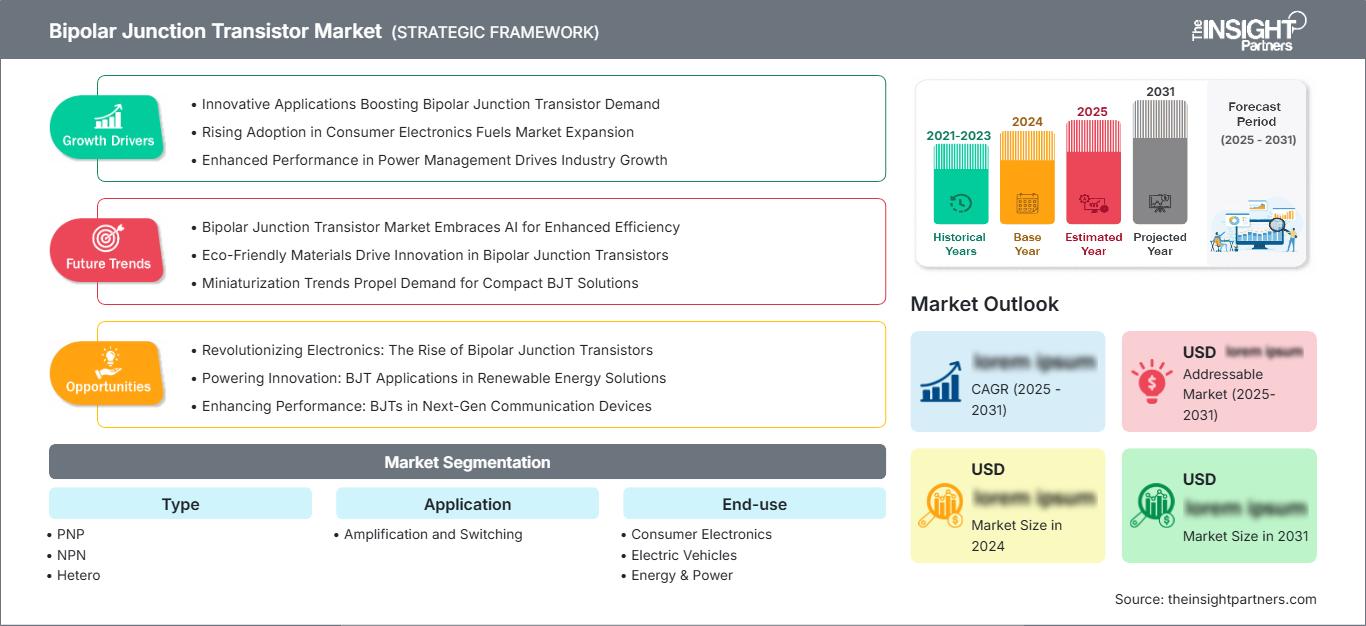
Bipolar Junction Transistor Market: Strategic Insights
Regional Insights
North America Bipolar Junction Transistors Market
North America accounts for 24–28% share in 2025 and is projected to grow at a CAGR range of 5.8–6.4% during 2026–2034. The Bipolar Junction Transistors Market share is supported by automotive electronics, data-center power boards, industrial automation, and aerospace-grade control circuits. Demand favors low-loss BJTs for relay driving, load switching, signal conditioning, and gate control.
EV chain localization, design activity in the USA, and distributor-driven qualified catalog component sourcing affect regional procurement. Component suppliers enjoy demand for AEC-Q101 components, small surface mount packaging, and high-temperature applications. Demand in the USA is the highest due to automotive, military, and industrial customers demanding reliability and durability.
U.S. Bipolar Junction Transistors Market
The U.S. represents 80–84% of North America in 2025 and is expected to grow at a CAGR range of 5.9–6.5% during 2026–2034. Demand is concentrated in EV power modules, industrial drives, lighting controls, defense electronics, and medical equipment. Diodes Incorporated, Texas Instruments Incorporated, ON Semiconductor Corporation, and NXP Semiconductors N.V. support design activity.
The trends in applications include VCE low saturation transistors to ensure efficient switching, pre-biased transistors that make boards easy to design, and high voltage BJTs to serve as power conversion auxiliaries. Availability, PPAP capability, thermal modeling, and distributors' stock are the focus areas for engineers. The industry gains from domestic electronics manufacturing initiatives and increasing content per vehicle.
Europe Bipolar Junction Transistors Market
The Europe region owns 19% to 23% market share in 2025 and is expected to record a compound annual growth rate of 5.3% to 5.9% from 2026 to 2034. Germany dominates due to its automotive electronics, plant automation, and power supply industries. The UK caters to its aerospace and specialty instrument needs, and France generates demand via energy systems, rail electronics, and industrial controls.
Italy and Spain also contribute via its appliance electronics, industrial equipment, renewable energy, and vehicle component segments. Buyers here consider RoHS compliance, reliability, and lifecycle availability factors. STMicroelectronics N.V., Nexperia B.V., Infineon’s legacy lines and distributors play a significant role in buyer sourcing. NPN devices, automotive qualified parts, and power switching transistors are in greatest demand in Europe.
APAC Bipolar Junction Transistors Market
Asia Pacific commands 41–45% market share by 2025 and is estimated to have a compound annual growth rate between 6.8–7.5% from 2026 to 2034. It has the highest market share due to consumer electronics, EVs, solar inverters, and industrial automation applications which ensure high volume of component usage.
Other countries, such as Japan and South Korea supplement this demand via automotive electronics and precision instrumentation. India, Taiwan, and Australia contribute through electronic manufacturing incentives, semiconductor supply, and power projects. The encouragement of local assembly and energy transition initiatives ensures high demand for switching and amplification components.
Middle East & Africa Bipolar Junction Transistors Market
The CAGR for the MEA market is projected to be within the range of 4.2%-4.9% between 2026-2034. Adoption in the region is driven by energy automation, smart infrastructure, and industrial localization in Saudi Arabia. UAE is driving data center, telecom, and building automation projects while South Africa is contributing mining electronics, automotive components, and power equipment maintenance projects.
Rest of MEA demand is import-driven and project-based on utility projects, telecom projects, transport projects, and digitization in public sector. End-users seek rugged products, availability of supply chain, and ease of replacement. Projects involving energy and infrastructure utilize BJTs as auxiliary power supply, relay control, alarm system, and industrial monitor.

Segmentation Analysis
Type
Type is projected to grow at a CAGR range of 6.1–6.8% during 2026–2034. The Bipolar Junction Transistors Market scope by type reflects differences in current flow direction, switching behavior, thermal limits, and circuit compatibility. NPN devices dominate many switching and amplification circuits, PNP devices remain essential for complementary designs, and heterojunction variants address higher frequency and specialized performance requirements.
- PNP: PNP transistors serve high-side switching, complementary amplifier stages, and legacy control circuits where hole-dominant current flow supports stable operation and predictable biasing.
- NPN: NPN transistors lead volume demand because faster electron mobility, broad catalog availability, and easy low-side switching integration support consumer, automotive, and industrial circuits.
- Hetero: Heterojunction bipolar transistors address high-frequency and specialist analog applications where speed, gain, and noise performance are more important than commodity component cost.
Application
Application is expected to grow at a CAGR range of 6.0–6.7% during 2026–2034. Amplification remains important in audio, instrumentation, sensing, and communication circuits, while switching demand rises with EV controls, relays, LEDs, small motors, and power supply auxiliaries. Design engineers select BJTs where gain linearity, simple drive circuits, and predictable saturation behavior improve circuit reliability.
- Amplification: Amplification applications use BJTs in audio circuits, sensor interfaces, RF stages, and instrumentation where gain stability, low noise, and analog linearity are critical.
- Switching: Switching applications dominate design activity in relays, motors, LEDs, power regulators, and EV subsystems where saturation voltage, thermal behavior, and compact packages matter.
End-use
End-use is projected to grow at a CAGR range of 6.3–7.0% during 2026–2034. Demand varies by lifecycle, qualification burden, and power density. Consumer electronics sustains volume, electric vehicles create the fastest design-in momentum, energy and power systems require robust switching, and industrial control uses BJTs for relays, drives, sensors, and safety circuits.
- Consumer Electronics: Consumer electronics creates high-volume demand through chargers, audio devices, appliances, wearables, lighting controls, and compact boards needing low-cost amplification and switching components.
- Electric Vehicles: Electric vehicles use BJTs in battery management, gate driving, onboard charging, lighting, relays, and auxiliary power circuits where reliability and thermal stability are crucial.
- Energy & Power: Energy and power applications rely on BJTs in inverters, UPS systems, metering, renewable controls, and protection circuits that need dependable switching under variable loads.
- Industrial Control: Industrial control systems use BJTs in PLCs, motor drives, sensors, alarms, and relay interfaces where rugged operation and long component availability support equipment uptime.
Opportunity Snapshot
| End-use | Revenue Contribution | Trend Tag | Adoption Stage |
| Consumer Electronics | High | Compact Boards | Mature |
| Electric Vehicles | High | Battery Control | Scaling |
| Energy & Power | Medium | Power Protection | Scaling |
| Industrial Control | Medium | Relay Drives | Mature |
Bipolar Junction Transistor Market Growth Drivers and Impact Analysis
Rising EV Power Control Requirements
Electric vehicles are driving an increase in the use of small power control circuits needed for battery management, on-board charging, lighting, thermal control, relays, and other auxiliary power supplies. BJTs still have value in such applications since they feature well-defined saturation characteristics, ease of driving, and economical current rating. The commercial effects include increased use of automotive-grade NPN/PNP devices that have low VCE(sat), can operate up to 175°C, and have packaging designed to allow automated optical inspections. Suppliers who are able to offer AEC-Q101 qualified products and PPAPs will gain more designs.
Miniaturization Across Consumer and Industrial Boards
The trend towards densification, slimness, and multi-functionality of consumer products, household appliances, sensors, and industrial control continues. This has increased the need for BJTs packaged in DFN, SOT, flat-lead, and chip-scale packaging formats, which minimize size while maintaining reliable switching performance. In the commercial sphere, this has translated into more value added for suppliers offering wide parametric range, standard hFE bins, low thermal resistance, and layout recommendations. Small size transistors facilitate automation in manufacturing, thereby reducing cost and increasing yield.
Energy Efficiency and Power Reliability Needs
The increase in electronics use in energy transition applications such as solar inverters, UPS units, smart meters, grid sensing, and power protection devices results in increased investment in BJT technology for such equipment by enabling auxiliary switching, signal conditioning, alarm circuits, and relay drivers. The growth in electrification and grid investment as stated by the International Energy Agency, results in increasing market demand for such components. The market influence is clear from the high levels of qualification needs, voltage ranges, and thermal and voltage stress resistance requirements.
Bipolar Junction Transistor Market Future Trends
Low Saturation Devices in Compact Automotive Packages
Bipolar Junction Transistors Market trends will increasingly center on low saturation voltage parts that reduce conduction losses in space-constrained automotive and industrial circuits. Future designs will favor packages with side-wettable flanks, exposed thermal pads, and smaller footprints that improve automated inspection and heat flow. This direction aligns with EV modules, lighting controllers, and auxiliary converters where board area and operating temperature are constrained. Suppliers will compete through thermal data, application notes, and verified reliability rather than catalog breadth alone.
Heterojunction Adoption in High-Frequency Analog Systems
Heterojunction bipolar transistors are expected to gain selective traction in high-frequency analog and RF systems where gain, linearity, and noise performance are critical. Their adoption will not displace commodity silicon BJTs, but it will expand in instrumentation, communications, optical modules, and advanced sensing. The trend will encourage suppliers to link device design with packaging, thermal simulation, and signal integrity support. Buyers will evaluate total circuit performance, not only unit cost, when selecting heterojunction solutions.
Bipolar Junction Transistor Market Opportunities
Automotive-Qualified Discrete Portfolio Expansion
Automotive electronics create an actionable opportunity for suppliers that can expand qualified NPN, PNP, low VCE saturation, and pre-biased transistor portfolios. Bipolar Junction Transistors Market Forecasts support investment in package miniaturization, thermal characterization, and production documentation aligned with EV and ADAS platforms. Vendors can improve conversion by offering design kits, SPICE models, PPAP documentation, and clear second-source guidance. The opportunity is attractive because automotive programs typically run for several years and reward suppliers that demonstrate reliability, availability, and engineering support before platform launch.
Industrial Control Replacement and Retrofit Demand
Industrial equipment replacement cycles offer a practical opportunity because factories, utilities, rail systems, and building automation networks need long-availability components for repairs and upgrades. BJTs are often embedded in relay interfaces, sensor modules, alarms, motor controls, and auxiliary supplies. Suppliers can target this opportunity with stable product lifecycles, cross-reference tools, and packages compatible with older board layouts. Distributors play a major role because maintenance teams value immediate availability, technical documentation, and reliable substitutes that reduce downtime without requiring circuit redesign.
Recent Developments
- July 2025: Nexperia expanded its bipolar junction transistor (BJT) portfolio by introducing 12 new MJD-style bipolar transistors in clip-bonded FlatPower (CFP15B) packaging under its MJPE series. The new bipolar devices provide a compact and efficient alternative to traditional DPAK-packaged MJD transistors, delivering improved thermal performance, reduced board footprint, and reliable switching capability. Available in automotive-qualified and industrial-grade versions with voltage ratings of 50 V, 80 V, and 100 V and collector currents from 2 A to 8 A, these bipolar junction transistors are designed for applications such as battery management system (BMS) power supplies, electric vehicle (EV) on-board chargers, and display backlighting systems.
- July 2024: Magnachip Semiconductor expanded its solar energy power product lineup with the launch of a new 1200V 75A Insulated Gate Bipolar Transistor (IGBT) in a TO-247PLUS package, designed specifically for solar inverter applications. The new MBQA75T120RFS IGBT features a wide heat spreader for improved thermal performance, reduces conduction loss by more than 14% compared with the previous generation, and supports stable operation under overload conditions. The device integrates a fast recovery anti-parallel diode to reduce switching losses and supports a maximum operating junction temperature of 175°C. The new IGBT strengthens Magnachip’s power semiconductor portfolio for solar inverters, converters, uninterruptible power supplies, and industrial inverter applications.
- December 2025: Diodes Incorporated expanded its automotive bipolar transistor portfolio with the introduction of the DXTN/P 78Q and 80Q series, featuring ultra-low VCE(sat) NPN and PNP bipolar junction transistors (BJTs) designed for high-efficiency automotive power switching and control applications. The new series includes 12 devices supporting 12V, 24V, and 48V automotive systems, with voltage ratings of 30V, 60V, and 100V. These bipolar transistors deliver improved conduction efficiency, thermal performance, and reliability, making them suitable for MOSFET and IGBT gate driving, power line and load switching, LDO voltage regulation, DC-DC conversion, and control of motors, solenoids, relays, and actuators. The devices support continuous operation up to +175°C and offer enhanced ESD protection for demanding automotive environments.
Frequently Asked Questions

- Comprehensive Market Sizing and Forecast Analysis
- Detailed Segmentation Analysis
- In-Depth Market Dynamics Assessment
- Regional and Country-Level Insights
- Competitive Landscape and Company Benchmarking
- Strategic Business Intelligence
Recent Reports
Testimonials

The Insight Partners' SCADA System Market report is comprehensive, with valuable insights on current trends and future forecasts. The team was highly professional, responsive, and supportive throughout. We are very satisfied and highly recommend their services.
RAN KEDEM Partner, Reali Technologies LTDs
I requested a report on a very specific software market and the team produced the report in a few days. The information was very relevant and well presented. I then requested some changes and additions to the report. The team was again very responsive and I got the final report in less than a week.
JEAN-HERVE JENN Chairman, Future Analytica
We worked with The Insight Partners for an important market study and forecast. They gave us clear insights into opportunities and risks, which helped shape our plans. Their research was easy to use and based on solid data. It helped us make smart, confident decisions. We highly recommend them.
PIYUSH NAGPAL Sr. Vice President, High Beam Global
The Insight Partners delivered insightful, well-structured market research with strong domain expertise. Their team was professional and responsive throughout. The user-friendly website made accessing industry reports seamless. We highly recommend them for reliable, high-quality research services
YUKIHIKO ADACHI CEO, Deep Blue, LLC.
This is the first time I have purchased a market report from The Insight Partners.While I was unsure at first, I visited their web site and felt more comfortable to take the risk and purchase a market report.I am completely satisfied with the quality of the report and customer service. I had several questions and comments with the initial report, but after a couple of dialogs over email with their analyst I believe I have a report that I can use as input to our strategic planning process.Thank you so much for taking the extra time and making this a positive experience.I will definitely recommend your service to others and you will be my first call when we need further market data.
JOHN SUZUKI President and Chief Executive Officer, Board Director, BK Technologies
I wish to appreciate your support and the professionalism you displayed in the course of attending to my request for information regarding to infectious disease IVD market in Nigeria. I appreciate your patience, your guidance, and the fact that you were willing to offer a discount, which eventually made it possible for us to close a deal. I look forward to engaging The Insight Partners in the future, all thanks to the impression you have created in me as a result of this first encounter.
DR CHIJIOKE ONYIA MANAGING DIRECTOR, PineCrest Healthcare Ltd.Reason to Buy
- Informed Decision-Making
- Understanding Market Dynamics
- Competitive Analysis
- Identifying Emerging Markets
- Customer Insights
- Market Forecasts
- Risk Mitigation
- Boosting Operational Efficiency
- Strategic Planning
- Investment Justification
- Tracking Industry Innovations
- Aligning with Regulatory Trends





 Get Free Sample for