
Board-to-Board Connectors Market Share, Demand & Growth by 2034
Board-to-Board Connectors Market Size and Forecasts (2021–2034), Global and Regional Share, Trends, and Growth Opportunity Analysis Report Coverage : By Type (Pin Header, and Socket); Component (Less than 1mm, 1mm to 2mm, Greater than 2 mm); End-User (Automotive, Consumer Electronics, Healthcare, IT & Telecommunication, Transportation, Others); Geography (North America, Europe, Asia-Pacific, Middle East & Africa, South and Central America)
- Status : Data Released
- Report Code : TIPRE00039757
- Category : Electronics and Semiconductor
- No. of Pages : 150
- Available Report Formats :


- Last update date : July 21, 2026


2025 Market Size
US$ 14.06 Bn
Base year value
2034 Forecast
US$ 27.86 Bn
Projected by 2034
CAGR 2026-2034
8.92 %
Growth rate
Addressable Market
US$ 198.74 Bn
(2026-2034)
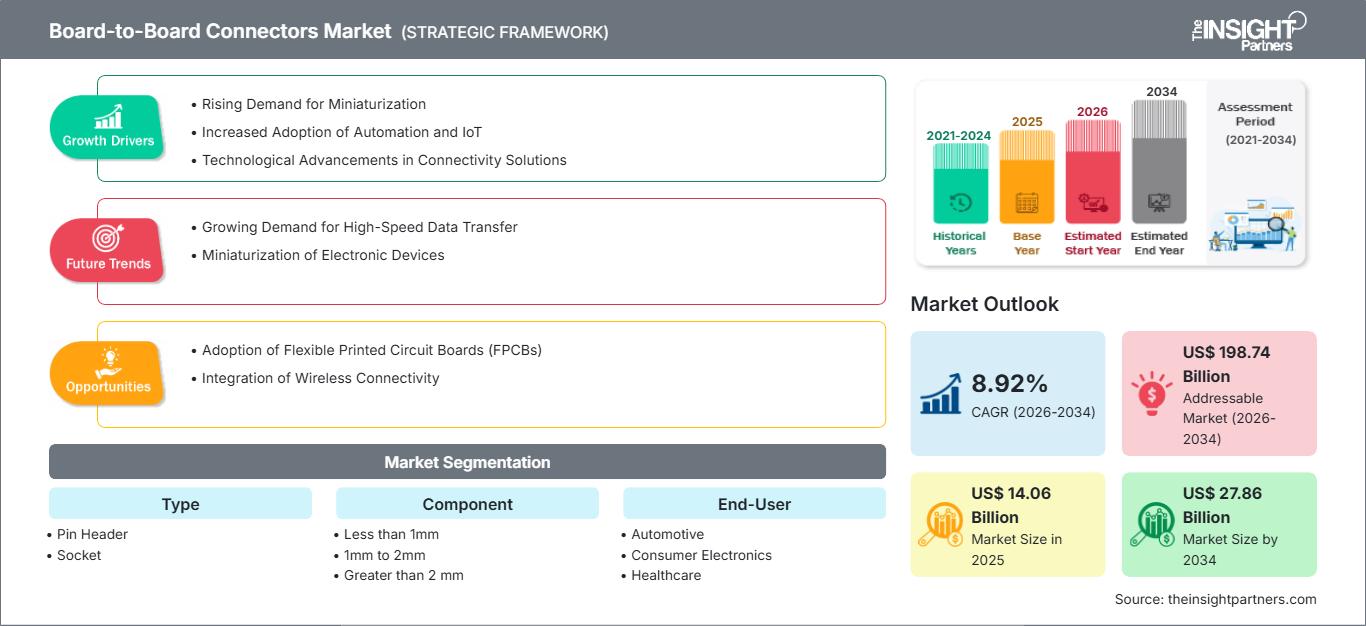
The Board-To-Board Connectors Market is projected to grow from US$ 14.06 Billion in 2025 to US$ 27.86 Billion by 2034, registering a CAGR of 8.92% during 2026–2034. The market for demand is evolving due to increased densities of printed circuit boards, small electronic designs, and increasing signal integrity needs within automotive electronics, consumer electronics, healthcare applications, information technology, and telecommunications infrastructure.
North America continues to be one of the key markets that drive the Board-To-Board Connectors Market, where improvements in data centers, software-definable automobiles, and medical electronics manufacturing fuel the growth of the market size. North America is projected to register a CAGR of 8.4% to 8.8% till 2034 owing to premium connector usage in smaller modules, edge computing, and regulated devices.
Board-to-Board Connectors Market Assessment and Insights
- North America accounted for 26–29% share in 2025 and is projected to grow at a CAGR of 8.4–8.8% between 2026–2034, led by cloud infrastructure, automotive electronics, and advanced medical device production.
- US represented 78–82% of North America in 2025 and is projected to grow at a CAGR of 8.5–8.9% between 2026–2034, supported by hyperscale and EV electronics.
- Europe held 20–23% share in 2025 and is projected to grow at a CAGR of 7.8–8.2% between 2026–2034, with Germany, France, and the UK leading demand from automotive and industrial electronics.
- Asia Pacific captured 41–45% share in 2025 and is projected to grow at a CAGR of 9.4–9.9% between 2026–2034, led by China, Japan, South Korea, India, and electronics export hubs.
- Largest Segment Consumer Electronics held 32–35% market share in 2025, growing at a CAGR of 8.2–8.7% during 2026–2034 as compact devices require finer pitch interconnects.
- High Growth Segment Automotive held 22–25% market share in 2025, growing at a CAGR of 9.8–10.4% during 2026–2034 due to EV, ADAS, and zonal architecture demand.
- Key companies analyzed in detail: TE Connectivity plc, Molex, LLC, Amphenol Communications Solutions, ERNI Deutschland GmbH, 3M Company, CSCONN Precise Electronics Co., Ltd., Harwin plc, Fujitsu Limited, KYOCERA Corporation, OMRON Corporation.
Source: The Insight Partners' analysis based on proprietary research, government publications, company annual reports, investor presentations, industry databases, and expert interviews.
Connector architecture has shifted from simple board stacking toward engineered interconnect systems designed for high-speed signaling, thermal stability, and automated assembly. Production dynamics now favor surface-mount compatibility, tighter pitch tolerances, and material formulations that maintain contact reliability under vibration. The Board-To-Board Connectors Market is therefore evolving around miniaturization, modular electronics, and higher pin-count configurations that reduce cabling while supporting compact product design.
Investment momentum is moving toward Asia-based electronics clusters, North American data infrastructure, and European vehicle platforms where reliability standards are stringent. Regulatory tailwinds around vehicle safety, medical device traceability, and energy-efficient digital infrastructure are strengthening demand for qualified connectors. Emerging geographies are expected to gain assembly share as OEMs diversify supply chains and specify interoperable, high-density interconnect families.
Board-to-Board Connectors Market Report Scope
| Report Attribute | Details |
|---|---|
| Market size in 2025 | US$ 14.06 Billion |
| Market Size by 2034 | US$ 27.86 Billion |
| Global CAGR (2026 - 2034) | 8.92% |
| Historical Data | 2021-2024 |
| Forecast period | 2026-2034 |
Board-to-Board Connectors Market Analysis
The Board-To-Board Connector market growth depends on higher PCB density, faster signal speeds, and less space inside electronic modules. Connectors with fine-pitch, high mating cycles, and reliable contact performance are needed for automotive control units, wearable products, diagnostics equipment, and telecommunication circuit boards. There is increased demand due to the growth in the global connector market, where PCB connectors play an important role.
The supply chain is affected by prices for copper alloy, plating availability, precise molding, and automated inspection processes. The companies are increasing their manufacturing capacity for qualified parts in proximity to the assembly locations in order to minimize risks related to lead times. The ecosystem consists of terminals suppliers, resin suppliers, stamped contacts manufacturers, connector engineers, EMS companies, and OEM qualification teams.
The Board-To-Board Connectors Market Report shows that the market is highly competitive with global players having comprehensive qualification and regional companies concentrating on customizing fine pitch boards. TE Connectivity plc, Molex, LLC, and Amphenol Communications Solutions compete based on platforms, while ERNI Deutschland GmbH, Harwin plc, and CSCONN Precise Electronics Co., Ltd. cater to specializations like industrial, rugged, and compact designs.
Capital investments are now going towards shielded products, floating connectors, high current mezzanine connectors, and automated inspections. 3M Company, Fujitsu Limited, KYOCERA Corporation, and OMRON Corporation position themselves leveraging their experience in electronics, product integration, and OEM relations. The key differentiation factor for strategy implementation involves design services, quality documentation, supply chain stability, and compatibility with client's roadmap of several product generations.
● REPORT CUSTOMIZATION
Tailor This Report To Align With Your Specific Business Requirements
This report can be customized to align precisely with your business objectives, scope, and target markets. Customization options include tailored segmentation, geography, competitive analysis, and strategic insights to support informed decision-making.
Customize This Report →WHAT YOU CAN ADJUST
- ● Segmentations
- ● Geography
- ● Competitive Analysis
- ● Language Preferences
Board-to-Board Connectors Market: Strategic Insights
Regional Insights
North America Board-To-Board Connectors Market
North America held 26–29% share in 2025 and is projected to expand at a CAGR of 8.4–8.8% during 2026–2034. The Board-To-Board Connectors Market share in the region is supported by server platforms, medical electronics, defense-grade computing, and premium automotive electronics that require validated interconnect reliability.
Demand is concentrated in the US, with Canada and Mexico supporting manufacturing, automotive supply, and electronics assembly. Data center acceleration, EV control electronics, and reshoring initiatives keep qualification activity high. Suppliers benefit from customers that value compliance documentation, stable sourcing, and engineering support for high-speed, vibration-resistant board connections.
U.S. Board-To-Board Connectors Market
The US represented 78–82% of North America in 2025 and is projected to grow at a CAGR of 8.5–8.9% through 2034. Applications such as hyperscale computing, driver assistance systems, healthcare electronics, and aerospace electronics generate stable demand for controlled impedance connectors with mating security and miniaturized footprints.
The company is highly present in terms of engineering offices, logistics chains, and customer qualifying groups. TE Connectivity plc, Molex, LLC, and Amphenol Communications Solutions gain from their design-in processes in the United States as OEMs need lifecycle support services. Emerging applications include AI servers, EV battery electronics, radars, and wearable medical electronics.
Europe Board-To-Board Connectors Market
Europe accounted for 20–23% share in 2025 and is projected to grow at a CAGR of 7.8–8.2% during 2026–2034. Germany dominates the regional market with high quality automotive electronics, industrial automation, and testing equipment. The UK markets itself with aerospace, defense, and medical electronics, in which traceability of connectors is important for purchases.
The contribution from France, Italy, and Spain comes in transportation electronics, energy, and industrial control systems. ERNI Deutschland GmbH plays a role in military connectors, while the international companies cater to automotive and telecommunications customers. The demand in Europe focuses on durability, reliability, and compliance with environmental materials regulations for electronic manufacturing.
APAC Board-To-Board Connectors Market
APAC held 41–45% share in 2025 and is forecast to grow at a CAGR of 9.4–9.9% during 2026–2034. The market leader is China due to the volume of demand coming from consumer electronics, telecommunications equipment, electric vehicles (EVs), and local supply chains of components. Japan and South Korea contribute to high-reliability segments through automotive, robotic, and semiconductor equipment.
India and Australia are smaller but growing regions due to the development of electronics production initiatives, medical devices, and transportation modernization. Regional government support in the development of semiconductors packaging, devices assembly, and EV localization contributes to increased demand for connectors.
Middle East & Africa Board-To-Board Connectors Market
Middle East and Africa is projected to grow at a CAGR of 7.1–7.6% during 2026–2034. Saudi Arabia leads demand as energy digitization, smart infrastructure, and industrial localization expand electronics requirements. The UAE adds demand through data centers, aviation systems, and connected building technologies.
South Africa and the Rest of MEA contribute through telecom upgrades, mining automation, and transportation electronics. Adoption remains project-led but higher-value applications require stable board interconnects. Suppliers serving the region compete on distribution reach, availability, certification support, and compatibility with harsh operating environments.
Segmentation Analysis
Type
Type is projected to grow at a CAGR of 8.6–9.1% during 2026–2034 as connector selection becomes more dependent on mating reliability, profile height, and assembly automation. The Board-To-Board Connectors Market scope across pin header and socket formats reflects demand for standardized interfaces in cost-sensitive products and engineered designs in high-density electronics.
- Pin Header remains important in industrial controls, consumer boards, and cost-focused electronics where simple mating, availability, and assembly familiarity support recurring demand across medium-density applications.
- Socket demand is rising in compact, serviceable electronics where reliable mating, protection of contact surfaces, and compatibility with fine-pitch layouts support high-value design adoption.
Component
Component is projected to grow at a CAGR of 8.8–9.3% during 2026–2034 as pitch selection directly influences device thickness, routing density, and signal performance. Fine-pitch products are gaining traction in wearables and mobile devices, while larger pitch formats remain relevant in power, rugged industrial, and transportation electronics.
- Less than 1mm connectors are positioned for smartphones, wearables, compact medical devices, and camera modules where ultra-low profile designs and high pin density are decisive.
- 1mm to 2mm connectors balance density, manufacturability, and mechanical tolerance, making them broadly used in industrial electronics, telecom modules, and automotive control applications.
- Greater than 2 mm connectors serve higher robustness and power handling needs in transportation, industrial systems, and equipment exposed to vibration or more demanding mechanical conditions.
End-User
End-User is projected to grow at a CAGR of 8.9–9.4% during 2026–2034 as electronics content rises across vehicles, personal devices, healthcare equipment, network infrastructure, and transport systems. Selection criteria vary by application, but qualification quality, miniaturization, signal integrity, and supply reliability shape purchasing decisions across all major end-user groups.
- Automotive is strategically important as EVs, ADAS, infotainment, and battery management systems require compact connectors that tolerate vibration, thermal cycling, and rising data rates.
- Consumer Electronics remains the largest demand base because smartphones, wearables, laptops, gaming devices, and AR/VR products continuously push thinner profiles and higher board density.
- Healthcare adoption is supported by imaging systems, patient monitors, portable diagnostics, and wearable health devices where reliability, miniaturization, and traceable component quality are essential.
- IT & Telecommunication requires high-speed board interconnects for servers, switches, routers, and 5G equipment where signal integrity and thermal stability affect system uptime.
- Transportation demand is tied to rail, aviation, fleet electronics, and infrastructure monitoring systems where ruggedness, service life, and vibration resistance support mission-critical performance.
Opportunity Snapshot
| End-User | Revenue Contribution | Trend Tag | Adoption Stage |
| Automotive | High | Zonal ECUs | Scaling |
| Consumer Electronics | High | Wearable Density | Mature |
| Healthcare | Medium | Portable Diagnostics | Scaling |
| IT & Telecommunication | High | AI Servers | Scaling |
| Transportation | Medium | Smart Mobility | Emerging |
Board-to-Board Connectors Market Growth Drivers and Impact Analysis
Rising PCB Density in Compact Electronic Platforms
The designers of the devices are making the products thinner but packing more processing, sensing, and communication functionalities into it, hence the need for more connections from board to board in each system. It is especially true in the areas of wearables, smartphones, medical monitoring systems, camera modules, and compact industrial controllers, where the use of cables takes up too much space. The Board-To-Board Connectors Market stands to benefit since there is no need for long internal routes, repeatable assembly, and less product weight.
Automotive Electronics Content Expanding Across Vehicle Platforms
Electric cars, software-driven cars, and ADAS are leading to increased usage of control boards within batteries, power converters, radars, infotainment systems, and high-performance computers. Connector applications are required to withstand vibration, temperature fluctuations, electromagnetic interference, and increased lifecycle. This driver drives procurement decisions because OEMs and Tier-1 manufacturers focus on qualified manufacturers that have consistent documentation and testing capabilities. Increased usage of electronics within each vehicle increases both volume and value per design socket.
High-Speed Infrastructure Requiring Better Signal Integrity
The server boards, telecommunication components, edge computing modules, and networking components need connectors capable of delivering signals in an effective manner in high density and heat conditions. With the increasing data speeds, there is a need for connector engineering to be able to handle issues like impedance, shielding, insertion loss, and crosstalk. This makes it more desirable to use connectors with proven performance rather than commodity connectors. The Board-To-Board Connectors Market enjoys price elasticity in those cases when manufacturers show clear electrical performance.
Board-to-Board Connectors Market Future Trends
Shielded Fine-Pitch Designs Moving Into Mainstream Devices
Board-To-Board Connectors Market trends will increasingly center on shielded fine-pitch connectors that reduce electromagnetic interference without adding separate shielding parts. Such development will be critical for applications in wearable devices, augmented and virtual reality headsets, small form-factor computers, and healthcare electronics that work close to wireless modules. The future roadmap of product development may include integrated shielding features, reduced stack heights, and better grounding systems. Companies that are able to miniaturize their products and demonstrate reliable signal integrity will have competitive design wins.
Floating and High-Tolerance Connectors Supporting Automation
Floatable connector technology will see more use in automated assembly lines due to tighter tolerances and greater production levels. Floating connectors take care of any slight misalignment of the boards and eliminate problems during assembly. This trend will apply especially in the cases of automotive modules, industrial controls, and telecommunication boards, where the cost of reworking is high. Differentiation of products in the future will rely on mechanical compliance and contact robustness besides pitch and pin count requirements.
Board-to-Board Connectors Market Opportunities
Design-In Partnerships for Software-Defined Vehicle Electronics
Suppliers can create value by engaging earlier with OEMs and Tier-1 companies developing zonal controllers, battery electronics, and high-performance compute modules. Board-To-Board Connectors Market Forecasts indicate that automotive design cycles will reward connector platforms validated for vibration, current capacity, EMI behavior, and modular reuse. Companies that provide simulation support, samples, testing data, and regional production continuity can secure multi-year sockets. This opportunity is investment-oriented because early design involvement improves switching costs and stabilizes revenue across vehicle generations.
Localized Supply for Healthcare and Industrial Electronics
There is growing demand for continuity planning, traceability, and reduced lead times for board-level products from the healthcare and industrial sector. Connector companies have the potential to grow through localization of their inventory, qualification services, and engineering expertise near manufacturing centers in North America, Europe, and APAC regions. The potential is high in portable diagnostics, robotics, factory automation, and monitoring applications. Companies that provide reliable distribution along with technical customization can turn fragmented demand into repeatable platform business.
Recent Developments
- May 2026: IRISO ELECTRONICS CO., LTD. announced the release of the "11010 series" board to board connectors with a 0.4mm pitch and high-speed transmission capability. In recent years, while electronic devices, such as those used in cars and industrial machinery, have been becoming smaller and more compact over time, demand for high-speed transmission has been growing even further. In the internal and inter-device connections of ADAS systems, such as automotive cameras, it has been a crucial issue to both save spaces and transmit data at very high speeds.
- June 2026: Hirose Electric has developed and released the "BK19" Series, among the world's smallest-class single-row FPC to board connectors. By pursuing miniaturization across all key dimensions—pitch, width, and height—the BK19 Series provides greater freedom in housing and mechanical design. At the same time, it maintains high reliability, helping address critical challenges in next-generation device development.
- November 2025: Molex announced the availability of the industry’s first space-saving Quad-Row Board-to-Board Connectors with EMI shields. Molex, a global electronics leader and connectivity innovator, announced the launch of the Molex Quad-Row Shield Connector, featuring the industry’s first space-saving four-row signal pin layout with an integrated metal electromagnetic interference (EMI) shield.
Frequently Asked Questions

- Comprehensive Market Sizing and Forecast Analysis
- Detailed Segmentation Analysis
- In-Depth Market Dynamics Assessment
- Regional and Country-Level Insights
- Competitive Landscape and Company Benchmarking
- Strategic Business Intelligence
Recent Reports
Testimonials

The Insight Partners' SCADA System Market report is comprehensive, with valuable insights on current trends and future forecasts. The team was highly professional, responsive, and supportive throughout. We are very satisfied and highly recommend their services.
RAN KEDEM Partner, Reali Technologies LTDs
I requested a report on a very specific software market and the team produced the report in a few days. The information was very relevant and well presented. I then requested some changes and additions to the report. The team was again very responsive and I got the final report in less than a week.
JEAN-HERVE JENN Chairman, Future Analytica
We worked with The Insight Partners for an important market study and forecast. They gave us clear insights into opportunities and risks, which helped shape our plans. Their research was easy to use and based on solid data. It helped us make smart, confident decisions. We highly recommend them.
PIYUSH NAGPAL Sr. Vice President, High Beam Global
The Insight Partners delivered insightful, well-structured market research with strong domain expertise. Their team was professional and responsive throughout. The user-friendly website made accessing industry reports seamless. We highly recommend them for reliable, high-quality research services
YUKIHIKO ADACHI CEO, Deep Blue, LLC.
This is the first time I have purchased a market report from The Insight Partners.While I was unsure at first, I visited their web site and felt more comfortable to take the risk and purchase a market report.I am completely satisfied with the quality of the report and customer service. I had several questions and comments with the initial report, but after a couple of dialogs over email with their analyst I believe I have a report that I can use as input to our strategic planning process.Thank you so much for taking the extra time and making this a positive experience.I will definitely recommend your service to others and you will be my first call when we need further market data.
JOHN SUZUKI President and Chief Executive Officer, Board Director, BK Technologies
I wish to appreciate your support and the professionalism you displayed in the course of attending to my request for information regarding to infectious disease IVD market in Nigeria. I appreciate your patience, your guidance, and the fact that you were willing to offer a discount, which eventually made it possible for us to close a deal. I look forward to engaging The Insight Partners in the future, all thanks to the impression you have created in me as a result of this first encounter.
DR CHIJIOKE ONYIA MANAGING DIRECTOR, PineCrest Healthcare Ltd.Reason to Buy
- Informed Decision-Making
- Understanding Market Dynamics
- Competitive Analysis
- Identifying Emerging Markets
- Customer Insights
- Market Forecasts
- Risk Mitigation
- Boosting Operational Efficiency
- Strategic Planning
- Investment Justification
- Tracking Industry Innovations
- Aligning with Regulatory Trends





 Get Free Sample for