
Booster Compressor Market Size and Competitive Analysis by 2034
Coverage: By Pressure (14-40 Bar, 41-100 Bar, 101-350 Bar, and >350 Bar); Type of Cooling (Water and Air); Compression Stage (Single, Double, and Multi); Industry Vertical (Manufacturing, Chemicals, Oil and Gas, Energy & Power, and Others); and Geography
- Status : Data Released
- Report Code : TIPEL00002495
- Category : Electronics and Semiconductor
- No. of Pages : 150
- Available Report Formats :


- Last update date : July 22, 2026


2025 Market Size
US$ 3.20 Bn
Base year value
2031 Forecast
US$ 4.93 Bn
Projected by 2031
CAGR 2026-2034
4.9 %
Growth rate
Addressable Market
US$ 22.78 Bn
(2026-2034)
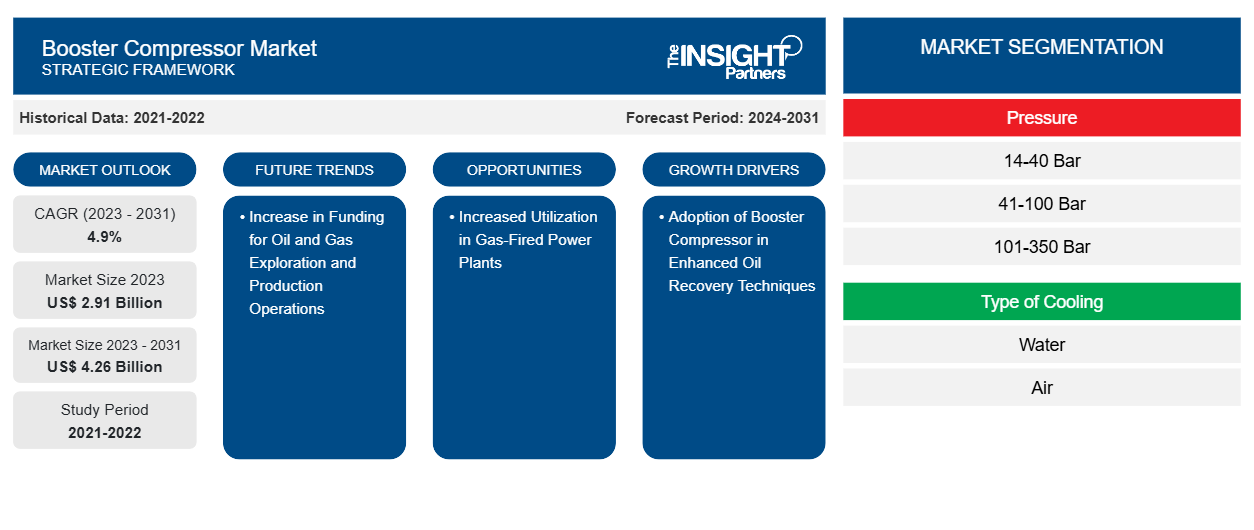
The Booster Compressor Market size was valued at US$ 3.20 Billion in 2025 and is projected to reach US$ 4.93 Billion by 2034, growing at a CAGR of 4.9% during 2026–2034. The growth in demand comes from the increased need for pressure-intensive processes in manufacturing plants, chemical plants, oil/gas production plants, and power stations, where conventional compressors or compressed air/gas need pressure augmentation in stages for efficient and continuous production processes.
In North America, the market size for Booster Compressors is anticipated to grow at a CAGR of around 4.6 to 5.1 percent on account of increased demands from shale gas processing plants, petrochemical industry expansion, and hydrogen blending pilots. There is also a growing trend towards replacement of older compressor rooms with energy-efficient booster compressors.
Booster Compressor Market Assessment and Insights
- North America accounted for 34–37% share in 2025 and is projected to grow at a CAGR of 4.6–5.1% during 2026–2034, supported by gas infrastructure, petrochemical processing, and compressor replacement cycles.
- US represented 78–82% of North America in 2025 and is expected to record a 4.7–5.2% CAGR during 2026–2034, led by shale gas and manufacturing.
- Europe held 24–27% share in 2025 and is forecast to expand at 4.1–4.6% CAGR, with Germany, the UK, France, Italy, and Spain leading industrial modernization.
- Asia Pacific captured 27–30% share in 2025 and is expected to post 5.2–5.8% CAGR, driven by China, India, Japan, and South Korea’s manufacturing and energy investments.
- Largest Segment Water cooling held 54–58% market share in 2025 and is projected to grow at 4.5–5.0% CAGR as process industries prioritize heat management.
- High Growth Segment Multi-stage compression held 38–42% market share in 2025 and is expected to grow at 5.4–6.0% CAGR due to high-pressure gas applications.
- Key companies analyzed in detail: Atlas Copco AB, Baker Hughes Company, BAUER COMP Holding GmbH, BOGE KOMPRESSOREN Otto Boge GmbH and Co. KG, Corken, Inc., Ingersoll Rand Inc., Hitachi Industrial Equipment Systems Co., Ltd., Kaeser Kompressoren SE, Sauer Compressors USA, Inc., and Gardner Denver, Inc.
Source: The Insight Partners' analysis based on proprietary research, government publications, company annual reports, investor presentations, industry databases, and expert interviews.
With the evolution in technology, the future of the Booster Compressor Market lies in the shift towards systems that enable predictive maintenance, variable speed, and improved thermal management through sensor-technology integration, away from independent pressure-boosting equipment. The dynamics of production also are changing because suppliers are localizing their services across the globe, designing modular frame products, and offering oil-free or low-maintenance units for use in chemical plants, energy, and manufacturing where uptime and repeatable process performance with efficiency at the plant level are essential.
Moving forward, demand will grow in emerging industrial economies through the creation of facilities capable of processing gas, providing hydrogen-ready infrastructure, and testing at high pressures. Investments associated with LNG infrastructure development, refinery revamps, and power grid reliability result in a larger installation base, whereas more stringent energy efficiency regulations drive a need to replace fixed-speed boosters.
Booster Compressor Market Report Scope
| Report Attribute | Details |
|---|---|
| Market size in 2025 | US$ 3.20 Billion |
| Market Size by 2031 | US$ 4.93 Billion |
| Global CAGR (2025 - 2034) | 4.9% |
| Historical Data | 2021-2024 |
| Forecast period | 2026-2034 |
Booster Compressor Market Analysis
The Booster Compressor Market has a base on the operations where the inlet pressure changes but the outlet pressure is constant. This equipment is utilized in oil and gas collection, pneumatic tools, nitrogen production, pressure tests, and chemical transfers to increase pressure levels without having to change the whole system for the compressed air.
Supply fundamentals continue being dependent on casting, precise machining, motors availability, and controls integration. Companies that produce complete systems along with replacement equipment and global servicing are favored since the clients consider the total cost and uptime more important than the cost of the equipment itself, especially when the plants use continuous processes.
According to the Booster Compressor Market report, the market players include Atlas Copco AB, Ingersoll Rand Inc., Kaeser Kompressoren SE, Sauer Compressors USA, Inc., Baker Hughes Company, and BAUER COMP Holding GmbH, which focus on energy efficiency, remote monitoring, and engineering packages. Corken, Inc. and BOGE KOMPRESSOREN have a different approach due to their specialization.
Trends include investments into smaller multiple stage system, non-oil based gas compression, and service agreements that minimize any unexpected shut-downs. Positioning strategy has become one of ensuring compatibility between pressure ranges, cooling configurations, and controls with the requirements of the industrial duty cycle of the particular customer base.
● REPORT CUSTOMIZATION
Tailor This Report To Align With Your Specific Business Requirements
This report can be customized to align precisely with your business objectives, scope, and target markets. Customization options include tailored segmentation, geography, competitive analysis, and strategic insights to support informed decision-making.
Customize This Report →WHAT YOU CAN ADJUST
- ● Segmentations
- ● Geography
- ● Competitive Analysis
- ● Language Preferences
Booster Compressor Market: Strategic Insights
Regional Insights
North America Booster Compressor Market
North America held 34–37% share in 2025, supported by upstream gas gathering, LNG export infrastructure, refinery debottlenecking, and high-value manufacturing. The region’s Booster Compressor Market share reflects a mature installed base where replacement demand is as important as greenfield demand, especially where operators seek lower leakage, better controls, and safer high-pressure operation.
The regional CAGR is estimated at 4.6–5.1% during 2026–2034. IEA analysis highlights continued gas infrastructure and energy investment, which supports compression demand across midstream and industrial sites. Buyers are prioritizing digitally monitored packages, low-maintenance designs, and service agreements that protect uptime in chemicals, power generation, and pressure-testing applications.
U.S. Booster Compressor Market
The U.S. accounted for 78–82% of North America in 2025 and is projected to grow at 4.7–5.2% CAGR. Shale gas production, LNG liquefaction, petrochemical capacity, and high-pressure industrial testing create dense demand for boosters that maintain consistent discharge pressure across variable inlet conditions.
Company presence is strong through Atlas Copco AB, Ingersoll Rand Inc., Sauer Compressors USA, Inc., Baker Hughes Company, Gardner Denver, Inc., and Kaeser Kompressoren SE. Applications are expanding in nitrogen generation, gas recovery, hydrogen blending pilots, and plant air systems where energy monitoring and preventive service reduce outage risk.
Europe Booster Compressor Market
Europe represented 24–27% share in 2025 and is expected to grow at 4.1–4.6% CAGR. Germany is the leading country because of chemicals, automotive, industrial gases, and machinery exports, while energy-efficiency regulation accelerates compressor-room audits and replacement of legacy fixed-speed boosters.
The UK market benefits from energy infrastructure, hydrogen demonstration projects, and industrial maintenance demand. Germany continues to favor engineered packages for precision manufacturing and chemical plants. France, Italy, and Spain add demand through refineries, food processing, industrial gases, and power-related maintenance where pressure reliability supports safety and productivity.
APAC Booster Compressor Market
APAC accounted for 27–30% share in 2025 and is forecast to grow at 5.2–5.8% CAGR, the fastest regional pace. China leads due to manufacturing scale, chemicals, energy equipment, and industrial gas demand, while India adds momentum through refinery expansion, city gas, and infrastructure-linked manufacturing.
Japan and South Korea emphasize high-reliability packages for electronics, shipbuilding, and hydrogen-related applications, whereas Australia’s energy and mining sectors support durable high-pressure equipment. Policy support for industrial modernization and domestic manufacturing strengthens local assembly, service partnerships, and adoption of digitally controlled booster systems.
Middle East & Africa Booster Compressor Market
Middle East and Africa is projected to grow at 4.4–5.0% CAGR, supported by Saudi Arabia, the UAE, South Africa, and the Rest of MEA. Saudi Arabia is the leading country because oil, gas, petrochemical, and industrial diversification projects require reliable pressure boosting.
The UAE supports demand through LNG, refining, industrial zones, and district energy projects. South Africa contributes through mining, power, and manufacturing maintenance. Across the region, equipment selection favors rugged designs, water-efficient cooling choices, and service partners capable of supporting remote energy and infrastructure sites.
Segmentation Analysis
Pressure
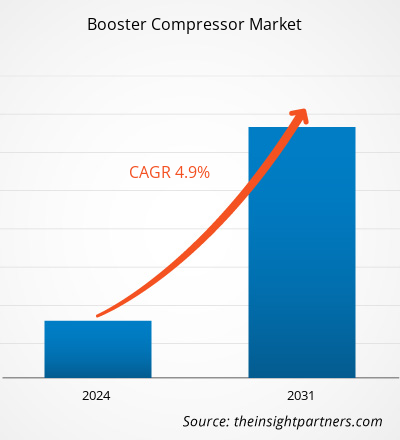
The pressure segment is projected to grow at 4.6–5.2% CAGR during 2026–2034. Booster Compressor Market scope across pressure bands reflects different duty cycles, from plant air stabilization to high-pressure gas charging, with buyers selecting systems according to discharge pressure, safety margin, duty duration, and downstream process sensitivity.
- 14-40 Bar serves general industrial boosting, leak testing, and pneumatic support where moderate pressure rise improves tool performance without extensive compressor-room redesign.
- 41-100 Bar is important in manufacturing, packaging, gas transfer, and maintenance operations requiring stronger pressure consistency and dependable intermittent-duty performance.
- 101-350 Bar supports industrial gases, pressure testing, cylinder filling, and process applications where safety controls and cooling performance influence selection.
- >350 Bar addresses specialized gas charging, hydrogen pilots, defense, and laboratory applications where engineering customization, sealing integrity, and compliance requirements are critical.
Type of Cooling
The type of cooling segment is expected to register 4.4–5.1% CAGR during 2026–2034. Cooling choice affects energy use, thermal stability, noise, installation footprint, and maintenance intensity, making it a strategic specification in continuous chemical, gas, and power applications where heat rejection determines reliability.
- Water remains preferred for higher-duty and heat-intensive applications because it provides stronger thermal control, supports continuous operation, and protects components in demanding process environments.
- Air appeals to facilities seeking simpler installation, lower utility dependence, and compact packages, especially where intermittent use and moderate ambient temperatures reduce cooling stress.
Compression Stage
The compression stage segment is forecast to grow at 4.8–5.5% CAGR during 2026–2034. Stage selection balances achievable pressure, discharge temperature, efficiency, and service complexity, with multi-stage designs gaining preference where high compression ratios are required without compromising equipment life or process safety.
- Single stage systems fit moderate pressure boosting, maintenance tasks, and space-constrained installations where low complexity, faster commissioning, and economical ownership are key.
- Double stage systems offer improved pressure capability and thermal control, supporting industrial gases, process plants, and high-reliability manufacturing operations.
- Multi stage systems are strategically important for high-pressure gas transfer, hydrogen applications, and demanding oil and gas services requiring controlled compression ratios.
Industry Vertical
The industry vertical segment is projected to grow at 4.7–5.4% CAGR during 2026–2034. Demand varies by process criticality, uptime requirements, and pressure stability needs, with energy, chemicals, and manufacturing using boosters to extend existing compressor infrastructure while supporting safety, productivity, and emissions-control objectives.
- Manufacturing uses boosters for pneumatic tools, pressure testing, automation, and quality control where stable pressure prevents production variability and equipment stoppages.
- Chemicals require controlled compression for gas transfer, reactor support, inerting, and process safety, making reliability and material compatibility central purchasing criteria.
- Oil applications include drilling support, well services, vapor recovery, and refinery operations where rugged equipment must withstand variable duty and harsh environments.
- Gas demand is linked to gathering, processing, LNG, pipeline maintenance, and cylinder filling, where boosters enhance pressure without major infrastructure replacement.
- Energy & Power facilities use boosters in turbine support, maintenance, hydrogen blending pilots, and auxiliary systems where pressure stability improves operational resilience.
Opportunity Snapshot
| Industry Vertical | Revenue Contribution | Trend Tag | Adoption Stage |
| Manufacturing | High | Smart Plants | Mature |
| Chemicals | High | Process Safety | Scaling |
| Oil | Medium | Field Services | Mature |
| Gas | High | LNG Support | Scaling |
| Energy & Power | Medium | Hydrogen Pilots | Emerging |
Booster Compressor Market Growth Drivers and Impact Analysis
Expansion of Gas Processing and LNG Infrastructure
The requirement of pressure management during gas chain operations in gathering, treating, liquefying, transferring, and maintaining operations calls for boosters as necessary equipment rather than a mere accessory in this market segment. According to the International Energy Agency, about 300 Bcm/year of LNG export capacity is forecasted by 2030, with most coming from the US and Qatar, thus further increasing the need for auxiliary compressors. This is one of the drivers in the Booster Compressor Market, where orders for auxiliary compressor packages, parts, and services will become more frequent. Boosters are also used to debottleneck the existing installations.
Industrial Automation and Pressure Stability Requirements
Automated assembly lines require consistent air/gas pressure levels for sustaining cycle times, quality of coating, leak tests, and tool performance. With more sensors, robots, and energy management systems being deployed in plants, the effects of pressure fluctuations become more pronounced and expensive. The use of booster compressors makes sure that a higher pressure level can be maintained in local areas without having to size up the entire compression system. The implications for the market are an increased demand for packages incorporating variable speed drives, remote monitoring capabilities, and proactive maintenance alerts.
Energy-Efficiency Compliance and Replacement Demand
More and more energy audits are highlighting compressed air systems as one of the largest sources of unnecessary energy use and loss through leakage. Boosters with energy-efficient motors, advanced cooling methods, and control systems could improve efficiency by supplying compressed air only to high-pressure locations and not pumping up the pressure at all points in the facility. The effects would be the transformation of replacement programs into quantifiable cost-of-operation programs. This means greater need for retrofits of boosters, intelligent controllers, and business cases showing the energy saving.
Booster Compressor Market Future Trends
Digitally Managed Booster Packages
Booster Compressor Market trends will increasingly center on connected packages that combine vibration monitoring, temperature analytics, pressure mapping, and cloud-based service recommendations. Instead of reacting to failures, operators will plan maintenance around actual duty cycles and component stress. This trend is especially relevant for remote gas sites, continuous chemical plants, and automated factories where downtime can affect multiple downstream processes. Digital management also enables suppliers to sell outcome-oriented service agreements, benchmarking, and energy optimization. As installed fleets become more connected, data quality will influence product design, warranty risk, and customer retention strategies.
Hydrogen-Compatible High-Pressure Designs
Hydrogen blending, mobility fueling pilot programs, and industrial decarbonization initiatives are generating demand for materials, sealing elements, and safety equipment that are appropriate for small molecule gases at elevated pressure levels. Manufacturers of booster pumps are likely to modify their design to accommodate leak-proof operation, contaminant-free gas flow, and heat dissipation concerns. While the market for hydrogen continues to be nascent in most parts of the world, the qualifying process is exacting and favors engineering-driven companies. In the long run, hydrogen-ready boosters will have premium applications in energy, chemical, laboratory, and transportation sectors.
Booster Compressor Market Opportunities
Retrofit Programs for Industrial Compressor Rooms
Industrial sites often operate central compressors at higher pressure than necessary because only a few processes require elevated output. Targeted booster retrofits can lower plant-wide setpoints while maintaining high-pressure supply for specific tools, tests, or gas transfer points. This creates a practical opportunity for audits, packaged upgrades, and performance-based contracts. Booster Compressor Market Forecast favor suppliers that can quantify energy savings, specify appropriate cooling, and integrate controls with plant monitoring systems. The opportunity is strongest in mature manufacturing hubs where equipment is aging but full compressor-room replacement is financially difficult.
Localized Service Networks in Emerging Industrial Hubs
Young manufacturing plants, petrochemical centers, and energy zones require rapid technical assistance, since the failure to operate the compressor may bring production and field operations to a standstill. The supplier may add value through setting up local repair centers, training the channel partners, and stocking up critical spares at locations close to customers. This is especially true in countries like India, Southeast Asia, Middle East, and some parts of Africa, where capacity is increasing more rapidly than the ability to provide specialized maintenance services.
Recent Developments
- July 2025: Celeroton has announced the launch of the CT-6000-Ar, a high-performance gas booster designed for demanding industrial and energy applications. The new gas booster supports inlet pressures of up to 190 bara, making it the world's first compressor with gas bearings capable of operating at inlet pressures exceeding 150 bara. Developed for inert gas recirculation applications, the CT-6000-Ar combines a compact design with oil-free operation to deliver reliable performance across a wide range of industrial processes.
- February 2025: Kawasaki Heavy Industries, Ltd. announced today that it commences sales of a high-capacity hydraulic booster hydrogen compressor (hydrogen supply capacity: 600 Nm³/h) in FY 2025, designed for large-scale hydrogen refueling stations(HRSs)primarily serving fuel cell heavy-duty vehicles (FC HDVs) such as buses and trucks.
- January 2025: Haskel invented the Hydraulic Booster, engineering it to maintain gas purity and resist hydrogen embrittlement. Continual innovation led to the latest evolution of the original Hydraulic booster, H-Drive. H-Drive is the ideal hydrogen compressor because of its ability to deliver contamination free compression for ultra-high-purity applications, such as with hydrogen fueling stations.
Frequently Asked Questions

- Comprehensive Market Sizing and Forecast Analysis
- Detailed Segmentation Analysis
- In-Depth Market Dynamics Assessment
- Regional and Country-Level Insights
- Competitive Landscape and Company Benchmarking
- Strategic Business Intelligence
Recent Reports
Testimonials

The Insight Partners' SCADA System Market report is comprehensive, with valuable insights on current trends and future forecasts. The team was highly professional, responsive, and supportive throughout. We are very satisfied and highly recommend their services.
RAN KEDEM Partner, Reali Technologies LTDs
I requested a report on a very specific software market and the team produced the report in a few days. The information was very relevant and well presented. I then requested some changes and additions to the report. The team was again very responsive and I got the final report in less than a week.
JEAN-HERVE JENN Chairman, Future Analytica
We worked with The Insight Partners for an important market study and forecast. They gave us clear insights into opportunities and risks, which helped shape our plans. Their research was easy to use and based on solid data. It helped us make smart, confident decisions. We highly recommend them.
PIYUSH NAGPAL Sr. Vice President, High Beam Global
The Insight Partners delivered insightful, well-structured market research with strong domain expertise. Their team was professional and responsive throughout. The user-friendly website made accessing industry reports seamless. We highly recommend them for reliable, high-quality research services
YUKIHIKO ADACHI CEO, Deep Blue, LLC.
This is the first time I have purchased a market report from The Insight Partners.While I was unsure at first, I visited their web site and felt more comfortable to take the risk and purchase a market report.I am completely satisfied with the quality of the report and customer service. I had several questions and comments with the initial report, but after a couple of dialogs over email with their analyst I believe I have a report that I can use as input to our strategic planning process.Thank you so much for taking the extra time and making this a positive experience.I will definitely recommend your service to others and you will be my first call when we need further market data.
JOHN SUZUKI President and Chief Executive Officer, Board Director, BK Technologies
I wish to appreciate your support and the professionalism you displayed in the course of attending to my request for information regarding to infectious disease IVD market in Nigeria. I appreciate your patience, your guidance, and the fact that you were willing to offer a discount, which eventually made it possible for us to close a deal. I look forward to engaging The Insight Partners in the future, all thanks to the impression you have created in me as a result of this first encounter.
DR CHIJIOKE ONYIA MANAGING DIRECTOR, PineCrest Healthcare Ltd.Reason to Buy
- Informed Decision-Making
- Understanding Market Dynamics
- Competitive Analysis
- Identifying Emerging Markets
- Customer Insights
- Market Forecasts
- Risk Mitigation
- Boosting Operational Efficiency
- Strategic Planning
- Investment Justification
- Tracking Industry Innovations
- Aligning with Regulatory Trends





 Get Free Sample for