
Bridge Monitoring System Market Size, Trends & Growth by 2034
Coverage: By Component (Hardware, Software, Services); Communication Technology (Zigbee, GSM, Others); Application (Railway Bridges, Highway Bridges) , and Geography (North America, Europe, Asia Pacific, and South and Central America)
- Status : Data Released
- Report Code : TIPRE00020791
- Category : Electronics and Semiconductor
- No. of Pages : 150
- Available Report Formats :


- Last update date : July 27, 2026


2025 Market Size
US$ 1.95 Bn
Base year value
2034 Forecast
US$ 3.24 Bn
Projected by 2034
CAGR 2026-2034
5.77 %
Growth rate
Addressable Market
US$ 23.48 Bn
(2026-2034)
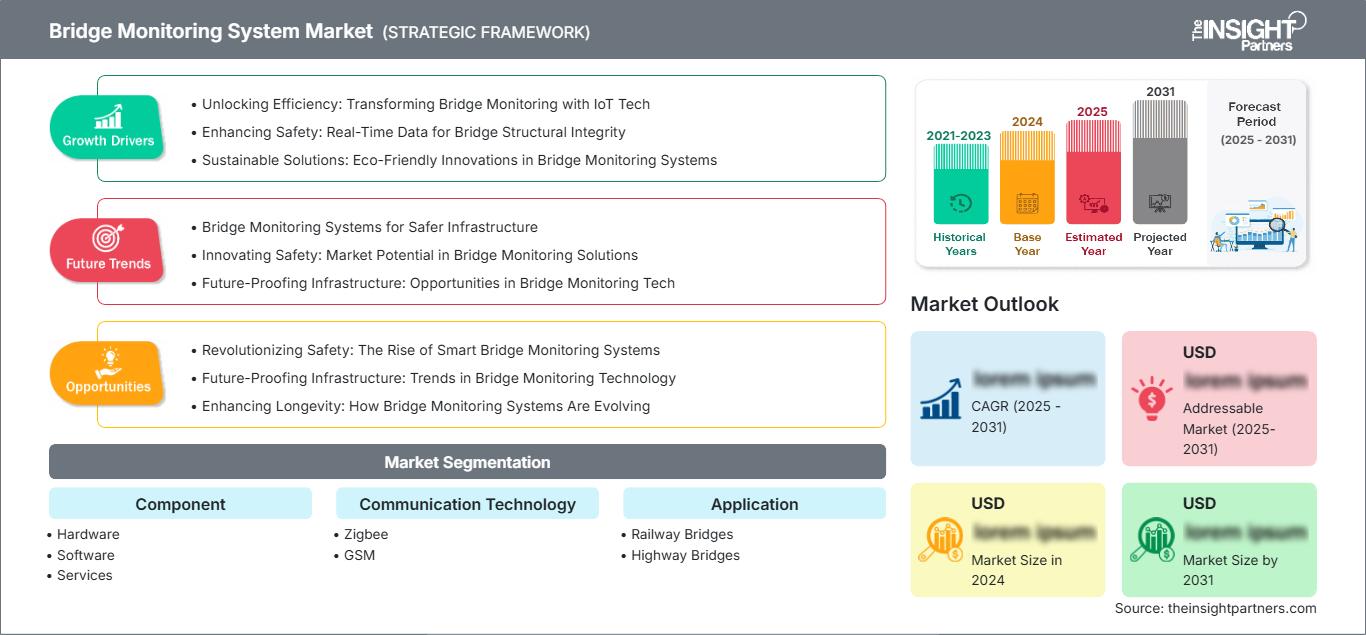
The Bridge Monitoring System Market size was assessed at US$ 1.95 billion in 2025 and estimated to be US$ 3.24 billion by 2034 at a 5.77% CAGR in 2026–2034. Market dynamics are driven by safety standards for bridges, continuous structure health monitoring and the shift from inspection-based maintenance to data-based asset management in both railway bridges and highway bridges.
In North America, there is an ongoing trend towards connected monitoring systems, with regional market dynamics being expected to drive the growth in the range of 5.4–6.1% CAGR until 2034. Such market dynamics are fueled by aging bridge inventories, federal funding for rehabilitation and increasing usage of wireless sensors. Additionally, the Bridge Monitoring System Market in the region is positively impacted by the mandate of predictive maintenance and the necessity to mitigate disruptions caused by inspections.
Bridge Monitoring System Market Assessment and Insights
- North America held 31–34% share in 2025 and is expected to grow at a 5.4–6.1% CAGR during 2026–2034, led by aging assets, safety funding, and connected inspection programs.
- US represented 76–80% of North America in 2025 and is projected to expand at a 5.3–6.0% CAGR as state DOTs scale bridge instrumentation.
- Europe accounted for 25–28% share in 2025 and is forecast to grow at a 4.8–5.5% CAGR, led by Germany, the UK, France, Italy, and Spain.
- Asia Pacific captured 26–29% share in 2025 and is expected to rise at a 6.3–7.0% CAGR, supported by China, Japan, India, South Korea, and Australia.
- Largest Segment Hardware held 54–58% market share in 2025 and is expected to grow at a 5.2–5.8% CAGR, reflecting sensor, logger, and gateway intensity.
- High Growth Segment Services held 19–23% market share in 2025 and is projected to grow at a 6.4–7.2% CAGR as agencies outsource analytics and maintenance support.
- Key companies analyzed in detail: Smartec SA, Pure Technologies Ltd., Campbell Scientific, Inc., NBG Systems GmbH, Vallen Systeme GmbH, Monnit Corporation, LORD MicroStrain Sensing Systems, Alliance Sensors Group, Digitexx Data Systems, Inc., and Roctest Ltd.
Source: The Insight Partners' analysis based on proprietary research, government publications, company annual reports, investor presentations, industry databases, and expert interviews.
From regular visual inspections, bridge authorities have moved on to embedded sensing, automated data collection, and cloud computing. Hardware has become very important in the process as strain gauges, accelerometers, tilt meters, temperature sensors, and data loggers make up the measurement system that helps diagnose any faults. Production trends show increasing preference towards modular systems that can be installed without prolonged closures. The Bridge Monitoring Systems market is thus going from specific project installations to lifecycle installations.
The future of demand will be dictated by budgetary allocation for infrastructure resilience, rail modernization, and asset digitization of emerging corridors. Asia Pacific and certain economies in the Middle East are forecast to invest in bridge sensing systems in line with the development of new corridors for high-speed rail, expressways, and ports.
Bridge Monitoring System Market Report Scope
| Report Attribute | Details |
|---|---|
| Market size in 2025 | US$ 1.95 Billion |
| Market Size by 2034 | US$ 3.24 Billion |
| Global CAGR (2026 - 2034) | 5.77% |
| Historical Data | 2021-2024 |
| Forecast period | 2026-2034 |
Bridge Monitoring System Market Analysis
The demand for Bridge Monitoring System is based on detecting fatigue, corrosion, displacement, and vibration prior to deterioration. Authorities tend to opt for continuous monitoring when bridge shutdowns are expensive and where access is difficult. Value addition occurs in sensors, data logging, edge communication, interpretation, and maintenance advisory services.
The supply characteristics represent an ecosystem rather than a commodity electronics industry. The participants include sensor companies, geotech instrumentation companies, analytics developers, wireless telecommunication firms, and civil engineering consultancies. Wireless communication cuts cabling costs, while GSM connectivity enhances remote monitoring of bridges where there are no fixed networks.
The competitive positioning in the Bridge Monitoring System Market depends upon aspects such as accuracy in measurements, field reliability, ability to conduct analyses and installation assistance. In this market, Smartec SA, Roctest Ltd., Campbell Scientific, Inc., Pure Technologies Ltd., Vallen Systeme GmbH, and LORD MicroStrain Sensing Systems compete on the basis of their application expertise, while Monnit Corporation and Digitexx Data Systems, Inc. offer advanced wireless and remote data analysis capabilities.
There is a growing trend towards investments in integrated service offerings, which will include hardware installation, diagnostic services, dashboards, alerts, and regular engineering analysis. There is an increasing emphasis on evaluation of vendors based on total cost of ownership, cybersecurity and interoperability with asset management systems.
● REPORT CUSTOMIZATION
Tailor This Report To Align With Your Specific Business Requirements
This report can be customized to align precisely with your business objectives, scope, and target markets. Customization options include tailored segmentation, geography, competitive analysis, and strategic insights to support informed decision-making.
Customize This Report →WHAT YOU CAN ADJUST
- ● Segmentations
- ● Geography
- ● Competitive Analysis
- ● Language Preferences
Bridge Monitoring System Market: Strategic Insights
Regional Insights
North America Bridge Monitoring System Market
North America held 31–34% share in 2025 and is projected to grow at a 5.4–6.1% CAGR during 2026–2034. The Bridge Monitoring System Market share in this region reflects a large stock of aging highway bridges, rail structures, and urban viaducts requiring condition-based maintenance.
Adoption at a regional level is possible due to the presence of federal bridge programs, state safety data, and instrumentation of important corridors. The agencies are relying more and more on accelerometer data, strain gauges, and GSM gateways to minimize inspections, better respond to weather-related emergencies, and allocate repair budgets.
U.S. Bridge Monitoring System Market
The US had occupied 76-80% share in North America in 2025 and was expected to report a 5.3-6.0% CAGR until 2034. Demand would be supported by the use of inter-state bridges, large rivers bridges, freight rail bridges, and urban elevated structures that cause economic damage when shut down.
Company presence is strong in Campbell Scientific, Inc., Monnit Corporation, Digitexx Data Systems, Inc., Alliance Sensors Group, and LORD MicroStrain Sensing Systems. The uses would be based on vibration monitoring, strain measurement, seismic response tracking, and remote notifications of bridges subjected to heavy traffic, floods, or winds.
Europe Bridge Monitoring System Market
The Europe segment accounted for a 25-28% market share in 2025 and will witness growth at a CAGR of 4.8-5.5%. Germany leads the regional segment due to highway refurbishment projects and bridge renewal on rail lines. The United Kingdom focuses on optimizing inspection on constrained roads and railways.
France, Italy, and Spain add value to the region via viaduct monitoring systems, bridge-tunnel junctions, and climate adaptation programs for coastal and mountain regions. European customers prefer certified sensors, stable calibration, and the integration of an engineering consulting process, which favors specialist companies like Smartec SA, NBG Systems GmbH, and Vallen Systeme GmbH.
APAC Bridge Monitoring System Market
The Asia-Pacific market was valued at 26-29% in 2025 and is projected to grow at a 6.3-7.0% CAGR. Leading in the region are China because of expressway and high-speed railway bridges and Japan and South Korea by addressing the issue of earthquake resistance and extending their lifecycle.
India and Australia will gain from the increased use through upgrading of highways, metro-rails, and digitization of assets. Growth in the region is driven by both the construction of bridges and monitoring of existing bridges facing monsoon, cyclone, earthquake, and heavy loading threats.
Middle East & Africa Bridge Monitoring System Market
Middle East and Africa is expected to grow at a 5.1–5.8% CAGR during 2026–2034, with Saudi Arabia leading regional demand. Monitoring opportunities are linked to urban mobility, logistics corridors, port access bridges, and energy-linked infrastructure.
The UAE emphasizes smart infrastructure integration, while South Africa requires monitoring for aging transport assets and heavy freight routes. Rest of MEA demand remains project-led, with deployments often tied to large highway, railway, and industrial infrastructure packages.
Segmentation Analysis
Component
Component is expected to grow at a 5.5–6.2% CAGR during 2026–2034 as agencies procure integrated measurement, analytics, and maintenance support. The Bridge Monitoring System Market scope across components is expanding from basic sensing packages toward service-backed platforms that combine field data, alerts, dashboards, and engineering interpretation for bridge owners.
- Hardware remains the largest component because sensors, acquisition units, cables, gateways, and power systems form the physical measurement base for bridge condition tracking.
- Software is gaining importance as owners require dashboards, alarm logic, visualization, and analytics that convert raw vibration, strain, tilt, and temperature data into maintenance decisions.
- Services support design, installation, calibration, data interpretation, and periodic reporting, making them strategically important for agencies lacking in-house structural monitoring expertise.
Communication Technology
Communication Technology is projected to grow at a 5.7–6.5% CAGR as bridge sites require reliable data transfer from distributed sensors to central platforms. Selection depends on bridge length, power availability, network coverage, latency needs, cybersecurity requirements, and whether the installation is temporary, retrofit, or permanent.
- Zigbee suits short-range, low-power networks where multiple sensors must communicate across a bridge span with controlled energy consumption and manageable installation cost.
- GSM supports remote monitoring where cellular coverage enables alerts, periodic reporting, and cloud connectivity without dependence on fixed communication infrastructure at the bridge site.
Application
Application is expected to grow at a 5.6–6.4% CAGR as railway and highway authorities adopt continuous monitoring for safety, service availability, and asset prioritization. Demand differs by load profile, inspection access, traffic disruption cost, and the consequences of unplanned bridge restrictions.
- Railway Bridges require monitoring for vibration, fatigue, settlement, and dynamic response under repeated axle loads, especially on high-speed, freight-heavy, and urban transit corridors.
- Highway Bridges represent broad deployment potential because traffic volumes, aging decks, weather exposure, and rehabilitation backlogs make condition-based maintenance increasingly valuable for road authorities.
Opportunity Snapshot
| Application | Revenue Contribution | Trend Tag | Adoption Stage |
| Railway Bridges | High | Axle Fatigue | Scaling |
| Highway Bridges | High | Deck Safety | Mature |
Bridge Monitoring System Market Growth Drivers and Impact Analysis
Aging Bridge Inventories Requiring Continuous Condition Visibility
In developed countries, a great proportion of the bridges’ networks is reaching or even exceeding their design lifespan. Hence, the need for measurable condition data is growing as the shift from periodic visual inspection to reliable data on the structure's condition in use becomes imperative. Constant monitoring allows getting the information about the change in stress conditions, vibration, bearing displacement, signs of corrosion, and damage after an event, which is helpful in changing the plans for maintenance by pinpointing those structures that require attention to prevent limitations or closures.
Shift Toward Predictive Maintenance and Asset Digitization
Transportation management organizations are digitizing their asset portfolios for capital budgeting based on risk, performance, and service consequences. Bridge monitoring systems are helping with this transition because it is possible to represent the physical response as time series data and compare them with each other. The predictive maintenance enables avoiding unneeded on-site inspections while helping the organization schedule the necessary maintenance when there is low traffic and rail activity along with appropriate weather conditions. Suppliers that provide instrumentation, communication capability, and software analytics are likely to benefit from this driver.
Wireless Connectivity Reducing Installation Disruption
With wireless communication technologies available, the cost effectiveness of bridge monitoring systems would be improved through minimization of cables, reduced installation time and reduced need for traffic management during installation. A Zigbee system would be ideal for distributed, short-range sensor nodes, whereas GSM technology would enable the long-range bridge to send sensor data remotely without need for fixed data infrastructure. Minimal installation disruption would be a key factor, particularly for highway bridges, railroad bridges, and urban viaducts, since lane closures and track possession come at a cost.
Bridge Monitoring System Market Future Trends
AI-Assisted Structural Diagnostics
One of the most important Bridge Monitoring System Market trends will be the use of AI-assisted diagnostics to screen large volumes of vibration, strain, tilt, and environmental data. Future platforms will increasingly identify abnormal signatures, compare them against historical baselines, and prioritize alerts by structural relevance. This will reduce false alarms and help bridge engineers focus on events that indicate fatigue, settlement, scour, or connection deterioration. The trend will favor vendors with validated algorithms, domain-specific datasets, and the ability to explain alerts in engineering terms. Integration with edge computing devices and automated reporting tools will further improve response times during critical events. Continuous algorithm refinement using verified inspection outcomes can enhance prediction accuracy, strengthen infrastructure resilience, and support cost effective maintenance strategies across transportation networks worldwide.
Digital Twins for Bridge Lifecycle Management
Bridge owners are expected to connect monitoring feeds with digital twins that represent geometry, materials, loading history, inspection records, and repair schedules. This will make monitoring data more useful for scenario planning, fatigue modelling, and capital budgeting. Instead of treating a sensor alert as a standalone event, agencies will evaluate it against structural models and remaining-life assumptions. The trend will also improve communication among engineers, contractors, insurers, and public authorities because visual dashboards can show risk evolution and maintenance consequences more clearly. Enhanced interoperability with asset management platforms and geographic information systems will improve decision making across infrastructure portfolios. Standardized data formats, cloud collaboration, and predictive maintenance insights can help authorities optimize investment priorities, reduce operational disruptions, and extend bridge service life through timely interventions.
Bridge Monitoring System Market Opportunities
Managed Monitoring Services for Public Agencies
Public agencies often lack enough internal staff to install, calibrate, and interpret structural monitoring networks across large bridge portfolios. This creates an opportunity for managed service contracts that combine equipment, remote diagnostics, periodic engineering reports, and maintenance recommendations. Bridge Monitoring System Market Forecasts point toward recurring revenue models as asset owners prefer predictable budgets and accountability over one-time procurement. Vendors can differentiate by offering service-level agreements, cybersecurity controls, calibration schedules, and clear escalation protocols when measurements exceed thresholds. Long term partnerships supported by performance guarantees, regulatory compliance expertise, and continuous technical support can strengthen customer confidence. Flexible subscription pricing and scalable deployment options will further encourage adoption across transportation agencies managing diverse infrastructure assets with varying operational requirements and maintenance priorities.
Retrofit Packages for Mid-Sized Highway Bridges
Many monitoring deployments have historically focused on landmark bridges, but mid-sized highway structures represent a larger volume opportunity. Standardized retrofit packages can include a defined sensor set, wireless gateway, solar or battery power, dashboard access, and remote alarm configuration. This approach reduces engineering cost per site and supports portfolio-wide rollout. Suppliers that simplify installation, provide rugged hardware, and create templates for common bridge types can reach county, municipal, and regional authorities that need better visibility but cannot fund highly customized systems. Expanding financing options, training programs, and modular upgrade paths can improve accessibility for budget constrained agencies. Integration with existing inspection workflows and infrastructure databases will further increase operational efficiency, enabling broader adoption while minimizing implementation complexity and long term ownership costs across regional networks.
Recent Developments
- July 2026:The Ministry of Road Transport and Highways has entrusted IIT Madras and C-DAC with managing a centralized software system for real-time bridge health monitoring across India's national highways. The platform will use sensor data to improve infrastructure safety and enable timely maintenance.
- May 2026: IoTBridge, along with Mid Sweden University, FiberCheck, and Chemnitz University of Technology, launched the SHIELD project to develop reliable and cost-effective bridge monitoring solutions. The initiative will leverage low-power wireless sensors, IoT, and AI to detect structural issues in real time and enhance bridge safety.
- July 2026: Glucotrack completed a bridge financing round following its merger with Lōkahi Therapeutics to support strategic growth and future capital initiatives. The funding is expected to strengthen the combined company's healthcare technology platform and expansion plans.
Frequently Asked Questions

- Comprehensive Market Sizing and Forecast Analysis
- Detailed Segmentation Analysis
- In-Depth Market Dynamics Assessment
- Regional and Country-Level Insights
- Competitive Landscape and Company Benchmarking
- Strategic Business Intelligence
Recent Reports
Testimonials

The Insight Partners provided valuable market intelligence that supported our global go-to-market strategy. Their team was professional, responsive, and attentive to our feedback, providing thoughtful analysis and helpful methodological clarifications throughout the project.
Junmo Kim Chief Financial Officer (CFO), Enertech Co., Ltd.
The Insight Partners' SCADA System Market report is comprehensive, with valuable insights on current trends and future forecasts. The team was highly professional, responsive, and supportive throughout. We are very satisfied and highly recommend their services.
RAN KEDEM Partner, Reali Technologies LTDs
I requested a report on a very specific software market and the team produced the report in a few days. The information was very relevant and well presented. I then requested some changes and additions to the report. The team was again very responsive and I got the final report in less than a week.
JEAN-HERVE JENN Chairman, Future Analytica
We worked with The Insight Partners for an important market study and forecast. They gave us clear insights into opportunities and risks, which helped shape our plans. Their research was easy to use and based on solid data. It helped us make smart, confident decisions. We highly recommend them.
PIYUSH NAGPAL Sr. Vice President, High Beam Global
The Insight Partners delivered insightful, well-structured market research with strong domain expertise. Their team was professional and responsive throughout. The user-friendly website made accessing industry reports seamless. We highly recommend them for reliable, high-quality research services
YUKIHIKO ADACHI CEO, Deep Blue, LLC.
This is the first time I have purchased a market report from The Insight Partners.While I was unsure at first, I visited their web site and felt more comfortable to take the risk and purchase a market report.I am completely satisfied with the quality of the report and customer service. I had several questions and comments with the initial report, but after a couple of dialogs over email with their analyst I believe I have a report that I can use as input to our strategic planning process.Thank you so much for taking the extra time and making this a positive experience.I will definitely recommend your service to others and you will be my first call when we need further market data.
JOHN SUZUKI President and Chief Executive Officer, Board Director, BK Technologies
I wish to appreciate your support and the professionalism you displayed in the course of attending to my request for information regarding to infectious disease IVD market in Nigeria. I appreciate your patience, your guidance, and the fact that you were willing to offer a discount, which eventually made it possible for us to close a deal. I look forward to engaging The Insight Partners in the future, all thanks to the impression you have created in me as a result of this first encounter.
DR CHIJIOKE ONYIA MANAGING DIRECTOR, PineCrest Healthcare Ltd.Reason to Buy
- Informed Decision-Making
- Understanding Market Dynamics
- Competitive Analysis
- Identifying Emerging Markets
- Customer Insights
- Market Forecasts
- Risk Mitigation
- Boosting Operational Efficiency
- Strategic Planning
- Investment Justification
- Tracking Industry Innovations
- Aligning with Regulatory Trends





 Get Free Sample for