
Bus Card Reader Market Growth, Size & Forecast by 2034
Coverage: by Technology (Contact, Contactless/NFC); Application (Public Transport Bus, School Bus, Tourist Bus, Others) , and Geography (North America, Europe, Asia Pacific, and South and Central America)
- Status : Data Released
- Report Code : TIPRE00011123
- Category : Electronics and Semiconductor
- No. of Pages : 150
- Available Report Formats :


- Last update date : July 21, 2026


2025 Market Size
US$ 1.37 Bn
Base year value
2034 Forecast
US$ 2.36 Bn
Projected by 2034
CAGR 2026-2034
6.23 %
Growth rate
Addressable Market
US$ 16.88 Bn
(2026-2034)
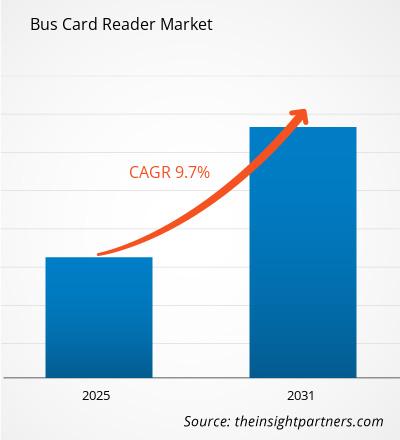
The global Bus Card Reader market was valued at US$ 1.37 billion in 2025 and is expected to reach US$ 2.36 billion by 2034; it is estimated to record a CAGR of 6.23% during 2026-2034.
Bus Card Reader Market Assessment and Insights
- North America held 27%–31% share in 2025 and is expected to grow at a CAGR between 6.2%–7.2% during 2026–2034, supported by contactless fare modernization, open payment pilots, and agency procurement focused on interoperable validators.
- US represented 76%–80% of North America in 2025 and is projected to grow at a CAGR between 6.4%–7.4% during 2026–2034.
- Europe held 24%–28% share in 2025 and is forecast to grow at a CAGR between 5.8%–6.8% during 2026–2034, led by the UK, Germany, France, Italy, and Spain.
- Asia Pacific captured 31%–35% share in 2025 and is projected to grow at a CAGR between 7.4%–8.4% during 2026–2034, led by China, Japan, South Korea, India, and Australia.
- Largest Segment Contactless/NFC held a market share of 63%–67% in 2025, with CAGR range of 7.6%–8.6% between 2026–2034.
- High Growth Segment Public Transport Bus held a market share of 58%–62% in 2025, with CAGR range of 7.3%–8.3% between 2026–2034.
- Key companies analyzed in detail: Advanced Card Systems Ltd., CARLAN GROUP, EMtest, a.s., HID Global Corporation, Identiv, Inc., MagTek, Inc., Mikroelektronika spol. s r.o., Shenzhen Unique Electronic Int'l Limited, TapToPay Limited, and Telepower Communication Co., Ltd.
Source: The Insight Partners' analysis based on proprietary research, government publications, company annual reports, investor presentations, industry databases, and expert interviews.
Hardware solutions for validating fares have moved from magnetic and contact readers to robust and connected terminal devices able to validate contactless cards, NFCs, QRs, and bank cards through one touchpoint. The expansion of the Bus Card Reader Market can be seen through the transition from independent devices to the development of endpoints with the ability to produce data connected to automatic fare collection, account-based ticketing, fleet management, and revenue protection solutions.
Future demands in this industry will be driven by the transit digitalization process occurring in new cities, requirements on transportation accessibility, and the need for reducing cash transaction operations. The 2025 HID research among 102 mass transit operators showed that 88% expected digital ticketing hardware implementation within 12–24 months, while 43% aimed at deploying contactless ticketing solutions.
Bus Card Reader Market Report Scope
| Report Attribute | Details |
|---|---|
| Market size in 2025 | US$ 1.37 Billion |
| Market Size by 2034 | US$ 2.36 Billion |
| Global CAGR (2026 - 2034) | 6.23% |
| Historical Data | 2021-2024 |
| Forecast period | 2026-2034 |
Bus Card Reader Market Analysis
The increasing demand comes because of the transition from outdated technologies like paper tickets, cash fare box, and validator to newer systems that enable quicker boarding and improved audit processes. The market is composed of various components including hardware of the bus card readers, access module, payment certifications, vehicle interfacing, software, system integration, and transport agencies. The Bus Card Reader Market Report emphasizes the importance of reliability, speed of transactions, anti-tampering, and closed-loop cards.
The supply chain consists of embedded processing, NFC chip sets, display modules, scanners, cell phone connectivity, and rugged enclosure procurement. Customers are demanding one equipment that performs both card and QR code, EMV, and mobile wallet validation. Suppliers with flexible software development kits, field diagnostics, and regional certification capability will have shortened deployment cycle for buses operators and private fleets.
The competition pool includes smart card reader specialists, payment equipment manufacturers, and transit validator manufacturers. Advanced Card Systems Ltd. and TapToPay Limited provide products for AFC validators, HID Global Corporation focuses on multi-technology ticketing equipment, Identiv, Inc. and MagTek, Inc. provide solutions related to identity and payment security, and EMtest, a.s. offers hardware and software for public transport and cloud-based systems.
Investments are made in open architecture, remote device management, cybersecurity, and analytics across the fleet. The companies such as CARLAN GROUP, Mikroelektronika spol. s r.o., Shenzhen Unique Electronic Int'l Limited, and Telepower Communication Co., Ltd. have competitive advantage due to lower prices, customization, and production capabilities. It is important to position a company according to payment regulations, support of several fare media, and ability to serve public, school, and tourist buses.
● REPORT CUSTOMIZATION
Tailor This Report To Align With Your Specific Business Requirements
This report can be customized to align precisely with your business objectives, scope, and target markets. Customization options include tailored segmentation, geography, competitive analysis, and strategic insights to support informed decision-making.
Customize This Report →WHAT YOU CAN ADJUST
- ● Segmentations
- ● Geography
- ● Competitive Analysis
- ● Language Preferences
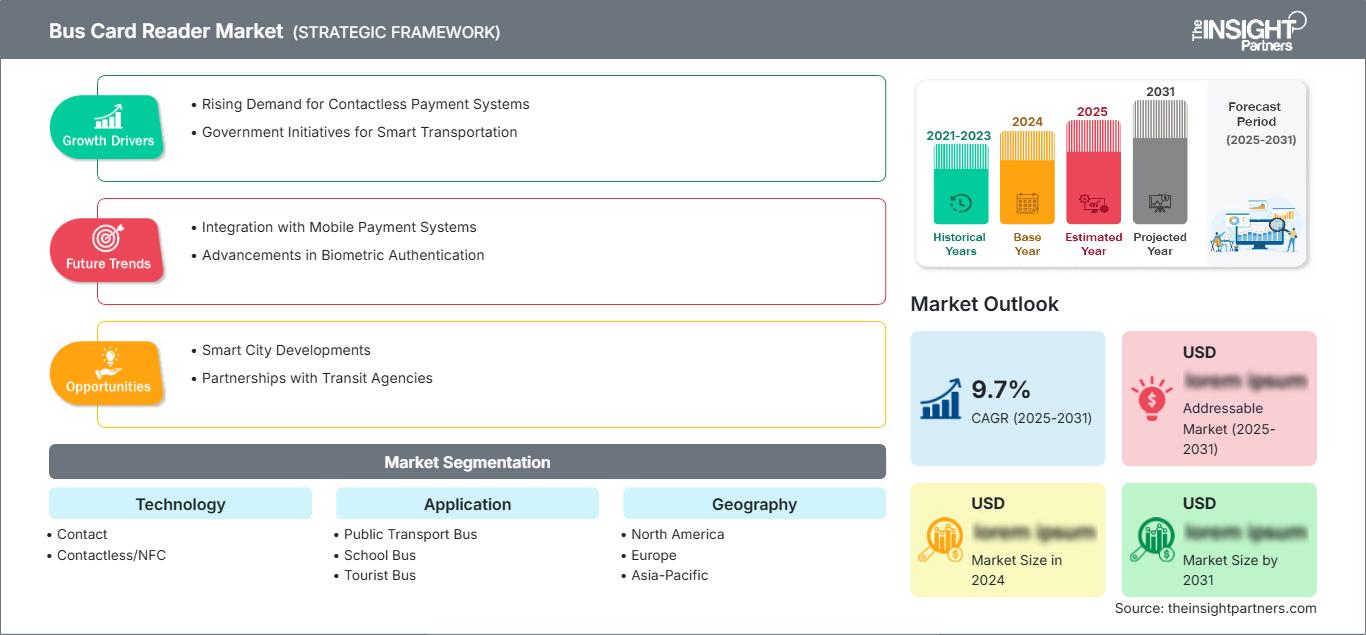
Bus Card Reader Market: Strategic Insights
Regional Insights
North America Bus Card Reader Market
North America held 27%–31% share in 2025 and is forecast to grow at 6.2%–7.2% through 2034. Share in Bus Card Readers Market indicates the early adaptability to contactless payments, substantial procurement budgets, and the desire to upgrade to fare media technology. The demand will be driven by account-based ticketing, trials for EMV, barcode validation, and reduction of expenses on cash handling.
In regions, preferences will go to validators with open API, tampering resistance, 4G/Wi-Fi connection, and maintenance monitoring features. These will be used by public transportation authorities for route buses and BRT fleet, whereas school districts and charter operators will prefer readers for limited boarding purposes. Among beneficiaries of such demand will be HID Global Corporation, Advanced Card Systems Ltd., Identiv, Inc., and MagTek, Inc.
U.S. Bus Card Reader Market
The U.S. represented 76%–80% of North American demand in 2025 and is projected to grow at 6.4%–7.4%. Adoption is mainly seen among metro transit agencies, regional buses, university buses, school bus contractors, and tourist buses. Application trends include open-loop transactions, mobile ticketing, real-time passengers data, and validators that can handle several media of passengers.
Corporate presence is backed by security companies, transit software integrators, and vendors supplying hardware solutions for transit agency bidding process. American transit agencies tend to demand compliance with the ADA, rapid transactions, tough mounting options, and connectivity with back-end clearing systems. School bus applications have recently gained popularity due to linking with safety programs such as validation of students ID and attendance.
Europe Bus Card Reader Market
Europe accounted for 24%–28% share in 2025 and is expected to grow at 5.8%–6.8%. The UK leads through contactless bank-card transit use and strong bus network digitization. Germany is characterized by interoperable ticketing systems, transport association in regions, as well as validators for smart cards, QR codes and account based back office solutions for municipal and commercial bus companies.
France, Italy, and Spain increase demand through metropolitain ticketing solutions, tourist mobility, and ticket integration for buses, trams, and rails. Companies such as EMtest, a.s., Mikroelektronika spol. s r.o., HID Global Corporation, and Advanced Card Systems Ltd. provide operators with solutions that require certified readers, validation devices, and flexible software.
APAC Bus Card Reader Market
APAC held 31%–35% share in 2025 and is projected to grow at 7.4%–8.4%. China leads through smart-city transport, domestic hardware scale, and mobile payment familiarity. While Japan and South Korea incorporate fully matured contactless technology, India and Australia help development through the use of modernized buses, mobility cards, and route digitization.
Industrial policies, manufacturing prowess of electronics, and investments in public transportation improve adoption levels within the region. Some companies that are positioned for the NFC readers, validators, and AFC systems include Shenzhen Unique Electronic Int'l Limited, Telepower Communication Co., Ltd., Advanced Card Systems Ltd., and TapToPay Limited. The market demand is increasing fastest in regions with high passenger flows needing low latency boarding and cashless transactions.
Middle East & Africa Bus Card Reader Market
Middle East & Africa is projected to grow at 5.1%–6.1%, led by Saudi Arabia and the UAE through smart-city mobility, airport shuttle networks, and public transport expansion. The South African market is driven by demands arising from metro bus upgrade projects, commuter transport, and school transport management, whereas RoMEA is characterized by project-based procurement.
Energy, tourism, and infrastructure development require rugged devices that can withstand high temperatures, dusty environments, and varying levels of network connectivity. There is a greater emphasis on offline transactional storage, cellular backup, and maintainability. Although adoption is limited compared to other regions, bus corridors, integrated ticketing, and cashless economies drive modernization.
Segmentation Analysis
Technology
Technology is projected to grow at 6.8%–7.8% during 2026–2034. Bus Card Reader Market scope covers contact readers used in legacy card environments and contactless/NFC readers that support faster boarding, mobile wallets, and bank-card validation. Procurement is shifting toward multi-standard devices because agencies need backward compatibility while preparing for account-based ticketing and open-loop payment acceptance.
- Contact remains relevant in legacy fare systems, staff cards, and controlled school or tourist bus operations where physical card insertion, secure authentication, and low-cost replacement cycles remain important.
- Contactless/NFC leads adoption because tap-and-go validation reduces dwell time, supports smart cards and mobile devices, and enables cleaner integration with EMV, QR, and account-based ticketing systems.
Application
Application is expected to grow at 7.1%–8.1% during 2026–2034. Public transport buses dominate because agencies manage high passenger volumes, fare integration, concession rules, and audit requirements. School buses create safety-led demand for ID validation, while tourist buses use readers for prepaid packages, group boarding, and route-based settlement across private mobility operators.
- Public Transport Bus is strategically central because high ridership, integrated fares, subsidy tracking, and revenue protection require robust onboard validators connected to fleet and back-office systems.
- School Bus adoption is driven by student identification, attendance verification, route accountability, and parent-facing safety records, especially in districts upgrading from manual manifests.
- Tourist Bus operators use card readers for prepaid tours, hotel partnerships, event shuttles, and multi-stop validation where fast boarding and transparent settlement improve service reliability.
Opportunity Snapshot
| Application | Revenue Contribution | Trend Tag | Adoption Stage |
| Public Transport Bus | High | Open Payment | Scaling |
| School Bus | Medium | Student ID | Emerging |
| Tourist Bus | Medium | Group Ticketing | Scaling |
| Others | Low | Private Shuttle | Emerging |
Bus Card Reader Market Growth Drivers and Impact Analysis
Contactless Fare Collection Reduces Boarding Friction
The priority for transit agencies now is to have validators capable of processing smart cards, QR-based tickets, mobile wallets, and bank cards within seconds since the boarding time is a critical factor influencing schedule adherence and operational efficiency. Contactless validation eliminates the need for handling cash, dealing with the driver, and resolving fare disputes, as well as minimizing ticket examination issues. Market effect is most pronounced on urban routes characterized by large passenger numbers during peak hours, when even slight improvements in dwell time translate into better punctuality.
Open Architecture Supports Multi-Vendor Transit Systems
Public transportation systems are shying away from proprietary fare collection equipment that forces agencies to stick to one technology roadmap. An open system ensures that validators will be able to communicate with the ticketing application, the clearing house, the agency back office, the fleet system, and third party analytical tools. The implication of this trend on procurement scoring is that the equipment used has to cater for fare policy changes, concession policy changes, and payment options without necessitating new hardware. The market effect is seen in the requirement of software development kits and payment modules.
School and Tourist Fleets Digitize Passenger Control
Apart from city buses, there is an increased use of readers within school buses and tourist buses to facilitate improved accountability of passengers, cashless transactions, and better visibility of services. Within the former, the use of readers helps in identifying the validity of ID cards to validate passenger boarding, conduct route auditing, and eliminate paper-based attendance. For tourist buses, card/QR readers help with prepaid packages, hotel shuttles, transportation of events, and multiple-stop packages. The effect will be seen in the form of a larger addressable market for affordable and small-sized readers without the need for metro-type solutions.
Bus Card Reader Market Future Trends
Validators Become Multimodal Mobility Gateways
Bus Card Reader Market trends will increasingly center on devices that serve as mobility gateways rather than fare-only terminals. Future validators will read smart cards, QR codes, EMV cards, wearables, and mobile credentials while exchanging data with journey planners and mobility-as-a-service platforms. This evolution can help agencies integrate buses with rail, bike sharing, parking, and demand-responsive transport. Suppliers that design flexible user interfaces, secure firmware, and modular payment stacks will capture value as transport operators seek one passenger touchpoint across multiple modes.
Remote Diagnostics Reduce Field Maintenance Burden
Future deployments will place greater emphasis on remote monitoring, predictive maintenance, and over-the-air updates because bus validators are distributed across moving fleets. Operators need alerts for failed readers, connectivity gaps, payment module issues, and storage limits before revenue collection is affected. This trend favors devices with health telemetry, secure update channels, and configuration management. Hardware vendors that provide cloud dashboards and service analytics can reduce depot visits, improve uptime, and convert one-time equipment sales into recurring support revenue.
Bus Card Reader Market Opportunities
Account-Based Ticketing Retrofit Programs
Account-based ticketing retrofits offer a strong investment path because many bus networks must modernize validators without replacing every back-office system immediately. Bus Card Reader Market Forecasts point to value capture in devices that can run legacy cards while enabling cloud fare calculation, capping, concessions, and bank-card acceptance. Suppliers should prioritize modular payment certification, secure access modules, and migration services that reduce implementation risk. Partnerships with fare system integrators can help hardware firms enter agency projects earlier and secure maintenance contracts after deployment.
Student and Workforce Shuttle Validation
Student transport, corporate shuttles, and campus mobility create an opportunity for simplified readers linked to identity, attendance, and access control systems. Operators in these segments often need proof of boarding, route compliance, and cashless entitlement management rather than complex public fare rules. Vendors can target this opportunity with compact NFC or QR validators, cloud dashboards, and APIs for school administration or workforce platforms. The commercial appeal lies in shorter sales cycles, repeat fleet orders, and recurring software revenue from monitoring and reporting services.
Recent Developments
- May 2026: CT Bus, a public transport operator serving the municipality of Constanța and the surrounding areas, ensuring urban mobility through an extensive network of routes and stations. The company operates a modern fleet of over 200 buses, including vehicles manufactured by Isuzu, MAZ, BYD, Ayats, Mercedes-Benz, ZTE, and Karsan, running on 31 routes.
- September 2025: HID Global Corporation HID reported that Stockholm’s public transport authority used HID validators and barcode, NFC, and contactless EMV modules across buses, ferries, tram platforms, and metro gates, helping reduce fare evasion by 26% while supporting multimodal digital ticketing.
- November 2024, Buses of Somerset introduced tap-on-tap-off (TOTO) technology across its routes in Somerset to make contactless payments more convenient for passengers. Passengers use their contactless bank cards, smartphones, or smartwatches to pay for their journeys with ease.
Frequently Asked Questions

- Comprehensive Market Sizing and Forecast Analysis
- Detailed Segmentation Analysis
- In-Depth Market Dynamics Assessment
- Regional and Country-Level Insights
- Competitive Landscape and Company Benchmarking
- Strategic Business Intelligence
Recent Reports
Testimonials

The Insight Partners provided valuable market intelligence that supported our global go-to-market strategy. Their team was professional, responsive, and attentive to our feedback, providing thoughtful analysis and helpful methodological clarifications throughout the project.
Junmo Kim Chief Financial Officer (CFO), Enertech Co., Ltd.
The Insight Partners' SCADA System Market report is comprehensive, with valuable insights on current trends and future forecasts. The team was highly professional, responsive, and supportive throughout. We are very satisfied and highly recommend their services.
RAN KEDEM Partner, Reali Technologies LTDs
I requested a report on a very specific software market and the team produced the report in a few days. The information was very relevant and well presented. I then requested some changes and additions to the report. The team was again very responsive and I got the final report in less than a week.
JEAN-HERVE JENN Chairman, Future Analytica
We worked with The Insight Partners for an important market study and forecast. They gave us clear insights into opportunities and risks, which helped shape our plans. Their research was easy to use and based on solid data. It helped us make smart, confident decisions. We highly recommend them.
PIYUSH NAGPAL Sr. Vice President, High Beam Global
The Insight Partners delivered insightful, well-structured market research with strong domain expertise. Their team was professional and responsive throughout. The user-friendly website made accessing industry reports seamless. We highly recommend them for reliable, high-quality research services
YUKIHIKO ADACHI CEO, Deep Blue, LLC.
This is the first time I have purchased a market report from The Insight Partners.While I was unsure at first, I visited their web site and felt more comfortable to take the risk and purchase a market report.I am completely satisfied with the quality of the report and customer service. I had several questions and comments with the initial report, but after a couple of dialogs over email with their analyst I believe I have a report that I can use as input to our strategic planning process.Thank you so much for taking the extra time and making this a positive experience.I will definitely recommend your service to others and you will be my first call when we need further market data.
JOHN SUZUKI President and Chief Executive Officer, Board Director, BK Technologies
I wish to appreciate your support and the professionalism you displayed in the course of attending to my request for information regarding to infectious disease IVD market in Nigeria. I appreciate your patience, your guidance, and the fact that you were willing to offer a discount, which eventually made it possible for us to close a deal. I look forward to engaging The Insight Partners in the future, all thanks to the impression you have created in me as a result of this first encounter.
DR CHIJIOKE ONYIA MANAGING DIRECTOR, PineCrest Healthcare Ltd.Reason to Buy
- Informed Decision-Making
- Understanding Market Dynamics
- Competitive Analysis
- Identifying Emerging Markets
- Customer Insights
- Market Forecasts
- Risk Mitigation
- Boosting Operational Efficiency
- Strategic Planning
- Investment Justification
- Tracking Industry Innovations
- Aligning with Regulatory Trends





 Get Free Sample for