
Busbar Trunking Market Demand, Trends & Forecast by 2034
Coverage: by Power Rating (Lighting Range, Low Power Range, Medium Power Range, High Power Range); Conductor (Copper, Aluminum); Insulation (Air Insulation, Sandwich Insulation); End User (Manufacturing Industry, Process Industry, Renewable Power Generation, Public Infrastructure, Transportation, Others) and Geography , and Geography (North America, Europe, Asia Pacific, and South and Central America)
- Status : Data Released
- Report Code : TIPRE00029398
- Category : Electronics and Semiconductor
- No. of Pages : 150
- Available Report Formats :


- Last update date : July 28, 2026


2025 Market Size
US$ 1.28 Bn
Base year value
2034 Forecast
US$ 3.10 Bn
Projected by 2034
CAGR 2026-2034
10.30 %
Growth rate
Addressable Market
US$ 19.42 Bn
(2026-2034)
In 2025, the Busbar Trunking Market size was valued at US$ 1.28 Billion and is estimated to hit the mark of US$ 3.10 Billion by 2034 with a CAGR of 10.30% between 2026 and 2034. The market consists of prefabricated electrical distribution systems which allow efficient and safe distribution of electricity across various areas including manufacturing plants, process industries, renewable power generation facilities, public infrastructure, and transport networks.
North America continues to be a structured demand hub due to the need for grid improvements, data center power rooms, manufacturing reshoring, and transport electrification, all of which necessitate the adoption of compact distribution solutions. The market in North America is estimated to grow at a CAGR of 9.6-10.2% during 2026-2034.
Busbar Trunking Market Assessment and Insights
- North America: The region accounts for 24–28% share in 2025 and grows at a CAGR range of 9.6–10.2% during 2026–2034, led by data centers, industrial retrofits, and transport electrification.
- US: The country represents 78–82% of North America in 2025 and grows at a CAGR range of 9.8–10.4% during 2026–2034, supported by manufacturing and grid investment.
- Europe: The region holds 19–23% share in 2025 and grows at a CAGR range of 8.8–9.4% during 2026–2034, with Germany, the UK, France, Italy, and Spain leading demand.
- Asia Pacific: The region holds 41–45% share in 2025 and grows at a CAGR range of 11.2–11.8% during 2026–2034, led by China, India, Japan, South Korea, and Australia.
- Largest Segment: Copper holds 56–60% market share in 2025 and grows at a CAGR range of 9.8–10.4% during 2026–2034 due to conductivity and reliability.
- High Growth Segment: Renewable Power Generation holds 14–18% market share in 2025 and grows at a CAGR range of 12.0–12.8% during 2026–2034 as grid-connected clean power expands.
- Key companies analyzed in detail: ABB Ltd.; ARJ Group; Busbar Services Ltd.; C&S Electric Limited; DBTS Industries Sdn. Bhd.; Eaton Corporation plc; GE Vernova Inc.; Legrand SA; Schneider Electric SE; Siemens AG.
Source: The Insight Partners' analysis based on proprietary research, government publications, company annual reports, investor presentations, industry databases, and expert interviews.
Busbars have expanded from their traditional role in industrial distribution to data centers, transit stations, renewable energy installations, and skyscrapers where the efficiency of the system depends on space, safety, and thermal performance. The Busbar Trunking Market growth is driven by requirements for modules, tap-off flexibility, and simpler installation than with heavy-duty cables. Current production trends focus on conductor efficiency, enclosure protection, short circuit resistance, and tested assemblies.
Upcoming demand drivers are expected to include increased use of electricity for factory operations, expansion of urban transportation such as metros, and renewable energy facilities. According to the IEA, demand for electricity is growing in relation to buildings, transport, industry, cooling, and data centers. There will be investments in smaller sandwich assemblies, cheaper aluminum busbars, and digitally monitored busbars.
Busbar Trunking Market Report Scope
| Report Attribute | Details |
|---|---|
| Market size in 2025 | US$ 1.28 Billion |
| Market Size by 2034 | US$ 3.10 Billion |
| Global CAGR (2026 - 2034) | 10.30% |
| Historical Data | 2021-2024 |
| Forecast period | 2026-2034 |
Busbar Trunking Market Analysis
Demand arises in locations where load density, reliability, and fast installation are essential. Busbar trunking systems are used in manufacturing units on flexible production lines, whereas process industries require reliable power distribution in proximity to motors, drives, and control rooms. The market has growth potential with increasing electrification, automation, and growing energy intensity in commercial and industrial buildings.
The ecosystem consists of suppliers of copper and aluminum, manufacturers of insulation compound, manufacturers of enclosures, switchgear OEMs, test labs, electrical contractors, and engineering consultants. Supply factors include metals pricing fluctuations, local certifications, capability to perform short circuit tests, and project-based delivery cycle. Purchasers consider fire safety, voltage drop, tap-off safety, maintenance issues, and compatibility with switchboard and building management systems.
Market analysis suggests competition among global electrification leaders and regional companies with connections to contractors. Schneider Electric SE, Siemens AG, ABB Ltd., Eaton Corporation plc, and Legrand SA are competing via comprehensive portfolio of low voltage solutions, while C&S Electric Limited, DBTS Industries Sdn. Bhd., ARJ Group, and Busbar Services Ltd. are catering to localized project needs.
Areas of investment include sandwich insulation, digital temperature sensing, compact risers, and prefabrication for speedy installation. GE Vernova Inc. is gaining from broader experience in electrification, while competitors in the global Busbar Trunking market position busbar solutions as integral components of switchgear and energy management systems. Competitiveness now hinges upon certification, assembly, engineering, and services throughout the life cycle.
● REPORT CUSTOMIZATION
Tailor This Report To Align With Your Specific Business Requirements
This report can be customized to align precisely with your business objectives, scope, and target markets. Customization options include tailored segmentation, geography, competitive analysis, and strategic insights to support informed decision-making.
Customize This Report →WHAT YOU CAN ADJUST
- ● Segmentations
- ● Geography
- ● Competitive Analysis
- ● Language Preferences
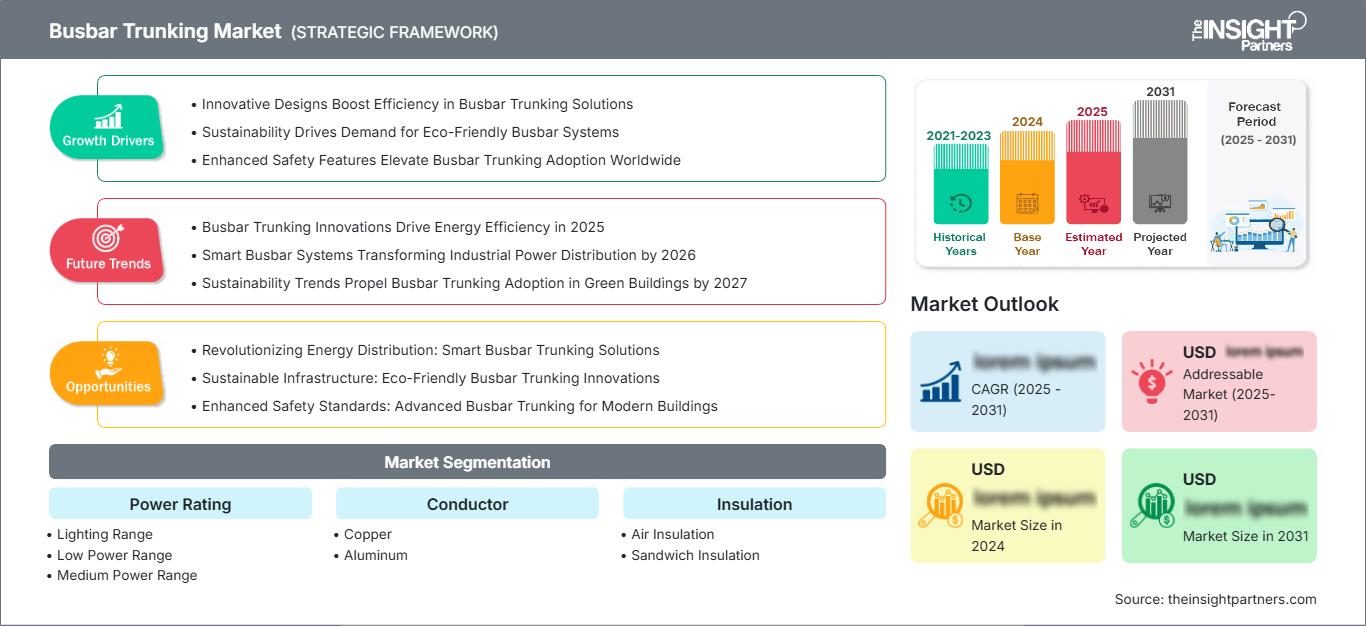
Busbar Trunking Market: Strategic Insights
Regional Insights
North America Busbar Trunking Market
North America holds 24–28% share in 2025 and is projected to grow at a CAGR range of 9.6–10.2% during 2026–2034. Busbar Trunking Market share is supported by data center power distribution, semiconductor fabs, electric vehicle battery plants, airports, hospitals, and industrial modernization projects that need high-current, space-efficient distribution.
Structural demand is reinforced by power availability constraints and grid connection delays for digital infrastructure. IEA reporting shows data center electricity demand rose 17% in 2025, creating pressure for reliable internal distribution. Busbar systems reduce installation time, support tap-off flexibility, and help operators reconfigure loads as server halls, production lines, and transport facilities expand.
U.S. Busbar Trunking Market
The U.S. represents 78–82% of North America in 2025 and is expected to grow at a CAGR range of 9.8–10.4% during 2026–2034. ABB Ltd., Eaton Corporation plc, Schneider Electric SE, Siemens AG, Legrand SA, and GE Vernova Inc. maintain strong specification influence through switchgear, power distribution, and contractor channels.
Application demand is strongest in hyperscale data centers, battery manufacturing, industrial automation, hospitals, airports, and rail-linked infrastructure. U.S. buyers prioritize UL-listed assemblies, short-circuit ratings, rapid installation, and service availability. Copper systems remain preferred for mission-critical loads, while aluminum products gain consideration where weight and cost control shape project decisions.
Europe Busbar Trunking Market
Europe held 19-23% market share for the year 2025 and records a compound annual growth rate between 8.8%-9.4% from 2026 to 2034. Germany dominates due to its automotive plant, machinery production, and industrial automation. The UK utilizes busbar systems within its data center, health estate and transport modernization. France encourages utilization by developing public infrastructures and energy-efficiency initiatives.
Italy and Spain play an integral role through their commercial buildings, railway structures, manufacturing and renewable connections. Fire safety, efficient distribution, recyclability and compliance are the key areas of procurement in Europe. Growth is more stable compared to the Asia Pacific region since most facilities are already equipped with advanced electricity systems, but renovation of industries and digital infrastructure drives replacements.
APAC Busbar Trunking Market
The APAC region accounts for 41-45% market share in 2025, growing at a CAGR of 11.2-11.8% during 2026-2034. China takes the lead with industrial parks, data centers, metros, and renewable energy integration. India brings its strength with manufacturing corridors and infrastructure development, whereas Japan, South Korea, and Australia drive the demand via automation and renewable energy projects.
Electrification driven by policies, locally made equipment manufacturing, and grid investments drives the Busbar Trunking Market in APAC. The preference for modular systems by the contractors is due to its ease in routing cables and easy access for maintenance in high-density urban constructions. Competition in the market is strong due to the competition between global players and regional manufacturers.
Middle East & Africa Busbar Trunking Market
The Middle East & Africa is expected to expand with a CAGR of 8.4%-9.0% in 2026-2034. Saudi Arabia dominates the market with industrial cities, airports, utilities, and transport infrastructure projects, and the UAE contributes with data centers, hospitality, and commercial buildings. South Africa helps with mining, manufacturing, and infrastructure renovation projects.
Energy diversification, port expansion, and renewable energy production lead to the need for robust low voltage distribution systems, despite varying project schedules depending on fiscal cycles. Buyers require heat-resistant housing, reliable connections, and local installation facilities. It works well when EPC players agree on busbar requirements in all locations.
Segmentation Analysis
Power Rating
Power Rating is projected to grow at a CAGR range of 10.0–10.6% during 2026–2034. The Busbar Trunking Market scope by rating reflects diversified use from lighting circuits to high-current feeders. Low and medium power ranges dominate commercial and industrial floors, while high power systems are critical in data centers, large plants, renewable substations, and transport infrastructure.
- Lighting Range: Lighting systems serve commercial floors, transit stations, and public buildings where compact distribution, simple tap-offs, and safer maintenance support frequent layout changes.
- Low Power Range: Low power products support light industrial equipment, retail spaces, and small commercial facilities requiring reliable distribution with lower installation complexity than conventional cable systems.
- Medium Power Range: Medium power systems address production lines, mechanical rooms, and process utilities where flexible load additions and lower voltage drop improve operating resilience.
- High Power Range: High power busbar trunking is strategically important in data centers, large factories, transport hubs, and renewable plants where high-current distribution must remain compact.
Conductor
Conductor is expected to grow at a CAGR range of 10.1–10.7% during 2026–2034. Copper remains the largest conductor option because conductivity, compactness, and thermal stability matter in mission-critical loads. Aluminum gains adoption in cost-sensitive and weight-sensitive projects, especially where engineering design can accommodate larger cross-sections without compromising safety or reliability.
- Copper: Copper leads in high-reliability installations because superior conductivity, compact sizing, and thermal performance support dense loads in data centers, factories, and infrastructure assets.
- Aluminum: Aluminum is attractive where cost, weight, and ease of handling matter, enabling broader adoption in commercial projects and infrastructure with controlled load profiles.
Insulation
Insulation is forecast to grow at a CAGR range of 10.2–10.8% during 2026–2034. Sandwich insulation is favored for compactness, thermal control, and lower impedance in dense installations, while air insulation remains relevant where inspection access, simpler construction, or lower cost is prioritized. Selection depends on current rating, environment, safety code, and maintenance philosophy.
- Air Insulation: Air-insulated systems remain useful in accessible facilities where simpler design, inspection convenience, and moderate load density are more important than maximum compactness.
- Sandwich Insulation: Sandwich insulation holds strong strategic importance because compact construction, improved heat dissipation, and lower reactance suit high-rise buildings, factories, and data centers.
End User
End User is projected to grow at a CAGR range of 10.4–11.0% during 2026–2034. Manufacturing remains the largest use base because production halls require flexible high-current distribution. Renewable power generation is the fastest-growing end user as solar, wind, storage, and grid-interconnection projects need reliable internal distribution for inverters, transformers, and control systems.
- Manufacturing Industry: Manufacturing plants use busbar systems for production lines, robotics, welding, HVAC loads, and machinery clusters where fast reconfiguration reduces downtime.
- Process Industry: Process facilities need durable distribution near pumps, compressors, drives, and control rooms, making reliability and thermal stability important purchasing factors.
- Renewable Power Generation: Renewable projects use busbar trunking around inverter rooms, substations, battery systems, and auxiliary loads where modularity supports phased capacity expansion.
- Public Infrastructure: Public infrastructure demand comes from hospitals, airports, metros, campuses, and civic buildings that require safer distribution and easier maintenance access.
- Transportation: Transportation assets use busbar systems in rail stations, depots, airports, tunnels, and charging facilities where compact routes and service continuity are essential.
Opportunity Snapshot
| End User | Revenue Contribution | Trend Tag | Adoption Stage |
| Manufacturing Industry | High | Flexible Lines | Mature |
| Process Industry | Medium | Motor Loads | Scaling |
| Renewable Power Generation | Medium | Grid Tie | Scaling |
| Public Infrastructure | Medium | Safe Distribution | Scaling |
| Transportation | Medium | Depot Power | Emerging |
Busbar Trunking Market Growth Drivers and Impact Analysis
Electrification Raises Load Density in Built Assets
Building, transport, factory, and digital infrastructure electrification results in an increase in the amount of high current distribution points within these structures. The report on Electricity 2025 published by the International Energy Agency emphasizes increasing electricity demand from the industry, buildings, transport, cooling, and data centers. This enhances the significance of using efficient power distribution within premises. A busbar trunking system offers simplicity of installation, safety at tap-off points, and expandability of the system, as opposed to the use of cable-based systems. Practically, the benefits include fast project execution in hospital, airport, warehouse, metro station, and automated factory environments.
Data Centers Require Compact and Reliable Power Routes
The adoption of artificial intelligence and cloud computing is driving higher power density in data centers and shorter commissioning timeframes. According to IEA data, data center electricity consumption increased by 17% in 2025. Additionally, the capital spending of a leading technological corporation was over US$ 400 billion in the same period. Data centers require power distribution systems that will be capable of handling dense power loads, allow gradual expansion, and mitigate the problems related to installation congestion. The busbar trunking allows for overhead and underfloor installations, fast tapping and load balancing in case of changes in server rooms.
Renewable and Industrial Projects Need Modular Distribution
Renewable energy plants, battery storage systems, and electrification of industrial plants need reliable connections among inverters, transformers, switchgear, and other auxiliary equipment. Busbar trunking systems are ideal for this purpose as they provide known short-circuit behavior, prefabrication capabilities, and simple expansion in case of capacity increase of the project. Industrial customers will also appreciate that such systems reduce downtime during line replacement or plant expansion. The market effect is increased interest from EPC contractors, who require repeated electrical solutions for their solar power plants, wind power plants, hydrogen plants, and industrial plants.
Busbar Trunking Market Future Trends
Digital Monitoring Moves into Critical Busway Networks
Busbar Trunking Market trends will increasingly include embedded temperature sensing, joint condition monitoring, and integration with energy management platforms. Critical facilities want early warning of overheating, phase imbalance, or abnormal load patterns before downtime occurs. Digital busway also supports predictive maintenance records for data centers, hospitals, airports, and automated factories. Over the forecast period, suppliers will differentiate through sensor accuracy, cybersecurity, dashboard usability, and compatibility with switchgear platforms. This shift changes busbar systems from passive distribution hardware into monitored electrical infrastructure that supports reliability reporting and lifecycle service contracts.
Low-Carbon Materials Shape Procurement Criteria
Sustainable criteria will affect conductors, insulating materials, enclosure design, and product recycling. The owners of large buildings and infrastructures are increasingly calling for their suppliers to quantify the carbon footprint, recyclability, and energy consumption during production of the products. Aluminum conductors may become more attractive if weight and cost are considered alongside performance requirements, while copper is indispensable in small installations that require reliability. Comparisons between lifecycle benefits and environmental costs at the procurement stage will need to be made.
Busbar Trunking Market Opportunities
Standardized Packages for Data Center Campuses
Busbar Trunking Market Forecasts help justify spending on standardized busway systems for hyperscale and colocation facilities. The operators require designs that can be replicated to work in the halls with known ratings, thermal properties, and maintenance requirements. Suppliers will benefit by providing integrated switchboards, risers, tap-offs, monitoring equipment, and commissioning services. The financial gain comes from working together with consulting and contracting companies at the early stages of designing the system. It simplifies customization, optimizes spare parts stocking, and facilitates growth of the facility as the needs for servers change.
Renewable Power and Storage Interconnection Rooms
Opportunities for renewable generation and battery storage plants come from inverter rooms, transformer yards, auxiliary power stations, and control centers. Bus bar trunking system installations save time and offer more layout efficiency at locations where multiple feeders meet. Manufacturers need to market EPCs with prefabricated kits, proven connections, corrosion-proof enclosures, and documentation for grid-connected systems. Opportunities arise in solar plus energy storage plants, repowering wind projects, and industrial behind-the-meter power systems. Cooperation with suppliers of inverters, switchgear, and containerized electrical rooms could be helpful here.
Recent Developments
- April 2026: Honeywell announced the launch of a new busbar trunking product solution, expanding its low-voltage power distribution portfolio following the recent introduction of its intelligent circuit breakers. The new modular solution includes low-voltage dense bus ducts, fire-resistant bus ducts, and intelligent bus ducts with current ratings ranging from 400A to 6300A. Designed to deliver high reliability, efficient heat dissipation, and intelligent monitoring, the system enhances operational safety, reduces maintenance costs, and supports long-term, efficient power distribution across high-end manufacturing facilities, smart parks, commercial buildings, and data centers.
- September 2025: AN Busway launched its new Compact Busbar Trunking System, designed specifically for installations in narrow spaces such as commercial complexes and building renovation projects. The system features a compact design with high current-carrying capacity, optimized heat dissipation through a flat conductor arrangement and ultra-thin insulation, and supports customized lengths and interfaces for flexible installation. The product was validated through third-party testing for current-carrying capacity, insulation withstand voltage, and temperature rise, meeting national standards while addressing space constraints and improving installation efficiency.
- September 2014: Siemens introduced the SIVACON 8PS LDM busbar trunking system, a new air-insulated power distribution solution for wind turbines designed to replace conventional cabling between the generator and grid connection. The maintenance-free, modular system supports current ratings from 800A to 8200A, reduces power losses through optimized conductor cross-sections, enables faster and more cost-efficient installation via pre-assembled tower segments, and enhances operational safety with a low fire-load design and compliance with IEC 61439 standards.
Frequently Asked Questions

- Comprehensive Market Sizing and Forecast Analysis
- Detailed Segmentation Analysis
- In-Depth Market Dynamics Assessment
- Regional and Country-Level Insights
- Competitive Landscape and Company Benchmarking
- Strategic Business Intelligence
Recent Reports
Testimonials

The Insight Partners' SCADA System Market report is comprehensive, with valuable insights on current trends and future forecasts. The team was highly professional, responsive, and supportive throughout. We are very satisfied and highly recommend their services.
RAN KEDEM Partner, Reali Technologies LTDs
I requested a report on a very specific software market and the team produced the report in a few days. The information was very relevant and well presented. I then requested some changes and additions to the report. The team was again very responsive and I got the final report in less than a week.
JEAN-HERVE JENN Chairman, Future Analytica
We worked with The Insight Partners for an important market study and forecast. They gave us clear insights into opportunities and risks, which helped shape our plans. Their research was easy to use and based on solid data. It helped us make smart, confident decisions. We highly recommend them.
PIYUSH NAGPAL Sr. Vice President, High Beam Global
The Insight Partners delivered insightful, well-structured market research with strong domain expertise. Their team was professional and responsive throughout. The user-friendly website made accessing industry reports seamless. We highly recommend them for reliable, high-quality research services
YUKIHIKO ADACHI CEO, Deep Blue, LLC.
This is the first time I have purchased a market report from The Insight Partners.While I was unsure at first, I visited their web site and felt more comfortable to take the risk and purchase a market report.I am completely satisfied with the quality of the report and customer service. I had several questions and comments with the initial report, but after a couple of dialogs over email with their analyst I believe I have a report that I can use as input to our strategic planning process.Thank you so much for taking the extra time and making this a positive experience.I will definitely recommend your service to others and you will be my first call when we need further market data.
JOHN SUZUKI President and Chief Executive Officer, Board Director, BK Technologies
I wish to appreciate your support and the professionalism you displayed in the course of attending to my request for information regarding to infectious disease IVD market in Nigeria. I appreciate your patience, your guidance, and the fact that you were willing to offer a discount, which eventually made it possible for us to close a deal. I look forward to engaging The Insight Partners in the future, all thanks to the impression you have created in me as a result of this first encounter.
DR CHIJIOKE ONYIA MANAGING DIRECTOR, PineCrest Healthcare Ltd.Reason to Buy
- Informed Decision-Making
- Understanding Market Dynamics
- Competitive Analysis
- Identifying Emerging Markets
- Customer Insights
- Market Forecasts
- Risk Mitigation
- Boosting Operational Efficiency
- Strategic Planning
- Investment Justification
- Tracking Industry Innovations
- Aligning with Regulatory Trends





 Get Free Sample for