
Busbar Trunking System Market Size, Growth & Demand by 2034
Coverage: By Power Rating (Lighting Power Range, Low Power Range, Medium Power Range, High Power Range); Insulation (Air Insulation, Sandwich Insulation); Conductor (Copper, Aluminum); End-user (Residential, Commercial, Industrial) , and Geography (North America, Europe, Asia Pacific, and South and Central America)
- Status : Data Released
- Report Code : TIPRE00009355
- Category : Electronics and Semiconductor
- No. of Pages : 150
- Available Report Formats :


- Last update date : July 28, 2026


2025 Market Size
US$ 11,813.29 Mn
Base year value
2034 Forecast
US$ 21,346.39 Mn
Projected by 2034
CAGR 2026-2034
6.79 %
Growth rate
Addressable Market
US$ 149,794.42 Mn
(2026-2034)
The Busbar Trunking System market size was valued at US$ 11,813.29 million in 2025 and is expected to reach US$ 21,346.39 million in 2034; the market is likely to grow at a CAGR of 6.79% from 2026-2034. The market will be fueled by the need for compact electrical distribution in data centers, industrial facilities, high-rise buildings, and transport infrastructure.
In North America, developments in electrical room modernization, expansion of the data center sector, and mandatory fire safety measures are expected to influence the market size. The Busbar Trunking System market in North America is likely to experience a CAGR of 6.2–6.8% during 2026-2034 driven by power demands of AI-based data centers and industrial electrification through reshoring.
Busbar Trunking System Market Assessment and Insights
- North America held 29–32% share in 2025 and is growing at a CAGR of 6.2–6.8% during 2026–2034, led by data centers, industrial retrofits, and grid-resilient commercial campuses.
- US represented 76–79% of North America in 2025 and is growing at a CAGR of 6.3–6.9% as hyperscale campuses require faster electrical deployment.
- Europe accounted for 24–27% share in 2025 and is growing at a CAGR of 5.8–6.4%, with Germany, the UK, France, Italy, and Spain leading modernization demand.
- Asia Pacific held 31–34% share in 2025 and is growing at a CAGR of 7.3–8.0%, driven by China, India, Japan, South Korea, and Australia.
- Largest Segment Medium Power Range accounted for 34–38% market share in 2025 and is growing at a CAGR of 6.4–7.0% during 2026–2034.
- High Growth Segment Industrial end-user held 36–40% market share in 2025 and is growing at a CAGR of 7.1–7.8% during 2026–2034.
- Key companies analyzed in detail: ARJ Group, C&S Electric Limited, EAE Elektrik A.S., Eaton Corporation plc, General Electric Company, Legrand SA, Rittal GmbH & Co. KG, Sati Italia S.p.A., Schneider Electric SE, Siemens AG.
Source: The Insight Partners' analysis based on proprietary research, government publications, company annual reports, investor presentations, industry databases, and expert interviews.
Product evolution has shifted away from bulky cable troughs towards factory-tested and modular systems that will speed up the installation process and simplify wiring routing. Improvements in conductor plating, tap-off protection, housing, and interface design for monitoring are being made to accommodate higher current density. The production trend is now moving towards regional manufacturing, IEC 61439-6 conformity, and configuration capabilities for office buildings, data centers, and industrial applications.
In terms of investments, the focus is gradually shifting towards Asia Pacific, the Middle East, and selected regions in North America, where there is demand for power distribution solutions for data centers, rail, healthcare, and manufacturing. Increased focus on energy savings, fire prevention, and ease of maintenance is likely to continue driving purchase decisions in favor of tested busway assemblies rather than cabling.
Busbar Trunking System Market Report Scope
| Report Attribute | Details |
|---|---|
| Market size in 2025 | US$ 11,813.29 Million |
| Market Size by 2034 | US$ 21,346.39 Million |
| Global CAGR (2026 - 2034) | 6.79% |
| Historical Data | 2021-2024 |
| Forecast period | 2026-2034 |
Busbar Trunking System Market Analysis
Growth in Busbar Trunking System market is being fueled by the increase in electrical loading densities within data centers, automated factories, hospitals, airports, and hybrid office buildings. According to the IEA report, electricity demand from data centers globally may more than double up to 2030, whereas delays in connecting to the grid increase the importance of quick and modular distribution of power internally.
The value chain includes materials for conductors, production of enclosures, insulation, testing, design software, installers, and electrical contractors. The supply side is still connected to metal price fluctuations, but prefabrication decreases the risk of on-site labor and allows gradual expansion of capacity within buildings without shutdowns.
The market analysis is characterized by intense competition among the major players, including Schneider Electric SE, Siemens AG, Legrand SA, Eaton Corporation plc, C&S Electric Limited, and EAE Elektrik A.S. Companies are competing on the basis of their compact footprint, ability to integrate with monitoring tap-offs, manufacturing locally and high current certifications for data centers and industries.
Increasing importance is being attached to companies that have design software, shorter lead times and project engineering services. The acquisition of Linkk Busway Systems by Legrand by 2025 enhanced its Asian data center busbar offering, and Siemens and Schneider Electric are further associating busbar trunking with digital low-voltage platform solutions.
● REPORT CUSTOMIZATION
Tailor This Report To Align With Your Specific Business Requirements
This report can be customized to align precisely with your business objectives, scope, and target markets. Customization options include tailored segmentation, geography, competitive analysis, and strategic insights to support informed decision-making.
Customize This Report →WHAT YOU CAN ADJUST
- ● Segmentations
- ● Geography
- ● Competitive Analysis
- ● Language Preferences
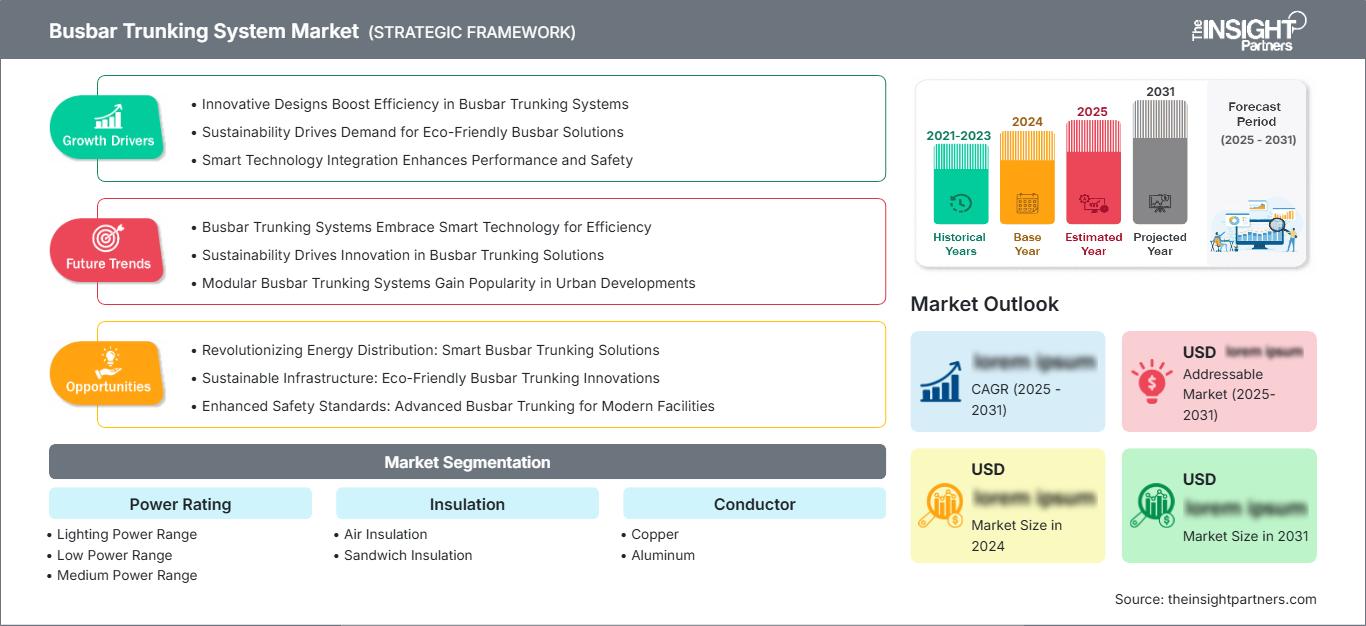
Busbar Trunking System Market: Strategic Insights
Regional Insights
North America Busbar Trunking System Market
North America represented 29–32% share in 2025 and is projected to expand at a CAGR of 6.2–6.8% during 2026–2034. The Busbar Trunking System Market share is supported by data center clustering, factory automation, healthcare infrastructure, and commercial building electrical upgrades.
Power availability has become a site-selection constraint for US and Canadian data halls, encouraging modular busway layouts that can be extended without major rewiring. Utilities and building owners are also prioritizing lower-loss distribution, faster commissioning, and safer maintenance access in dense electrical rooms.
U.S. Busbar Trunking System Market
The United States constituted 76-79% of North America in 2025 and is expected to register a CAGR of 6.3-6.9% in 2026-2034. Key applications include data centers, semiconductor fabs, logistic centers, hospitals, and tall commercial buildings where load balancing is required.
Relevant players include Schneider Electric SE, Siemens AG, Eaton Corporation plc, Legrand SA, and General Electric Company, which have US electrical infrastructure product portfolio or channels. Key application requirements include medium and high-power busways, tap off density, and monitoring.
Europe Busbar Trunking System Market
Europe held 24–27% share in 2025 and is forecast to grow at a CAGR of 5.8–6.4% during 2026–2034. Germany leads through industrial automation, process manufacturing, and electrical retrofit demand, while the UK benefits from data center and commercial real estate modernization.
France, Italy, and Spain contribute through transport terminals, healthcare projects, renewable integration, and industrial parks. European buyers emphasize IEC conformity, fire safety, energy efficiency, and compact riser distribution. Rittal GmbH & Co. KG, Sati Italia S.p.A., Siemens AG, Legrand SA, and Schneider Electric SE support regional specification depth.
APAC Busbar Trunking System Market
Asia Pacific accounted for 31–34% share in 2025 and is expected to record a CAGR of 7.3–8.0% during 2026–2034. China is the leading country, supported by manufacturing expansion, data center construction, and urban infrastructure electrification.
India, Japan, South Korea, and Australia add demand through metro rail, electronics manufacturing, hospitals, and cloud regions. Policy support for industrial corridors and grid modernization is increasing preference for modular, tested assemblies that reduce installation time and support future load additions.
Middle East & Africa Busbar Trunking System Market
Middle East & Africa is projected to grow at a CAGR of 6.5–7.2% during 2026–2034, led by Saudi Arabia. Energy diversification, commercial megaprojects, airports, hotels, and industrial zones are raising requirements for compact, high-current distribution.
The UAE, South Africa, and Rest of MEA contribute through data centers, healthcare, mining, and district-scale infrastructure. Harsh ambient conditions make enclosure protection, heat performance, and reliable joints important procurement criteria for busbar trunking systems.
Segmentation Analysis
Power Rating
The Power Rating segment is projected to grow at a CAGR of 6.4–7.0% during 2026–2034. Busbar Trunking System Market scope is broadening as projects combine lighting circuits, low-voltage distribution, medium-power risers, and high-current feeders within one coordinated electrical architecture.
- Lighting Power Range supports adaptable lighting networks in retail, warehouses, and commercial towers where fixture layouts change and maintenance teams need quick reconfiguration with limited shutdown time.
- Low Power Range serves small commercial floors, workshops, and distributed equipment zones where compact routing, simple tap-offs, and installation efficiency are more important than very high current capacity.
- Medium Power Range is the largest segment, suited to risers, data halls, hospitals, and industrial floors needing balanced load capacity, dense tap-off points, and manageable project economics.
- High Power Range addresses substations, heavy manufacturing, utilities, and large data centers where current density, short-circuit strength, heat control, and certified protection performance are critical.
Insulation
The Insulation segment is expected to grow at a CAGR of 6.1–6.8% during 2026–2034. Selection depends on installation environment, heat dissipation, compactness, ingress protection, and safety requirements, with buyers weighing lifecycle reliability against upfront system cost.
- Air Insulation remains preferred where ventilation, accessibility, and cost efficiency matter, particularly in standard commercial buildings and moderate-duty industrial settings with predictable operating conditions.
- Sandwich Insulation is strategically important in space-constrained, high-current, and data center environments because compact conductor spacing supports lower impedance, improved mechanical integrity, and reduced electrical-room congestion.
Conductor
The Conductor segment is projected to expand at a CAGR of 6.3–6.9% during 2026–2034. Copper remains favored for conductivity and compactness, while aluminum gains traction where weight, cost, and large-volume deployment influence procurement decisions.
- Copper is specified for dense electrical rooms, critical power, and high-performance applications where conductivity, thermal behavior, and smaller cross-sections justify premium material cost.
- Aluminum supports cost-sensitive commercial and industrial projects, offering lighter installation handling and acceptable performance when engineered with suitable plating, joints, and thermal design.
End-user
The End-user segment is forecast to grow at a CAGR of 7.1–7.8% during 2026–2034. Industrial users form the high-growth demand pool as automation, electrified process lines, and power-intensive plants require scalable internal distribution with safer maintenance and lower installation disruption.
- Residential demand is concentrated in high-rise apartments and mixed-use towers where rising mains, compact shafts, and safer load distribution improve maintainability across multiple floors.
- Commercial adoption is strong in data centers, malls, hospitals, airports, and office campuses where tenant changes and equipment additions require flexible tap-off arrangements.
- Industrial applications include manufacturing, warehouses, utilities, mining, and process plants where high currents, uptime, and staged capacity additions make modular trunking strategically important.
Opportunity Snapshot
| End-user | Revenue Contribution | Trend Tag | Adoption Stage |
| Residential | Low | High-Rise | Scaling |
| Commercial | High | Data Centers | Mature |
| Industrial | High | Factory Power | Scaling |
Busbar Trunking System Market Growth Drivers and Impact Analysis
Data Center Power Density and Faster Commissioning
AI and cloud campuses are putting pressure on rack loading, leading to greater demands for density and ease of expandability through reconfiguration without significant rewiring. Busway solutions offer an ability to incorporate tap-offs, load redistribution, and quicker hall commissions compared to cabling solutions. This impacts the project bottom line as electrical closets, cooling clearances, and schedule impacts revenue timing. IEA figures that estimate the data center energy consumption to increase by 17% in 2025 make a case for internal network flexibility.
Industrial Electrification and Automation Upgrades
Factories will be incorporating robots, drives, batteries, and electronic control systems that need more safety, flexibility, and high density power distribution. Conventional wiring may become hard to adapt in case production lines have to be changed, but busbar trunking allows for capacity increments to be done incrementally as well as providing load balancing. This trend has greater significance in factories where shutdown periods are short and where electricity performance influences production, energy, and quality control.
Building Safety Codes and Space Optimization
Tall buildings, hospitals, airports, and mixed-use developments require electrical installations that minimize riser overcrowding, enhance fire separation, and ensure maintenance predictability. Certified busbar trunking systems can assist planners in handling voltage drops, short circuit capability, and future load expansions in confined shaft and ceiling spaces. There is practicality in market applications, as the benefits that may arise from the use of certified systems will result in time savings and accessibility improvements when tenants are fitting out their spaces.
Busbar Trunking System Market Future Trends
Monitoring-Ready Busway for Predictive Power Management
Busbar Trunking System Market trends will be geared towards sensor embedding, tap-off monitoring, and connection with building management systems and energy management platforms. Users require visibility into load conditions, temperature monitoring, and diagnostics at an asset level so that they can avoid downtime in data centers, hospitals, and manufacturing plants. With increased digital control of power grids, manufacturers who offer reliability with software interface solutions will get an edge in specifications. Advanced analytics, remote monitoring capabilities, and predictive maintenance features will further improve operational efficiency across critical facilities. Integration with cloud-based dashboards and automated reporting systems can help operators optimize energy usage, detect anomalies early, extend equipment lifespan, and reduce maintenance costs while supporting regulatory compliance and sustainability initiatives across complex electrical infrastructure.
DC-Ready Distribution for Electrified Facilities
Direct current architectures are emerging in battery storage, renewable integration, EV charging hubs, and some data center applications. Siemens highlighted DC protection and switching advances in 2026 that can integrate with low-voltage systems and busbar trunking. As facilities seek lower conversion losses and simpler renewable coupling, suppliers may develop DC-compatible busway configurations with validated protection, insulation, and switching coordination. Adoption will be gradual, but high-load campuses are likely early evaluators. Future deployments will depend on standardized installation practices, enhanced safety certifications, and compatibility with evolving electrical codes. Manufacturers investing in research, field validation, and collaborative pilot projects can establish technical leadership while supporting efficient power distribution for next generation industrial facilities, renewable energy systems, and digitally connected commercial infrastructure worldwide.
Busbar Trunking System Market Opportunities
Localized Manufacturing for Data Center Supply Chains
Busbar Trunking System Market Forecasts indicate that suppliers with regional plants, short engineering cycles, and tested high-current ranges can capture fast-moving data center projects. Lead times for electrical equipment remain a bottleneck in several markets, so local fabrication and assembly can reduce logistics risk and support phased campus expansion. Partnerships with contractors, design consultants, and colocation developers create recurring specification opportunities, particularly where clients require repeatable designs across multiple sites. Investment in localized testing laboratories, digital production planning, and supplier qualification programs can further improve responsiveness and quality assurance. Regional manufacturing also helps companies comply with domestic sourcing requirements, reduce transportation costs, strengthen supply chain resilience, and support faster maintenance or replacement services for mission critical electrical infrastructure projects across expanding data center ecosystems.
Retrofit Programs in Commercial and Industrial Buildings
Older cable-based electrical networks are being reassessed as buildings add EV chargers, heat pumps, automation, and higher digital loads. Retrofit programs offer opportunities for modular busbar systems because they can improve capacity, simplify future changes, and reduce outage duration during phased upgrades. Suppliers can differentiate with survey-led design support, prefabricated sections, and compliance documentation. The opportunity is strongest in hospitals, malls, factories, warehouses, and multi-tenant towers where electrical flexibility protects asset value. Growing emphasis on energy efficiency and operational continuity will encourage building owners to modernize aging electrical infrastructure. Service providers offering lifecycle assessments, predictive maintenance support, and scalable expansion capabilities can strengthen long term customer relationships while helping facilities meet evolving safety standards, sustainability objectives, and increasing electrical demand with minimal business disruption.
Recent Developments
- April 2026: Several manufacturers showcased next-generation busway systems at RACC Expo 2026, highlighting compact designs, higher power capacity, and easier installation to meet the growing needs of commercial buildings and industrial facilities.
- March 2026: Vertiv launched its PowerBar Track Double Stack busway system for AI and high-density data centers. The new solution delivers higher power capacity in a compact design, enabling flexible, scalable power distribution while optimizing valuable floor space.
- 2026: AN Busway introduced a new compact busbar trunking system designed to simplify installation and improve power distribution efficiency. The solution features a space-saving design, enhanced safety, and flexible configurations for industrial and commercial applications.
Frequently Asked Questions

- Comprehensive Market Sizing and Forecast Analysis
- Detailed Segmentation Analysis
- In-Depth Market Dynamics Assessment
- Regional and Country-Level Insights
- Competitive Landscape and Company Benchmarking
- Strategic Business Intelligence
Recent Reports
Testimonials

The Insight Partners provided valuable market intelligence that supported our global go-to-market strategy. Their team was professional, responsive, and attentive to our feedback, providing thoughtful analysis and helpful methodological clarifications throughout the project.
Junmo Kim Chief Financial Officer (CFO), Enertech Co., Ltd.
The Insight Partners' SCADA System Market report is comprehensive, with valuable insights on current trends and future forecasts. The team was highly professional, responsive, and supportive throughout. We are very satisfied and highly recommend their services.
RAN KEDEM Partner, Reali Technologies LTDs
I requested a report on a very specific software market and the team produced the report in a few days. The information was very relevant and well presented. I then requested some changes and additions to the report. The team was again very responsive and I got the final report in less than a week.
JEAN-HERVE JENN Chairman, Future Analytica
We worked with The Insight Partners for an important market study and forecast. They gave us clear insights into opportunities and risks, which helped shape our plans. Their research was easy to use and based on solid data. It helped us make smart, confident decisions. We highly recommend them.
PIYUSH NAGPAL Sr. Vice President, High Beam Global
The Insight Partners delivered insightful, well-structured market research with strong domain expertise. Their team was professional and responsive throughout. The user-friendly website made accessing industry reports seamless. We highly recommend them for reliable, high-quality research services
YUKIHIKO ADACHI CEO, Deep Blue, LLC.
This is the first time I have purchased a market report from The Insight Partners.While I was unsure at first, I visited their web site and felt more comfortable to take the risk and purchase a market report.I am completely satisfied with the quality of the report and customer service. I had several questions and comments with the initial report, but after a couple of dialogs over email with their analyst I believe I have a report that I can use as input to our strategic planning process.Thank you so much for taking the extra time and making this a positive experience.I will definitely recommend your service to others and you will be my first call when we need further market data.
JOHN SUZUKI President and Chief Executive Officer, Board Director, BK Technologies
I wish to appreciate your support and the professionalism you displayed in the course of attending to my request for information regarding to infectious disease IVD market in Nigeria. I appreciate your patience, your guidance, and the fact that you were willing to offer a discount, which eventually made it possible for us to close a deal. I look forward to engaging The Insight Partners in the future, all thanks to the impression you have created in me as a result of this first encounter.
DR CHIJIOKE ONYIA MANAGING DIRECTOR, PineCrest Healthcare Ltd.Reason to Buy
- Informed Decision-Making
- Understanding Market Dynamics
- Competitive Analysis
- Identifying Emerging Markets
- Customer Insights
- Market Forecasts
- Risk Mitigation
- Boosting Operational Efficiency
- Strategic Planning
- Investment Justification
- Tracking Industry Innovations
- Aligning with Regulatory Trends





 Get Free Sample for