
C-RAN Ecosystem Market Share, Growth & Demand by 2034
Coverage: By Application (Indoor, Outdoor); Component (Hardware, Software, Services); Network Type (5G and LTE, 3G), and Geography (North America, Europe, Asia Pacific, and South and Central America)
- Status : Data Released
- Report Code : TIPRE00014956
- Category : Electronics and Semiconductor
- No. of Pages : 150
- Available Report Formats :


- Last update date : July 17, 2026


2025 Market Size
US$ 22.78 Bn
Base year value
2034 Forecast
US$ 50.09 Bn
Projected by 2034
CAGR 2026-2034
9.15 %
Growth rate
Addressable Market
US$ 325.80 Bn
(2026-2034)
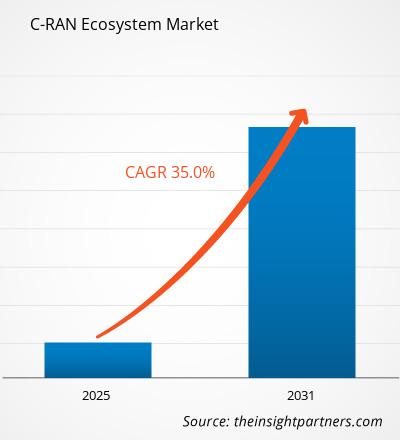
C-RAN Ecosystem market was valued at US$ 22.78 Billion in 2025 and is projected to reach US$ 50.09 Billion by 2034, registering a CAGR of 9.15% during 2026–2034. Demand will be driven by 5G densification, baseband centralization, Open RAN deployment, cloud-native NFs, and low latency, energy-efficient, and dynamic capacity management needs of operators.
Expected CAGR for North America C-RAN Ecosystem market size in the period 2026–2034 is 8.2% to 9.1%, which will be backed by operator modernization efforts, enterprise private 5G deployments, and advancements in the fronthaul via packetized transport technology. U.S. operators are focusing on baseband virtualization, open interfaces, and automation in order to optimize the use of spectrum and reduce site-level duplication of equipment.
C-RAN Ecosystem Market Assessment and Insights
- North America held 28–32% of the C-RAN Ecosystem market share in 2025 and is growing at a CAGR of 8.2–9.1% during 2026–2034, led by 5G densification, enterprise private networks, and virtualized RAN modernization.
- US represented 80–84% of North American revenue in 2025 and is growing at a CAGR of 8.3–9.2% during 2026–2034, supported by carrier cloud RAN pilots.
- Europe accounted for 22–26% share in 2025 and is growing at a CAGR of 7.4–8.3% during 2026–2034, with Germany, the UK, France, Italy, and Spain leading network cloudification demand.
- Asia Pacific held 33–37% share in 2025 and is growing at a CAGR of 10.0–11.2% during 2026–2034, led by China, Japan, South Korea, India, and Australia.
- Largest Segment Remote Radio Heads held 42–46% market share in 2025 and are growing at a CAGR of 8.6–9.4% during 2026–2034 due to dense outdoor radio deployment.
- High Growth Segment Indoor applications represented 34–38% market share in 2025 and are growing at a CAGR of 10.5–11.6% during 2026–2034, driven by private 5G venues.
- Key companies analyzed in detail: Huawei Technologies Co., Ltd.; Nokia Corporation; Cisco Systems, Inc.; Ericsson AB; ZTE Corporation; Samsung Electronics Co., Ltd.; NEC Corporation; Fujitsu Limited; Intel Corporation; Mavenir Systems, Inc.
Source: The Insight Partners' analysis based on proprietary research, government publications, company annual reports, investor presentations, industry databases, and expert interviews.
C-RAN Ecosystem’s technology evolution is progressing towards poolable basebands, splitting of radio functionalities and packetized fronthauls. Operators are striving to reconcile radio performance and reduced energy consumption at sites, easy maintainability and quick scalability. Current production dynamics hinge on semiconductor availability, optics transport deployment, software validation and inter-operability testing of remote radio heads, baseband units, and fronthauls.
Future demand will be driven by Open RAN standards, AI-enhanced RAN management, enterprise private networks, and governmental 5G blanket programs. The emerging markets will expand macro and small cell outdoor coverage whereas established markets will upgrade to cloud-native baseband units and indoor blanket coverage. The supportive regulatory framework for safe and interoperable architecture should provide the grounds for C-RAN Ecosystem investments until 2024.
C-RAN Ecosystem Market Report Scope
| Report Attribute | Details |
|---|---|
| Market size in 2025 | US$ 22.78 Billion |
| Market Size by 2034 | US$ 50.09 Billion |
| Global CAGR (2026 - 2034) | 9.15% |
| Historical Data | 2021-2024 |
| Forecast period | 2026-2034 |
C-RAN Ecosystem Market Analysis
The C-RAN Ecosystem expansion stems from the increase in mobile data usage, more dense 5G radio networks, and the need for mobile operators to lower duplicated baseband resources at the cell site. Supply chain components include radio manufacturers, optical modules makers, cloud service providers, silicon providers, systems integrators, mobile operators, tower operators, and testing specialists. The supply chain dynamics will be increasingly determined by the transport capabilities, synchronizations, accelerators, software life cycle services, and validation of multi-vendor solutions.
C-RAN Ecosystem market report points to the competition dominated by Huawei Technologies Co., Ltd., Nokia Corporation, Ericsson AB, ZTE Corporation, Samsung Electronics Co., Ltd., and NEC Corporation, whereas Cisco Systems, Inc., Fujitsu Limited, Intel Corporation, and Mavenir Systems, Inc. are enhancing transport, silicon, integration, and virtualized RAN capabilities.
Innovation is taking the form of cloud RAN software, AI-driven orchestration, accelerator chips, open fronthaul testing, and power-efficient radio systems. Positioning requires the combination of portfolios, interoperability case studies, operator references, as well as being able to cater for brownfield and greenfield private 5G networks without impacting service-level agreements.
● REPORT CUSTOMIZATION
Tailor This Report To Align With Your Specific Business Requirements
This report can be customized to align precisely with your business objectives, scope, and target markets. Customization options include tailored segmentation, geography, competitive analysis, and strategic insights to support informed decision-making.
Customize This Report →WHAT YOU CAN ADJUST
- ● Segmentations
- ● Geography
- ● Competitive Analysis
- ● Language Preferences
C-RAN Ecosystem Market: Strategic Insights
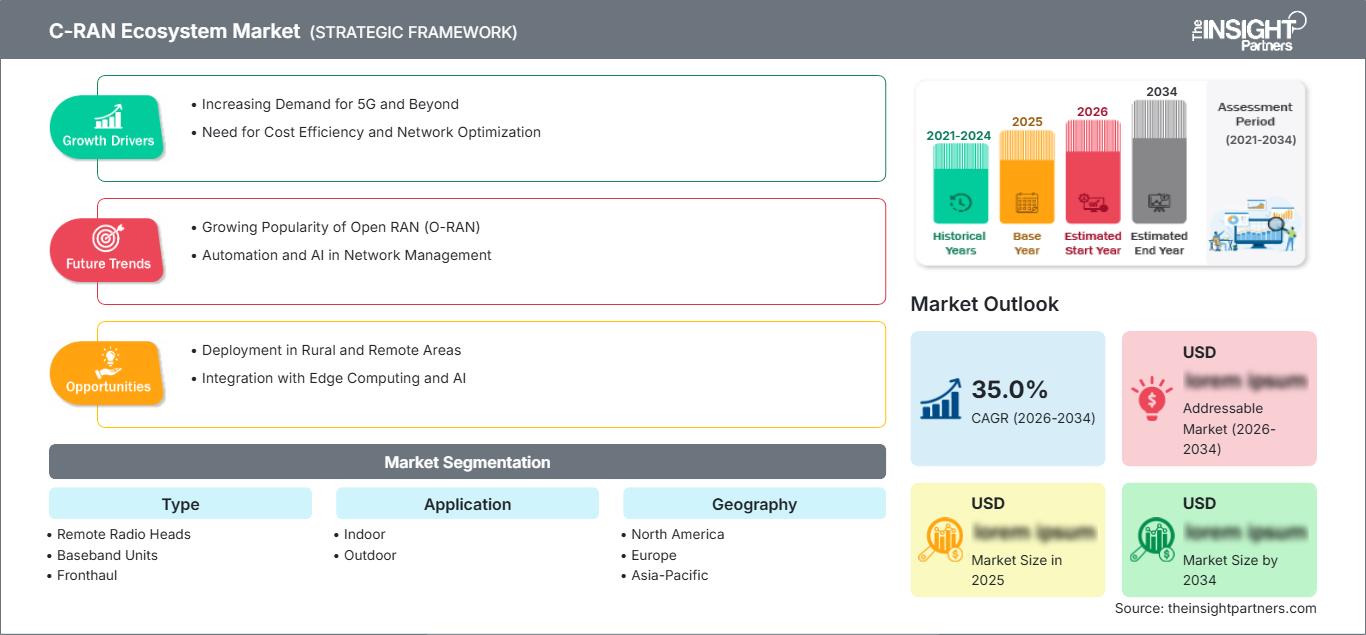
Regional Insights
North America C-RAN Ecosystem Market
North America accounted for 28–32% of C-RAN Ecosystem share in 2025 and is projected to expand at a CAGR of 8.2–9.1% during 2026–2034. The demand is due to 5G Standalone migration, private wireless networks, cloud RAN pilots, and operators’ attempts to increase spectral efficiency in dense urban and enterprise settings.
Regional procurements are influenced by national security considerations, supply chain diversity, fiber requirements, and energy targets. Carriers are looking at centralized baseband pooling in stadia, universities, transportation routes, and industry locations where traffic spikes can be anticipated. The C-RAN Ecosystem is aided by advanced cloud technology, test lab capability, and collaboration between radio equipment suppliers and hyperscale clouds.
U.S. C-RAN Ecosystem Market
The U.S. represented 80–84% of North American revenue in 2025 and is expected to grow at a CAGR of 8.3–9.2% during 2026–2034. Application trends are focused on macro outdoor modernization, indoor enterprise connectivity, stadium connectivity, neutral host connectivity, and cloud-based baseband processing in dense metropolitan regions.
Corporate participation consists of Cisco Systems, Inc., Intel Corporation, Mavenir Systems, Inc., Samsung Electronics Co., Ltd., Ericsson AB, Nokia Corporation, and Fujitsu Limited either based in the United States or using American facilities to deploy C-RAN Ecosystem. Secure network funding by the federal government and 5G spectrum allocation allow for C-RAN deployment.
Europe C-RAN Ecosystem Market
Europe held 22–26% share in 2025 and is projected to grow at a CAGR of 7.4–8.3% during 2026–2034. Germany drives the demand via 5G campuses for industrial usage, car production, and urban densification. The UK contributes to the development via trials of open networks and neutral host indoor systems for transport, venues, and enterprises.
France, Italy, and Spain provide an additional push via mergers and acquisitions of operators, government initiatives regarding public connectivity, and spectrum-based coverage obligations. Buyers from Europe prioritize security, energy savings, open interfaces, and resilience of vendors. That is why the C-RAN Ecosystem is defined by compliance issues and lengthy validation cycles during network modernization.
APAC C-RAN Ecosystem Market
Asia Pacific accounted for 33–37% share in 2025 and is forecast to grow at a CAGR of 10.0–11.2% during 2026–2034. China leads through large-scale 5G base station density, domestic supplier strength, and centralized processing deployments.
Japan and South Korea support early virtualization, Open RAN trials, and advanced indoor coverage. India adds rapid outdoor expansion and cost-sensitive fronthaul demand, while Australia focuses on mining, transport, and public safety networks. Policy support for local manufacturing and digital infrastructure strengthens C-RAN Ecosystem procurement across the region.
Middle East & Africa C-RAN Ecosystem Market
The Middle East & Africa C-RAN Ecosystem market forecast is projected to grow at a CAGR of 6.8–7.7% during 2026–2034. Saudi Arabia leads as smart-city, energy, logistics, and venue connectivity projects require scalable outdoor and indoor radio capacity.
The UAE supports demand through premium enterprise networks, ports, airports, and high-capacity event infrastructure. South Africa remains important for urban coverage and industrial connectivity, while Rest of MEA growth depends on fiber availability, power resilience, and practical deployment models that reduce operating complexity for mobile operators.
Segmentation Analysis
Type
Type is projected to grow at a CAGR of 8.8–9.7% during 2026–2034. The C-RAN Ecosystem scope includes remote radio heads, baseband units, and fronthaul platforms that determine radio reach, processing flexibility, and transport quality. Procurement priorities are shifting toward open interfaces, timing accuracy, accelerator-ready baseband, and transport systems that can support centralized and distributed deployment models.
- Remote Radio Heads remain the largest type because operators need dense radio coverage, Massive MIMO support, energy-efficient outdoor sites, and multi-band equipment for urban, suburban, and transport corridors.
- Baseband Units are central to pooled processing, virtualization, and network slicing because they coordinate radio functions, traffic scheduling, interference control, and service quality across multiple cell sites.
- Fronthaul is strategically important as eCPRI, synchronization, optical transport, and low-latency packet networking determine whether centralized RAN architectures can perform reliably at commercial scale.
Application
Application is forecast to grow at a CAGR of 9.2–10.4% during 2026–2034. Indoor deployment is advancing faster as enterprises, venues, airports, hospitals, and campuses require predictable coverage and low-latency private 5G. Outdoor networks remain larger in absolute deployment volume because macro sites, small cells, and transport corridors still require scalable radio coverage.
- Indoor adoption is scaling in factories, campuses, logistics hubs, hospitals, and venues where private 5G, neutral-host systems, and predictable user density justify centralized radio coordination.
- Outdoor deployments remain foundational for macro coverage, urban capacity, transport corridors, smart cities, and wide-area public networks that require resilient radio performance and fronthaul availability.
Opportunity Snapshot
| Application | Revenue Contribution | Trend Tag | Adoption Stage |
| Indoor | Medium | Private 5G | Scaling |
| Outdoor | High | Macro Cloud | Mature |
C-RAN Ecosystem Market Growth Drivers and Impact Analysis
5G densification increases centralized processing demand
The densification of 5G will be creating more radios per square kilometer, particularly in traffic corridors, stadiums, campus areas, and industrial sites. Distributing baseband at each location reduces efficiency when there are additional spectrum layers and small cells. Centralized baseband pooling increases the efficiency of resource allocation, helps in managing interference, and reduces the duplication of maintenance. The business case for this technology will have greater impact in dense locations where there is fiber connectivity and rising cost of energy. C-RAN Ecosystem vendors with efficient radios, flexible baseband, and good fronthaul connectivity can create value for the operator.
Open interfaces reshape vendor selection and testing
Open fronthaul and virtualized RAN deployments are allowing operators to decrease their lock-in and innovate cycles and build a more agile procurement model. It is leading to the transformation of purchasing from vendor-specific testing to interoperability, life cycle, and integration certification. Vendors will need to prove themselves capable of demonstrating reliable performance of radios, distributed units, centralized units, timing, and cloud infrastructures. We see that in longer testing periods but stronger multi-year deals post-certification. Vendors that have established lab environments, operator references, and automation capabilities are well equipped for open network evolution from pilot to commercial clusters.
Enterprise private networks expand indoor deployment cases
Private enterprise 5G is driving the development of indoor C-RAN deployments for commercial purposes. There is a need for manufacturing facilities, logistics centers, airports, hospitals, and universities to have continuous coverage, low latency, dense connections, and secure traffic management. Centralized processing will make it easier to handle multiple indoor radio nodes along with the ability to perform policy control and service assurance. The commercial impact is practical since enterprises are interested in reliability and ease of operations rather than just capacity of radio alone.
C-RAN Ecosystem Market Future Trends
AI-native RAN control becomes a purchasing criterion
C-RAN Ecosystem market trends point toward AI-native control loops that tune beamforming, traffic steering, energy use, and service-level performance in near real time. Future procurements will assess whether platforms can expose telemetry, train models safely, and coordinate across radio, transport, and cloud layers. This will shift differentiation from hardware capacity alone toward operational intelligence, lifecycle automation, and measurable energy savings. Suppliers that embed AI into radios, baseband software, and management systems should gain preference as operators pursue autonomous network targets.
Hybrid cloud RAN architectures move beyond trials
Hybrid cloud RAN will become more common as operators blend purpose-built baseband, edge data centers, and public cloud resources. The model gives carriers flexibility to place latency-sensitive functions near radios while running orchestration, assurance, and centralized functions on scalable infrastructure. Future adoption will depend on validated performance, security policy, cost transparency, and common observability across sites. C-RAN Ecosystem vendors with portable software, cloud partnerships, and integration services can support staged migration without forcing operators into abrupt network replacement programs.
C-RAN Ecosystem Market Opportunities
Private 5G packages for enterprise indoor networks
C-RAN Ecosystem Forecasts support investment in standardized private 5G packages for enterprises that want reliable wireless coverage but lack telecom engineering resources. Suppliers can combine indoor radios, compact baseband, edge computing, orchestration, cybersecurity, and managed services into repeatable deployment kits. The opportunity is strongest in manufacturing, logistics, healthcare, education, and large venues where uptime, mobility, and predictable latency influence operations. Vendors that simplify deployment audits, spectrum planning, integration, and lifecycle support can reduce adoption friction and build recurring service revenue.
Fronthaul modernization for dense outdoor networks
Dense outdoor 5G requires fronthaul that can support synchronization, packet timing, bandwidth scaling, and low-latency transport across macro and small-cell clusters. Many operators must upgrade legacy fiber, microwave, or aggregation infrastructure before centralized processing delivers full value. This creates an actionable opportunity for suppliers that provide optical modules, switches, timing systems, assurance software, and integration services. The strongest propositions will link fronthaul readiness with measurable improvements in capacity utilization, energy efficiency, and service reliability across high-traffic corridors and metropolitan networks.
Recent Developments
- June 2026: Ericsson today introduced AI in RAN, a software subscription that brings telco-grade AI models into basebands and radios to boost efficiency, performance, and energy savings. This commercially scalable offering gives communications service providers (CSPs) immediate benefits for 5G networks and supports the shift to AI-native RAN without requiring additional hardware.
- March 2026: Samsung Electronics and Vodafone announced that the companies have successfully completed the first call utilizing Samsung’s virtualized RAN (vRAN) solution and Intel Xeon 6 SoC (system-on-chip), marking a first milestone in Europe. This test of the latest chipset reinforces a shared commitment to advance next-generation autonomous networks, which are built on a software-driven, cloud-native and open network architecture, fully supporting AI.
- December 2024: Nokia announced that it has successfully completed a commercial Cloud RAN deployment with the Finnish telco and digital service provider, Elisa in Espoo, Finland. This means that Elisa is now able to deploy Nokia’s commercial Cloud RAN solution, which can co-exist with purpose-built networks in hybrid environments and evolve into full cloud-native networks, supporting the rising demand for RAN cloudification. Common Nokia RAN software ensures feature and performance consistency of Cloud RAN and purpose-built RAN across the entire commercial footprint. Both companies previously completed Europe’s first Cloud RAN trial in October 2023.
Frequently Asked Questions

- Comprehensive Market Sizing and Forecast Analysis
- Detailed Segmentation Analysis
- In-Depth Market Dynamics Assessment
- Regional and Country-Level Insights
- Competitive Landscape and Company Benchmarking
- Strategic Business Intelligence
Recent Reports
Testimonials

The Insight Partners provided valuable market intelligence that supported our global go-to-market strategy. Their team was professional, responsive, and attentive to our feedback, providing thoughtful analysis and helpful methodological clarifications throughout the project.
Junmo Kim Chief Financial Officer (CFO), Enertech Co., Ltd.
The Insight Partners' SCADA System Market report is comprehensive, with valuable insights on current trends and future forecasts. The team was highly professional, responsive, and supportive throughout. We are very satisfied and highly recommend their services.
RAN KEDEM Partner, Reali Technologies LTDs
I requested a report on a very specific software market and the team produced the report in a few days. The information was very relevant and well presented. I then requested some changes and additions to the report. The team was again very responsive and I got the final report in less than a week.
JEAN-HERVE JENN Chairman, Future Analytica
We worked with The Insight Partners for an important market study and forecast. They gave us clear insights into opportunities and risks, which helped shape our plans. Their research was easy to use and based on solid data. It helped us make smart, confident decisions. We highly recommend them.
PIYUSH NAGPAL Sr. Vice President, High Beam Global
The Insight Partners delivered insightful, well-structured market research with strong domain expertise. Their team was professional and responsive throughout. The user-friendly website made accessing industry reports seamless. We highly recommend them for reliable, high-quality research services
YUKIHIKO ADACHI CEO, Deep Blue, LLC.
This is the first time I have purchased a market report from The Insight Partners.While I was unsure at first, I visited their web site and felt more comfortable to take the risk and purchase a market report.I am completely satisfied with the quality of the report and customer service. I had several questions and comments with the initial report, but after a couple of dialogs over email with their analyst I believe I have a report that I can use as input to our strategic planning process.Thank you so much for taking the extra time and making this a positive experience.I will definitely recommend your service to others and you will be my first call when we need further market data.
JOHN SUZUKI President and Chief Executive Officer, Board Director, BK Technologies
I wish to appreciate your support and the professionalism you displayed in the course of attending to my request for information regarding to infectious disease IVD market in Nigeria. I appreciate your patience, your guidance, and the fact that you were willing to offer a discount, which eventually made it possible for us to close a deal. I look forward to engaging The Insight Partners in the future, all thanks to the impression you have created in me as a result of this first encounter.
DR CHIJIOKE ONYIA MANAGING DIRECTOR, PineCrest Healthcare Ltd.Reason to Buy
- Informed Decision-Making
- Understanding Market Dynamics
- Competitive Analysis
- Identifying Emerging Markets
- Customer Insights
- Market Forecasts
- Risk Mitigation
- Boosting Operational Efficiency
- Strategic Planning
- Investment Justification
- Tracking Industry Innovations
- Aligning with Regulatory Trends





 Get Free Sample for