
Cable Fault Locator Market Growth Drivers, Trends, and Regional Forecast by 2034
Coverage: By Type (Portable and Handheld), Product (Cable Sheath Fault Locators, Cable Route Tracer, Time Domain Reflectometer, Pinpointer, and Voltage Surge Generator), Industry (Petroleum, Electrical and Electronics, Telecommunication, Power Generation, Mining, Construction, Others), and Geography
- Status : Data Released
- Report Code : TIPRE00026586
- Category : Electronics and Semiconductor
- No. of Pages : 150
- Available Report Formats :


- Last update date : July 28, 2026


2025 Market Size
US$ 1.75 Bn
Base year value
2034 Forecast
US$ 4.09 Bn
Projected by 2034
CAGR 2026-2034
9.9 %
Growth rate
Addressable Market
US$ 26.01 Bn
(2026-2034)
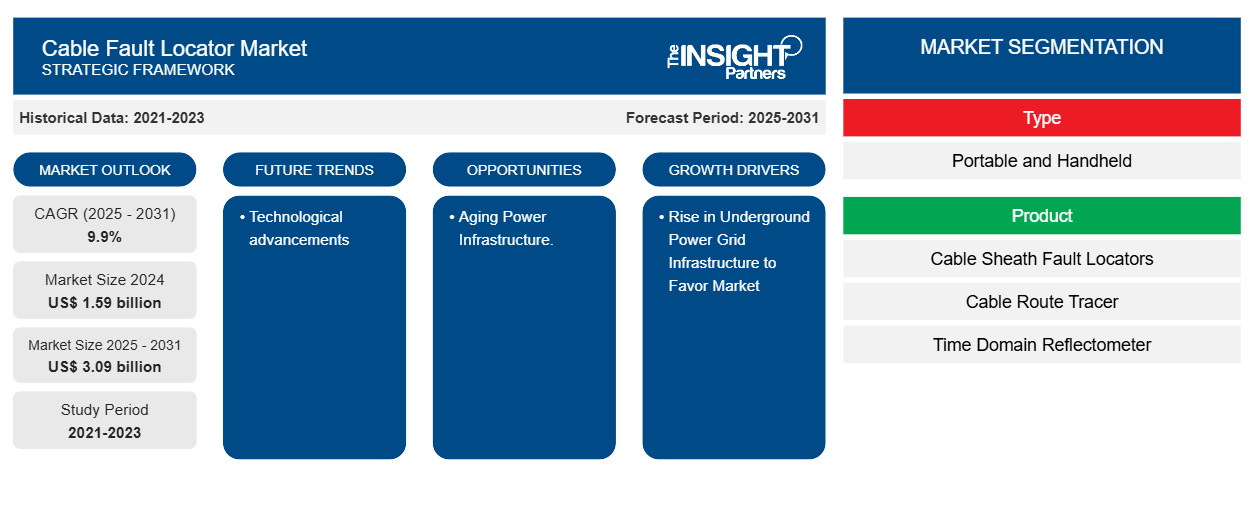
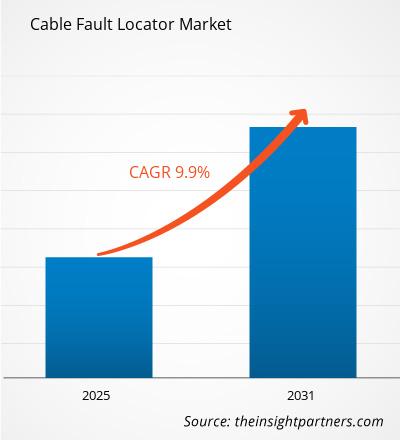
The Cable Fault Locator Market size stood at US$ 1.75 Billion in 2025 and expected to reach US$ 4.09 Billion by 2034 growing at a CAGR of 9.9% during 2026 to 2034. The market growth is primarily driven by factors such as applications in power distribution networks, telecommunications networks, industrial cable testing, mining industries, petroleum industries, and construction industry for fault location which can reduce the cost of excavation and improve safety of the workers and decrease the downtime of work.
In the North America region, the Cable Fault Locator Market is fueled by an estimated CAGR of 9.1–10.0%, owing to the development of aging infrastructure of the underground network and telecommunication infrastructure along with fiber and 5G backhaul investments by various service providers in order to provide reliable service with shorter recovery time.
Cable Fault Locator Market Assessment and Insights
- North America: North America held a 29–32% share in 2025 and is growing at a 9.1–10.0% CAGR between 2026–2034, supported by utility reliability programs, underground cable maintenance, and telecom network densification.
- US: The US represented 76–80% of North America in 2025 and is growing at a 9.3–10.2% CAGR between 2026–2034, led by grid hardening and broadband investment.
- Europe: Europe accounted for a 24–27% share in 2025 and is growing at an 8.4–9.3% CAGR between 2026–2034, with Germany, the UK, France, Italy, and Spain leading demand.
- Asia Pacific: Asia Pacific held a 31–34% share in 2025 and is growing at a 10.4–11.5% CAGR between 2026–2034, driven by China, India, Japan, South Korea, and Australia.
- Largest Segment: Portable devices led with a 58–62% market share in 2025 and a 9.4–10.3% CAGR between 2026–2034 due to field deployment flexibility.
- High Growth Segment: Time Domain Reflectometer products held a 30–34% market share in 2025 and are growing at a 10.8–11.8% CAGR between 2026–2034 as digital diagnostics expand.
- Key companies analyzed in detail: Eaton Corporation plc, Schweitzer Engineering Laboratories, Inc., Schneider Electric SE, H. Horstmann GmbH, Elektro-Mechanik GmbH, Nortroll AS, Bowden Bros. Ltd., Megger Group Limited, BAUR GmbH, 3M Company, Fluke Corporation, and Keysight Technologies, Inc.
Source: The Insight Partners' analysis based on proprietary research, government publications, company annual reports, investor presentations, industry databases, and expert interviews.
From cable faults' analog thumping to manual route tracking, the technology has transitioned into fully integrated test equipment using TDR, surge generation, acoustic locating, sheath tests, and digital reportage. The Cable Fault Locator market is driven by the need for replacing existing diagnostic equipment as well as the deployment of such equipment in applications like underground power cables, renewable interconnections, fiber cable routing, and industrial cables. Production trends include rugged electronic devices, efficient batteries, modular probes, voltage protection, and computer-based interpretation of results for field engineers under time pressure.
The future demand for this equipment will be driven by Asian Pacific infrastructure development, North American utility investments into resilience enhancement, and European renewal of underground distribution networks. IEA has emphasized growing demands for investments into electricity network infrastructure, while telecom companies expand their fiber-based backhaul infrastructure. The regulatory drive to shorten outage duration, increase safety of field workers, and avoid excessive excavations will ensure steady demand for accurate portable and computer-assisted cable diagnostics.
Cable Fault Locator Market Report Scope
| Report Attribute | Details |
|---|---|
| Market size in 2025 | US$ 1.75 Billion |
| Market Size by 2034 | US$ 4.09 Billion |
| Global CAGR (2026 - 2034) | 9.9% |
| Historical Data | 2021-2024 |
| Forecast period | 2026-2034 |
Cable Fault Locator Market Analysis
Growth of the Cable Fault Locator Market is being supported by higher cost of outages, urban underground cabling, renewable energy integration into grids, and fiber network densification. Locators are used by utilities and contractors to speed up repairs, eliminate needless digging, and check cable quality prior to its reenergization. The market also receives demand boost from industrial facilities interested in safe maintenance of medium-voltage feeders, control cables, and critical production lines.
The Cable Fault Locator Market ecosystem comprises instrument manufacturers, sensor suppliers, distributors, rental fleets, electrical contractors, telecom maintenance services, and utility companies’ asset management divisions. Dynamics of the supply chain is influenced by accessibility of electronic components, calibration ability, safety certifications, and presence of field-service capacity. Increasingly, customers tend to select cable locators featuring both pre-location, routing, pin-pointing, and data output functionalities.
Cable Fault Locator Market analysis suggests that there exists competition among protection experts, testing firms, and specialized cable fault location providers. Companies such as Eaton Corporation plc, Schweitzer Engineering Laboratories, Inc., Schneider Electric SE, H. Horstmann GmbH, Elektro-Mechanik GmbH, Nortroll AS, and Bowden Bros. Ltd. provide solutions for network monitoring and fault indications, whereas Megger Group Limited, BAUR GmbH, 3M Company, Fluke Corporation, and Keysight Technologies, Inc. enhance test and measurement capabilities.
Investment is being made towards development of TDR systems with digital interfaces, connectivity-enabled fault indicators, robust handhelds, and portable surge systems, which allow for accelerated restorations. Strategic positioning is determined by precision, safety lockouts, battery life, availability for rent, and capability to support crews with training and calibration. Providers with references to utility customers and local service networks can maintain market share as infrastructure owners consolidate diagnostic kits.
● REPORT CUSTOMIZATION
Tailor This Report To Align With Your Specific Business Requirements
This report can be customized to align precisely with your business objectives, scope, and target markets. Customization options include tailored segmentation, geography, competitive analysis, and strategic insights to support informed decision-making.
Customize This Report →WHAT YOU CAN ADJUST
- ● Segmentations
- ● Geography
- ● Competitive Analysis
- ● Language Preferences
Cable Fault Locator Market: Strategic Insights
Regional Insights
North America Cable Fault Locator Market
North America had a 29-32% market share in 2025 and is projected to register a CAGR of 9.1-10.0% in 2026-2034. Factors driving Cable Fault Locator Market share include aging underground distribution networks, investments in storm resistance measures, and growing telecom fiber deployment in metro areas.
Replacement-based procurement is increasingly tied to smart grid initiatives and the standardization of contractors' tools. Canadian demand stems from urban distribution upgrades and mining projects, while Mexico derives its growth from industrial park electrical network construction and telecom fiber deployment. Increased use of portable units, sheath fault locators, and TDRs is driven by the necessity for diagnostics flexibility in mixed environments.
U.S. Cable Fault Locator Market
The United States made up 76-80% of the North American region in 2025 and is expected to expand at a CAGR of 9.3-10.2% between 2026 and 2034. There is a need for fault location devices in electric utilities, broadband contractors, data centers power corridors, and industrial maintenance staff. The equipment is used for restoring feeder cables, proving newly laid cable paths, and reducing recurring faults following an emergency repair.
Among the firms operating within the market are Eaton Corporation plc, Schweitzer Engineering Laboratories, Inc., 3M Company, Fluke Corporation, Megger Group Limited, and Keysight Technologies, Inc. Current trends include the use of fault location instruments in connected fault indicators, hand held time domain reflectometers, and portable surge generators for utility mutual-aid work.
Europe Cable Fault Locator Market
Europe accounted for a 24–27% market share in 2025 and is expected to record growth at a CAGR of 8.4-9.3% during 2026-2034. Germany leads owing to its large underground MV networks, renewables, and high requirements in service reliability, which drive diagnosis. The UK emphasizes distribution automation and cable management.
Grid reinforcement and electric transport in France, Italy, and Spain help Europe achieve high growth rates. European buyers have requirements for safety regulations, traceability of test results, noiseless fault location, and equipment rental for contractors. BAUR GmbH, Schneider Electric SE, H. Horstmann GmbH, Elektro-Mechanik GmbH, Nortroll AS, and Megger Group Limited benefit from their existing utilities network.
APAC Cable Fault Locator Market
The APAC region constituted 31–34% market share in 2025 and is expected to grow at 10.4–11.5% CAGR from 2026 to 2034. China dominates the market based on grid expansions, urban undergrounding, and telecommunications infrastructure development. India contributes through upgrades to the distribution network, industrial zones, metro rails, and fiber-optic installations.
Japan, South Korea, and Australia sustain market demand through reliability-oriented utilities, renewable energy integration, and mining operations. Government policies that promote electrification, smart cities, and broadband connectivity result in greater number of installations that require diagnostics. Local distributors and rental companies are critical since the crew requires proper training and calibration probes in proximity of the projects.
Middle East & Africa Cable Fault Locator Market
The Middle East & Africa region will register growth at a CAGR of 8.8%–9.7% between 2026 and 2034. Saudi Arabia drives demand via strengthening its power grids, electrifying its oil fields, and mega-infrastructure projects. The UAE favors high-reliability utility power supply, whereas South Africa and Rest of MEA need fault locators to meet their demands in mining, distribution repair, and telecommunication continuity.
Environmental conditions in energy & infrastructure segments call for rugged devices that are heat-resistant and dustproof, can handle long feeder distances, and are capable of operating in remote areas. However, the adoption is highly project-based, though underground cables in emerging cities, ports, railways, and industrial clusters create recurring test requirements.
Segmentation Analysis
Type
The Type segment is forecast to grow at a 9.2–10.1% CAGR during 2026–2034. Cable Fault Locator Market scope by type is defined by field mobility, crew skill levels, and emergency restoration needs. Portable systems dominate utility and contractor fleets because they combine power, surge, and diagnostic functions, while handheld units serve quick screening, telecom, building, and low-voltage maintenance tasks.
- Portable: Portable locators hold the stronger position because utilities and contractors need high-energy testing, pre-location, and pinpointing capabilities in substations, streets, renewable sites, and remote industrial corridors.
- Handheld: Handheld devices support rapid screening, route checks, and low-voltage diagnostics where technicians value light weight, simple menus, battery operation, and quick interpretation before escalating to larger systems.
Product
The Product segment is projected to grow at a 9.6–10.6% CAGR during 2026–2034. Product demand is shaped by the fault type, cable voltage, insulation condition, and site accessibility. Time domain reflectometers support first-line pre-location, while sheath fault locators, route tracers, pinpointers, and voltage surge generators complete the workflow from suspected fault to excavation-ready repair point.
- Cable Sheath Fault Locators: Cable sheath fault locators are strategically important for underground power networks because insulation defects can worsen into outages and require precise step-voltage or voltage-gradient detection.
- Cable Route Tracer: Cable route tracers help crews confirm cable paths before excavation, reducing accidental strikes, repair delays, and mapping uncertainty in crowded utility corridors and industrial premises.
- Time Domain Reflectometer: Time domain reflectometers lead diagnostic adoption because they quickly estimate fault distance, compare traces, and support decision-making before surge testing or acoustic pinpointing begins.
- Pinpointer: Pinpointers provide the final field confirmation by using acoustic or electromagnetic signals, making them essential for reducing excavation area and restoring service faster.
- Voltage Surge Generator: Voltage surge generators remain critical for high-resistance and intermittent cable faults where controlled thumping converts hidden defects into detectable acoustic or reflected signals.
Industry
The Industry segment is estimated to grow at a 9.5–10.5% CAGR during 2026–2034. Power generation and telecom remain high-priority users because outages affect grid reliability, data traffic, and customer service commitments. Petroleum, mining, construction, and electrical and electronics applications add demand where cable networks are exposed to harsh environments, mechanical damage, and continuous operating schedules.
- Petroleum: Petroleum facilities use fault locators in refineries, pipelines, terminals, and offshore support areas where cable failure can interrupt pumping, safety systems, and process control.
- Electrical and Electronics: Electrical and electronics users require diagnostic equipment for manufacturing plants, test labs, data rooms, and facility maintenance where downtime directly affects production continuity.
- Telecommunication: Telecommunication operators rely on route tracing and TDR tools to maintain copper, fiber support infrastructure, and power feeds across dense access and backhaul networks.
- Power Generation: Power generation sites need medium-voltage cable diagnostics for generators, substations, wind farms, solar plants, and auxiliary systems that require fast restoration.
- Mining: Mining applications value rugged portable locators because cables face abrasion, moisture, mobile equipment damage, and long feeder runs in underground and open-pit operations.
- Construction: Construction contractors use locators to verify installed routes, locate damaged cables, and prevent excavation strikes during utility relocation, building electrification, and infrastructure projects.
Opportunity Snapshot
| Industry Vertical | Revenue Contribution | Trend Tag | Adoption Stage |
| Petroleum | Medium | Process Safety | Scaling |
| Electrical and Electronics | Medium | Plant Uptime | Mature |
| Telecommunication | High | Fiber Backhaul | Scaling |
| Power Generation | High | Grid Reliability | Mature |
| Mining | Medium | Rugged Diagnostics | Scaling |
| Construction | Medium | Utility Mapping | Emerging |
Cable Fault Locator Market Growth Drivers and Impact Analysis
Grid Reliability Programs Raise Diagnostic Tool Demand
It has become necessary for utilities to minimize the duration of outages owing to increasing electricity demand and reduced customer tolerance levels for outages. It becomes even more expensive for utilities when there are underground cable outages since the crew would have to first establish the route, estimate the distance from the fault point, verify its location, and conduct safe excavation. Modern locator devices shorten this process significantly and enable utilities to maintain their reliability goals without stretching the field team too thin.
Telecom Network Densification Expands Field Testing Needs
The deployment of fiber-optic cables, small cells, and data center interconnections increases the use of underground cables for communications and electrical supply lines. Portable route locators and TDR test devices have to be available to contractors in order to check continuity and locate disruptions before causing any damage. Since telecommunication services enable the integration of business activities and provide emergency communication and cloud computing connectivity, rapid fault localization is important even for lower-voltage or auxiliary cables.
Industrial Safety and Excavation Cost Control Support Adoption
In industrial plants, mining, refining, and construction, fault location technology is utilized in order to avoid hazards associated with trial and error attempts at repairs. Precise location of the route and exact pinpointing reduces excavation scope, minimizes traffic disruptions, and decreases the probability of cutting adjacent lines. Grounding tests, surge-controlled output, and operator instructions are also appreciated by safety officers. This makes a strong business case for multifunctional technologies which are both precise and safe in repair environments.
Cable Fault Locator Market Future Trends
AI-Assisted Trace Interpretation Moves into Field Tools
Cable Fault Locator Market trends point toward AI-assisted interpretation that helps technicians classify reflections, compare reference traces, and recommend next diagnostic steps. Future systems will not replace expert judgment, but they can reduce training time and improve consistency across large contractor fleets. Embedded guidance will be valuable where utilities face retirements of experienced cable specialists. Vendors that combine waveform libraries, cloud updates, and explainable recommendations can shift buying criteria from hardware specifications alone toward decision support and repeatable restoration outcomes.
Connected Diagnostics Integrate with Asset Management
Fault location data will increasingly move from isolated field reports into utility asset management, GIS, and outage management systems. Connected locators can upload fault distance, route information, test voltage, and repair notes, creating a better record of cable condition over time. This trend supports predictive maintenance and helps planners identify feeders with recurring insulation issues. Equipment suppliers that provide secure data export and open integration options will gain relevance as utilities digitize maintenance evidence.
Cable Fault Locator Market Opportunities
Rental and Managed Calibration Models for Contractors
Cable Fault Locator Market Forecasts indicate a practical opportunity in rental fleets and managed calibration services, especially for contractors handling seasonal utility, telecom, and construction projects. High-energy surge systems and advanced TDR platforms are capital-intensive, and many contractors need them only during specific outage or commissioning windows. Suppliers can bundle devices with certified calibration, operator training, probe replacement, and remote support. This model lowers adoption barriers while creating recurring revenue and stronger customer retention.
Smart Grid Retrofit Packages for Underground Networks
Utilities upgrading underground distribution networks can create demand for bundled packages that include fault passage indicators, portable locators, route tracers, and digital reporting software. The opportunity is strongest where regulators reward reliability improvement and where outage crews need faster information before dispatch. Vendors should position solutions around restoration minutes saved, excavation avoided, and safety compliance rather than device features alone. Partnerships with engineering firms and distribution automation integrators can accelerate specification in multiyear grid programs.
Recent Developments
- July 2025: Megger Group Limited — UK Power Networks completed a trial of Megger’s Fault Sniffer 2 and moved toward wider deployment of more than 60 devices across London, the South East, and East of England. The backpack-mounted system detects gases from underground cable insulation breakdown, helping crews find defects before outages and reduce disruptive excavation. — https://www.electricalreview.co.uk/2025/07/31/uk-power-networks-rolls-out-meggers-fault-sniffer-2-after-successful-trial
- May 2025: VIAVI Solutions and 3-GIS announced a partnership to deliver faster and more accurate fiber fault location capabilities by integrating the VIAVI ONMSi Remote Fiber Test System (RFTS) with 3-GIS's geospatial network management platform. The solution, deployed at Windstream Wholesale, automates fiber fault detection and localization, enabling instant identification of full and partial fiber cuts, GPS-based fault mapping, faster technician dispatch, reduced network downtime, and improved operational efficiency while leveraging existing GIS infrastructure.
- October 2025: Haesong Offshore Wind and Korea Electric Power Corporation (KEPCO) signed a Memorandum of Understanding (MoU) to deploy Smart Fault Locator (SFL) technology for subsea cable fault detection across the 1 GW Haesong Offshore Wind 1 and 3 projects in South Korea. The SFL system is designed to rapidly identify and pinpoint submarine cable faults, improving maintenance efficiency, minimizing downtime, and enhancing the reliability of offshore wind power transmission and grid integration.
- July 2023: Lucy Group acquired the assets and intellectual property of Fundamentals’ Artificial Intelligence and Machine Learning (AI/ML) business to enhance its grid monitoring and fault location capabilities. The acquired technology, including the SYNAPS AI-based fault detection solution, uses data collected from underground cable networks and applies machine learning algorithms with digital twin models of electricity grids to identify, classify, and locate intermittent cable faults before failures occur. The technology will be integrated with Lucy Electric’s GridKey low-voltage remote monitoring system and digital substation solutions, enabling utilities to improve fault management, predictive maintenance, and network reliability
Frequently Asked Questions

- Comprehensive Market Sizing and Forecast Analysis
- Detailed Segmentation Analysis
- In-Depth Market Dynamics Assessment
- Regional and Country-Level Insights
- Competitive Landscape and Company Benchmarking
- Strategic Business Intelligence
Recent Reports
Testimonials

The Insight Partners' SCADA System Market report is comprehensive, with valuable insights on current trends and future forecasts. The team was highly professional, responsive, and supportive throughout. We are very satisfied and highly recommend their services.
RAN KEDEM Partner, Reali Technologies LTDs
I requested a report on a very specific software market and the team produced the report in a few days. The information was very relevant and well presented. I then requested some changes and additions to the report. The team was again very responsive and I got the final report in less than a week.
JEAN-HERVE JENN Chairman, Future Analytica
We worked with The Insight Partners for an important market study and forecast. They gave us clear insights into opportunities and risks, which helped shape our plans. Their research was easy to use and based on solid data. It helped us make smart, confident decisions. We highly recommend them.
PIYUSH NAGPAL Sr. Vice President, High Beam Global
The Insight Partners delivered insightful, well-structured market research with strong domain expertise. Their team was professional and responsive throughout. The user-friendly website made accessing industry reports seamless. We highly recommend them for reliable, high-quality research services
YUKIHIKO ADACHI CEO, Deep Blue, LLC.
This is the first time I have purchased a market report from The Insight Partners.While I was unsure at first, I visited their web site and felt more comfortable to take the risk and purchase a market report.I am completely satisfied with the quality of the report and customer service. I had several questions and comments with the initial report, but after a couple of dialogs over email with their analyst I believe I have a report that I can use as input to our strategic planning process.Thank you so much for taking the extra time and making this a positive experience.I will definitely recommend your service to others and you will be my first call when we need further market data.
JOHN SUZUKI President and Chief Executive Officer, Board Director, BK Technologies
I wish to appreciate your support and the professionalism you displayed in the course of attending to my request for information regarding to infectious disease IVD market in Nigeria. I appreciate your patience, your guidance, and the fact that you were willing to offer a discount, which eventually made it possible for us to close a deal. I look forward to engaging The Insight Partners in the future, all thanks to the impression you have created in me as a result of this first encounter.
DR CHIJIOKE ONYIA MANAGING DIRECTOR, PineCrest Healthcare Ltd.Reason to Buy
- Informed Decision-Making
- Understanding Market Dynamics
- Competitive Analysis
- Identifying Emerging Markets
- Customer Insights
- Market Forecasts
- Risk Mitigation
- Boosting Operational Efficiency
- Strategic Planning
- Investment Justification
- Tracking Industry Innovations
- Aligning with Regulatory Trends





 Get Free Sample for