
Cable Modem Market Size, Trends & Demand by 2034
Coverage: By Type (Wired, Wireless); Application (Residential, Commercial, Industrial) , and Geography (North America, Europe, Asia Pacific, and South and Central America)
- Status : Data Released
- Report Code : TIPRE00026568
- Category : Electronics and Semiconductor
- No. of Pages : 150
- Available Report Formats :


- Last update date : July 21, 2026


2025 Market Size
US$ 2.95 Bn
Base year value
2034 Forecast
US$ 3.58 Bn
Projected by 2034
CAGR 2026-2034
2.45 %
Growth rate
Addressable Market
US$ 30.02 Bn
(2026-2034)
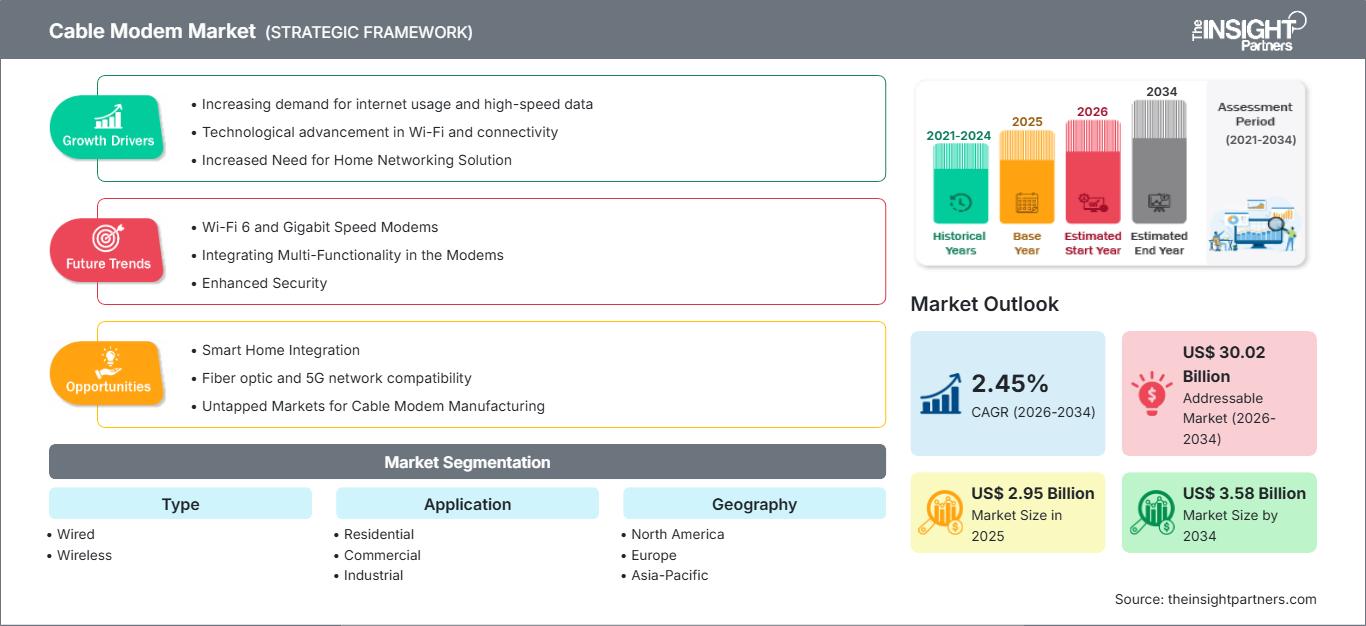
The global cable modem market size was valued at US$2.95 billion in 2025 and is projected to reach US$3.58 billion by 2034, registering a CAGR of 2.45% during the forecast period from 2026 to 2034. The market forms an established yet developing niche in the wider ecosystem of broadband connectivity, based on the continuous use of HFC networks to provide the internet to homes and businesses.
In 2025, North America commanded around 31-35% of the market and is expected to record a CAGR of 2.1-2.5% during the forecast period. Market drivers in the region include the availability of cable network in North America, especially in the U.S., and the ongoing requirement for broadband services. Upgrades of DOCSIS 3.1 and the initial stages of deployment of DOCSIS 4.0 contribute to the cycle of replacements, while commercial and industrial sectors opt for cable modems.
Cable Modem Market Assessment and Insights
- North America: Held roughly 31–35% share in 2025, growing at a CAGR of 2.1–2.5% from 2026 to 2034, driven by high broadband penetration and continuous network upgrades across the region.
- U.S.: Accounted for approximately 80–85% of the North American market in 2025, growing at a CAGR of 2.2–2.6%, led by major cable operators investing in network enhancements and residential broadband services.
- Europe: Estimated at 21–25% share in 2025, growing at a CAGR of 2.0–2.4%. Key markets include the UK, Germany, France, and Italy, with growth supported by broadband infrastructure modernization and commercial sector demand.
- Asia Pacific: Estimated at 27–31% share in 2025, growing at a CAGR of 2.8–3.2%. China and India lead due to rapid digitalization, increasing internet penetration, and expanding cable network investments.
- Largest Segment: Residential application accounted for approximately 65–70% of the market in 2025 and is projected to grow at a CAGR of 2.3–2.7%, driven by the need for reliable high-speed internet for streaming, gaming, and remote work.
- High Growth Segment: Industrial application, though smaller in scale, is expected to grow at a CAGR of 3.2–3.6%, fueled by increasing automation, IIoT adoption, and the need for robust network connectivity in manufacturing and logistics environments.
- Key companies analyzed in detail: Arcadyan Technology Corporation, Askey Computer Corporation, CastleNet Technology, Inc., Cisco Systems, Inc., CommScope, D-Link Corporation, Lindsay Broadband Inc., Netgear, Inc., Technicolor SA, and Texas Instruments.
Source: The Insight Partners' analysis based on proprietary research, government publications, company annual reports, investor presentations, industry databases, and expert interviews.
The development of the cable modem market can be described in terms of constant technological improvements, such as the introduction of the DOCSIS 3.1 technology and the new DOCSIS 4.0 standard, which provide for symmetrical multi-gigabit speed and reduced latency. The aforementioned technological innovation has a considerable influence on product cycles, since operators improve their network infrastructure, whereas customers opt for gateways that combine both the functions of a modem and a router.
From a future perspective, the market is likely to experience constant growth owing to the expanding coverage of the broadband network and the significance of the connection reliability in residential, commercial, and industrial sectors. The developments related to the network reliability, government broadband programs, and cable modems integration with the managed Wi-Fi and smart homes ecosystem will determine the dynamics of the market development.
Cable Modem Market Report Scope
| Report Attribute | Details |
|---|---|
| Market size in 2025 | US$ 2.95 Billion |
| Market Size by 2034 | US$ 3.58 Billion |
| Global CAGR (2026 - 2034) | 2.45% |
| Historical Data | 2021-2024 |
| Forecast period | 2026-2034 |
Cable Modem Market Analysis
The market drivers in the cable modem sector are primarily due to the continuous need for high speed internet. As more and more bandwidth hungry applications like 4K/8K video streaming, online gaming, and cloud computing applications become popular, there is a growing need for high speed low latency broadband connectivity. Cable modems using coaxial cable network offer a cost-effective means of fulfilling that need, especially where there are well-established cable network systems in place.
The value chain consists of providers of raw materials (semiconductor, chips, radio frequency modules), original design manufacturing, device manufacturers, and channel distributors selling directly to Internet service providers and end users. The supply chain depends on the availability of semiconductors and tariffs on imported electronics products.
The competitive environment in the Cable Modem Market Report is somewhat fragmented, consisting of both global leaders of technology and dedicated networking companies. Cisco Systems, Inc., and CommScope have firm market shares in the CMTS and networking equipment, while Netgear, Inc., and D-Link Corporation are well-known players in consumer-retail market. Arcadyan Technology Corporation, Askey Computer Corporation, and CastleNet Technology, Inc., are used as dedicated ODMs by different vendors. Investment pattern is oriented towards the development of DOCSIS 4.0-compliant equipment and integrated gateways incorporating high-speed cable modems and Wi-Fi functionality.
● REPORT CUSTOMIZATION
Tailor This Report To Align With Your Specific Business Requirements
This report can be customized to align precisely with your business objectives, scope, and target markets. Customization options include tailored segmentation, geography, competitive analysis, and strategic insights to support informed decision-making.
Customize This Report →WHAT YOU CAN ADJUST
- ● Segmentations
- ● Geography
- ● Competitive Analysis
- ● Language Preferences
Cable Modem Market: Strategic Insights
Regional Insights
North America Cable Modem Market
North America accounted for approximately 31–35% of the global cable modem market in 2025 and is estimated to grow at a CAGR of 2.1–2.5% from 2026 to 2034. The region has a well-established infrastructure for HFC and a high number of broadband subscribers. Cable providers such as Comcast and Charter Communications upgrade their network infrastructures regularly. The emergence of multi-gig services and the deployment of DOCSIS 4.0 technologies are some of the factors that have enabled growth within the market. The business segment is witnessing increasing adoption of cable modems for primary as well as secondary Internet access services.
U.S. Cable Modem Market
The U.S. cable modem market represented approximately 80–85% of the North American market in 2025 and is estimated to grow at a CAGR of 2.2–2.6%.The United States of America is one of the leaders when it comes to broadband infrastructure around the world. The characteristics of the U.S. market include the existence of big cable operators and the early implementation of DOCSIS 3.1 and 4.0 technologies. The demand for fast internet, which is promoted by working from home and streaming services, stimulates people to change their modems.
Europe Cable Modem Market
Europe held approximately 21–25% share of the global market in 2025, with a projected CAGR of 2.0–2.4%. The market is driven by broadband expansion and cable network upgrades in key countries. The UK ranks first because of its wide usage of DOCSIS 3.1 technology for residences and businesses. Germany, France, and Italy come next in terms of having well-established cable networks and increased needs for fast internet connections. The importance of regulations encouraging gigabit internet usage is emphasized in the region.
APAC Cable Modem Market
Asia Pacific is estimated to account for 27–31% of the global market in 2025 and is expected to grow at a CAGR of 2.8–3.2%, driven by digitalization and broadband expansion in China and India. This is made possible through the implementation of government policies on broadband connectivity, as well as the investment of funds by the private sector in the development of cable networks. This includes the huge market represented by China, which has substantial demands for fast Internet and cable network connections, India and Japan being others.
Middle East & Africa Cable Modem Market
Estimated growth rate of MEA will be in range of 2.5% to 2.9%. Growth will occur due to the development of infrastructure and increasing internet penetration. Leading countries in this region include Saudi Arabia, the UAE where investment in smart cities and broadband take place. In addition, there is South Africa which plays a crucial role in connectivity solutions..
Segmentation Analysis
Type
The market is segmented into wired and wireless devices. Wired cable modems remain the predominant type, holding a significant market share due to their established presence and reliability in residential and commercial broadband setups. These devices provide a stable physical connection to cable networks, ensuring consistent data transmission. Wireless cable modems, which integrate Wi-Fi capabilities, are gaining traction as households and businesses demand network flexibility. The growth of wireless variants is supported by the increasing adoption of smart home devices and the need for convenient network access across multiple endpoints without physical cable constraints.
- Wired: Represents the largest sub-segment, valued for its superior reliability, stable connection, and widespread compatibility with existing cable network infrastructure, making it a preferred choice for residential and commercial applications.
- Wireless: Rapidly gaining adoption, particularly in residential markets, as consumers demand integrated modem-router solutions that provide both internet connectivity and wireless access for smart devices and mobile endpoints.
Application
The application segment is categorized into residential, commercial, and industrial sectors. The residential sector dominates the market, driven by the widespread adoption of cable modems for home broadband internet access, streaming, and gaming. Commercial applications, including SMEs and enterprises, require reliable broadband for daily operations. Industrial applications represent the high-growth segment, fueled by automation and IIoT.
- Residential: Largest market segment, driven by household demand for high-speed internet for streaming, online gaming, remote work, and education, accounting for a significant share of global cable modem deployments.
- Commercial: Enterprises and SMEs utilize cable modems for primary and backup internet connectivity, requiring reliability and business-grade service level agreements.
- Industrial: The fastest-growing application segment, driven by the adoption of IIoT, remote monitoring, and factory automation requiring robust network connectivity in industrial environments.
Opportunity Snapshot
| Segment | Revenue Contribution | Trend Tag | Adoption Stage |
|---|---|---|---|
| Residential | High | Broadband Demand | Mature |
| Commercial | Medium | Business Connectivity | Scaling |
| Industrial | Medium-High | IIoT Integration | Emerging |
Cable Modem Market Growth Drivers and Impact Analysis
Rising Demand for High-Speed Broadband Internet
Increased data consumption via video streaming, online gaming, telecommuting, and e-learning have resulted in insatiable demand for fast broadband solutions. The availability of cable modems that make use of pre-existing coaxial cable technology represents an economical and scalable solution to meet the demands of multi-gigabit speeds. This demand becomes especially relevant in the residential and commercial market segments where there is need for internet connectivity on a day-to-day basis. The migration towards DOCSIS 3.1/4.0 broadband solutions with their ability to provide symmetrical speed and reduced latency makes compatible cable modems increasingly important. Digital inclusion programs implemented by governments also play an important role here.
Expansion of Smart Home and IoT Ecosystems
The prevalence of intelligent homes comprising connected appliances, surveillance equipment, voice control systems, and connected lights makes strong and reliable home networking infrastructure critical. A combination of cable modems and Wi-Fi connectivity plays a key role in the ecosystem, handling connectivity to several devices at once. The growing number of connected devices per household puts additional pressure on modem functionality, security and dependability. To address this challenge, manufacturers are introducing new generations of cable modems offering dual band Wi-Fi connectivity, improved security options and IoT integration possibilities.
Broadband Infrastructure Investments and Digital Inclusion
Various governments around the world are developing policies that will help in increasing broadband access, especially in rural and underdeveloped communities. In America, government initiatives such as Broadband Equity, Access, and Deployment (BEAD) Programs and other government subsidies have been instrumental in increasing the size of networks. Cable companies have taken advantage of these investments by building their Hybrid Fiber Coax (HFC) networks and using DOCSIS 4.0 technology in order to compete effectively. Such investments in Europe, APAC, and elsewhere have led to an increase in broadband coverage and deployment of cable modems.
Cable Modem Market Future Trends
DOCSIS 4.0 Deployment Enabling Symmetrical Multi-Gigabit Speeds
The deployment of DOCSIS 4.0 technology represents a significant milestone for the cable modem market trends, enabling symmetrical multi-gigabit speeds and ultra-low latency. This next-generation standard supports both Full Duplex DOCSIS (FDX) and Extended Spectrum DOCSIS (ESD), allowing cable operators to compete with fiber-optic networks. DOCSIS 4.0-compatible cable modems will be essential for delivering next-generation services, supporting applications requiring high upload speeds for video conferencing and cloud collaboration. While early adoption is underway, widespread network upgrades and consumer modem availability are expected to increase penetration in the coming years.
Integration of AI-Powered Network Management and Security
Cable modems are increasingly incorporating AI-powered network management and security features, transforming them from passive connectivity devices into intelligent network gateways. These capabilities enable real-time traffic optimization, predictive maintenance, and proactive threat detection. AI-driven insights help network operators troubleshoot issues remotely, reducing truck rolls and improving customer satisfaction. Manufacturers are embedding AI capabilities in firmware, enabling cable modems to learn user behavior patterns and optimize connectivity accordingly. This trend positions cable modems as critical components of intelligent network infrastructure.
Cable Modem Market Opportunities
Next-Generation Gateway Devices for Smart Homes
Opportunities exist for developing integrated gateway devices combining high-speed cable modems with advanced Wi-Fi 6/6E, mesh networking, and smart home hub functionalities. These devices can serve as central command centers for connected homes, offering comprehensive connectivity and management capabilities in the Cable Modem Market Forecast. Manufacturers can target premium segments with devices featuring enhanced security, parental controls, and AI-powered network optimization. Strategic partnerships with ISPs and smart home platforms can facilitate bundled offerings.
Managed Services and Value-Added Subscriptions
Providers have opportunities to expand beyond hardware sales by offering managed services, including network monitoring, cybersecurity protection, and performance optimization. Subscription-based offerings, such as premium Wi-Fi, parental controls, and security suites, represent recurring revenue streams. ISPs can leverage modem data to offer differentiated service tiers, ensuring an optimal customer experience. This approach is particularly relevant in the commercial and industrial sectors, where advanced connectivity services are valued.
Recent Developments
- June 2026: CableLabs has announced a significant milestone in the industry’s transition towards DOCSIS 4.0, with cable modem devices from six manufacturers achieving DOCSIS 3.1 Verified for Interoperability (VFI) status.
- July 2025: Gemtek Technology, a leading Taiwan-based provider of wireless broadband solutions, proudly announces that its GT-DUO31 DOCSIS 3.1 Cable Modem has earned CableLabs certification, marking a significant milestone in its expansion into the North American market. With shipments now underway to a major North American cable operator, Gemtek is also advancing toward the launch of its next-generation DOCSIS 4.0 Cable Modem, which has been submitted for CableLabs certification.
- June 2024: CommScope completed the acquisition of Casa Systems' cable business assets, strengthening its portfolio of virtual Cable Modem Termination Systems (CMTS) and access network solutions. The acquisition is expected to enhance CommScope's competitive position in the cable broadband market.
Frequently Asked Questions

- Comprehensive Market Sizing and Forecast Analysis
- Detailed Segmentation Analysis
- In-Depth Market Dynamics Assessment
- Regional and Country-Level Insights
- Competitive Landscape and Company Benchmarking
- Strategic Business Intelligence
Recent Reports
Testimonials

The Insight Partners' SCADA System Market report is comprehensive, with valuable insights on current trends and future forecasts. The team was highly professional, responsive, and supportive throughout. We are very satisfied and highly recommend their services.
RAN KEDEM Partner, Reali Technologies LTDs
I requested a report on a very specific software market and the team produced the report in a few days. The information was very relevant and well presented. I then requested some changes and additions to the report. The team was again very responsive and I got the final report in less than a week.
JEAN-HERVE JENN Chairman, Future Analytica
We worked with The Insight Partners for an important market study and forecast. They gave us clear insights into opportunities and risks, which helped shape our plans. Their research was easy to use and based on solid data. It helped us make smart, confident decisions. We highly recommend them.
PIYUSH NAGPAL Sr. Vice President, High Beam Global
The Insight Partners delivered insightful, well-structured market research with strong domain expertise. Their team was professional and responsive throughout. The user-friendly website made accessing industry reports seamless. We highly recommend them for reliable, high-quality research services
YUKIHIKO ADACHI CEO, Deep Blue, LLC.
This is the first time I have purchased a market report from The Insight Partners.While I was unsure at first, I visited their web site and felt more comfortable to take the risk and purchase a market report.I am completely satisfied with the quality of the report and customer service. I had several questions and comments with the initial report, but after a couple of dialogs over email with their analyst I believe I have a report that I can use as input to our strategic planning process.Thank you so much for taking the extra time and making this a positive experience.I will definitely recommend your service to others and you will be my first call when we need further market data.
JOHN SUZUKI President and Chief Executive Officer, Board Director, BK Technologies
I wish to appreciate your support and the professionalism you displayed in the course of attending to my request for information regarding to infectious disease IVD market in Nigeria. I appreciate your patience, your guidance, and the fact that you were willing to offer a discount, which eventually made it possible for us to close a deal. I look forward to engaging The Insight Partners in the future, all thanks to the impression you have created in me as a result of this first encounter.
DR CHIJIOKE ONYIA MANAGING DIRECTOR, PineCrest Healthcare Ltd.Reason to Buy
- Informed Decision-Making
- Understanding Market Dynamics
- Competitive Analysis
- Identifying Emerging Markets
- Customer Insights
- Market Forecasts
- Risk Mitigation
- Boosting Operational Efficiency
- Strategic Planning
- Investment Justification
- Tracking Industry Innovations
- Aligning with Regulatory Trends





 Get Free Sample for