
Cable Modem Termination System (CMTS) Market Size, Growth & Trends by 2034
Cable Modem Termination System (CMTS) Market Size and Forecasts (2021–2034), Global and Regional Share, Trends, and Growth Opportunity Analysis Report Coverage : By Type (Integrated CMTS and Modular CMTS), DOCSIS Standard (DOCSIS 3.0, DOCSIS 3.1, and Below System Standard), Application (Residential and Commercial)
- Status : Data Released
- Report Code : TIPRE00039764
- Category : Electronics and Semiconductor
- No. of Pages : 150
- Available Report Formats :


- Last update date : August 11, 2026


2025 Market Size
US$ 6.68 Bn
Base year value
2034 Forecast
US$ 13.47 Bn
Projected by 2034
CAGR 2026-2034
8.1 %
Growth rate
Addressable Market
US$ 90.55 Bn
(2026-2034)
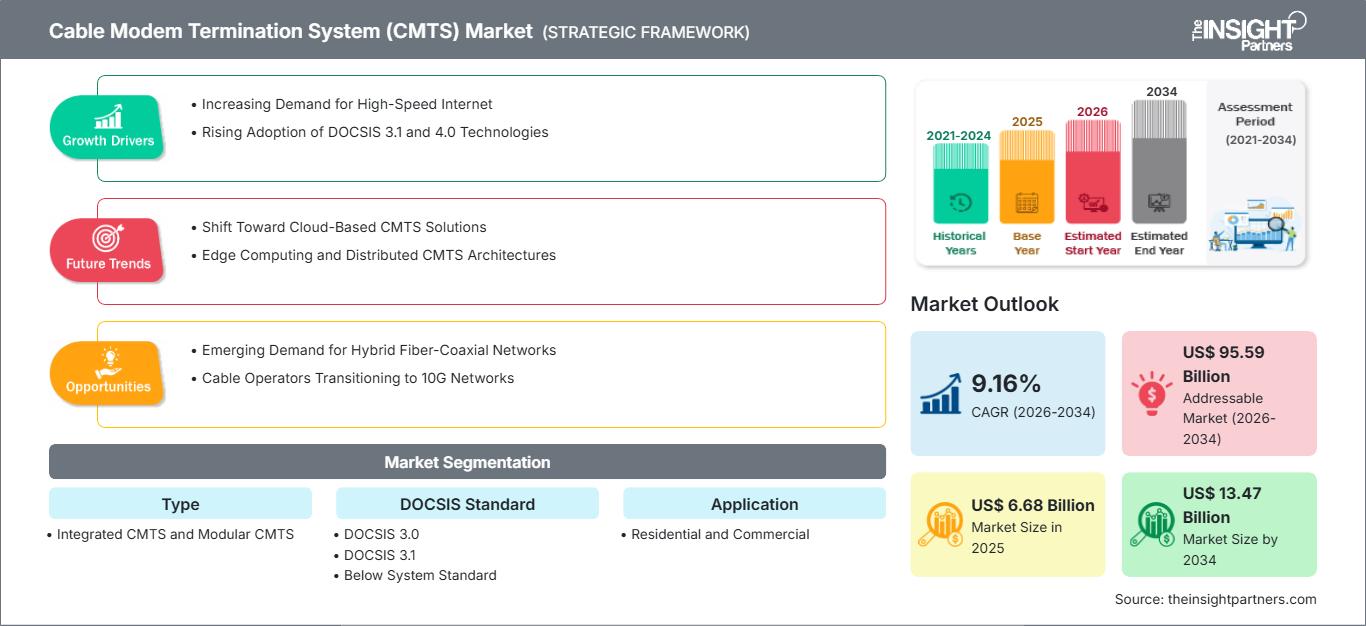
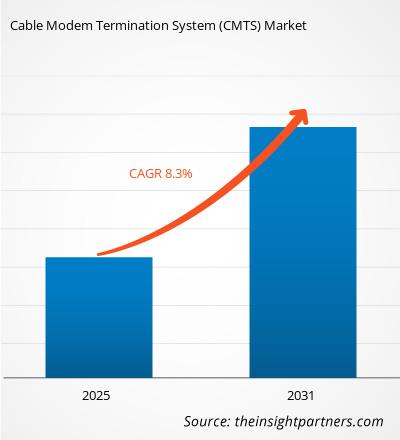
The Cable Modem Termination System (CMTS) market was valued at US$ 6.68 billion in 2025 and is expected to reach US$ 13.47 billion by 2034; it is estimated to record a CAGR of 8.1% during 2026-2034.
Cable Modem Termination System (CMTS) Market Assessment and Insights
- North America held 34–37% share in 2025 and is growing at a CAGR of 8.0–8.7% during 2026–2034, led by network capacity upgrades, DOCSIS adoption, and broadband demand across the US and Canada.
- US represented 82–85% of North American revenue in 2025 and is growing at a CAGR of 8.2–8.9% during 2026–2034.
- Europe accounted for 22–25% share in 2025 and is growing at a CAGR of 7.5–8.2% during 2026–2034, led by Germany, the UK, France, Italy, and Spain.
- Asia Pacific held 28–31% share in 2025 and is growing at a CAGR of 10.0–10.7% during 2026–2034, led by China, India, Japan, South Korea, and Australia.
- Largest Segment Integrated CMTS held 58–62% market share in 2025 and is growing at a CAGR of 8.5–9.2% during 2026–2034.
- High Growth Segment Modular CMTS represented 38–42% market share in 2025 and is growing at a CAGR of 10.0–10.7% during 2026–2034.
- Key companies analyzed in detail: Cisco Systems, Inc.; Axing AG; COMMSCOPE; ATX Network Corp.; CASA Systems; Harmonic Inc.; Huawei Technologies Co., Ltd.; Broadcom Inc.; Juniper Networks, Inc.; Sumavision Technologies Co., Ltd.; Nokia Corporation; ARRIS International plc.
Source: The Insight Partners' analysis based on proprietary research, government publications, company annual reports, investor presentations, industry databases, and expert interviews.
The CMTS technology has moved from integrated headend components into modular designs that accommodate increased data speeds, higher density of subscribers, and efficient operation in the network. The production trend in the industry currently focuses on highly dense process capabilities, virtualization, remote PHY architecture, and software-defined networking. CMTS Market trends in terms of demand are influenced by the system integrators that match the CMTS solution with cable modem networks, back office, and network management solutions in the environment of the cable operators.
According to the Cable Modem Termination System Market report, future investments in the CMTS market are expected to be largely confined to regions such as Asia Pacific, North America, and Europe, which experience high broadband infrastructure upgrade and expansion of digital connectivity initiatives, as well as increased customer expectations with regards to the speed of internet services. Telecommunications operators and cable service providers are making significant efforts to update their networks to ensure better use of bandwidth and low latency.
Investment in DOCSIS 4.0 has emerged as a critical driver of investment in network upgrades because it facilitates multi-gigabit capability for both downstream and upstream traffic as well as efficient use of spectrum and scalability of the network that can cater to bandwidth-hungry applications such as cloud computing, video streaming, online games, remote working, AI services, and Internet of Things (IoT). Investments have also been made in distributed access architectures, virtualized CMTS architectures, edge computing, and software defined networking (SDN).
Compatibility with the national standards on communications and broadband policies, cybersecurity needs, and spectrum management framework will continue to drive network modernization investments by promoting deployment of standards-based solutions and efficient utilization of network resources. At the same time, government initiatives for digital inclusion and rural broadband expansion also offer new opportunities for cable companies to invest in network upgrades.
Buyers are increasingly prioritizing CMTS platforms that combine high hardware density, modular scalability, software-driven network management, automation capabilities, energy-efficient operation, and seamless compatibility with existing cable infrastructure. In addition to technical performance, purchasing decisions are strongly influenced by comprehensive lifecycle management, responsive technical support, reliable software updates, resilient supply chains, and the ability to implement capacity expansions and technology upgrades without disrupting subscriber services, enabling operators to enhance network performance while maintaining uninterrupted customer experiences and optimizing long-term operational efficiency.
Cable Modem Termination System (CMTS) Market Report Scope
| Report Attribute | Details |
|---|---|
| Market size in 2025 | US$ 6.68 Billion |
| Market Size by 2034 | US$ 13.47 Billion |
| Global CAGR (2026 - 2034) | 8.1% |
| Historical Data | 2021-2024 |
| Forecast period | 2026-2034 |
Cable Modem Termination System (CMTS) Market Analysis
Cable Modem Termination System Market growth is driven by broadband subscriber growth, cable network capacity upgrades, DOCSIS technology adoption, and competition from fiber networks. The value chain includes semiconductor suppliers, system manufacturers, cable operators, and technology service providers. Supply dynamics are shaped by component availability, technology transitions, and operator-led procurement cycles. Cable Modem Termination System Market analysis indicates that integrated CMTS remains preferred for smaller deployments while modular solutions address large-scale capacity requirements. Service capability is decisive because technical support, software updates, and capacity planning affect network performance and subscriber experience.
The competitive landscape of the CMTS market is shaped by leading telecommunications equipment manufacturers and cable technology specialists that compete through continuous innovation, advanced network solutions, and long-standing relationships with broadband service providers worldwide. Major participants include Cisco Systems, Inc., Harmonic Inc., CommScope, Juniper Networks, Inc., Broadcom Inc., Huawei Technologies Co., Ltd., Nokia Corporation, CASA Systems, Axing AG, ATX Network Corp., and Sumavision Technologies Co., Ltd., each offering solutions designed to enhance broadband network capacity, scalability, and service reliability. Competition is driven by the ability to support evolving DOCSIS standards, deliver higher downstream and upstream throughput, enable distributed access architectures, and simplify migration toward virtualized and cloud-native CMTS deployments. Industry investment increasingly focuses on distributed architectures, Remote PHY implementation, software-defined networking, virtualization, network automation, and energy-efficient infrastructure that improve operational flexibility while reducing total cost of ownership. Cisco Systems, Inc. and Harmonic Inc. maintain strong market positions through comprehensive CMTS portfolios, extensive deployment experience, and established relationships with cable operators, while Broadcom Inc. and Nokia Corporation leverage their semiconductor, networking, and broadband technology expertise to strengthen product performance and interoperability. Other participants continue to expand their competitive positions by introducing modular, scalable, and software-centric solutions that address the growing demand for multi-gigabit broadband services. Strategic positioning across the CMTS market increasingly depends on certified performance, compliance with DOCSIS specifications and telecommunications standards, seamless integration with existing cable infrastructure, robust cybersecurity capabilities, lifecycle management services, responsive technical support, and the ability to deliver scalable, future-ready platforms that enable operators to modernize networks without disrupting subscriber services.
● REPORT CUSTOMIZATION
Tailor This Report To Align With Your Specific Business Requirements
This report can be customized to align precisely with your business objectives, scope, and target markets. Customization options include tailored segmentation, geography, competitive analysis, and strategic insights to support informed decision-making.
Customize This Report →WHAT YOU CAN ADJUST
- ● Segmentations
- ● Geography
- ● Competitive Analysis
- ● Language Preferences
Cable Modem Termination System (CMTS) Market: Strategic Insights
Regional Insights
North America Cable Modem Termination System Market
North America accounted for 34–37% of Cable Modem Termination System Market share in 2025 and is projected to grow at a CAGR of 8.0–8.7% during 2026–2034. Demand is supported by cable network upgrades, DOCSIS 4.0 deployment, consumer broadband demand, and competition with fiber services. The region's extensive cable infrastructure and operator consolidation drive consistent demand for CMTS platforms. Cisco Systems, Inc., Harmonic Inc., COMMSCOPE, Juniper Networks, Inc., and Broadcom Inc. support installed bases across cable operator headend facilities, hub sites, and network operations centers in the US and Canada.
U.S. Cable Modem Termination System Market
The U.S. represented 82–85% of North American revenue in 2025 and is forecast to grow at a CAGR of 8.2–8.9% during 2026–2034. Application demand is concentrated in cable broadband networks, DOCSIS upgrades, and high-speed data service deployment. Company presence is reinforced by Cisco Systems, Inc., Harmonic Inc., COMMSCOPE, Juniper Networks, Inc., and Nokia Corporation. Buyers prioritize system capacity, DOCSIS support, scalability, and operational simplicity, plus network integration that reduces deployment time and improves confidence in subscriber service delivery.
Europe Cable Modem Termination System Market
Europe held 22–25% share in 2025 and is expected to grow at a CAGR of 7.5–8.2% during 2026–2034. Germany leads through cable broadband investment and network modernization, while the UK supports demand from cable operator consolidation and service upgrades. France, Italy, and Spain add demand through network expansion and broadband competition. Telecommunications infrastructure investment and broadband policy favor suppliers with documented performance and operator relationships. Cisco Systems, Inc., Harmonic Inc., Nokia Corporation, and Axing AG remain visible across commercial network projects.
APAC Cable Modem Termination System Market
Asia Pacific accounted for 28–31% share in 2025 and is projected to grow at a CAGR of 10.0–10.7% during 2026–2034. China leads through cable network modernization and broadband subscriber growth, while India expands through network infrastructure investment and service expansion. Japan and South Korea prioritize high-capacity networks for premium services, while Australia adds cable network upgrades for broadband competition. Policy support for broadband development and cable network investment strengthen Cable Modem Termination System Market adoption where subscriber growth and network performance carry significant commercial value.
Middle East & Africa Cable Modem Termination System Market
The Middle East & Africa market is projected to grow at a CAGR of 7.0–7.7% during 2026–2034. Saudi Arabia leads through broadband infrastructure investment and digital transformation, while the UAE adds cable network development and service expansion. South Africa and Rest of MEA rely on broadband development and network modernization. Digital transformation and connectivity investment create demand for CMTS solutions. Suppliers succeed when they combine product quality, technical support, and network integration expertise for operator requirements.
Segmentation Analysis
Type
Type is projected to grow at a CAGR of 9.0–9.7% during 2026–2034. Cable Modem Termination System Market scope covers Integrated CMTS and Modular CMTS. Selection depends on deployment scale, capacity requirements, and network architecture. Integrated CMTS leads through established deployment patterns and simplified operations.
- Integrated CMTS combines all CMTS functions in a single chassis, offering simplified deployment for smaller networks and traditional headend applications.
- Modular CMTS enables distributed processing and capacity expansion, supporting large-scale deployments with flexible architecture and scalability.
DOCSIS Standard
DOCSIS Standard is forecast to grow at a CAGR of 8.5–9.2% during 2026–2034. DOCSIS 3.0, DOCSIS 3.1, and Below System Standard categories reflect technology evolution and network capability progression. DOCSIS 3.1 leads through gigabit service enablement and capacity advantages.
- DOCSIS 3.0 provides foundational cable broadband capability supporting channel bonding and mid-tier service delivery.
- DOCSIS 3.1 enables gigabit services with higher spectral efficiency and improved capacity for next-generation broadband.
- Below System Standard covers older implementations requiring upgrade and replacement for current service requirements.
Application
Application is expected to grow at a CAGR of 8.8–9.5% during 2026–2034. Residential and Commercial applications represent distinct subscriber environments with varying service requirements. Application adoption grows when broadband requirements and service delivery drive network investment.
- Residential applications include consumer broadband services, streaming video, gaming, and telework requiring reliable, high-speed connectivity.
- Commercial applications encompass business internet, enterprise connectivity, and managed services requiring service-level guarantees.
Opportunity Snapshot
| Application | Revenue Contribution | Trend Tag | Adoption Stage |
|---|---|---|---|
| Residential | High | Broadband Access | Mature |
| Commercial | High | Enterprise Services | Scaling |
Cable Modem Termination System (CMTS) Market Growth Drivers and Impact Analysis
Broadband Subscriber Growth Drives Network Capacity Investment
Global broadband subscriber growth continues expanding, with cable operators needing to add capacity and upgrade networks to maintain service quality and competitive positioning. Each additional subscriber and increasing data consumption per subscriber creates demand for CMTS capacity. Operator competition and consumer expectations drive continuous network investment. The practical impact is continued demand for high-capacity CMTS platforms supporting subscriber growth and service delivery across cable networks worldwide.
DOCSIS 4.0 and Next-Generation Technology Deployments
DOCSIS 4.0 technology enabling symmetric multi-gigabit services is driving network upgrades and CMTS replacement cycles. Cable operators are deploying next-generation CMTS platforms supporting new modulation schemes, extended spectrum, and improved latency. The migration to next-generation DOCSIS creates consistent demand for upgraded CMTS equipment. This driver benefits suppliers that can deliver DOCSIS 4.0-compliant platforms with operational support for operator migration.
Competition with Fiber Networks Accelerates Capacity Investment
Competition from fiber-to-the-home networks is accelerating cable operator investment in network capacity and technology upgrades. Cable operators require CMTS platforms that deliver competitive speeds and performance to retain subscribers. The competitive environment drives CMTS capacity and technology investment cycles. The market impact is demand for high-capacity, future-proof CMTS platforms supporting cable operator competitive positioning.
Cable Modem Termination System (CMTS) Market Future Trends
Distributed and Virtualized CMTS Architectures Reshape Networks
Cable Modem Termination System Market trends point toward distributed and virtualized CMTS architectures enabling more efficient capacity utilization and reduced headend space requirements. The next product cycle will combine virtualization, remote PHY, and distributed processing to deliver flexible, scalable CMTS platforms. This shift matters because cable operators increasingly value efficiency and operational flexibility. Vendors with virtualization and distributed architecture expertise will be better positioned as network architectures evolve.
Software-Defined Networking Integration Enhances Operational Efficiency
SDN integration in CMTS platforms is emerging as a direction for improving network operations, automation, and capacity management. Next-generation CMTS will incorporate software-defined control and management features supporting operator efficiency. This evolution enables more responsive, efficient network operations. Suppliers that can deliver SDN integration with proven CMTS performance will gain credibility with operators seeking operational advantages.
Cable Modem Termination System (CMTS) Market Opportunities
DOCSIS 4.0 Upgrade Programs for Cable Operators
Cable Modem Termination System Market Forecasts support investment in DOCSIS 4.0 upgrade programs requiring CMTS platforms supporting symmetric multi-gigabit services. Operators need platforms meeting DOCSIS 4.0 specifications with documented performance and migration support. Providers can create opportunities by developing and qualifying DOCSIS 4.0-compliant CMTS platforms. The opportunity is strongest where operator upgrade programs create demand for next-generation CMTS solutions.
Emerging Cable Markets with Expanding Broadband Infrastructure
Emerging cable markets in Asia Pacific, Latin America, and Africa with expanding broadband infrastructure create demand for cost-effective CMTS platforms. Operators need platforms balancing performance and cost for growing subscriber bases. Suppliers with scalable solutions can capture opportunities in developing cable markets. This opportunity rewards companies that can deliver capacity, reliability, and cost-effectiveness for operator requirements.
Recent Developments
- June 2026: Mavenir announced an Integrated AI Platform developed in collaboration with Red Hat that enables network operators to monetize AI the way they already monetize data; through token-based consumption plans, billed on the phone bill, with full control over pricing, service-level agreements (SLAs) and the models that power every interaction. The Integrated AI Platform will operate across three models: operator-branded AI services for their own subscribers; as the AI infrastructure layer powering operator AI grid deployments; and as a managed AI platform through which operators offer AI capabilities to enterprise customers on a token-based consumption basis. Using Red Hat AI as a unified platform that brings together AI capabilities running on Kubernetes infrastructure powered by Red Hat OpenShift, Mavenir’s Integrated AI Platform empowers operators with a flexible, sovereign-first architecture. This allows operators to utilize on-premises models and custom-built small language models (SLMs) that can handle a wide range of use cases, while also benefitting from selective, policy-governed connectivity to frontier models for tasks that demand cutting-edge reasoning capability. Operators control which model handles which request, who pays for it and how it is billed.
- March 2026: Nokia announced a suite of new optical networking innovations designed to address the unprecedented scale and application diversity demands driven by the AI supercycle. AI traffic and data center interconnect (DCI) requirements are continuing to accelerate, exceeding the practical limits of approaches based solely on incremental improvements over previous generations. As applications diversify, network operators increasingly require solutions that are specifically optimized for different performance, reach, and efficiency requirements. Nokia’s latest innovations represent a fundamental shift in how optical transport products are designed and developed, delivering application-optimized connectivity that maximizes performance while significantly reducing cost, space, and power and simplifying network operations.
- February 2025: Nokia announced the closing of the acquisition of Infinera Corporation. The San Jose based company has become part of Nokia effective as of the closing. The acquisition brings together two innovation leaders with a history of industry firsts. In doing so, it creates an optical networks powerhouse with the scale to accelerate product roadmaps, further expanding Nokia’s ability to help network operators – whether service providers, webscalers or enterprises – unlock the opportunities and meet the network and power demands of the AI era.
Frequently Asked Questions

- Comprehensive Market Sizing and Forecast Analysis
- Detailed Segmentation Analysis
- In-Depth Market Dynamics Assessment
- Regional and Country-Level Insights
- Competitive Landscape and Company Benchmarking
- Strategic Business Intelligence
Recent Reports
Testimonials

The Insight Partners provided valuable market intelligence that supported our global go-to-market strategy. Their team was professional, responsive, and attentive to our feedback, providing thoughtful analysis and helpful methodological clarifications throughout the project.
Junmo Kim Chief Financial Officer (CFO), Enertech Co., Ltd.
The Insight Partners' SCADA System Market report is comprehensive, with valuable insights on current trends and future forecasts. The team was highly professional, responsive, and supportive throughout. We are very satisfied and highly recommend their services.
RAN KEDEM Partner, Reali Technologies LTDs
I requested a report on a very specific software market and the team produced the report in a few days. The information was very relevant and well presented. I then requested some changes and additions to the report. The team was again very responsive and I got the final report in less than a week.
JEAN-HERVE JENN Chairman, Future Analytica
We worked with The Insight Partners for an important market study and forecast. They gave us clear insights into opportunities and risks, which helped shape our plans. Their research was easy to use and based on solid data. It helped us make smart, confident decisions. We highly recommend them.
PIYUSH NAGPAL Sr. Vice President, High Beam Global
The Insight Partners delivered insightful, well-structured market research with strong domain expertise. Their team was professional and responsive throughout. The user-friendly website made accessing industry reports seamless. We highly recommend them for reliable, high-quality research services
YUKIHIKO ADACHI CEO, Deep Blue, LLC.
This is the first time I have purchased a market report from The Insight Partners.While I was unsure at first, I visited their web site and felt more comfortable to take the risk and purchase a market report.I am completely satisfied with the quality of the report and customer service. I had several questions and comments with the initial report, but after a couple of dialogs over email with their analyst I believe I have a report that I can use as input to our strategic planning process.Thank you so much for taking the extra time and making this a positive experience.I will definitely recommend your service to others and you will be my first call when we need further market data.
JOHN SUZUKI President and Chief Executive Officer, Board Director, BK Technologies
I wish to appreciate your support and the professionalism you displayed in the course of attending to my request for information regarding to infectious disease IVD market in Nigeria. I appreciate your patience, your guidance, and the fact that you were willing to offer a discount, which eventually made it possible for us to close a deal. I look forward to engaging The Insight Partners in the future, all thanks to the impression you have created in me as a result of this first encounter.
DR CHIJIOKE ONYIA MANAGING DIRECTOR, PineCrest Healthcare Ltd.Reason to Buy
- Informed Decision-Making
- Understanding Market Dynamics
- Competitive Analysis
- Identifying Emerging Markets
- Customer Insights
- Market Forecasts
- Risk Mitigation
- Boosting Operational Efficiency
- Strategic Planning
- Investment Justification
- Tracking Industry Innovations
- Aligning with Regulatory Trends





 Get Free Sample for