
Camera Modules Market Demand, Size & Forecast by 2034
Coverage: By Interface (Camera Serial Interface, Camera Parallel Interface); Focus Type (Autofocus, Fixed Focus); Pixels (Up to 7 MP, 8 to 13 MP, Above 13 MP); Application (Healthcare, Consumer Electronics, Industrial, Automotive, Security and Surveillance, Others) , and Geography (North America, Europe, Asia Pacific, and South and Central America)
- Status : Data Released
- Report Code : TIPRE00008807
- Category : Electronics and Semiconductor
- No. of Pages : 150
- Available Report Formats :


- Last update date : July 24, 2026


2025 Market Size
US$ 63.19 Bn
Base year value
2034 Forecast
US$ 138.95 Bn
Projected by 2034
CAGR 2026-2034
9.15 %
Growth rate
Addressable Market
US$ 903.75 Bn
(2026-2034)
The Camera Modules Market size stood at US$ 63.19 Billion in 2025 and is expected to reach US$ 138.95 Billion by 2034, growing at a CAGR of 9.15% from 2026 to 2034. The market for Camera Modules exhibits growing needs for imaging units comprising lenses, sensors, actuators, filters, and interface chips utilized in consumer electronic devices, automotive safety, imaging in healthcare, industrial applications, and security systems.
North America continues to remain an important region with respect to demand, and the growth of the Camera Modules Market is driven by the usage of such modules in automotive safety equipment, medical devices and imaging, machine vision systems, and premium consumer electronics. North America is expected to grow at a CAGR of 8.3% to 8.8% through 2034, mainly owing to demand for improved cameras for advanced driver-assistance systems, telemedicine imaging capabilities, and enterprise security.
Camera Modules Market Assessment and Insights
- North America: Held 22–25% Camera Modules Market share in 2025 and is projected to grow at a CAGR of 8.3–8.8% during 2026–2034, supported by ADAS, medical imaging, and security modernization.
- US: Represented 78–82% of North America in 2025 and is expected to grow at a CAGR of 8.4–8.9%, led by automotive electronics and healthcare device integration.
- Europe: Accounted for 18–21% share in 2025 and is forecast to grow at 7.9–8.4% CAGR, with Germany, the UK, and France leading automotive and industrial adoption.
- Asia Pacific: Held 43–47% share in 2025 and is expected to grow at 9.8–10.4% CAGR, led by China, South Korea, Japan, and India across smartphones and vehicle electronics.
- Largest Segment: Consumer Electronics held 58–62% market share in 2025 and is expected to grow at 8.6–9.1% CAGR as multi-camera smartphones remain the volume anchor.
- High Growth Segment: Automotive held 12–15% share in 2025 and is projected to grow at 11.8–12.6% CAGR, supported by ADAS, surround-view, and driver monitoring systems.
- Key companies analyzed in detail: ams-OSRAM AG, Jenoptik AG, KYOCERA Corporation, LG Innotek Co., Ltd., MCNEX Co., Ltd., Primax Electronics Ltd., Q Technology (Group) Company Limited, Samsung Electro-Mechanics Co., Ltd., Sharp Corporation, and Sunny Optical Technology (Group) Company Limited.
Source: The Insight Partners' analysis based on proprietary research, government publications, company annual reports, investor presentations, industry databases, and expert interviews.
Technology evolution in the Camera Modules Market has progressed from basic fixed focus camera modules to stacked CMOS sensors, optical image stabilization, folded zoom, wafer-level optics, and AI-driven image processing. Manufacturing capabilities will continue to diversify in China, South Korea, Japan, Taiwan, Vietnam, and India in response to handsets and vehicles seeking greater supply chain security, quicker qualification processes, and minimized logistics risk.
In 2034, demand will expand beyond smartphone applications to include vehicle vision, robot perception, endoscopy, clinical monitoring, smart factories, and perimeter security, as well as applications that incorporate more expensive modules. In light of regulatory requirements around road safety, data-enabled healthcare processes, and industry efficiency, optics, miniaturization, reliability testing, and processing technologies will come together to form application-specific modules.
Camera Modules Market Report Scope
| Report Attribute | Details |
|---|---|
| Market size in 2025 | US$ 63.19 Billion |
| Market Size by 2034 | US$ 138.95 Billion |
| Global CAGR (2026 - 2034) | 9.15% |
| Historical Data | 2021-2024 |
| Forecast period | 2026-2034 |
Camera Modules Market Analysis
Camera modules market growth is fueled by an increasing number of cameras per device, usage of ADAS systems, telemedicine imaging, and automation of inspections. As per Yole, shipments of camera modules have increased to 7 billion units in 2024 whereas the shipment of automotive cameras has gone beyond 250 million units, which implies that the volume growth is no more restricted to smartphones but is spread across sectors.
The value chain comprises of components such as CMOS image sensor, set of lenses, voice-coil motors, filters, flex circuits, testing, and assembly. Selection of interface has a bearing on the design of the system and Camera Serial Interface is preferred for compact and high-speed devices, whereas the Camera Parallel Interface is used if cost and other factors weigh in.
Camera Module Market competitive forces revolve around optical precision, large-scale assembly, automotive certification, and customization for specific customers. High-resolution mobile and automotive modules are contested by LG Innotek, Samsung Electro-Mechanics, Sunny Optical Technology, Q Technology, and MCNEX, whereas ams-OSRAM, Jenoptik, KYOCERA, Primax, and Sharp improve their offerings in sensing, industrial, and special optical segments.
Investment focus is shifting towards automotive-certified reliability, under-display camera optics, periscope camera assemblies, and manufacturing localization. Revenue of RMB 43,229.1 million was projected by Sunny Optical for 2025, which reflects their scale in optical product integration, and Samsung Electro-Mechanics has expanded supply of high-performance camera modules in 2025.
● REPORT CUSTOMIZATION
Tailor This Report To Align With Your Specific Business Requirements
This report can be customized to align precisely with your business objectives, scope, and target markets. Customization options include tailored segmentation, geography, competitive analysis, and strategic insights to support informed decision-making.
Customize This Report →WHAT YOU CAN ADJUST
- ● Segmentations
- ● Geography
- ● Competitive Analysis
- ● Language Preferences
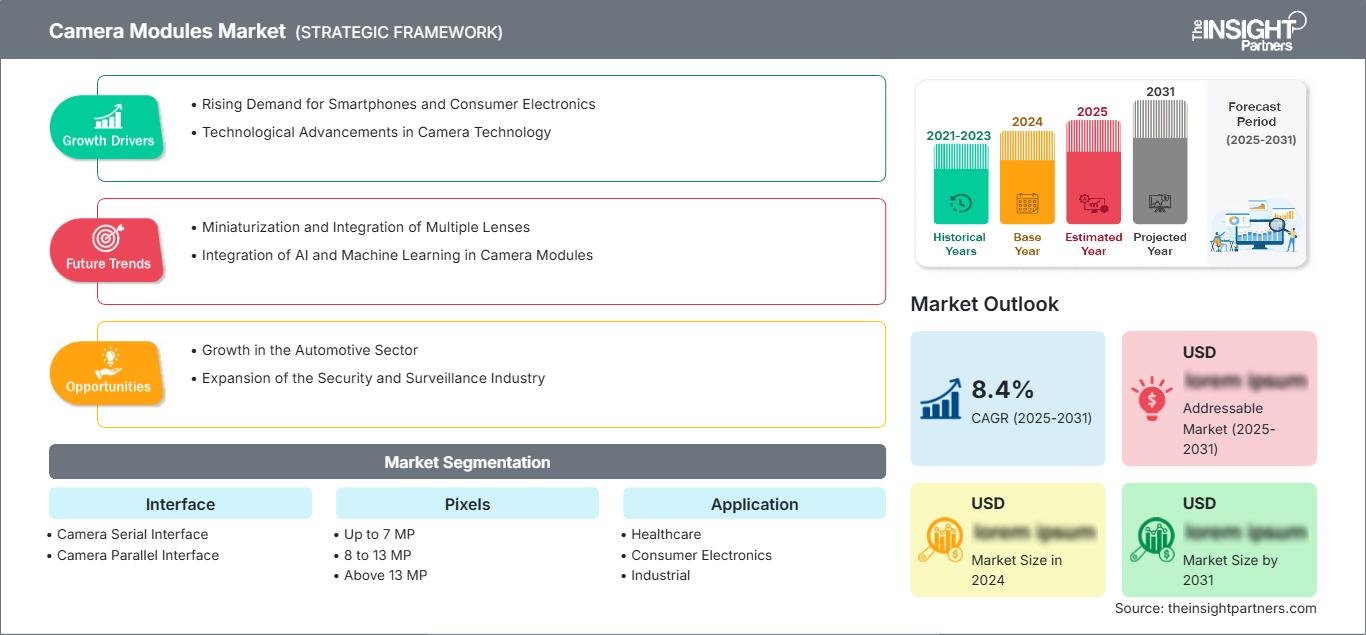
Camera Modules Market: Strategic Insights
Regional Insights
North America Camera Modules Market
The market share of North America in 2025 was between 22% and 25% for Camera Modules and is estimated to have a CAGR of 8.3%- 8.8%. There will be significant demands for tough, low light, and high-dynamic-range modules in the US and Canada due to regulations in automotive safety, hospital imaging, and enterprise surveillance cycles.
Semiconductor design capabilities and advanced system integration will drive the regional demand. More than 250 million units of automobiles were shipped globally in 2024 and there is an increasing use of multi-camera systems in vehicles in North America.
U.S. Camera Modules Market Market
The US accounted for 78-82% of North America in 2025, with an expected CAGR of 8.4-8.9%. The application areas with high demand include ADAS systems, surgery applications, patient monitoring, inspection applications, and security networks that need consistent imaging capabilities in varying light conditions.
The company's influence is ensured by having design centers, automobile electronics manufacturers, and medical devices companies. High-end mobile phones and machine vision applications are driving demand for modules with resolutions above 13 megapixels, while low-pixel modules remain relevant for embedded healthcare and access control systems.
Europe Camera Modules Market Market
Europe accounted for 18-21% in 2025 and is forecast to grow at a 7.9-8.4% CAGR. Germany leads the way because of applications like automotive electronics, ADAS validation, and industrial automation, whereas the UK provides support by medical imaging, security analytics, and embedded vision in logistics and infrastructure.
France, Italy, and Spain provide support through applications such as smart mobility projects, factory retooling, healthcare purchasing, and security system improvements. The EU's vehicle safety regulations, along with driver monitoring, are major factors driving demand for in-cabin and external cameras.
APAC Camera Modules Market Market
APAC commanded 43-47% market share in 2025 and is forecast to grow at a 9.8-10.4% CAGR, making it the largest regional base. APAC is fueled by demand from China, Japan, South Korea, India, and Australia in terms of smartphones, automotive electronics, industrial automation, and security systems.
The largest country market is China because of the number of handsets produced and the presence of an ecosystem of optical components. The premium modules are primarily developed in South Korea and Japan.
Middle East & Africa Camera Modules Market Market
Middle East & Africa is expected to grow at 7.2–7.8% CAGR, led by the UAE, Saudi Arabia, South Africa, and Rest of MEA. Smart city surveillance, energy infrastructure monitoring, and airport security programs support demand for rugged imaging modules.
Saudi Arabia leads regional infrastructure-linked deployments as logistics, oil and gas, and public safety projects require reliable video capture. South Africa contributes through security and industrial use cases, while the UAE emphasizes smart mobility and urban monitoring.
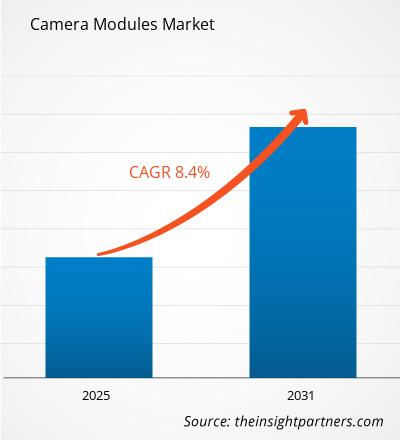
Segmentation Analysis
Interface
Interface is expected to grow at 8.7–9.2% CAGR during 2026–2034. The Camera Modules Market scope across interfaces is shaped by bandwidth needs, power efficiency, processor compatibility, and cost targets. High-resolution mobile, automotive, and healthcare designs favor compact serial links, while established embedded systems continue to use parallel interfaces where simplicity and legacy integration remain valuable.
- Camera Serial Interface: This sub-segment leads new designs because it supports high-speed image transfer, compact routing, lower pin count, and compatibility with mobile processors, ADAS platforms, and medical imaging electronics.
- Camera Parallel Interface: Demand persists in cost-sensitive embedded systems, legacy industrial equipment, and simpler security devices where deterministic data transfer, established controller compatibility, and lower design complexity remain important.
Pixels
Pixels is projected to grow at 9.0–9.6% CAGR during 2026–2034. Pixel segmentation reflects the trade-off between resolution, sensor size, optics, cost, and processing load. Premium smartphones, automotive perception, and machine vision increasingly require higher pixel counts, while lower-resolution modules remain essential in access control, basic monitoring, and compact medical devices.
- Up to 7 MP: These modules serve cost-sensitive products, embedded monitoring, entry-level security, and compact devices where reliable imaging, low power consumption, and small optical footprints matter more than premium resolution.
- 8 to 13 MP: This range balances image clarity and cost, supporting mainstream smartphones, tablets, industrial readers, and mid-range surveillance systems that need dependable performance without excessive processing requirements.
- Above 13 MP: High-resolution modules are strategically important in premium smartphones, ADAS, machine vision, and healthcare imaging, where detail capture, digital zoom, analytics accuracy, and differentiation justify higher component value.
Application
Application is expected to grow at 9.2–9.8% CAGR during 2026–2034. Consumer electronics remains the largest volume base, but automotive, healthcare, industrial, and security use cases are increasing module value through stricter reliability, better low-light performance, edge analytics, and application-specific optical requirements.
- Healthcare: Medical device makers use compact imaging modules in endoscopy, diagnostics, telehealth peripherals, and patient monitoring, prioritizing image consistency, sterilization-compatible design, and reliable performance in constrained spaces.
- Consumer Electronics: Smartphones, tablets, laptops, wearables, drones, and smart-home devices drive the largest volume demand as multi-camera architectures, autofocus, stabilization, and computational imaging remain central to device differentiation.
- Industrial: Machine vision, robotics, barcode reading, inspection, and quality control require modules that deliver stable image capture, long operating life, and compatibility with automation platforms and edge processing.
- Automotive: ADAS, parking assistance, surround-view, driver monitoring, and cabin sensing create strong demand for rugged modules qualified for vibration, temperature, lighting variation, and functional safety requirements.
- Security and Surveillance: Smart cameras, access control, public infrastructure monitoring, and commercial surveillance need low-light performance, wide dynamic range, compact design, and analytics-ready image capture for reliable operation.
Opportunity Snapshot
| Application | Revenue Contribution | Trend Tag | Adoption Stage |
| Healthcare | Medium | Clinical Imaging | Scaling |
| Consumer Electronics | High | Multi Camera | Mature |
| Industrial | Medium | Machine Vision | Scaling |
| Automotive | High | ADAS Vision | Scaling |
| Security and Surveillance | Medium | Low Light | Mature |
Camera Modules Market Growth Drivers and Impact Analysis
Multi-Camera Device Architectures Raise Module Intensity
Imaging channels are being incorporated into smartphones, tablets, laptops, wearables, drones, and smart home devices to enable wide-angle, telephoto, depth, biometric, and low-light photography. According to Yole, roughly 96% of compact camera module shipments in 2024 were mobile- and consumer-electronics-related, totaling about 6.7 billion units. Such a massive user base results in a continued need for autofocus, stabilization, folded optics, and high-pixel modules. This market is characterized by two dynamics. Firstly, volume is firmly rooted in consumer electronics. Secondly, suppliers enhance their margins by increasing the complexity of lenses, actuators, and image-processing algorithms with each generation.
Vehicle Safety Electronics Expand Automotive Imaging Demand
Cameras for front view, surround view, rear view, side view, driver monitoring, and cabin monitoring are being used for automotive platforms for ADAS and partial automation systems. According to Yole, automotive camera shipments surpassed 250 million units in 2024, while revenue from automotive camera modules has reached around $6 billion and is expected to reach $8.7 billion by 2030. This trend is creating qualification challenges for camera modules that should perform well under vibration, temperature fluctuations, glare, and in dark environments.
Healthcare and Industrial Vision Shift Imaging Beyond Consumer Devices
Doctors and equipment manufacturers are integrating compact imaging into endoscopy, remote diagnosis, robotics, inspection assembly lines, and quality assurance tools. WHO still stresses the need for scaling up diagnostic tests and access to services, and factory operators deploy vision systems to decrease defects and increase throughput. These applications prefer components with reliable calibration, small size, and durability over high resolution alone. The result is increased diversification of revenue streams, allowing vendors to balance the cyclicality of smartphones by developing low-volume but demanding programs.
Camera Modules Market Future Trends
AI-Ready Edge Imaging Becomes a Design Requirement
In the Camera Modules Market trends, it becomes clear that imaging modules will become better suited for use at the edge and will be designed for AI inference rather than just imaging. In the future, there will be a trend towards designing modules with synchronized sensors, global shutters, HDR capabilities, low-light performance, and interfaces that enable efficient transfer of image data to embedded processors. In cars, manufacturing facilities and even security applications, real-time interpretation will become more important compared to raw resolution.
Optical Miniaturization Supports Invisible and Embedded Cameras
The optics in under-display, in-cabin, wearable, and medical modules will need to be slimmer, heat-resistant, and compensate for light loss. The development of the under-display and RGB-IR camera by LG Innotek reflects how the module design will evolve into something that can be installed discreetly and capable of multi-sensing. The future growth of optical modules lies in the assembly of modules that incorporate RGB, infrared, depth sensing, and environmental durability into one unit. Those companies that can preserve the quality of the image in environments shielded by screens, glass, dashboards, or medical enclosures.
Camera Modules Market Opportunities
Automotive Camera Platforms for ADAS and Cabin Monitoring
Camera Modules Market Forecasts indicate that automotive applications will remain the most attractive expansion path because each vehicle can require multiple exterior and interior modules. Suppliers can invest in platforms covering front ADAS, surround-view, e-mirror, driver monitoring, and occupant sensing with shared manufacturing and testing architecture. The opportunity lies in winning long-term vehicle programs by offering temperature robustness, functional safety support, waterproof packaging, and stable color performance. Strategic partnerships with Tier 1 suppliers and automakers can help module vendors move from component supply to co-development, improving revenue visibility across vehicle life cycles. Additionally, increasing adoption of electric and autonomous vehicles is expected to accelerate demand for advanced camera modules with higher resolution, AI-enabled image processing, and enhanced low-light performance. Continuous innovation, scalable production capabilities, and compliance with evolving automotive regulations will further strengthen competitive positioning and create sustainable long-term growth opportunities for manufacturers.
Medical and Industrial Imaging Customization
Specialized healthcare and industrial modules provide opportunities for value-added engineering beyond commodity smartphone assemblies. Device makers need miniature endoscopic cameras, sterilization-compatible housings, calibrated inspection modules, and vision units that withstand dust, vibration, and extended duty cycles. Vendors can differentiate through application engineering, optical simulation, regulatory documentation support, and lifecycle supply commitments. These programs may be smaller in unit volume, but they often require closer technical collaboration and longer product lifetimes. That creates pricing resilience and reduces exposure to short consumer electronics replacement cycles. Growing adoption of automation, robotics, and precision diagnostics is further increasing demand for reliable, high-performance camera modules tailored to specialized environments. Investments in customized optics, advanced sensor integration, and rigorous quality validation can strengthen customer relationships, support premium pricing, and establish long-term partnerships across healthcare, manufacturing, laboratory, and industrial inspection applications worldwide.
Recent Developments
- March 2026: Samsung Electro-Mechanics Co., Ltd. began mass production of a 200-megapixel continuous optical zoom camera module adopted in Xiaomi’s 17 Ultra, supporting 3.2x to 4.3x optical zoom and improving premium smartphone telephoto performance.
- May 2025: LG Innotek Co., Ltd. signed a partnership with Boston Dynamics to develop robot vision sensing systems integrating RGB cameras and 3D sensing modules for Atlas, expanding camera module applications into robotics perception.
- January 2025: LG Innotek Co., Ltd. showcased mobility innovations at CES 2025, including a 5-megapixel RGB-IR in-cabin camera module and all-weather camera solution designed for ADAS and passenger monitoring applications.
Frequently Asked Questions

- Comprehensive Market Sizing and Forecast Analysis
- Detailed Segmentation Analysis
- In-Depth Market Dynamics Assessment
- Regional and Country-Level Insights
- Competitive Landscape and Company Benchmarking
- Strategic Business Intelligence
Recent Reports
Testimonials

The Insight Partners' SCADA System Market report is comprehensive, with valuable insights on current trends and future forecasts. The team was highly professional, responsive, and supportive throughout. We are very satisfied and highly recommend their services.
RAN KEDEM Partner, Reali Technologies LTDs
I requested a report on a very specific software market and the team produced the report in a few days. The information was very relevant and well presented. I then requested some changes and additions to the report. The team was again very responsive and I got the final report in less than a week.
JEAN-HERVE JENN Chairman, Future Analytica
We worked with The Insight Partners for an important market study and forecast. They gave us clear insights into opportunities and risks, which helped shape our plans. Their research was easy to use and based on solid data. It helped us make smart, confident decisions. We highly recommend them.
PIYUSH NAGPAL Sr. Vice President, High Beam Global
The Insight Partners delivered insightful, well-structured market research with strong domain expertise. Their team was professional and responsive throughout. The user-friendly website made accessing industry reports seamless. We highly recommend them for reliable, high-quality research services
YUKIHIKO ADACHI CEO, Deep Blue, LLC.
This is the first time I have purchased a market report from The Insight Partners.While I was unsure at first, I visited their web site and felt more comfortable to take the risk and purchase a market report.I am completely satisfied with the quality of the report and customer service. I had several questions and comments with the initial report, but after a couple of dialogs over email with their analyst I believe I have a report that I can use as input to our strategic planning process.Thank you so much for taking the extra time and making this a positive experience.I will definitely recommend your service to others and you will be my first call when we need further market data.
JOHN SUZUKI President and Chief Executive Officer, Board Director, BK Technologies
I wish to appreciate your support and the professionalism you displayed in the course of attending to my request for information regarding to infectious disease IVD market in Nigeria. I appreciate your patience, your guidance, and the fact that you were willing to offer a discount, which eventually made it possible for us to close a deal. I look forward to engaging The Insight Partners in the future, all thanks to the impression you have created in me as a result of this first encounter.
DR CHIJIOKE ONYIA MANAGING DIRECTOR, PineCrest Healthcare Ltd.Reason to Buy
- Informed Decision-Making
- Understanding Market Dynamics
- Competitive Analysis
- Identifying Emerging Markets
- Customer Insights
- Market Forecasts
- Risk Mitigation
- Boosting Operational Efficiency
- Strategic Planning
- Investment Justification
- Tracking Industry Innovations
- Aligning with Regulatory Trends





 Get Free Sample for