
Cancer Test Market Trends, Size & Growth by 2034
Coverage: By Test Type (Laboratory Tests, Genetic Tests, Imaging, Endoscopy, Biopsy, Others); Application (Breast Cancer, Colorectal Cancer, Cervical Cancer, Lung Cancer, Prostate Cancer, Skin Cancer, Blood Cancer, Ovarian Cancer, Others) , and Geography (North America, Europe, Asia Pacific, and South and Central America)
- Status : Data Released
- Report Code : TIPRE00019704
- Category : Life Sciences
- No. of Pages : 150
- Available Report Formats :


- Last update date : August 14, 2026


2025 Market Size
US$ 17.55 Bn
Base year value
2034 Forecast
US$ 30.67 Bn
Projected by 2034
CAGR 2026-2034
6.40 %
Growth rate
Addressable Market
US$ 218.16 Bn
(2026-2034)
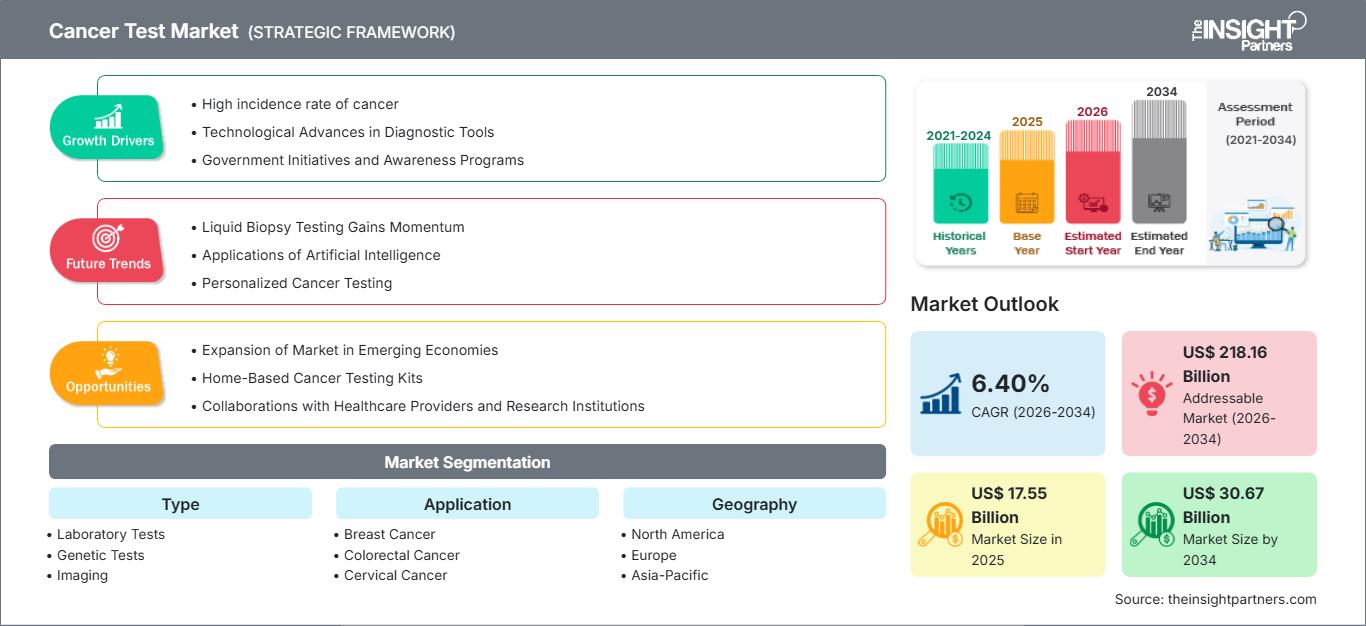
The Cancer Test Market is projected to grow from US$ 17.55 Billion in 2025 to US$ 30.67 Billion by 2034, registering a CAGR of 6.40% during 2026–2034. This growth has been driven by increasing use of laboratory tests, genetic testing, imaging, endoscopy, and biopsies for breast cancer, colorectal cancer, cervical cancer, lung cancer, prostate cancer, skin cancer, blood cancer, ovarian cancer, and other oncology applications.
In North America, the Cancer Test Market size has been enabled due to organized sscreening, high molecular diagnostics penetration, and payer coverage of evidence-based oncology tests. This market has been expected to grow at a CAGR rate ranging between 5.9% to 6.4% from 2026 to 2034, with the United States experiencing growth due to central reference laboratories, cancer centers, and companion diagnostics in treatment decision-making.
Cancer Test Market Assessment and Insights
- North America held 38–41% share in 2025 and is expected to grow at a CAGR between 2026–2034 of 5.9–6.4%, led by organized screening, reimbursement depth, and precision oncology adoption.
- U.S. accounted for 82–86% of North America in 2025 and is expected to grow at a CAGR between 2026–2034 of 5.8–6.3%, supported by molecular labs and cancer centers.
- Europe held 25–28% share in 2025 and is expected to grow at a CAGR between 2026–2034 of 5.5–6.0%, with Germany, the UK, and France leading organized diagnostics demand.
- Asia Pacific held 22–25% share in 2025 and is expected to grow at a CAGR between 2026–2034 of 7.4–8.1%, driven by China, Japan, India, South Korea, and Australia.
- Largest Segment Laboratory Tests held 35–39% market share in 2025 and is expected to grow at a CAGR range of 5.8–6.4% during 2026–2034.
- High Growth Segment Genetic Tests held 15–18% market share in 2025 and is expected to grow at a CAGR range of 8.2–9.0% during 2026–2034.
- Key companies analyzed in detail: GE HealthCare Technologies Inc., Abbott Laboratories, F. Hoffmann-La Roche Ltd, QIAGEN N.V., Becton, Dickinson and Company, Siemens Healthineers AG, Hologic, Inc., Koninklijke Philips N.V., Canon Medical Systems Corporation, Agilent Technologies, Inc.
Source: The Insight Partners' analysis based on proprietary research, government publications, company annual reports, investor presentations, industry databases, and expert interviews.
In terms of technology, adoption trends have moved away from later confirmation in the Market and towards early detection, stratification and treatment guidance. Automation, digital pathology, sequencing panels, and AI-based imaging solutions are disrupting test production through decreased interpretive steps and increased speed. There were an estimated 20 million new cancer diagnoses in 2022 as per WHO and IARC, highlighting the need for capacity to scale out diagnostic tests.
Future growth is anticipated in emerging geographies as the governments build out infrastructure and facilities in oncology, laboratory network development, and increase screening availability. Asia-Pacific and Middle East regions are focused on cancer centers, radiology capability, and population-level education programs. Tailwinds in regulatory landscape with regard to companion diagnostics, digital pathology, and accreditation will benefit companies with both validated testing and workflow solution, plus post-market evidence.
Cancer Test Market Report Scope
| Report Attribute | Details |
|---|---|
| Market size in 2025 | US$ 17.55 Billion |
| Market Size by 2034 | US$ 30.67 Billion |
| Global CAGR (2026 - 2034) | 6.40% |
| Historical Data | 2021-2024 |
| Forecast period | 2026-2034 |
Cancer Test Market Analysis
The Market in clinical labs, hospitals, imaging centers, and oncology centers is expanding because of rising diagnosis, aging population, and expansion of screening criteria. There is a shift in demand from individual test steps to a multi-step process where imaging locates the lesion, lab tests help in staging the disease, and genetic tests help in giving targeted treatment. The supply is affected by the availability of reagents, installation schedule of the scanner, pathologist availability, and value judgment of the payer.
The value chain consists of sample acquisition, pathology tests, molecular tests, imaging reading, reporting software, and physician assistance. Testing companies are emphasizing operational standardization since the decision making in oncology relies on timing, specimen quality, and the consistency of results. These factors are in favor of testing companies offering wide menus and automation capabilities.
Increasing competition is happening in the area as companies from diagnostics, imaging and life science tools sectors come together around oncology workflows. According to Cancer Test Market report, F. Hoffmann-La Roche Ltd, Abbott Laboratories, QIAGEN N.V., Hologic, Inc. and Agilent Technologies, Inc. are working on building up molecular and pathology expertise, while GE HealthCare Technologies Inc., Siemens Healthineers AG, Koninklijke Philips N.V. and Canon Medical Systems Corporation are competing based on imaging scale.
Evidence generation, companion diagnostic collaborations and installed base are becoming more important for strategic positioning. While Becton, Dickinson and Company offer sample preparation and cytology workflows, imaging companies are leveraging AI for improving lesions detection and making workflows more efficient. Investment focus is shifting towards precision oncology, liquid biopsy preparedness and digital pathology ecosystem which enables testing at scale without increasing labor force proportionally.
● REPORT CUSTOMIZATION
Tailor This Report To Align With Your Specific Business Requirements
This report can be customized to align precisely with your business objectives, scope, and target markets. Customization options include tailored segmentation, geography, competitive analysis, and strategic insights to support informed decision-making.
Customize This Report →WHAT YOU CAN ADJUST
- ● Segmentations
- ● Geography
- ● Competitive Analysis
- ● Language Preferences
Cancer Test Market: Strategic Insights
Regional Insights
North America Cancer Test Market
The North America Cancer Test Market occupied the largest market share of 38-41% of global revenue in 2025, and will witness a growth rate of CAGR 5.9-6.4% during 2026-2034. Factors driving the market include higher rate of screening, comprehensive insurance cover for oncology, and extensive network of reference laboratories in the region. In addition, FDA's policies promoting the development of companion diagnostics and digital pathology are also advantageous.
Clinical usage is mainly restricted to the detection of breast, colorectal, lung, and prostate cancers where there are many instances when diagnosis is required owing to screening rules and treatment selection. North America has a leading regional revenue position with the United States dominating the region. Canada contributes to the market through its public cancer screening and provincial laboratory facilities.
U.S. Cancer Test Market
The U.S. accounted for 82-86% of North America in 2025 and is estimated to grow at a CAGR of 5.8-6.3% between 2026 and 2034. Market depth includes Medicare reimbursement for specific tests such as screening and molecular tests, significant commercial payor coverage, and clustering of cancer centers. The nation is also one of the first to adopt the use of companion diagnostics in conjunction with targeted oncology treatments.
Market players have established presence in terms of commercial, regulatory, and manufacturing infrastructure, including Abbott Laboratories, F. Hoffmann-La Roche Ltd, Hologic, Inc., GE HealthCare Technologies Inc., Siemens Healthineers AG, and Agilent Technologies, Inc. Trends in application include increasing use of genomic testing for breast, lung, and colorectal cancer cases, whereas imaging is necessary for staging and therapy monitoring.
Europe Cancer Test Market
The market share in Europe stood at 25-28% in 2025 and is forecasted to expand with a CAGR of 5.5%-6.0% between 2026 and 2034, led by Germany. In the UK, early diagnosis is becoming more common due to national screening pathways and diagnostics centers' capacity, and reimbursement assessments will focus on the clinical value, turnaround time, and impact on oncology treatment decisions.
Germany has some key drivers including an advanced lab setting, high volume of procedures performed and the use of molecular pathology. France, Italy, and Spain have been expanding their screening and oncology networks but they struggle with lengthy procurement processes and reimbursement which may affect their implementation process. The demand for Europe will be higher where there is pathology modernization, digital imaging and availability of companion diagnostics.
APAC Cancer Test Market
In 2025, APAC had a market share of 22-25%, and is forecast to grow at a CAGR of 7.4-8.1% during 2026-2034, with China accounting for maximum regional revenues. Premium molecular diagnostics and imaging is driven by Japan and South Korea, whereas India and Australia make their contribution through the proliferation of diagnostics labs, screening programs, and investments in cancer facilities.
The policy drivers are national cancer programs, upgradation of urban hospitals, and increased coverage of diagnostics under insurance. The industrial drivers are development of sequencing services domestically, local manufacturing of imaging machines, and development of chains of reference laboratories. Demand is very high for diagnostics of lung, breast, colorectal, cervical, and blood cancer.
Middle East & Africa Cancer Test Market
The Middle East & Africa is expected to grow at a CAGR range of 6.8–7.4% during 2026–2034, with Saudi Arabia leading regional demand. The UAE is investing in specialty hospitals and private diagnostic centers, while South Africa remains the most developed sub-Saharan market for pathology and imaging-led cancer diagnosis.
Investments in infrastructure, medical tourism, and updating of public hospitals are driving the use of imaging, biopsy, and lab services. Healthcare spending of energy-exporting Gulf economies is being directed towards building oncology centers and digitizing hospitals, whereas for the Rest of MEA, there is a slow adaptation using donor funding, private labs, and cross-border referrals.
Segmentation Analysis
Type
Type is projected to grow at a CAGR range of 6.1–6.7% during 2026–2034 as laboratories and hospitals combine conventional pathology with imaging, molecular testing, and endoscopic assessment. Cancer Test Market scope is expanding as clinicians require diagnostic confirmation, staging, biomarker analysis, and treatment monitoring within coordinated oncology pathways.
- Laboratory Tests remain the largest testing category, supported by blood chemistry, cytology, immunoassays, tumor markers, and pathology-linked workflows used before, during, and after cancer treatment.
- Genetic Tests are strategically important because therapy selection, hereditary risk assessment, and recurrence monitoring increasingly depend on molecular signatures, sequencing panels, and validated biomarker interpretation.
- Imaging supports screening, anatomical localization, staging, and response assessment, making scanner availability and radiology productivity central to oncology pathway efficiency.
- Endoscopy is vital for gastrointestinal and respiratory cancer detection, particularly when visual inspection, guided sampling, and lesion characterization are required in one procedure.
- Biopsy remains the definitive diagnostic step for many cancers, linking tissue adequacy, pathology quality, and biomarker testing to treatment eligibility and clinical decision-making.
Application
Application is expected to grow at a CAGR range of 6.2–6.8% during 2026–2034 as high-incidence cancers draw screening investment and lower-incidence cancers gain molecular testing relevance. Adoption varies by cancer type, but all major applications are influenced by earlier diagnosis, risk-based protocols, and growing use of targeted therapy.
- Breast Cancer generates sustained testing demand through mammography, biopsy, hormone receptor testing, genomic assays, and surveillance protocols across screening and treatment planning pathways.
- Colorectal Cancer benefits from stool-based testing, colonoscopy, biopsy, and molecular profiling, with demand rising as more countries expand organized screening eligibility and follow-up capacity.
- Cervical Cancer testing is shaped by HPV screening, cytology, colposcopy, and biopsy, especially in countries prioritizing prevention and early detection programs for women.
- Lung Cancer requires imaging, tissue biopsy, liquid biopsy, and molecular profiling, making it one of the most complex and strategically important oncology testing pathways.
- Prostate Cancer demand is supported by PSA testing, MRI, biopsy, and genomic risk tools that improve patient stratification and reduce unnecessary interventions.
- Skin Cancer testing relies on dermatologic assessment, biopsy, histopathology, and imaging for advanced cases, with demand rising in aging and high ultraviolet-exposure populations.
- Blood Cancer requires laboratory panels, flow cytometry, cytogenetics, sequencing, and minimal residual disease monitoring, supporting recurring test volumes across treatment cycles.
- Ovarian Cancer testing combines imaging, biomarker assays, pathology, and genetic testing, particularly where hereditary risk assessment influences treatment and family screening decisions.
Opportunity Snapshot
| Application | Revenue Contribution | Trend Tag | Adoption Stage |
| Breast Cancer | High | Genomic Guidance | Mature |
| Colorectal Cancer | High | Stool Screening | Scaling |
| Cervical Cancer | Medium | HPV Testing | Scaling |
| Lung Cancer | High | Liquid Biopsy | Scaling |
| Prostate Cancer | Medium | MRI Triage | Scaling |
| Skin Cancer | Medium | Digital Dermoscopy | Emerging |
| Blood Cancer | High | MRD Monitoring | Scaling |
| Ovarian Cancer | Medium | Hereditary Risk | Emerging |
| Others | Low | Niche Panels | Emerging |
Cancer Test Market Growth Drivers and Impact Analysis
Expansion of Screening and Early Detection Pathways
Organized screening remains a primary driver because it creates predictable diagnostic volumes before symptoms appear. Breast, colorectal, cervical, lung, and prostate cancer pathways are increasingly linked to national guidelines, payer coverage, and quality metrics. WHO reported that cancer caused nearly 10 million deaths in 2024, underscoring the public health rationale for early detection infrastructure. For suppliers, the impact is higher demand for high-throughput assays, imaging systems, endoscopy capacity, and biopsy workflows. Health systems benefit when tests reduce late-stage diagnoses, but adoption depends on follow-up capacity. Screening expansion therefore shifts competition from standalone products toward integrated service models that can manage outreach, testing, reporting, referrals, and longitudinal surveillance at scale.
Precision Oncology Integration into Routine Care
Targeted therapies have increased the commercial importance of biomarkers, companion diagnostics, and tumor profiling. Oncologists increasingly require genomic, immunohistochemistry, and molecular test results before therapy initiation, making diagnostics a gatekeeper for treatment eligibility. The impact is visible in laboratory investment priorities, where sequencing capacity, tissue stewardship, and digital pathology are becoming core operating requirements. Roche’s FDA Breakthrough Device Designation for an AI-driven computational pathology companion diagnostic in non-small cell lung cancer illustrates how test interpretation is moving toward algorithm-supported precision. Vendors that demonstrate clinical validity, reimbursement readiness, and workflow compatibility are better positioned to capture repeat testing demand across diagnosis, treatment monitoring, and recurrence assessment.
Automation Pressure from Workforce and Turnaround Constraints
Cancer diagnostics depend on skilled radiologists, pathologists, molecular scientists, and laboratory technologists, yet many systems face workforce shortages and rising case volumes. Automation directly addresses this bottleneck by reducing manual slide review, improving sample tracking, standardizing staining, and accelerating image analysis. The market impact is stronger procurement interest in integrated instruments, laboratory information systems, digital pathology platforms, and AI-supported imaging software. Hologic reported that AI-enabled mammography evidence presented for RSNA 2025 focused on streamlining radiologists’ workflows while maintaining high detection sensitivity. As diagnostic volumes expand, automation shifts purchasing decisions toward total workflow productivity rather than equipment cost alone.
Cancer Test Market Future Trends
AI-Augmented Multimodal Interpretation
AI will increasingly connect pathology slides, radiology images, molecular profiles, and clinical histories into decision-support models. Cancer Test Market trends will move from isolated algorithm use toward multimodal interpretation that reduces uncertainty in diagnosis, staging, and treatment response. The shift will require validated datasets, explainable outputs, cybersecurity safeguards, and clinician oversight. Adoption is expected to begin in high-volume cancers such as breast, lung, and colorectal cancer, where image and biomarker data are abundant. Vendors with scanner access, laboratory connectivity, and regulatory experience will be positioned to commercialize integrated oncology intelligence rather than point solutions.
Decentralized Molecular Access
Molecular testing will gradually move closer to regional hospitals and large outpatient oncology networks as turnaround time becomes a treatment-quality metric. Central reference laboratories will remain essential for complex panels, but decentralized platforms can support faster triage, reflex testing, and monitoring. This trend is likely to benefit modular sequencing, automated sample preparation, cloud reporting, and quality assurance services. Emerging markets may adopt hub-and-spoke models, where central labs validate methods while regional sites process selected tests. The commercial implication is broader demand for training, controls, informatics, and service contracts that maintain consistency across distributed testing environments.
Cancer Test Market Opportunities
Companion Diagnostic Partnerships
Pharmaceutical pipelines create a clear opportunity for diagnostic vendors to co-develop tests that identify therapy-eligible patients. Cancer Test Market Forecasts point to stronger value creation where assay developers align early with drug trials, regulatory submissions, and payer evidence packages. Companies can invest in pathology platforms, gene panels, and AI-based scoring systems that support biomarker-defined oncology segments. The opportunity is not limited to large manufacturers, as specialist laboratories can partner on validation, real-world evidence, and regional test deployment. Successful execution requires sample access, clinical trial coordination, analytical validation, and reimbursement planning before therapy launch.
Emerging Market Screening Infrastructure
Population screening in Asia Pacific, the Middle East, Africa, and Latin America offers a long-term opportunity for scalable testing platforms. Governments are expanding cancer awareness, insurance coverage, and diagnostic infrastructure, but many programs still lack sufficient laboratories, imaging systems, endoscopy units, and trained personnel. Suppliers can invest in affordable automation, mobile imaging, regional pathology hubs, and public-private service contracts. The most attractive models will combine equipment, reagents, training, software, and maintenance. Adoption will depend on demonstrating lower downstream treatment costs, faster referrals, and measurable improvements in early-stage detection rates.
Recent Developments
- December 2025: Hologic, Inc. announced that 11 studies featuring the Breast Cancer Index test would be presented at the 2025 San Antonio Breast Cancer Symposium, expanding clinical evidence around endocrine therapy decisions in early-stage HR+ breast cancer and reinforcing the company’s precision oncology positioning.
- November 2025: Abbott Laboratories announced a definitive agreement to acquire Exact Sciences for approximately US$ 21 billion, adding Cologuard, Oncotype DX, Oncodetect, and Cancerguard to its cancer screening and precision oncology diagnostics portfolio, subject to approvals and customary closing conditions.
- April 2025: F. Hoffmann-La Roche Ltd received U.S. FDA Breakthrough Device Designation for the VENTANA TROP2 RxDx Device, an AI-driven computational pathology companion diagnostic intended to assess non-small cell lung cancer tissue and support treatment identification.
Frequently Asked Questions

- Comprehensive Market Sizing and Forecast Analysis
- Detailed Segmentation Analysis
- In-Depth Market Dynamics Assessment
- Regional and Country-Level Insights
- Competitive Landscape and Company Benchmarking
- Strategic Business Intelligence
Recent Reports
Testimonials

The Insight Partners provided valuable market intelligence that supported our global go-to-market strategy. Their team was professional, responsive, and attentive to our feedback, providing thoughtful analysis and helpful methodological clarifications throughout the project.
Junmo Kim Chief Financial Officer (CFO), Enertech Co., Ltd.
The Insight Partners' SCADA System Market report is comprehensive, with valuable insights on current trends and future forecasts. The team was highly professional, responsive, and supportive throughout. We are very satisfied and highly recommend their services.
RAN KEDEM Partner, Reali Technologies LTDs
I requested a report on a very specific software market and the team produced the report in a few days. The information was very relevant and well presented. I then requested some changes and additions to the report. The team was again very responsive and I got the final report in less than a week.
JEAN-HERVE JENN Chairman, Future Analytica
We worked with The Insight Partners for an important market study and forecast. They gave us clear insights into opportunities and risks, which helped shape our plans. Their research was easy to use and based on solid data. It helped us make smart, confident decisions. We highly recommend them.
PIYUSH NAGPAL Sr. Vice President, High Beam Global
The Insight Partners delivered insightful, well-structured market research with strong domain expertise. Their team was professional and responsive throughout. The user-friendly website made accessing industry reports seamless. We highly recommend them for reliable, high-quality research services
YUKIHIKO ADACHI CEO, Deep Blue, LLC.
This is the first time I have purchased a market report from The Insight Partners.While I was unsure at first, I visited their web site and felt more comfortable to take the risk and purchase a market report.I am completely satisfied with the quality of the report and customer service. I had several questions and comments with the initial report, but after a couple of dialogs over email with their analyst I believe I have a report that I can use as input to our strategic planning process.Thank you so much for taking the extra time and making this a positive experience.I will definitely recommend your service to others and you will be my first call when we need further market data.
JOHN SUZUKI President and Chief Executive Officer, Board Director, BK Technologies
I wish to appreciate your support and the professionalism you displayed in the course of attending to my request for information regarding to infectious disease IVD market in Nigeria. I appreciate your patience, your guidance, and the fact that you were willing to offer a discount, which eventually made it possible for us to close a deal. I look forward to engaging The Insight Partners in the future, all thanks to the impression you have created in me as a result of this first encounter.
DR CHIJIOKE ONYIA MANAGING DIRECTOR, PineCrest Healthcare Ltd.Reason to Buy
- Informed Decision-Making
- Understanding Market Dynamics
- Competitive Analysis
- Identifying Emerging Markets
- Customer Insights
- Market Forecasts
- Risk Mitigation
- Boosting Operational Efficiency
- Strategic Planning
- Investment Justification
- Tracking Industry Innovations
- Aligning with Regulatory Trends





 Get Free Sample for