
Car Stereo Receiver Market Size, Growth & Demand by 2034
Coverage: by Type (Single Din, Double Din and OEM replacement); Technology (GPS, Bluetooth, Mirrorlink Car Stereos and Others), and Geography (North America, Europe, Asia Pacific, and South and Central America)
- Status : Data Released
- Report Code : TIPAT00002410
- Category : Electronics and Semiconductor
- No. of Pages : 150
- Available Report Formats :


- Last update date : July 17, 2026


2025 Market Size
US$ 1.66 Bn
Base year value
2034 Forecast
US$ 2.54 Bn
Projected by 2034
CAGR 2026-2034
4.85 %
Growth rate
Addressable Market
US$ 19.07 Bn
(2026-2034)
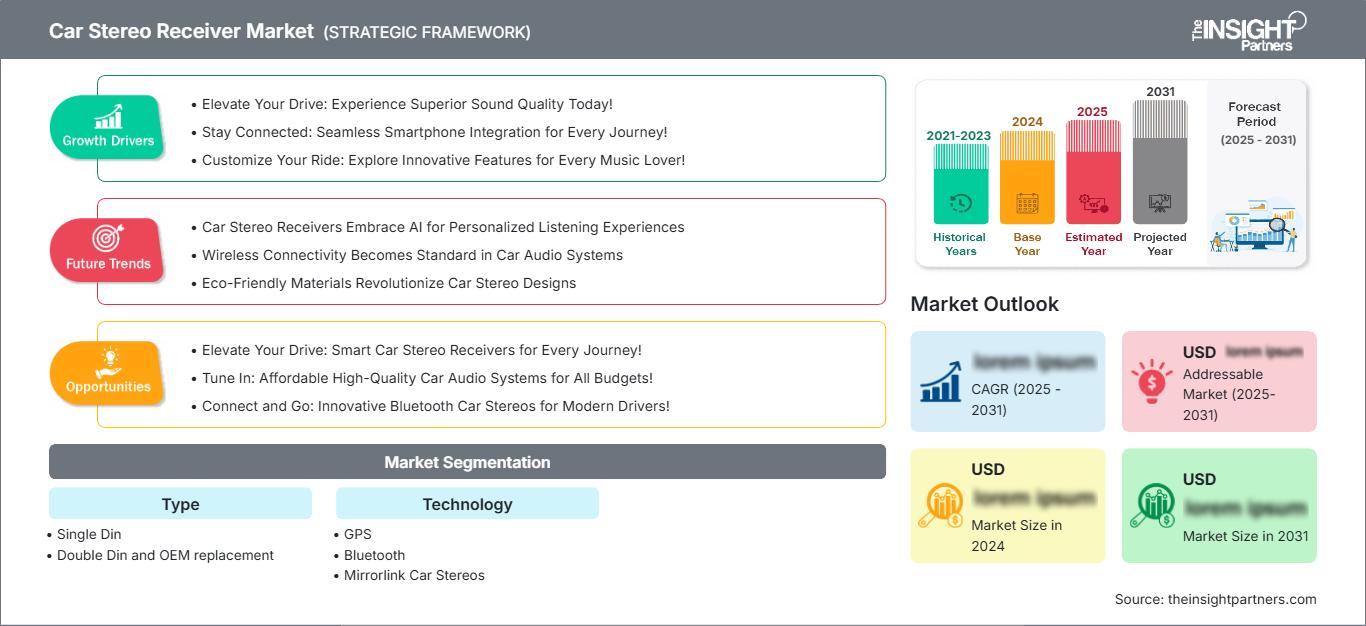
Car Stereo Receiver market was valued at US$ 1.66 Billion in 2025 and is projected to reach US$ 2.54 Billion by 2034, registering a CAGR of 4.85% during 2026–2034. The demand will be fueled by the aging of car parc, after-market audio upgrades, smartphone integration, navigation system demands, hands-free technology needs, and replacements from manufacturers.
It is anticipated that North America Car Stereo Receiver size will have a growth rate of 4.3%-5.1% between 2026-2034 due to the high number of old cars in use, the installer base, and the growing need for wireless Bluetooth, navigation systems, and smartphone integration. People are changing their older dashboards to enable safer phone calls and better sound, among other things.
Car Stereo Receiver Market Assessment and Insights
- North America held 28–32% share in 2025 and is growing at a CAGR of 4.3–5.1% during 2026–2034, led by aftermarket installers, used-car upgrades, and connected audio replacement.
- US represented 79–83% of North American revenue in 2025 and is growing at a CAGR of 4.4–5.2% during 2026–2034, supported by strong specialty retail.
- Europe accounted for 20–24% share in 2025 and is growing at a CAGR of 3.8–4.6% during 2026–2034, with Germany, the UK, France, Italy, and Spain leading demand.
- Asia Pacific held 34–38% share in 2025 and is growing at a CAGR of 5.2–6.1% during 2026–2034, led by China, Japan, South Korea, India, and Australia.
- Largest Segment Double Din held 45–49% market share in 2025 and is growing at a CAGR of 5.0–5.8% during 2026–2034 as touchscreen dashboards expand.
- High Growth Segment Mirrorlink Car Stereos represented 18–22% market share in 2025 and is growing at a CAGR of 5.8–6.7% during 2026–2034, helped by smartphone mirroring.
- Key companies analyzed in detail: Pioneer Corporation; Sony Corporation; Dual Electronics Corporation; Namsung Corporation; Alpine Electronics, Inc.; JVCKENWOOD Corporation; BOSS Audio Systems; D&M Holdings Inc.; Panasonic Holdings Corporation; Blaupunkt GmbH.
Source: The Insight Partners' analysis based on proprietary research, government publications, company annual reports, investor presentations, industry databases, and expert interviews.
The Car Stereo Receiver market has changed from simple AM/FM receivers to media control units which integrate audio processing, Bluetooth calling, navigation, rear camera feeds, and app mirroring capabilities. Manufacturing dynamics will take account of fast electronics production cycles, displays, and vehicle-specific fit kits. The Car Stereo Receiver market will grow best in regions where people keep their cars for longer periods, but require more advanced connectivity, intuitive interface, and acoustic control without infotainment systems.
Future demand will be driven by expectations for connected cars, legislation requiring safety on the roads and making hands-free usage a priority, and after-market segments offering combinations of receivers with cameras, amplifiers, speakers, and professional installation. New regions are implementing low-cost double DIN upgrades, whereas mature regions prefer wireless smartphone integration solutions.
Car Stereo Receiver Market Report Scope
| Report Attribute | Details |
|---|---|
| Market size in 2025 | US$ 1.66 Billion |
| Market Size by 2034 | US$ 2.54 Billion |
| Global CAGR (2026 - 2034) | 4.85% |
| Historical Data | 2021-2024 |
| Forecast period | 2026-2034 |
Car Stereo Receiver Market Analysis
Car Stereo Receiver growth comes from people replacing old factory-installed car stereos to enhance safety by enabling safe calls, music playback wirelessly, GPS prompts and touch screens. The demand depends on the age of vehicles, disposable income and the size of the existing base of cars which lack modern infotainment features. They act as entry points for other accessories such as backup camera systems, amplifiers, steering wheel controls and high-resolution music.
The supply chain comprises of companies manufacturing display units, chipsets, navigation software, contract manufacturers, car dealerships, installation services, online retailers and OEM accessoires programs. The dynamics within the supply chain revolve around semiconductors, cost of panels, firmware, certification and compatibility software libraries. Consumers look at more attributes than power output of a stereo receiver unit.
The Car Stereo Receiver Market report suggests that competition is influenced by brand reputation, channels coverage, sound processing, compatibility with vehicles, and mobile devices eco-system integration. The main competitors of the car stereo receiver market are Pioneer Corporation, Sony Corporation, Alpine Electronics, Inc., JVCKENWOOD Corporation, Panasonic Holdings Corporation, and Blaupunkt GmbH via multimedia receivers and navigation systems.
The specialists, such as Dual Electronics Corporation, Namsung Corporation, BOSS Audio Systems, and D&M Holdings Inc., provide additional competitiveness due to pricing, wider distribution coverage, and audio system adjacency. Investments are concentrated on wireless CarPlay and Android Auto, inbuilt GPS navigation systems, floating displays, digital signal processing, and installation kits for specific cars to decrease installation time.
● REPORT CUSTOMIZATION
Tailor This Report To Align With Your Specific Business Requirements
This report can be customized to align precisely with your business objectives, scope, and target markets. Customization options include tailored segmentation, geography, competitive analysis, and strategic insights to support informed decision-making.
Customize This Report →WHAT YOU CAN ADJUST
- ● Segmentations
- ● Geography
- ● Competitive Analysis
- ● Language Preferences
Car Stereo Receiver Market: Strategic Insights
Regional Insights
North America Car Stereo Receiver Market
North America accounted for 28–32% of Car Stereo Receiver share in 2025 and is projected to expand at a CAGR of 4.3–5.1% during 2026–2034. Structural demand reflects a large used-vehicle fleet, specialist installers, pickup and SUV ownership, and consumer preference for wireless audio, touchscreen control, and backup-camera integration.
Retailers and independent shops support upgrade bundles that combine receivers with speakers, amplifiers, harnesses, steering-wheel control adapters, and fitting kits. The region benefits from high credit-card e-commerce usage and established brands, while demand is moderated by factory infotainment penetration in newer vehicles and integration complexity in premium models.
U.S. Car Stereo Receiver Market
The U.S. represented 79–83% of North American revenue in 2025 and is expected to grow at a CAGR of 4.4–5.2% during 2026–2034. Application trends center on older sedans, trucks, recreational vehicles, work vans, and enthusiast builds requiring Bluetooth, GPS, touchscreen displays, camera input, and higher pre-out voltage.
Company presence includes Pioneer Corporation, Sony Corporation, JVCKENWOOD Corporation, BOSS Audio Systems, Dual Electronics Corporation, and Alpine Electronics, Inc. U.S. buyers often prioritize compatibility with Apple CarPlay, Android Auto, SiriusXM-ready functions, dash kits, and professional installation warranties, making channel execution as important as product specification.
Europe Car Stereo Receiver Market
Europe held 20–24% share in 2025 and is projected to grow at a CAGR of 3.8–4.6% during 2026–2034. Germany leads through vehicle ownership density, premium audio culture, and strong aftermarket specialists. The UK adds demand from used cars, van fleets, and dashboard modernization.
France, Italy, and Spain support replacement demand through urban commuting, compact vehicles, and online accessory sales. European buyers emphasize fit quality, radio standards, energy efficiency, data privacy, and integration with parking sensors or steering controls. Growth is steadier than APAC because many newer vehicles already include advanced infotainment systems.
APAC Car Stereo Receiver Market
Asia Pacific accounted for 34–38% share in 2025 and is forecast to grow at a CAGR of 5.2–6.1% during 2026–2034. China leads through vehicle scale, electronics manufacturing, and online head-unit sales, while Japan and South Korea support advanced display and audio processing demand.
India and Australia add momentum through used-car upgrades, affordability-driven double-DIN adoption, and installer-led accessory bundles. Policy support for safer driving, domestic electronics, and connected mobility helps channel investment. However, price sensitivity and fragmented fitment standards require suppliers to balance features, warranty, and localized compatibility.
Middle East & Africa Car Stereo Receiver Market
The Middle East & Africa market is projected to grow at a CAGR of 3.9–4.8% during 2026–2034. Saudi Arabia leads as vehicle customization, premium SUVs, and retail electronics demand support receiver upgrades, while the UAE benefits from enthusiast audio, tourism fleets, and accessory retail.
South Africa remains important for aftermarket audio, repairs, and value-oriented installations. Rest of MEA demand depends on vehicle import patterns, heat-resistant electronics, service availability, and infrastructure quality. Suppliers with ruggedized units, multilingual interfaces, and stable distribution can address harsh operating conditions and diverse vehicle fleets.
Segmentation Analysis
Type
Type is projected to grow at a CAGR of 4.7–5.5% during 2026–2034. The Car Stereo Receiver scope spans compact single-DIN upgrades, larger double-DIN multimedia systems, and OEM replacement units designed for factory-like fit. Demand favors double-DIN formats because screen space supports navigation, camera feeds, and smartphone mirroring, while single-DIN products remain relevant in older vehicles and price-sensitive fleets.
- Single Din receivers remain important for older vehicles, commercial fleets, and budget buyers needing Bluetooth calling, USB playback, radio, and simple installation without dashboard redesign.
- Double Din receivers lead market value because larger displays support touch control, GPS views, reverse cameras, streaming interfaces, and a modern cockpit appearance.
- OEM replacement units address vehicle-specific fitment where buyers want factory aesthetics, retained steering controls, and improved connectivity without compromising dashboard integration.
Technology
Technology is forecast to grow at a CAGR of 5.0–5.9% during 2026–2034. Technology selection increasingly determines upgrade value because consumers compare Bluetooth stability, GPS accuracy, mirroring responsiveness, audio tuning, and display clarity. GPS remains valuable for offline routing and fleet use, Bluetooth is the baseline connectivity feature, and Mirrorlink Car Stereos gain relevance where users expect familiar smartphone interfaces in older dashboards.
- GPS receivers serve drivers needing dependable navigation, route visibility, and location guidance in vehicles lacking embedded infotainment or consistent mobile-data coverage.
- Bluetooth is the core adoption feature because hands-free calling, wireless music, contact access, and simple pairing define minimum expectations for modern receiver replacement.
- Mirrorlink Car Stereos support smartphone-led navigation, media, messaging prompts, and app familiarity, making them strategically important for younger buyers and connected aftermarket upgrades.
Opportunity Snapshot
| Type | Revenue Contribution | Trend Tag | Adoption Stage |
| Single Din | Medium | Fleet Retrofit | Mature |
| Double Din | High | Touchscreen Hub | Scaling |
| OEM replacement | Medium | Factory Fit | Scaling |
Car Stereo Receiver Market Growth Drivers and Impact Analysis
Aging vehicle fleets create retrofit demand
Increased ownership periods are changing the receiver into something functional to retrofit into a vehicle rather than an accessory that customers will have as a luxury. People with older cars can upgrade to Bluetooth connectivity, navigation, camera views, and even better sound systems by simply replacing the receiver in the car. The effect on the industry is most felt in the pre-owned car sales industry, auto repair garages, and online shopping due to the need for up-to-date features without having to buy a new car. It is beneficial to suppliers of harnesses, dash kits, microphones, antennas, and cameras to have compatibility and installation information.
Hands-free connectivity supports safety-led upgrades
Expectations for road safety are driving motorists to give up the use of hand-held phones and move towards devices that allow voice calls, contacts, audio playback, and visual prompting. It is not just about comfort as commercial drivers, parents, ridesharing providers, and commuter motorists all consider hands-free as a day-to-day necessity. Basic devices include Bluetooth receivers while multimedia receivers offer bigger icons, improved microphones, and mirror applications. Merchants can present these upgrades based on safety and legal considerations rather than focusing on the audio quality alone. Providers offering good pairings, low echo, quick reconnects, and easy controls are in a better position to provide replacements.
Smartphone mirroring reshapes dashboard expectations
Increasingly, consumers demand that the dash emulate their phone experience with regards to navigation, music players, voice assistants, podcasts, texting, and touchscreen-friendly interface. These changes affect the way receivers are bought because the size of the screen, the speed of the processor, stability of the wireless connection, and software updates become relevant for purchase decisions. The market effect can be observed in the installation of double-DIN upgrades, floating screens, and OEM screens that retain the appearance of the stock one but add connectivity capabilities. Companies that cater to both iOS and Android devices can target a larger market of vehicles.
Car Stereo Receiver Market Future Trends
Wireless mirroring becomes the default upgrade path
The Car Stereo Receivers Market Trends indicate that wireless mirror linking is shifting from high-end car stereo receivers to mid-range models since customers prefer wireless navigation, streaming, and voice control. When making purchases in future, the customer will consider connectivity, speed, low latency, and ease of interface over screen size only. The trend will lead to an increase in upgrading of old receivers that have wireless technology only. This will happen in cars where there are still many years to go in terms of the service life of the car.
Vehicle-specific receivers reduce installation friction
Vehicle specific receiver mounting plates will become increasingly important as dashboards evolve to be more integrated and consumers resist any aftermarket modification. Future receivers will utilize model-specific mounts, retain climate control information, integrate cameras, and support steering controls to achieve a factory-like fit. Such an approach will favor premium installation shops and online retailers that will be able to provide a proper fitment of receivers to trim levels. In addition, this approach will minimize the risk of returns by identifying whether the product will fit the customer prior to making a purchase.
Car Stereo Receiver Market Opportunities
Bundled retrofit kits for used vehicles
Car Stereo Receiver Forecasts support investment in bundled retrofit kits that combine receivers, harnesses, dash panels, cameras, microphones, and installation instructions for high-volume used vehicles. This opportunity is actionable because buyers often abandon upgrades when compatibility appears uncertain. Suppliers and retailers can target common models with curated packages, transparent fitment tools, and tiered feature options. Installers can add labor, tuning, and warranty services around the same kits. The approach improves conversion rates, reduces returns, and builds customer confidence, especially for double-DIN and OEM replacement units where dashboard fit strongly influences purchase decisions.
Affordable connected receivers for emerging markets
Emerging markets offer an opportunity for affordable receivers that deliver Bluetooth, basic navigation support, USB playback, and durable screens at accessible prices. Many vehicles lack current infotainment, while consumers still want safer calling and media access. Vendors can succeed by prioritizing heat tolerance, simple interfaces, multilingual menus, and broad vehicle fitment over excessive features. Distribution through online marketplaces, local installers, and automotive accessory shops can expand reach. Financing bundles, warranty clarity, and spare-part availability will be important because value-conscious buyers need assurance that upgrades remain serviceable after installation.
Recent Developments
- March 2026: Panasonic Automotive Systems Co., Ltd. (Headquarters: Yokohama, Kanagawa, Japan; President: Masashi Nagayasu) announced that the company’s in-vehicle infotainment (IVI) system has debuted in Toyota Motor Corporation’s (Toyota) 2026 RAV4 vehicle. This cutting-edge platform is designed to keep drivers connected, informed and entertained with speed, personalization and future-ready technology.
- March 2026: Renault is further expanding its catalogue of partner apps in France with a new in-car audio experience co-developed with RMC BFM Group: RMC BFM Drive. This unique app will be deployed from March 2026 in vehicles featuring OpenR Link with Google built-in, Renault's connected multimedia system.
- January 2026: Pioneer, a global leader in in-vehicle sound and aftermarket car electronics, introduces a New Digital Multimedia Receiver in North American market, the world’s first aftermarket spatial audio in-dash receiver to feature Dolby Atmos playback in Apple CarPlay. To date, in-vehicle Dolby Atmos has been available only in models equipped with Dolby Atmos-enabled sound systems. With the new receiver, Pioneer expands access to Dolby Atmos through an aftermarket solution that can be installed in millions of existing vehicles, delivering an immersive sound experience leveraging speakers already in the vehicle.
Frequently Asked Questions

- Comprehensive Market Sizing and Forecast Analysis
- Detailed Segmentation Analysis
- In-Depth Market Dynamics Assessment
- Regional and Country-Level Insights
- Competitive Landscape and Company Benchmarking
- Strategic Business Intelligence
Recent Reports
Testimonials

The Insight Partners provided valuable market intelligence that supported our global go-to-market strategy. Their team was professional, responsive, and attentive to our feedback, providing thoughtful analysis and helpful methodological clarifications throughout the project.
Junmo Kim Chief Financial Officer (CFO), Enertech Co., Ltd.
The Insight Partners' SCADA System Market report is comprehensive, with valuable insights on current trends and future forecasts. The team was highly professional, responsive, and supportive throughout. We are very satisfied and highly recommend their services.
RAN KEDEM Partner, Reali Technologies LTDs
I requested a report on a very specific software market and the team produced the report in a few days. The information was very relevant and well presented. I then requested some changes and additions to the report. The team was again very responsive and I got the final report in less than a week.
JEAN-HERVE JENN Chairman, Future Analytica
We worked with The Insight Partners for an important market study and forecast. They gave us clear insights into opportunities and risks, which helped shape our plans. Their research was easy to use and based on solid data. It helped us make smart, confident decisions. We highly recommend them.
PIYUSH NAGPAL Sr. Vice President, High Beam Global
The Insight Partners delivered insightful, well-structured market research with strong domain expertise. Their team was professional and responsive throughout. The user-friendly website made accessing industry reports seamless. We highly recommend them for reliable, high-quality research services
YUKIHIKO ADACHI CEO, Deep Blue, LLC.
This is the first time I have purchased a market report from The Insight Partners.While I was unsure at first, I visited their web site and felt more comfortable to take the risk and purchase a market report.I am completely satisfied with the quality of the report and customer service. I had several questions and comments with the initial report, but after a couple of dialogs over email with their analyst I believe I have a report that I can use as input to our strategic planning process.Thank you so much for taking the extra time and making this a positive experience.I will definitely recommend your service to others and you will be my first call when we need further market data.
JOHN SUZUKI President and Chief Executive Officer, Board Director, BK Technologies
I wish to appreciate your support and the professionalism you displayed in the course of attending to my request for information regarding to infectious disease IVD market in Nigeria. I appreciate your patience, your guidance, and the fact that you were willing to offer a discount, which eventually made it possible for us to close a deal. I look forward to engaging The Insight Partners in the future, all thanks to the impression you have created in me as a result of this first encounter.
DR CHIJIOKE ONYIA MANAGING DIRECTOR, PineCrest Healthcare Ltd.Reason to Buy
- Informed Decision-Making
- Understanding Market Dynamics
- Competitive Analysis
- Identifying Emerging Markets
- Customer Insights
- Market Forecasts
- Risk Mitigation
- Boosting Operational Efficiency
- Strategic Planning
- Investment Justification
- Tracking Industry Innovations
- Aligning with Regulatory Trends





 Get Free Sample for