
Cardiac Rehabilitation Market Size, Share, and Analysis by 2034
Coverage: By Product (Heart Rate Monitor, Stabilization Balls, Treadmill, Elliptical Trainer, Blood Pressure Monitors, Stationery Bicycle, and Others), Application (Angioplasty, Coronary Artery Disease, Cardiomyopathy, Cholesterol Management, Diabetes, and Lung Transplant), End User (Hospitals & Clinics, Specialty Hospitals, Home Healthcare, Cardiac Rehabilitation Centers, and Others), and Geography
- Status : Data Released
- Report Code : TIPHE100000851
- Category : Life Sciences
- No. of Pages : 150
- Available Report Formats :


- Last update date : September 08, 2026


2025 Market Size
US$ 2.66 Bn
Base year value
2034 Forecast
US$ 4.03 Bn
Projected by 2034
CAGR 2026-2034
4.72 %
Growth rate
Addressable Market
US$ 30.36 Bn
(2026-2034)
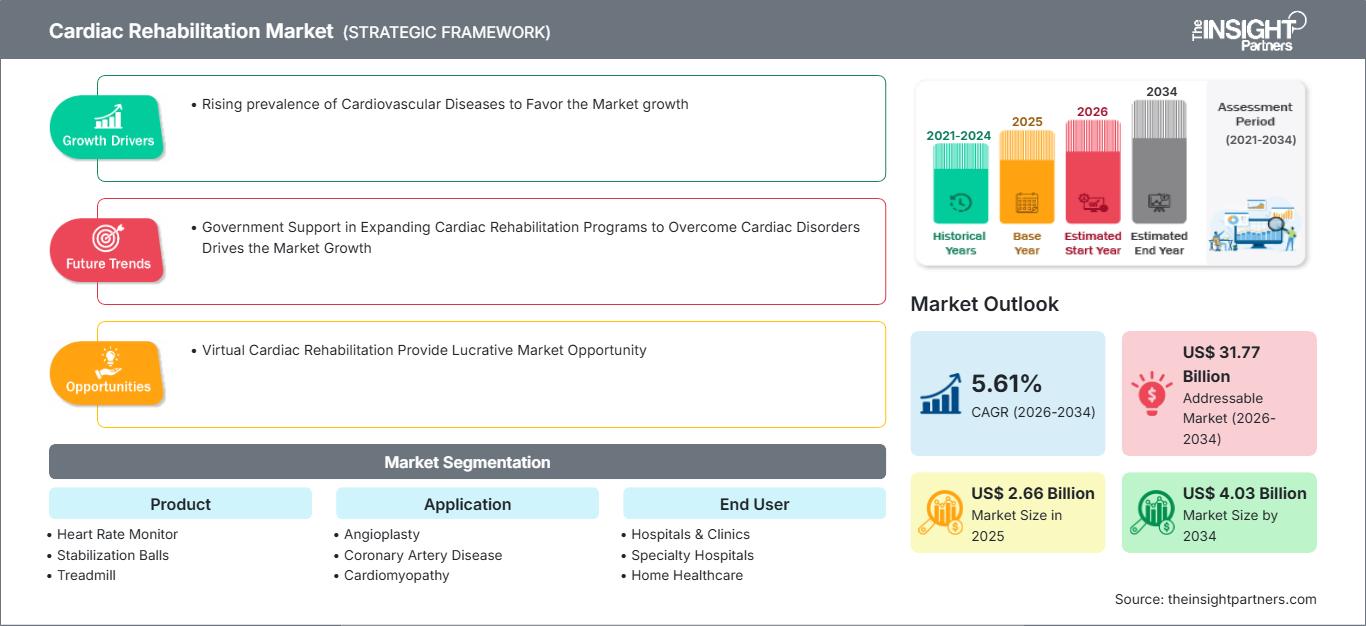
The global Cardiac Rehabilitation market was valued at US$ 2.66 billion in 2025 and is expected to reach US$ 4.03 billion by 2034; it is estimated to record a CAGR of 4.72% during 2026-2034.
Cardiac Rehabilitation Market Assessment and Insights
- North America: Representing 42–45% share in 2025 and growing at a CAGR of 5.0–5.5% during 2026–2034, the region benefits from reimbursement coverage, coordinated secondary-prevention programs, connected monitoring adoption, and mature cardiovascular care infrastructure.
- US: Accounting for 82–86% of North America in 2025, the country is forecast to record a 5.1–5.6% CAGR during 2026–2034 as hospitals increase automated referrals and hybrid rehabilitation capacity.
- Europe: Holding 26–29% share in 2025 and expanding at a 4.7–5.2% CAGR during 2026–2034, Europe is led by Germany, the UK, and France, supported by structured phase II services and preventive cardiology networks.
- Asia Pacific: Capturing 20–23% share in 2025 and advancing at a 6.5–7.2% CAGR during 2026–2034, Asia Pacific is led by China and Japan, while India gains from digital rehabilitation and hospital partnerships.
- Largest Segment: Blood pressure monitors held a 30–34% market share in 2025 and are projected to grow at a 5.0–5.5% CAGR during 2026–2034, supported by hypertension management and home monitoring.
- High Growth Segment: Home healthcare represented a 12–15% market share in 2025 and is expected to expand at a 7.2–8.0% CAGR during 2026–2034 through remote supervision and connected-device adoption.
- Key companies analyzed in detail: Halma plc, OMRON Corporation, Avecinna Company JSC, Koninklijke Philips N.V., GE HealthCare Technologies Inc., Core Health & Fitness, LLC, Peloton Interactive, Inc., Resideo Technologies, Inc., ergoline GmbH, Lupin Limited.
Source: The Insight Partners' analysis based on proprietary research, government publications, company annual reports, investor presentations, industry databases, and expert interviews.
The business strategy has evolved from programs that revolved around exercises performed at the facility level to rehabilitation programs involving clinically approved ergometer, blood pressure measuring machines, ECG telemetry, applications and consultations from multiple specialists. Machines have evolved into devices that facilitate data input/output, have infection proof material, ergonomic and maintainable designs. Meanwhile, software systems take care of managing work load, logging sessions and signaling for abnormal results. Programs such as ers.2 by ergoline keep track of the training process of 24 patients.
Expenditures until 2034 will progressively be channeled into networks for outpatient services, home-care services, and under-served urban/rural demographics. The AP region has positive deployment prospects in the context of cardiac hospitals’ interest in less costly continuance of care after discharge, while the ME region will build its cardiovascular facilities. The regulatory recognition of software-assisted monitoring, evidence-based referral algorithms, and payment for virtual component of care will expand availability, despite need for clinical governance and secure data exchange.
Cardiac Rehabilitation Market Report Scope
| Report Attribute | Details |
|---|---|
| Market size in 2025 | US$ 2.66 Billion |
| Market Size by 2034 | US$ 4.03 Billion |
| Global CAGR (2026 - 2034) | 4.72% |
| Historical Data | 2021-2024 |
| Forecast period | 2026-2034 |
Cardiac Rehabilitation Market Analysis
Rising survivorship after angioplasty, cardiac surgery, and acute coronary events is increasing the addressable population for secondary prevention. Cardiac Rehabilitation Market growth also reflects the continuing burden of hypertension, diabetes, inactivity, and dyslipidemia. Cardiovascular diseases caused an estimated 19.8 million deaths in 2022, or approximately 32% of global deaths, demonstrating the scale of the underlying clinical need.
The ecosystem covers manufacturers of devices, software providers, distributors, cardiologists, physiotherapists, nutritionists, payers, hospitals, and home-care organizations. Supply moves towards the modularity model, allowing combining treadmills, stationary bikes, blood pressure devices, and telemonitoring solutions. The importance of the certification of the product, its calibration, local servicing, and software integration increases, compared to the equipment price itself, especially for providers managing high-risk patients.
The Cardiac Rehabilitation Market is characterized by the fragmentation of the competitive landscape involving medical monitoring, therapeutic exercise devices, digital care solutions, and cardiac diagnostics. Halma plc offers a specialized solution in blood pressure technologies, while OMRON Corporation is involved in home monitoring and connected apps. Koninklijke Philips N.V. and GE HealthCare Technologies Inc. are focused on integrated cardiac data and monitoring workflows. Ergoline GmbH and Avecinna Company JSC offer rehabilitation telemetric and medical exercise solutions.
Strategic distinction moves towards the clinical interoperability and geographical scope. Lupin Limited competes through digital therapeutics through its LYFE platform, while Core Health & Fitness, LLC and Peloton Interactive, Inc. offer exercise hardware and engagement functionality. Resideo Technologies, Inc. provides the competences in connected sensing, although it is not specialized enough in rehabilitation. The investments go toward algorithm-driven personalization, hospital integration, subscriptions, and the evidence generation.
● REPORT CUSTOMIZATION
Tailor This Report To Align With Your Specific Business Requirements
This report can be customized to align precisely with your business objectives, scope, and target markets. Customization options include tailored segmentation, geography, competitive analysis, and strategic insights to support informed decision-making.
Customize This Report →WHAT YOU CAN ADJUST
- ● Segmentations
- ● Geography
- ● Competitive Analysis
- ● Language Preferences
Cardiac Rehabilitation Market: Strategic Insights
Regional Insights
North America Cardiac Rehabilitation Market
North America accounted for 42–45% of global revenue in 2025 and is expected to expand at a 5.0–5.5% CAGR during 2026–2034. Cardiac rehabilitation market share involves dense networks of hospitals, Medicare, high number of procedures, and availability of monitoring equipment. In the US cardiovascular disease, there have been 127.9 million adults between 2017-2020, which highlights ongoing secondary prevention capabilities.
The market growth is shifting from the classic gym setting inside hospitals to outpatient clinics, community programs, and virtual models. Million Hearts program uses claims data to monitor enrolment, initiation, completion, adherence, and virtual visits. Canada supplements the regional demand with provincial care pathways and remote monitoring services. Increasing procurement includes interoperable solutions like blood pressure devices, ECG, and exercise programs.
U.S. Cardiac Rehabilitation Market
The US represented 82–86% of North American revenue in 2025 and is forecast to grow at a 5.1–5.6% CAGR during 2026–2034. Hospitals and clinics still represent major buyers, whereas home health care is increasingly favored by those who have difficulties associated with distance, movement, work, and carers. According to the Medicare surveillance, involvement in rehabilitation services is characterized by participation in at least one session in 365 days after a qualifying event.
Companies that currently possess the necessary capabilities on the market include OMROM Corporation, GE HealthCare Technologies Inc., Koninklijke Philips N.V., Halma plc, Core Health & Fitness, LLC, and Peloton Interactive, Inc. Angioplasty and coronary heart disease provide regular rehabilitation services needs, but cholesterol management and diabetes treatment expand program content. Automatically triggered referrals, automatic enrollment, measurement through wearables, and customized reporting from hospitals should increase utilization.
Europe Cardiac Rehabilitation Market
Europe held 26–29% of global revenue in 2025 and is projected to grow at a 4.7–5.2% CAGR during 2026–2034. Germany excels in terms of rehabilitation infrastructure, medical engineering skills, and well-developed pathways for exercise therapy. The ergoline GmbH company improves regional supply with ergometers, telemetry transmitters, and rehabilitation software production in accordance with certified standards for medical devices.
In the UK, center-based pathways are combined with home and web-based programs, offering better access to those who cannot join group sessions. Audit data collected from 454,492 referrals have shown that 55% started rehabilitation and 78% of those who did start managed to complete it, suggesting that both capacity and potential in terms of enrollment exist.
Standardized referral process for those having myocardial infarction and undergoing cardiac surgery is developed in France. In Italy, exercise is integrated into chronic disease management programs, and Spain is developing preventive cardiology services regionally. European countries have different levels of adoption, encouraging investments into quality metrics, digital access, interoperability of patient data, and wider rehabilitation availability for HF and cardiomyopathy patients.
APAC Cardiac Rehabilitation Market
Asia Pacific represented 20–23% of global revenue in 2025 and is expected to expand at a 6.5–7.2% CAGR during 2026–2034. China leads through hospital scale and cardiovascular procedure volumes, while Japan and South Korea support adoption through aging populations and connected-care capability.
India is emerging through hospital partnerships and prescription digital programs, including Lupin Limited’s LYFE platform. Australia contributes mature clinical services. Policy emphasis on noncommunicable disease control, expanding specialty hospitals, localized equipment production, and mobile-first care models strengthens regional commercialization.
Middle East & Africa Cardiac Rehabilitation Market
The Middle East & Africa is forecast to grow at a 5.4–6.0% CAGR during 2026–2034. Saudi Arabia leads through hospital investment and specialist cardiac infrastructure, followed by the UAE, where digitally enabled private healthcare networks support hybrid delivery.
South Africa anchors sub-Saharan demand, while the Rest of MEA remains constrained by workforce and reimbursement gaps. Economic diversification, urban hospital construction, telecommunications coverage, and local distributor partnerships create opportunities for modular rehabilitation systems requiring limited floor space and centralized clinical supervision.
Segmentation Analysis
Product
Product is projected to expand at a 5.2–5.8% CAGR during 2026–2034. The Cardiac Rehabilitation Market scope across equipment covers physiological monitoring and structured exercise platforms adapted to patient risk. Buyers increasingly prioritize clinical accuracy, adjustable workloads, connectivity, and compatibility with electronic records. Blood pressure monitors remain the largest product category, while connected heart rate monitors and medical-grade exercise systems support hybrid care.
- Heart Rate Monitor: Wearable and chest-based monitors support exercise-zone control, early abnormality detection, and longitudinal adherence reviews, making them strategically important for supervised sessions and remotely managed rehabilitation plans.
- Stabilization Balls: Stabilization balls address balance, flexibility, and low-intensity strength training within multidisciplinary programs, with demand concentrated in clinics seeking affordable equipment for individualized functional recovery.
- Treadmill: Treadmills maintain strong hospital and rehabilitation-center demand because clinicians can control speed and incline while integrating ECG, blood pressure, and perceived-exertion monitoring during progressive exercise.
- Elliptical Trainer: Elliptical trainers provide lower-impact cardiovascular conditioning for patients requiring reduced joint loading, supporting later-stage recovery and maintenance programs where movement variety can improve continued participation.
- Blood Pressure Monitors: Blood pressure monitors hold the leading position because hypertension management is central to secondary prevention, while automated measurement and digital transmission enable consistent facility-based and home-based oversight.
- Stationery Bicycle: Stationary bicycles provide measurable workloads, seated stability, and compact placement, supporting early rehabilitation, exercise testing, and group programs serving older or mobility-limited patients.
Application
Application is expected to grow at a 5.3–5.9% CAGR during 2026–2034. Demand is strongest where rehabilitation follows a defined procedure or cardiovascular diagnosis, but programs are broadening toward cardiometabolic risk reduction. Application-specific pathways determine exercise intensity, monitoring frequency, nutrition protocols, and duration. Angioplasty and coronary artery disease remain central, while diabetes and cholesterol management support longer-term preventive engagement.
- Angioplasty: Post-angioplasty rehabilitation supports safe activity resumption, medication adherence, and recurrent-event prevention, creating a dependable referral pool linked directly to hospital discharge and interventional cardiology workflows.
- Coronary Artery Disease: Coronary artery disease generates sustained program demand because patients require exercise conditioning, symptom monitoring, dietary modification, stress management, and coordinated control of multiple cardiovascular risk factors.
- Cardiomyopathy: Cardiomyopathy programs require individualized workloads and closer physiological supervision, increasing the strategic value of accurate telemetry, clinician-configurable equipment, and gradual progression based on functional tolerance.
- Cholesterol Management: Cholesterol management expands rehabilitation beyond exercise by connecting nutrition counseling, medication adherence, weight control, and repeat risk assessment within comprehensive secondary-prevention pathways.
- Diabetes: Diabetes creates overlapping cardiovascular risk and requires programs to coordinate glucose monitoring, exercise dose, nutrition, medication timing, and patient education, strengthening multidisciplinary service demand.
- Lung Transplant: Lung transplant rehabilitation emphasizes cardiopulmonary endurance, mobility restoration, and closely monitored exercise, generating specialized equipment demand within transplant hospitals and advanced rehabilitation centers.
End User
End User is forecast to expand at a 5.5–6.1% CAGR during 2026–2034. Hospitals remain essential because referrals originate near diagnosis or intervention, but care is shifting toward specialized centers and homes. Providers are selecting delivery models according to patient risk, workforce availability, reimbursement, and travel barriers. Home healthcare is the fastest-growing sub-segment as connected monitoring supports clinically governed exercise outside facilities.
- Hospitals & Clinics: Hospitals and clinics lead initial enrollment because they connect rehabilitation prescriptions with discharge planning, cardiology assessment, emergency support, diagnostic data, and established reimbursement administration.
- Specialty Hospitals: Specialty hospitals manage complex cardiac and transplant populations, supporting demand for advanced telemetry, medical ergometers, multidisciplinary teams, and application-specific protocols with intensive clinical supervision.
- Home Healthcare: Home healthcare is scaling rapidly as connected devices, video consultation, digital coaching, and asynchronous review reduce travel barriers while extending service coverage beyond major cities.
- Cardiac Rehabilitation Centers: Dedicated centers deliver concentrated expertise, group capacity, structured exercise equipment, education, and outcomes tracking, positioning them as important partners for hospitals seeking scalable referral destinations.
Opportunity Snapshot
| End User | Revenue Contribution (High/Medium/Low) | Trend Tag | Adoption Stage (Emerging/Scaling/Mature) |
| Hospitals & Clinics | High | Auto Referral | Mature |
| Specialty Hospitals | Medium | Complex Recovery | Scaling |
| Home Healthcare | Medium | Remote Monitoring | Scaling |
| Cardiac Rehabilitation Centers | High | Hybrid Programs | Mature |
Cardiac Rehabilitation Market Growth Drivers and Impact Analysis
Expanding Cardiovascular Disease and Survivorship Burden
Cardiovascular disease continues to be the number one global cause of death, while better care for patients with acute coronary syndromes, angioplasty, and surgery leads to increased survival rate. Such a combination increases the proportion of patients who require structured secondary prevention rather than episodic follow-up. Exercise equipment, blood pressure measurement devices, dietary consultation services, and risk management for patients become a valuable product for rehabilitation providers when hospitals create links between discharge programs and these services. The biggest need is among patients with a combination of hypertension, diabetes, obesity, and inactivity. According to the World Health Organization, in 2022 there were 19.8 million deaths due to cardiovascular diseases worldwide, while more than three quarters occurred in low- and middle-income countries.
Low Participation Creates Measurable Capacity for Enrollment Expansion
Clinical eligibility does not necessarily mean market utilization since there are referral, distance, awareness, scheduling, and co-payment barriers that prevent access. In the US, less than one-third of the patients eligible for rehabilitation services take advantage of them, meaning that there is an excellent conversion opportunity even without the need for the same amount of eligible events to increase. Automatic referrals, bedside registration, program navigators, scheduling flexibility, and tele-rehabilitation services can be used by hospitals to fill this void. Equipment manufacturers and software developers, therefore, have an opening to assist with referral analysis, patient engagement, remote monitoring, and tracking of program completion. Million Hearts is aiming to reach at least 70% participation and has recruited over 700 members from 370 organizations.
Integration of Connected Monitoring with Clinical Workflows
Through remote connectivity in blood pressure monitors, ECG devices, activity tracking systems, and cloud-based dashboard systems, rehabilitation can become an ongoing process rather than a series of fragmented interventions. Healthcare providers can monitor workload progression, adherence, symptoms, and vital sign exceptions while reserving in-person visits for those in higher risk categories. This will allow for an expanded geographical coverage and efficient patient load management through secured data processing and clearly defined escalation processes. Through OMRON Corporation, there are now available blood pressure monitors with atrial fibrillation detection enabled by artificial intelligence technology. Also, through Lupin Limited, remote monitoring and clinical applications are used for continuous cardiac care.
Cardiac Rehabilitation Market Future Trends
Risk-Adaptive Hybrid Rehabilitation Pathways
Cardiac Rehabilitation Market trends will move toward hybrid pathways that assign service intensity according to clinical risk, digital literacy, mobility, and recovery stage. Patients at higher risk will be offered center-based telemetry and supervision, whereas patients who are relatively stable will be moved to connected-home-based programs with clinical review periodically. Algorithmic tools will help to balance workloads and prioritize exceptions, but decisions about the therapy will continue to be made by clinicians. Completion rates, functional capacity, blood pressure, medication compliance, and re-admissions will all be assessed during the entire process. Such an approach would be able to expand the flow of patients through the program without growing the actual physical infrastructure.
Outcome-Linked Procurement and Evidence-Based Differentiation
The Cardiac Rehabilitation Market forecasts show that purchasing decisions will increasingly assess demonstrated patient outcomes rather than technical specifications alone. Hospital providers, insurance carriers, and rehabilitation networks will look for proof that the platforms enhance speed of onset, session completion, functional capability, and risk factor management. The vendors will counteract with clinical collaboration, registries, reporting standardization, and real world evidence initiatives. Subscription agreements can tie payment amounts to milestones based on enrolment or engagement. This will make it a mandate for the suppliers to ensure that they offer equipment along with on-boarding, training, analysis, and patient care. Vendors having connected product portfolios will have the upper hand if they have proof of performance in both clinical and at-home environments.
Cardiac Rehabilitation Market Opportunities
Build Hospital-to-Home Rehabilitation Networks in Emerging Cities
Investors can develop hub-and-spoke services in which specialty hospitals provide assessment and clinical governance while neighborhood facilities and home-care teams deliver continuing exercise and monitoring. The model is suited to India, Southeast Asia, the Middle East, and selected African cities where advanced cardiac procedures are concentrated but rehabilitation capacity remains limited. Operators should combine compact stationary bicycles, blood pressure devices, heart rate monitoring, multilingual coaching, and escalation protocols. Partnerships with cardiologists and insurers can reduce patient-acquisition costs and improve continuity after discharge. Successful platforms will localize diet guidance, payment options, and technical support rather than transplanting high-cost Western facility models into markets with different workforce and affordability conditions.
Commercialize Interoperable Monitoring and Program Analytics
A significant opportunity exists for vendors that connect equipment data, patient-reported symptoms, medication adherence, and clinical records without locking providers into a single hardware brand. Hospitals need dashboards that identify nonattendance, abnormal measurements, stalled workload progression, and patients requiring intervention. Vendors should invest in application programming interfaces, cybersecurity certification, role-based access, and integration services. Cardiac Rehabilitation Market Report buyers evaluating technology partners should prioritize clinically interpretable analytics over consumer engagement metrics alone. Revenue can be generated through implementation fees, recurring licenses, device bundles, and service contracts. Partnerships with electronic health record providers and regional distributors can accelerate adoption while reducing integration and maintenance burdens.
Recent Developments
- August 2025: Koninklijke Philips N.V. showcased AI-enabled cardiac technologies at ESC Congress 2025, including integrated solutions spanning diagnosis, intervention, and long-term monitoring. The portfolio direction supports rehabilitation ecosystems by improving data continuity and enabling clinicians to apply cardiac insights across post-procedure and chronic-care pathways.
- April 2025: Lupin Limited reported that Lupin Digital Health’s cardiac-focused platform had reached approximately 10,000 patients and was expanding through hospital and insurer partnerships. The company positioned LYFE across post-procedure rehabilitation and preventive care, combining connected monitoring, applications, clinician access, and personalized interventions.
- March 2025: GE HealthCare Technologies Inc. announced the US launch of Flyrcado for myocardial perfusion imaging and presented AI-powered cardiology workflow technologies at ACC 2025. Although diagnostically focused, the launch strengthens upstream identification and assessment capabilities that can inform exercise prescriptions and follow-up pathways for coronary artery disease patients.
Frequently Asked Questions

- Comprehensive Market Sizing and Forecast Analysis
- Detailed Segmentation Analysis
- In-Depth Market Dynamics Assessment
- Regional and Country-Level Insights
- Competitive Landscape and Company Benchmarking
- Strategic Business Intelligence
Recent Reports
Testimonials

The Insight Partners' SCADA System Market report is comprehensive, with valuable insights on current trends and future forecasts. The team was highly professional, responsive, and supportive throughout. We are very satisfied and highly recommend their services.
RAN KEDEM Partner, Reali Technologies LTDs
I requested a report on a very specific software market and the team produced the report in a few days. The information was very relevant and well presented. I then requested some changes and additions to the report. The team was again very responsive and I got the final report in less than a week.
JEAN-HERVE JENN Chairman, Future Analytica
We worked with The Insight Partners for an important market study and forecast. They gave us clear insights into opportunities and risks, which helped shape our plans. Their research was easy to use and based on solid data. It helped us make smart, confident decisions. We highly recommend them.
PIYUSH NAGPAL Sr. Vice President, High Beam Global
The Insight Partners delivered insightful, well-structured market research with strong domain expertise. Their team was professional and responsive throughout. The user-friendly website made accessing industry reports seamless. We highly recommend them for reliable, high-quality research services
YUKIHIKO ADACHI CEO, Deep Blue, LLC.
This is the first time I have purchased a market report from The Insight Partners.While I was unsure at first, I visited their web site and felt more comfortable to take the risk and purchase a market report.I am completely satisfied with the quality of the report and customer service. I had several questions and comments with the initial report, but after a couple of dialogs over email with their analyst I believe I have a report that I can use as input to our strategic planning process.Thank you so much for taking the extra time and making this a positive experience.I will definitely recommend your service to others and you will be my first call when we need further market data.
JOHN SUZUKI President and Chief Executive Officer, Board Director, BK Technologies
I wish to appreciate your support and the professionalism you displayed in the course of attending to my request for information regarding to infectious disease IVD market in Nigeria. I appreciate your patience, your guidance, and the fact that you were willing to offer a discount, which eventually made it possible for us to close a deal. I look forward to engaging The Insight Partners in the future, all thanks to the impression you have created in me as a result of this first encounter.
DR CHIJIOKE ONYIA MANAGING DIRECTOR, PineCrest Healthcare Ltd.Reason to Buy
- Informed Decision-Making
- Understanding Market Dynamics
- Competitive Analysis
- Identifying Emerging Markets
- Customer Insights
- Market Forecasts
- Risk Mitigation
- Boosting Operational Efficiency
- Strategic Planning
- Investment Justification
- Tracking Industry Innovations
- Aligning with Regulatory Trends





 Get Free Sample for