
Cardiac Surgical Devices Market Share, Size & Demand by 2034
Coverage: By Product Type (Beating Heart Surgery Systems, Cardiopulmonary Bypass Equipment, Cardiac Ablation Devices, Perfusion Disposables); Application (Congenital Heart Defects, Cardiac Arrhythmia, Coronary Heart Disease, Congestive Heart Failure, Others); End User (Hospital, Ambulatory Surgical Centers, Others) , and Geography (North America, Europe, Asia Pacific, and South and Central America)
- Status : Data Released
- Report Code : TIPRE00004728
- Category : Life Sciences
- No. of Pages : 150
- Available Report Formats :


- Last update date : September 08, 2026


2025 Market Size
US$ 5.74 Bn
Base year value
2034 Forecast
US$ 10.02 Bn
Projected by 2034
CAGR 2026-2034
6.39 %
Growth rate
Addressable Market
US$ 71.32 Bn
(2026-2034)
The Cardiac Surgical Devices Market was valued at US$ 5.74 Billion in 2025 and is projected to reach US$ 10.02 Billion by 2034, expanding at a CAGR of 7.08% during 2026–2034. Growth reflects sustained demand for cardiopulmonary bypass systems, perfusion disposables, cardiac ablation technologies, and beating-heart surgery platforms across coronary, congenital, arrhythmia, and heart-failure procedures.
North America is expected to expand at a modeled CAGR of 6.6–7.2% through 2034, supported by high cardiac procedure volumes, mature reimbursement pathways, and rapid adoption of integrated electrophysiology technologies. The Cardiac Surgical Devices Market size in the region also benefits from hospital investments in digital perfusion management, minimally invasive operating rooms, and advanced ablation platforms that improve procedural reproducibility.
Cardiac Surgical Devices Market Assessment and Insights
- North America: The region accounted for an estimated 38–41% share in 2025 and is expected to register a CAGR of 6.6–7.2% during 2026–2034, supported by specialized cardiac centers and established reimbursement systems.
- US: The country represented 84–87% of North American revenue in 2025 and is projected to expand at a CAGR of 6.7–7.3% during 2026–2034.
- Europe: Europe held an estimated 27–30% share in 2025 and is anticipated to record a CAGR of 6.3–6.9% through 2034, led by Germany, the UK, France, Italy, and Spain.
- Asia Pacific: Asia Pacific represented approximately 22–25% of 2025 revenue and is forecast to grow at a CAGR of 8.4–9.1%, with China, Japan, India, South Korea, and Australia driving adoption.
- Largest Segment: Cardiopulmonary bypass equipment held an estimated market share of 34–37% in 2025 and is projected to register a CAGR of 6.4–7.0% during 2026–2034.
- High Growth Segment: Cardiac ablation devices accounted for an estimated market share of 24–27% in 2025 and are expected to expand at a CAGR of 8.8–9.6% during 2026–2034.
- Key companies analyzed in detail: Edwards Lifesciences Corporation, Medtronic plc, Getinge AB, Atrion Corporation, Abbott Laboratories, MedWaves, Inc., Becton, Dickinson and Company, Boston Scientific Corporation, ABIOMED, Inc., and AngioDynamics, Inc.
Source: The Insight Partners' analysis based on proprietary research, government publications, company annual reports, investor presentations, industry databases, and expert interviews.
Technologies in cardiac surgery have evolved from standalone pumps and manually recorded circuits into integrated solutions that incorporate sensors, automation, temperature monitoring, oxygenation monitoring, and clinical decision support. Manufacturers have been innovating new technologies through smaller circuits, reduced priming volume, biomaterials, and process standardization. The production dynamics are now driven by specialized polymers, precise catheters, electrical control units, and sterilized manufacturing techniques, thus supplier qualification and manufacturing redundancy become an important element in continuity planning within the Cardiac Surgical Devices Market.
The future demand will increase as the hospitals in the Asia Pacific and the Middle East regions set up cardiac centers and build their electrophysiology departments. Investments in the development of tertiary care hospitals and cardiovascular centers, as well as training programs for healthcare professionals, have made cardiovascular treatment accessible not only to large metropolitan hospitals. Regulation that focuses on clinical proof, post-market surveillance, security, and traceability will give the edge to manufacturers with scalable quality management systems and supported disposable portfolio over low-cost suppliers..
Cardiac Surgical Devices Market Report Scope
| Report Attribute | Details |
|---|---|
| Market size in 2025 | US$ 5.74 Billion |
| Market Size by 2034 | US$ 10.02 Billion |
| Global CAGR (2026 - 2034) | 6.39% |
| Historical Data | 2021-2024 |
| Forecast period | 2026-2034 |
Cardiac Surgical Devices Market Analysis
The drivers for the Cardiac Surgical Devices Market include the clinical needs arising from the incidence of coronary artery disease, arrhythmia, congenital conditions, and heart failure. According to the World Health Organization, there were 19.8 million fatalities associated with cardiovascular diseases in 2022, amounting to about 32% of total deaths. Therefore, hospitals need reliable systems covering perfusion, ablation, circulatory assistance, monitoring, and post-operative care.
In the value chain, component suppliers manufacture medical-grade polymers, sensors, coatings, pumps, electrodes, and control electronics to original equipment manufacturers. Distributors, sterilizers, clinicians, hospital biomedical engineers, and perfusionists help to bring the products to market. Resilience in supply continues to be an issue because the disposables require validation of the materials and stringent manufacturing processes, while installed equipment requires calibration, maintenance, and fast technical support.
According to the Cardiac Surgical Devices Market review, the competitive landscape has shifted from product-based rivalry to procedure-based ecosystem rivalry. Medtronic plc and Boston Scientific Corporation compete by developing their ablation, mapping, and catheter ranges, while Getinge AB retains its dominance in extracorporeal circulation and perfusion system. Edwards Lifesciences Corporation focuses on surgical and structural heart devices, while Abbott Laboratories operates in rhythm management and cardiovascular interventions.
There has been a growing focus on strategic investments in pulsed-field ablation technology, portable circulatory support systems, interoperable perfusion systems, and disposable devices that are less complicated to set up. ABIOMED, Inc. develops its temporary mechanical support technology, while AngioDynamics, Inc., Becton, Dickinson and Company, Atrion Corporation, and MedWaves, Inc. cater for specialized access, fluid management, catheter, and energy delivery.
● REPORT CUSTOMIZATION
Tailor This Report To Align With Your Specific Business Requirements
This report can be customized to align precisely with your business objectives, scope, and target markets. Customization options include tailored segmentation, geography, competitive analysis, and strategic insights to support informed decision-making.
Customize This Report →WHAT YOU CAN ADJUST
- ● Segmentations
- ● Geography
- ● Competitive Analysis
- ● Language Preferences
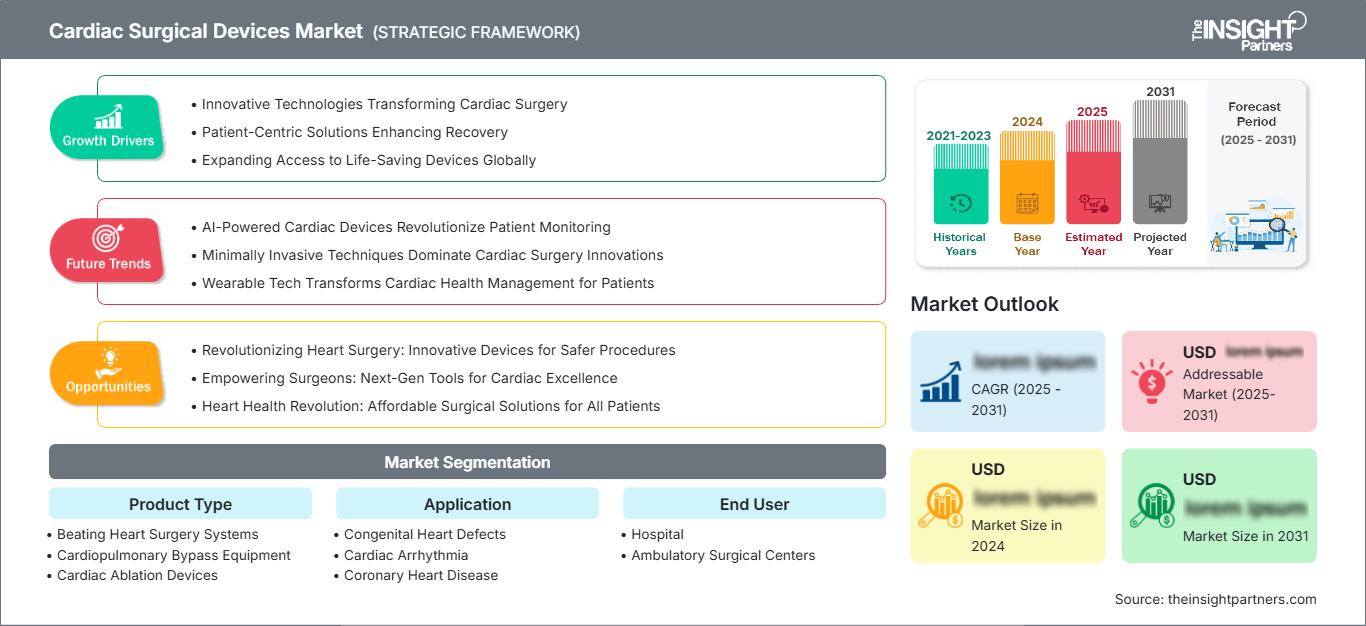
Cardiac Surgical Devices Market: Strategic Insights
Regional Insights
North America Cardiac Surgical Devices Market
North America retained an estimated 38–41% Cardiac Surgical Devices Market share in 2025 and is projected to grow at a CAGR of 6.6–7.2% during 2026–2034. The market features high procedure volume along with wide availability of cardiac surgeons, perfusionists, electrophysiologists, hybrid operating theaters, and imaging. Interoperability, availability of disposables, need for training, and total cost of procedure become more important factors in purchasing decisions.
The demand is driven by an aging population and high burden of coronary disease. The prevalence of coronary heart disease diagnosis in the adult population in the US was 5.0% in 2024, and heart disease continued to be the leading cause of mortality. Canada's contribution includes provincial programs for cardiology along with centralized hospital purchasing. The fastest-growing segment is represented by ablation systems, perfusion systems analytics, minimally invasive access products.
U.S. Cardiac Surgical Devices Market
The US represented an estimated 84–87% of North American revenue in 2025 and is expected to register a CAGR of 6.7–7.3% through 2034. About 805,000 heart attacks happen per year in the country, ensuring continued need for coronary procedures and surgery referrals. Research centers go on to utilize new cardiac mapping technology, pulsed field cardiac ablation, perfusion technology, and mechanical circulatory support.
Edwards Lifesciences Corporation, Medtronic plc, Abbott Laboratories, Boston Scientific Corporation, and ABIOMED, Inc. have large-scale commercial, clinical, or manufacturing presence for the US market. Hospitals are the primary buyers due to the requirement for critical care facilities and specialized manpower in open-heart surgeries. The ambulatory surgical centers have a limited scope that includes only certain rhythm management and minimally invasive cardiac procedures.
Europe Cardiac Surgical Devices Market
Europe accounted for an estimated 27–30% share in 2025 and is forecast to expand at a CAGR of 6.3–6.9% through 2034. Germany drives regional demand via its extensive hospital infrastructure, cardiac surgical capabilities, and advanced perfusion and electrophysiology technology adoption. The UK benefits from centralized purchasing and dedicated National Health Service Cardiac Centers.
France offers a combination of public reimbursement and developed cardiac devices ecosystem, whereas Italy and Spain create demand due to hospital upgrades and rising cases of arrhythmias. Approximately one fifth of EU's population is 65 years of age and above; hence, the patient pool with cardiovascular conditions increases. Nevertheless, adoption depends on capital budgets, health-technology assessment, and staffing considerations.
Medical Device Regulation evidence needs, post-market surveillance, and local tendering processes need to be considered by manufacturers. Equipment replacement cycles drive equipment demand, while procedure-related disposables generate ongoing income. Greatest growth opportunities exist for lower prime circuit technology, efficient data collection, ablation workflow efficiency, and systems that fit minimally invasive surgery.
APAC Cardiac Surgical Devices Market
Asia Pacific held an estimated 22–25% share in 2025 and is projected to record a CAGR of 8.4–9.1% through 2034. China leads regional revenue, followed by Japan, while India, South Korea, and Australia support expanding demand through hospital construction, insurance coverage, and specialist training.
China’s reported adult coronary heart disease prevalence was 758 per 100,000, reinforcing long-term procedural requirements. Japan favors premium, evidence-supported systems, while India presents opportunities for cost-adapted equipment and consumables. Local manufacturing, regulatory harmonization, and public cardiovascular programs will influence supplier access and pricing.
Middle East & Africa Cardiac Surgical Devices Market
The Middle East and Africa region is expected to expand at a CAGR of 6.0–6.7% during 2026–2034. Saudi Arabia leads demand through tertiary hospital investment, specialist recruitment, and health-system transformation. The UAE supports advanced private hospitals and medical tourism, while South Africa maintains the region’s most developed mixed public-private cardiac infrastructure.
Elsewhere, limited perfusion staffing and concentrated surgical capacity constrain adoption. Energy-funded infrastructure spending in Gulf countries supports high-acuity cardiac centers, whereas the Rest of MEA requires durable equipment, dependable consumable supply, clinical training, and service models adapted to dispersed facilities and constrained budgets.
Segmentation Analysis
Product Type
Product Type is projected to record an overall CAGR of 6.9–7.5% during 2026–2034. The Cardiac Surgical Devices Market scope across this segment includes capital systems, energy-delivery platforms, circuitry, oxygenation components, and procedure-specific consumables. Adoption depends on installed equipment compatibility, clinical evidence, procedural throughput, maintenance support, and recurring-disposable economics. Connected platforms and standardized setups are gaining priority as hospitals seek greater consistency and traceability.
- Beating Heart Surgery Systems: Demand is concentrated in coronary revascularization procedures where clinicians seek to avoid cardiopulmonary bypass, reduce physiological stress, and stabilize the operative field during technically demanding anastomoses.
- Cardiopulmonary Bypass Equipment: This category remains strategically central to open cardiac surgery, supported by replacement cycles, monitoring upgrades, oxygenator integration, and the requirement for reliable circulation during complex procedures.
- Cardiac Ablation Devices: Adoption is accelerating as electrophysiology programs expand treatment capacity, incorporate advanced mapping, and evaluate nonthermal energy approaches designed to improve workflow efficiency and tissue selectivity.
- Perfusion Disposables: Recurring requirements for oxygenators, tubing sets, reservoirs, filters, cannulae, and related components create predictable demand linked directly to procedure volumes and installed perfusion-system utilization.
Application
Application is anticipated to register a CAGR of 7.0–7.6% during 2026–2034. Demand varies by disease prevalence, intervention timing, patient complexity, and treatment setting. Coronary heart disease sustains established surgical volumes, while cardiac arrhythmia is gaining strategic importance through ablation innovation. Congenital procedures require specialized sizing and configurations, while congestive heart failure creates demand for complex surgery, temporary support, and multidisciplinary treatment pathways.
- Congenital Heart Defects: Specialized pediatric and adult congenital centers require adaptable perfusion circuits, cannulation products, monitoring technologies, and devices suitable for smaller anatomy and technically complex corrective procedures.
- Cardiac Arrhythmia: Rising electrophysiology referrals support demand for mapping-enabled ablation systems, catheters, energy generators, and integrated procedural tools addressing persistent or treatment-resistant rhythm disorders.
- Coronary Heart Disease: High clinical prevalence sustains demand for bypass equipment, beating-heart stabilization systems, perfusion consumables, vascular access technologies, and perioperative monitoring across established surgical centers.
- Congestive Heart Failure: Advanced disease creates requirements for surgical correction, circulatory support, hemodynamic monitoring, ablation, and bridge-to-recovery or bridge-to-transplant technologies within specialized programs.
End User
End User demand is forecast to advance at a CAGR of 6.8–7.4% during 2026–2034. Hospitals remain the principal setting because open cardiac surgery requires intensive care, blood management, perfusion staffing, imaging, and emergency support. Ambulatory surgical centers are positioned for selected lower-risk procedures, but expansion depends on reimbursement, patient-selection protocols, anesthesia capability, and access to immediate hospital transfer.
- Hospital: Hospitals dominate procurement of capital equipment and disposables because they manage complex cardiac operations, emergency cases, inpatient recovery, intensive-care monitoring, and multidisciplinary cardiovascular programs.
- Ambulatory Surgical Centers: These facilities present a scaling opportunity for selected rhythm-management and minimally invasive procedures where shorter recovery, standardized workflows, and appropriate patient risk profiles permit outpatient delivery.
Opportunity Snapshot
| End User | Revenue Contribution (High/Medium/Low) | Trend Tag | Adoption Stage |
| Hospital | High | Hybrid Suites | Mature |
| Ambulatory Surgical Centers | Medium | Outpatient Ablation | Scaling |
Cardiac Surgical Devices Market Growth Drivers and Impact Analysis
Expanding Burden of Surgically Relevant Cardiovascular Disease
Cardiovascular disease continues to be the top killer around the world, with the risk pool shifting toward older and more metabolically prone cohorts. Cardiovascular disease, rhythm disorders, structural anomalies, and heart failure generate distinct, but complementary demand pools for percutaneous, surgical, and ablation procedures, as well as cardiovascular support products. Epidemiological trends globally cannot be equated with surgical need, because the decision to diagnose, refer, specialize, and afford a procedure varies. However, as screening is more common and post-cardiac-event survivability rises, the population that requires more difficult follow-up treatments becomes larger. This situation provides advantages for the manufacturers of cardiovascular devices. The greatest benefits will be realized where there is a confluence of more diagnostics, surgical capacity, electrophysiological laboratories, intensive care beds, and skilled personnel.
Shift Toward Integrated and Reproducible Surgical Workflows
There is a move away from standalone devices towards networked procedural ecosystems in hospitals that automate data capture, circuit setup, mapping, and decision making. Perfusion offers the possibility of interoperability to reduce the need for manual documentation and increase traceability across bypasses. The use of ablation procedures that involve both mapping and energy delivery reduces equipment switching and may improve laboratory efficiency. These features affect the purchasing process as clinical departments are starting to measure not only the cost but also the duration of the procedure, staff burden, compatibility with disposables, training needs, and data system compatibility. Providers of equipment, disposables, software, education, and technical service will have an opportunity to develop more in-depth relationships and ongoing income streams.
Expansion of Cardiac Infrastructure in Emerging Health Systems
Investment in tertiary hospitals across China, India, Southeast Asia, Saudi Arabia, and the UAE is expanding the addressable base for advanced cardiac devices. For new cardiac centers to be developed, there will be a need for full operating environments that involve the heart lung machine, oxygenators, monitoring devices, ablation systems, cannulas, and training. In mature markets, this represents more opportunity through projects than replacement needs. However, purchasing is often driven by cost efficiency and sustainability. Companies that incorporate the modularity of their equipment along with the localized production of consumables, financing, preventative maintenance, and training have an easier time overcoming adoption obstacles. There is much more market potential beyond just the capital sale, as there is a need for disposables and servicing from the deployed platforms.
Cardiac Surgical Devices Market Future Trends
Nonthermal Ablation Will Reshape Electrophysiology Portfolios
Cardiac Surgical Devices Market trends increasingly favor pulsed-field ablation because nonthermal energy can selectively affect myocardial tissue while reducing exposure to complications associated with heat-based ablation. Future generations will have high density mapping, multiple energy types, automated lesions evaluation and catheters designed for treating arrhythmias of both atria and ventricles. Future competition will not be about generator efficiency but rather about workflow compatibility, wider population evidence and laboratory efficiency. The indication extension, real-world database creation and physician training will become a key area of investment. With growing use, the buying departments will evaluate catheter usage, procedure time, mapping compatibility, safety outcomes and overall cost of treatment per each patient, rather than energy delivery alone.
Digital Perfusion Will Advance Toward Predictive Decision Support
The Cardiac Surgical Devices Market forecast suggests that future perfusion systems will include automated record keeping, procedure alerting according to protocol, trend monitoring, remote troubleshooting, and standardized data transfer from the information system of hospitals. The next phase will involve using the acquired procedure data for early detection of discrepancies in pressure, oxygenation, temperature, flow rate, and hematological data before developing any adverse patterns. The adoption will be cautious due to the need for proper validation of prediction capabilities, transparency of logic used, cybersecurity protection measures, and the scope of responsibilities of clinicians. The hospitals will favor those systems which would increase the thoroughness of documenting the process and following protocol without increasing the number of false alarms.
Cardiac Surgical Devices Market Opportunities
Localized Manufacturing and Service Networks in Asia Pacific
Asia Pacific offers an actionable opportunity for manufacturers able to balance international quality standards with regionally appropriate pricing. Local production of tubing sets, reservoirs, catheters, and selected components can shorten lead times, reduce import exposure, and improve tender competitiveness. Investment should extend beyond assembly to supplier qualification, sterilization capacity, regulatory expertise, and clinical training. Partnerships with major cardiac hospitals can support evidence generation and reference-site development. Companies should also create tiered product configurations for national centers, provincial hospitals, and private providers. A localized model can strengthen recurring-disposable economics while supporting greater installed-equipment penetration, particularly in China, India, and rapidly expanding Southeast Asian healthcare systems.
Procedure-Specific Platforms for Ambulatory Cardiac Care
Selected arrhythmia and minimally invasive cardiac procedures are gradually moving toward shorter-stay and outpatient pathways. Suppliers can address this transition by designing compact platforms, simplified setup sequences, predictable disposable kits, and remote service capabilities appropriate for ambulatory surgical centers. Investment decisions should be guided by reimbursement, anesthesia requirements, patient-selection criteria, emergency-transfer standards, and procedure economics. The opportunity is not to transfer open-heart surgery into outpatient facilities, but to support defined interventions that can be delivered safely with appropriate infrastructure. Successful platforms will reduce room turnover time, minimize training complexity, and integrate documentation. Early engagement with payers, physicians, and facility operators can establish scalable care models.
Recent Developments
- August 2026: Medtronic plc received an expanded CE Mark indication for the Affera Mapping and Ablation System with Sphere-9 Catheter to treat ventricular tachycardia and premature ventricular complexes. The dual-energy catheter combines pulsed-field and radiofrequency ablation with high-definition mapping, expanding the platform beyond atrial arrhythmia treatment and supporting ongoing ventricular-ablation clinical development.
- June 2026: Edwards Lifesciences Corporation received US FDA 510(k) clearance for the ECLIPTIS Left Atrial Appendage Exclusion System, marking the company’s entry into surgical left atrial appendage management. The clearance gives Edwards an adjacent offering that can be commercialized through its established surgical valve relationships and cardiac surgery infrastructure.
- July 2025: Boston Scientific Corporation received US FDA approval for expanded labeling of the FARAPULSE Pulsed Field Ablation System for pulmonary vein and posterior-wall ablation in patients with drug-refractory, symptomatic persistent atrial fibrillation. The approval covered the FARAWAVE and FARAWAVE NAV catheters and was supported by the ADVANTAGE AF clinical trial.
Frequently Asked Questions

- Comprehensive Market Sizing and Forecast Analysis
- Detailed Segmentation Analysis
- In-Depth Market Dynamics Assessment
- Regional and Country-Level Insights
- Competitive Landscape and Company Benchmarking
- Strategic Business Intelligence
Recent Reports
Testimonials

The Insight Partners' SCADA System Market report is comprehensive, with valuable insights on current trends and future forecasts. The team was highly professional, responsive, and supportive throughout. We are very satisfied and highly recommend their services.
RAN KEDEM Partner, Reali Technologies LTDs
I requested a report on a very specific software market and the team produced the report in a few days. The information was very relevant and well presented. I then requested some changes and additions to the report. The team was again very responsive and I got the final report in less than a week.
JEAN-HERVE JENN Chairman, Future Analytica
We worked with The Insight Partners for an important market study and forecast. They gave us clear insights into opportunities and risks, which helped shape our plans. Their research was easy to use and based on solid data. It helped us make smart, confident decisions. We highly recommend them.
PIYUSH NAGPAL Sr. Vice President, High Beam Global
The Insight Partners delivered insightful, well-structured market research with strong domain expertise. Their team was professional and responsive throughout. The user-friendly website made accessing industry reports seamless. We highly recommend them for reliable, high-quality research services
YUKIHIKO ADACHI CEO, Deep Blue, LLC.
This is the first time I have purchased a market report from The Insight Partners.While I was unsure at first, I visited their web site and felt more comfortable to take the risk and purchase a market report.I am completely satisfied with the quality of the report and customer service. I had several questions and comments with the initial report, but after a couple of dialogs over email with their analyst I believe I have a report that I can use as input to our strategic planning process.Thank you so much for taking the extra time and making this a positive experience.I will definitely recommend your service to others and you will be my first call when we need further market data.
JOHN SUZUKI President and Chief Executive Officer, Board Director, BK Technologies
I wish to appreciate your support and the professionalism you displayed in the course of attending to my request for information regarding to infectious disease IVD market in Nigeria. I appreciate your patience, your guidance, and the fact that you were willing to offer a discount, which eventually made it possible for us to close a deal. I look forward to engaging The Insight Partners in the future, all thanks to the impression you have created in me as a result of this first encounter.
DR CHIJIOKE ONYIA MANAGING DIRECTOR, PineCrest Healthcare Ltd.Reason to Buy
- Informed Decision-Making
- Understanding Market Dynamics
- Competitive Analysis
- Identifying Emerging Markets
- Customer Insights
- Market Forecasts
- Risk Mitigation
- Boosting Operational Efficiency
- Strategic Planning
- Investment Justification
- Tracking Industry Innovations
- Aligning with Regulatory Trends





 Get Free Sample for