
Cardiomyopathy Medication Market Size, Share & Forecast by 2034
Coverage: By Type (Dilated Cardiomyopathy, Restrictive Cardiomyopathy, Unclassified Cardiomyopathy); Treatment (Anticoagulants, Antiarrhythmics, Anti-Hypertensives, Cardiac Glycosides, Diuretics); End User (Homecare, Hospitals and Clinics, Others), and Geography (North America, Europe, Asia Pacific, and South and Central America)
- Status : Data Released
- Report Code : TIPRE00008234
- Category : Life Sciences
- No. of Pages : 150
- Available Report Formats :


- Last update date : September 08, 2026


2025 Market Size
US$ 9.60 Bn
Base year value
2034 Forecast
US$ 14.41 Bn
Projected by 2034
CAGR 2026-2034
4.62 %
Growth rate
Addressable Market
US$ 109.03 Bn
(2026-2034)
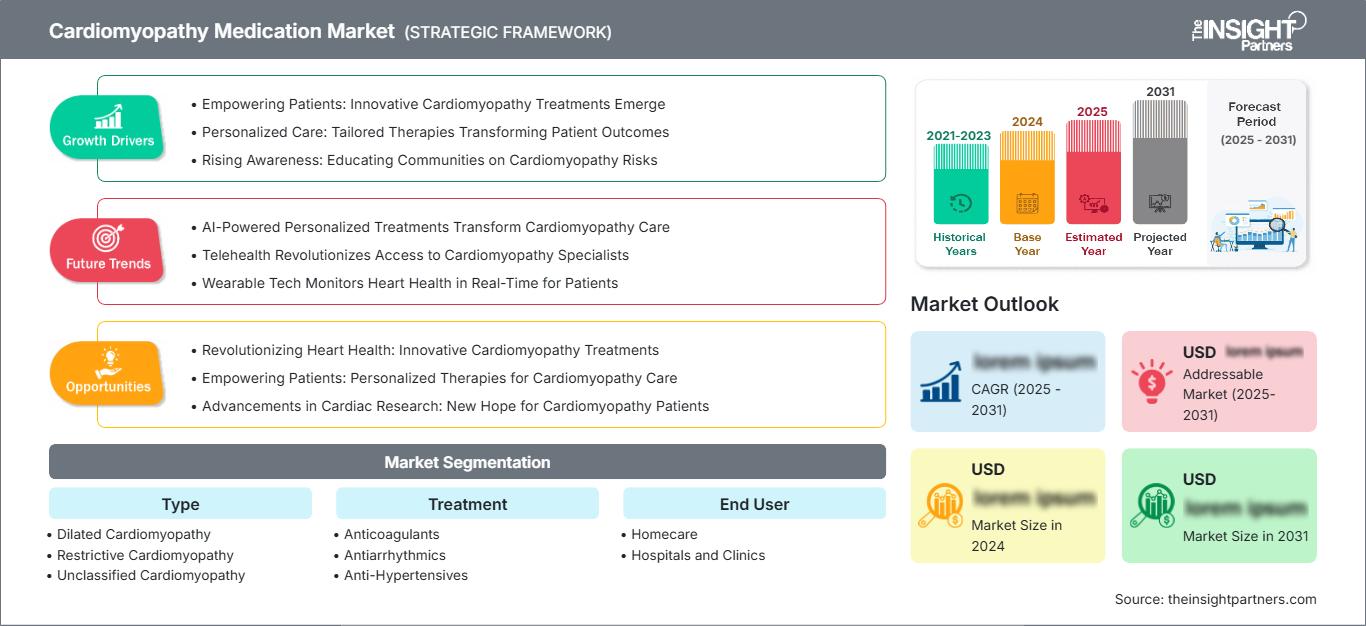
The Cardiomyopathy Medication Market was valued at US$ 9.60 Billion in 2025 and is projected to reach US$ 14.41 Billion by 2034, expanding at a CAGR of 4.62% during 2026–2034. Commercial expansion is supported by wider cardiomyopathy diagnosis, long-term pharmacological management, improved genetic screening, and growing use of disease-specific therapies alongside anticoagulants, antiarrhythmics, antihypertensives, cardiac glycosides, and diuretics.
North America remains central to the Cardiomyopathy Medication Market size outlook, with a modelled CAGR of 4.3–4.8% during 2026–2034. Its position reflects established cardiology networks, access to echocardiography and genetic testing, specialist prescribing, and comparatively rapid uptake of targeted therapies. The American Heart Association reported that 127.9 million US adults had some form of cardiovascular disease during 2017–2020, reinforcing the region’s substantial treatment pool.
Cardiomyopathy Medication Market Assessment and Insights
- North America: The region accounted for a modelled 38–42% share in 2025 and is expected to record a CAGR of 4.3–4.8% during 2026–2034, supported by specialist access, molecular testing, and reimbursement for chronic cardiovascular care.
- US: The country represented 84–88% of North American revenue in 2025 and is projected to expand at a CAGR of 4.4–4.9% during 2026–2034.
- Europe: Europe held a modelled 27–31% share in 2025 and is anticipated to register a CAGR of 4.0–4.5% through 2034. Germany leads regional demand, followed by the UK, France, Italy, and Spain.
- Asia Pacific: Asia Pacific represented a modelled 21–25% share in 2025 and is forecast to grow at a CAGR of 5.3–5.9% during 2026–2034, led by China, Japan, India, South Korea, and Australia.
- Largest Segment: Dilated cardiomyopathy held a modelled 52–56% market share in 2025 and is expected to expand at a CAGR of 4.5–5.0% during 2026–2034.
- High Growth Segment: Hospitals and clinics accounted for a modelled 68–72% market share in 2025 and are projected to register a CAGR of 4.8–5.3% during 2026–2034.
- Key companies analyzed in detail: Array BioPharma Inc., AstraZeneca PLC, Capricor Therapeutics, Inc., F. Hoffmann-La Roche Ltd, Ionis Pharmaceuticals, Inc., Janssen Products, LP, Merck & Co., Inc., Pfizer Inc., Sanofi-Aventis U.S. LLC, and Cytokinetics, Incorporated.
Source: The Insight Partners' analysis based on proprietary research, government publications, company annual reports, investor presentations, industry databases, and expert interviews.
Advancements in therapeutic development have advanced from general symptom relief to mechanism-based therapies, combinations, RNA-based drugs, cardiac myosin modulation, and novel gene or cellular therapy research. Manufacturing considerations are thus evolving away from large scale oral solid dose manufacturing toward specific biologics, oligonucleotides, viral vector production, and sophisticated cold chain requirements. Generic diuretics, anti-hypertensives, anticoagulants, and anti-arrhythmics still contribute significant sales due to the need for multiple medications to treat the condition over many years in patients.
Further growth will arise out of Asia Pacific and select Middle Eastern regions where cardiac imaging, insurance coverage, and referral are becoming more advanced. There is funding towards genetically stratified patient groups, digital clinical trial recruitment, decentralized monitoring, and biomarkers that can lower development risks. Clinical development of treatments for rare inherited cardiomyopathies may receive regulatory designations, despite the high standards necessary for evidence-based medicine and functional improvements, manufacturing reproducibility, and ongoing heart health monitoring post-therapy.
Cardiomyopathy Medication Market Report Scope
| Report Attribute | Details |
|---|---|
| Market size in 2025 | US$ 9.60 Billion |
| Market Size by 2034 | US$ 14.41 Billion |
| Global CAGR (2026 - 2034) | 4.62% |
| Historical Data | 2021-2024 |
| Forecast period | 2026-2034 |
Cardiomyopathy Medication Market Analysis
Increase in diagnosis and prolongation of treatment drive growth of the Cardiomyopathy Medication Market. The demand starts with general practitioners' identification of symptoms such as shortness of breath, heart arrhythmias, swelling, or hereditary predisposition and goes through medical imaging, genetic counseling, specialist prescriptions, dispensing, and follow-up. The supply chain includes pharmaceutical manufacturers, biotechnological developers, contract research organizations, hospital pharmacies, distributors, laboratories, payers, and patient support service providers.
Supply is reliable with respect to proven generic types, however, new advanced technologies have certain limitations. Synthetic RNA-based medications need special production processes, while gene therapy and cell-based approaches need controlled production processes, potency testing, and prepared treatment centers. Such demands raise development costs but also allow for differentiation based on clinical data, delivery systems, and reliable manufacturing.
According to the Cardiomyopathy Medication Market report, the competition is structured as diversified pharmaceutical corporations and cardiovascular biotechnology companies. AstraZeneca PLC and Ionis Pharmaceuticals, Inc. have developed a partnership for eplontersen for transthyretin-mediated amyloid cardiomyopathy, while Pfizer Inc. has its proven cardiovascular expertise and took over the Array BioPharma pipeline. Cytokinetics, Incorporated has enriched the mechanism-specific segment with the drug inhibiting cardiac myosin.
Increasingly, competitive positioning relies on genotype identification, proven functional benefit, and compatibility with contemporary standards of care. Capricor Therapeutics, Inc. is working on a cell-based approach for Duchenne muscular dystrophy cardiomyopathy, while large corporations still have an edge in international regulatory processes, clinical development, marketing, and physician education. Portfolio selections will be made in favor of drugs that improve outcomes over multidrug therapy.
● REPORT CUSTOMIZATION
Tailor This Report To Align With Your Specific Business Requirements
This report can be customized to align precisely with your business objectives, scope, and target markets. Customization options include tailored segmentation, geography, competitive analysis, and strategic insights to support informed decision-making.
Customize This Report →WHAT YOU CAN ADJUST
- ● Segmentations
- ● Geography
- ● Competitive Analysis
- ● Language Preferences
Cardiomyopathy Medication Market: Strategic Insights
Regional Insights
North America Cardiomyopathy Medication Market
North America represented a modelled 38–42% of worldwide revenue in 2025 and is projected to expand at a CAGR of 4.3–4.8% during 2026–2034. The Cardiomyopathy medication Market share includes the availability of widespread echocardiography, well-established heart failure pathways, availability of genetic counseling programs, high levels of clinical trials, and insurance for chronic cardiovascular drugs. This region is further supported by specialty centers that can offer advanced treatments and cardiac surveillance.
There is growing segmentation of demand based on phenotype, genotype, ventricular function, and arrhythmia risk. The US forms the biggest commercial market while Canada adds through its universal healthcare coverage and academic cardiovascular programs. Mexico represents a smaller but growing market owing to the increasing capabilities of private hospitals in diagnostics. Adoption is affected by formulary management, pre-authorization, safety surveillance, and comparative effectiveness of novel drugs along with standard therapy.
U.S. Cardiomyopathy Medication Market
The US accounted for a modelled 84–88% of North American revenue in 2025 and is expected to grow at a CAGR of 4.4–4.9% during 2026–2034. High levels of cardiovascular expense, specialized networks, genetic testing, and research provide evidence of demand. The American Heart Association recorded 941,652 deaths from heart disease in 2022 and cardiovascular expenses totaling US$ 417.9 billion in 2020-2021, thus representing the broader context of the cardiomyopathy problem.
Organizational landscape includes both traditional manufacturing companies and specialized biotechnology firms. Cytokinetics, Incorporated gained FDA approval for aficamten for the treatment of symptomatic obstructive hypertrophic cardiomyopathy in December 2025, while Capricor Therapeutics, Inc. has explored the use of deramiocel for the treatment of Duchenne muscular dystrophy cardiomyopathy. Increasingly application strategy incorporates a combination of hospital initiation and out-patient dosing and titration using echo-cardiography and specialty pharmacy.
Europe Cardiomyopathy Medication Market
Europe held a modelled 27–31% share in 2025 and is projected to record a CAGR of 4.0–4.5% during 2026–2034. Germany’s lead stems from its large treated patient population, its well-established cardiology practice, and its purchasing capabilities. The UK provides excellent genomic research and specialist centers for referrals, even if the health-technology assessment process and budgeting act as limitations on acceptance.
France capitalizes on its rare-disease network, Italy on its expertise in inherited cardiomyopathies, and Spain on trial inclusion. These countries promote phenotype-specific therapy through imaging, genetic testing, and multidisciplinary care. Their purchasing environments recognize clinical value, rather than fast adoption alone.
Germany is projected to maintain its leadership position in the region, while the UK, France, Italy, and Spain offer complementary business opportunities. The harmonized review process facilitates multinational product launches, but reimbursement varies by country. Companies need to develop their evidence package according to survival, hospitalization, functional status, quality of life, and resource utilization endpoints.
APAC Cardiomyopathy Medication Market
Asia Pacific accounted for a modelled 21–25% share in 2025 and is expected to register a CAGR of 5.3–5.9% during 2026–2034. China leads through hospital scale and improving diagnostic capacity, while Japan contributes specialist care, high medicine access, and an aging population. India adds volume through expanding cardiac centers and generic availability.
South Korea supports precision-medicine research, and Australia provides advanced referral networks and trial infrastructure. Public investment in cardiovascular services, wider insurance enrollment, urban hospital construction, and increasing use of genetic testing support regional expansion, although affordability and uneven specialist distribution remain important access constraints.
Middle East & Africa Cardiomyopathy Medication Market
The Middle East & Africa region is projected to expand at a CAGR of 3.7–4.2% during 2026–2034. Saudi Arabia leads through hospital investment, specialist recruitment, and national health transformation initiatives. The UAE supports premium private care and medical tourism, while South Africa provides the strongest specialist base in sub-Saharan Africa.
Demand elsewhere remains constrained by limited imaging, fragmented referral pathways, and out-of-pocket expenditure. Infrastructure investment, cardiac-center development, medicine procurement reform, and improved supply resilience can increase diagnosis and treatment continuity. The Rest of MEA represents a longer-term opportunity centered on essential cardiovascular medicines rather than high-cost precision therapies.
Segmentation Analysis
Type
Type is projected to record a modelled CAGR of 4.4–4.9% during 2026–2034. The Cardiomyopathy Medication Market scope by type reflects substantial differences in ventricular remodeling, hemodynamic impairment, arrhythmic risk, and underlying genetics. Dilated disease generates the broadest pharmacological demand, whereas restrictive and unclassified cases require individualized combinations, specialist interpretation, and repeated reassessment as diagnostic classification evolves.
- Dilated Cardiomyopathy: This category holds the leading position because ventricular dilation and systolic impairment frequently require sustained multidrug therapy, rhythm management, anticoagulation assessment, hospitalization prevention, and family-based genetic evaluation.
- Restrictive Cardiomyopathy: Demand is smaller but clinically complex, with treatment focused on congestion, rhythm disturbances, thromboembolic risk, and underlying causes while avoiding excessive preload reduction in vulnerable patients.
- Unclassified Cardiomyopathy: This category captures diagnostically uncertain or overlapping phenotypes, creating demand for adaptable symptom control, repeated imaging, genetic investigation, and medication revision as clinical evidence clarifies disease mechanisms.
Treatment
Treatment is anticipated to expand at a modelled CAGR of 4.3–4.8% during 2026–2034. Prescribing is typically combinational and adjusted according to ventricular function, rhythm status, blood pressure, fluid overload, thromboembolic risk, and tolerability. Established drug classes remain commercially important even as mechanism-specific products enter selected indications because supportive pharmacotherapy continues across most disease stages.
- Anticoagulants: Utilization is concentrated among patients with atrial fibrillation, intracardiac thrombus, prior embolic events, or elevated thromboembolic risk, making safety monitoring and individualized risk assessment strategically important.
- Antiarrhythmics: These medicines address atrial and ventricular rhythm disturbances that can worsen symptoms or increase sudden-event risk, supporting specialist-led prescribing alongside devices, ablation, and continuous rhythm surveillance.
- Anti-Hypertensives: Demand benefits from frequent cardiovascular comorbidity and the need to manage afterload, neurohormonal activation, and blood pressure while preserving tolerability in patients with impaired cardiac output.
- Cardiac Glycosides: Use remains selective because of narrow therapeutic margins, but these agents retain relevance for rate control or symptomatic support when clinicians require carefully monitored adjunctive pharmacological management.
- Diuretics: Diuretics maintain high prescription volume by relieving pulmonary and peripheral congestion. Their broad availability and rapid symptomatic utility make them essential, although dosing requires renal and electrolyte monitoring.
End User
End User is forecast to register a modelled CAGR of 4.6–5.1% during 2026–2034. Hospitals and clinics lead treatment initiation, diagnostic confirmation, acute stabilization, and advanced-therapy monitoring. Homecare is gaining strategic importance as digital follow-up, medication delivery, blood-pressure monitoring, symptom reporting, and adherence services shift appropriate elements of long-term management away from inpatient settings.
- Homecare: Home-based management is scaling through prescription delivery, remote vital-sign monitoring, virtual consultation, and caregiver-supported adherence, particularly for stable patients requiring long-duration multidrug regimens and frequent dose adjustment.
- Hospitals and Clinics: These settings generate the largest revenue contribution because they concentrate imaging, genetic testing, acute care, specialist prescribing, infusion capability, clinical trials, and monitoring for complex or advanced therapies.
Opportunity Snapshot
| End User | Revenue Contribution (High/Medium/Low) | Trend Tag | Adoption Stage (Emerging/Scaling/Mature) |
| Homecare | Medium | Remote Monitoring | Scaling |
| Hospitals and Clinics | High | Precision Care | Mature |
Cardiomyopathy Medication Market Growth Drivers and Impact Analysis
Earlier Diagnosis Through Imaging and Genetic Testing
Improved access to echocardiography, cardiac magnetic resonance, biomarker testing, and multigene panels is expanding the identifiable patient pool before irreversible ventricular deterioration. Also, family screening enables physicians to follow up on asymptomatic mutation carriers and take action should any structural or functional changes appear. In terms of the commercial aspect, early diagnosis will increase the period of treatment and increase referrals to specialists along with enabling stratification into programs specific to mechanism of action. Around two million individuals in the US are estimated to be affected by cardiomyopathy, and many of them might have a genetic cause behind their disease. This means increased need for existing supportive drugs.
Persistent Need for Multidrug Cardiovascular Management
Cardiomyopathy commonly produces overlapping requirements for congestion control, blood-pressure management, rhythm stabilization, anticoagulation assessment, and heart-failure therapy. Most patients consequently remain exposed to several medicine classes rather than a single product. The continued intensity of treatment ensures repeat prescribing and reduces the risk of displacing existing generics upon entry of new therapeutics. A pathway-specific treatment will affect one particular pathway in a disease, but background medicines are kept for other symptoms or comorbidities. There is an opportunity for manufacturers to gain value through creation of combination data, improving titration capability, managing the drug interactions issues, and integrating the specialty drugs with pharmacy channel. Modern clinical trials have shown that results should be compared with better standard treatments.
Specialty Cardiovascular Pipelines Targeting Disease Mechanisms
The focus of investments is moving away from general management of symptoms and towards therapies that target sarcomere hypercontractility, protein misfolding, gene variants, inflammatory responses, and cardiomyocyte dysfunction. This trend will expand the investment opportunity space beyond traditional oral therapies and will allow for higher-priced therapies in genetically or phenotypically stratified patient groups. There are several promising clinical-stage therapies such as cardiac myosin inhibitors, antisense therapies, AAV gene replacement therapy, and experimental cardiac cellular therapies. However, the success of such therapies hinges upon proving sustained functional improvement, proper safety monitoring, scalable manufacturing, and payer support. Positive results will create new therapeutic classes, whereas failures or partial successes will help fine-tune future strategies.
Cardiomyopathy Medication Market Future Trends
Genotype-Directed Treatment Pathways
Cardiomyopathy Medication Market trends will increasingly reflect genotype-directed treatment pathways rather than phenotype-only prescribing. Evaluating treatments tailored for BAG3, MYBPC3, PKP2, PLN, and many others has become easier with the advent of treatments developed for mutations associated with the respective diseases, thereby allowing for smaller yet more focused clinical groups. Specialized centers will have to coordinate genetic counseling, follow-up tests, interpretations of mutations, and registries to ascertain eligibility. The commercial viability of such treatments will require coordinating their diagnostic programs with referral centers even before the launch of their products. Genotype-based treatments may affect therapy, monitoring, screening, and reimbursement policies, among others.
Evidence Generation Through Remote Cardiac Monitoring
The Cardiomyopathy Medication Market Forecasts suggest that wearable rhythm sensors, connected blood-pressure devices, digital symptom tracking, and home weight monitoring will become more closely integrated with cardiomyopathy treatment. These tools can identify decompensation, arrhythmia, hypotension, or adherence problems between clinic visits and provide longitudinal evidence beyond periodic imaging. Pharmaceutical companies are likely to incorporate decentralized measurements into trials, patient-support programs, and post-authorization studies. The strategic value lies in demonstrating real-world persistence, reducing avoidable admissions, and supporting safer dose optimization. Adoption will require validated endpoints, interoperable data systems, clinician workflow integration, cybersecurity safeguards, and reimbursement models that compensate providers for reviewing continuous information rather than episodic encounters.
Cardiomyopathy Medication Market Opportunities
Integrated Diagnostic and Treatment Access Programs
Manufacturers can invest in programs that connect family-history assessment, genetic testing, cardiac imaging, specialist referral, and treatment navigation. Such infrastructure addresses a central commercial barrier: eligible patients may remain undiagnosed or be treated under broad heart-failure pathways without etiological classification. Partnerships with hospitals, laboratories, advocacy organizations, and specialty pharmacies can shorten the interval between symptoms, diagnosis, and appropriate therapy. Programs should prioritize transparent eligibility criteria, counseling, privacy protection, and equitable geographic access. The resulting diagnostic funnel can support trial enrollment, launch readiness, and post-market evidence while improving physicians’ ability to differentiate inherited, infiltrative, inflammatory, and idiopathic disease.
Localized Access Models for High-Growth Health Systems
Asia Pacific and selected Middle Eastern markets offer opportunities for tiered pricing, local evidence generation, regional manufacturing partnerships, and specialist education. Investors should focus on metropolitan cardiac centers first, then extend access through referral networks and remote follow-up. Product portfolios can combine affordable established medicines with precision therapies for well-characterized patients. Market entry should account for heterogeneous reimbursement, test availability, pharmacovigilance capacity, and cold-chain infrastructure. Companies that align clinical development with local genetic diversity and healthcare delivery patterns can establish durable positions. Actionable investment areas include diagnostic laboratories, specialty distribution, digital adherence support, and investigator-led registries that document treatment outcomes within regional populations.
Recent Developments
- July 2026: Ionis Pharmaceuticals, Inc. and AstraZeneca PLC reported that the Phase III CARDIO-TTRansform study of eplontersen in transthyretin-mediated amyloid cardiomyopathy did not meet its primary composite endpoint. The companies observed a nominally significant result in the prespecified monotherapy subgroup and reported no treatment effect among participants receiving stabilizer therapy at baseline.
- March 2026: Capricor Therapeutics, Inc. returned deramiocel to FDA review through a Class 2 resubmission supported by Phase III HOPE-3 evidence. The agency assigned an August 22, 2026, action date for the investigational cell therapy, which is being developed for cardiomyopathy associated with Duchenne muscular dystrophy.
- December 2025: Cytokinetics, Incorporated received FDA approval for MYQORZO, or aficamten, for adults with symptomatic obstructive hypertrophic cardiomyopathy to improve functional capacity and symptoms. The allosteric, reversible cardiac myosin inhibitor reduces hypercontractility and left ventricular outflow tract obstruction, with echocardiographic monitoring required because of heart-failure risk.
Frequently Asked Questions

- Comprehensive Market Sizing and Forecast Analysis
- Detailed Segmentation Analysis
- In-Depth Market Dynamics Assessment
- Regional and Country-Level Insights
- Competitive Landscape and Company Benchmarking
- Strategic Business Intelligence
Recent Reports
Testimonials

The Insight Partners provided valuable market intelligence that supported our global go-to-market strategy. Their team was professional, responsive, and attentive to our feedback, providing thoughtful analysis and helpful methodological clarifications throughout the project.
Junmo Kim Chief Financial Officer (CFO), Enertech Co., Ltd.
The Insight Partners' SCADA System Market report is comprehensive, with valuable insights on current trends and future forecasts. The team was highly professional, responsive, and supportive throughout. We are very satisfied and highly recommend their services.
RAN KEDEM Partner, Reali Technologies LTDs
I requested a report on a very specific software market and the team produced the report in a few days. The information was very relevant and well presented. I then requested some changes and additions to the report. The team was again very responsive and I got the final report in less than a week.
JEAN-HERVE JENN Chairman, Future Analytica
We worked with The Insight Partners for an important market study and forecast. They gave us clear insights into opportunities and risks, which helped shape our plans. Their research was easy to use and based on solid data. It helped us make smart, confident decisions. We highly recommend them.
PIYUSH NAGPAL Sr. Vice President, High Beam Global
The Insight Partners delivered insightful, well-structured market research with strong domain expertise. Their team was professional and responsive throughout. The user-friendly website made accessing industry reports seamless. We highly recommend them for reliable, high-quality research services
YUKIHIKO ADACHI CEO, Deep Blue, LLC.
This is the first time I have purchased a market report from The Insight Partners.While I was unsure at first, I visited their web site and felt more comfortable to take the risk and purchase a market report.I am completely satisfied with the quality of the report and customer service. I had several questions and comments with the initial report, but after a couple of dialogs over email with their analyst I believe I have a report that I can use as input to our strategic planning process.Thank you so much for taking the extra time and making this a positive experience.I will definitely recommend your service to others and you will be my first call when we need further market data.
JOHN SUZUKI President and Chief Executive Officer, Board Director, BK Technologies
I wish to appreciate your support and the professionalism you displayed in the course of attending to my request for information regarding to infectious disease IVD market in Nigeria. I appreciate your patience, your guidance, and the fact that you were willing to offer a discount, which eventually made it possible for us to close a deal. I look forward to engaging The Insight Partners in the future, all thanks to the impression you have created in me as a result of this first encounter.
DR CHIJIOKE ONYIA MANAGING DIRECTOR, PineCrest Healthcare Ltd.Reason to Buy
- Informed Decision-Making
- Understanding Market Dynamics
- Competitive Analysis
- Identifying Emerging Markets
- Customer Insights
- Market Forecasts
- Risk Mitigation
- Boosting Operational Efficiency
- Strategic Planning
- Investment Justification
- Tracking Industry Innovations
- Aligning with Regulatory Trends





 Get Free Sample for