
Catheter Stabilization Devices Market Size, Trends & Demand by 2034
Coverage: By Product (Arterial Securement Devices, Central Venous Catheter Securement Devices, Peripheral Securement Devices, Urinary Catheter Securement Devices, Chest Drainage Tube Securement Devices, Other Securement Devices); Application (Cardiovascular, Respiratory, Urological, Gastric, Radiology); End User (Hospitals, Homecare Settings, Others) , and Geography (North America, Europe, Asia Pacific, and South and Central America)
- Status : Data Released
- Report Code : TIPRE00004920
- Category : Life Sciences
- No. of Pages : 150
- Available Report Formats :


- Last update date : September 08, 2026


2025 Market Size
US$ 1.54 Bn
Base year value
2034 Forecast
US$ 2.77 Bn
Projected by 2034
CAGR 2026-2034
6.74 %
Growth rate
Addressable Market
US$ 19.48 Bn
(2026-2034)
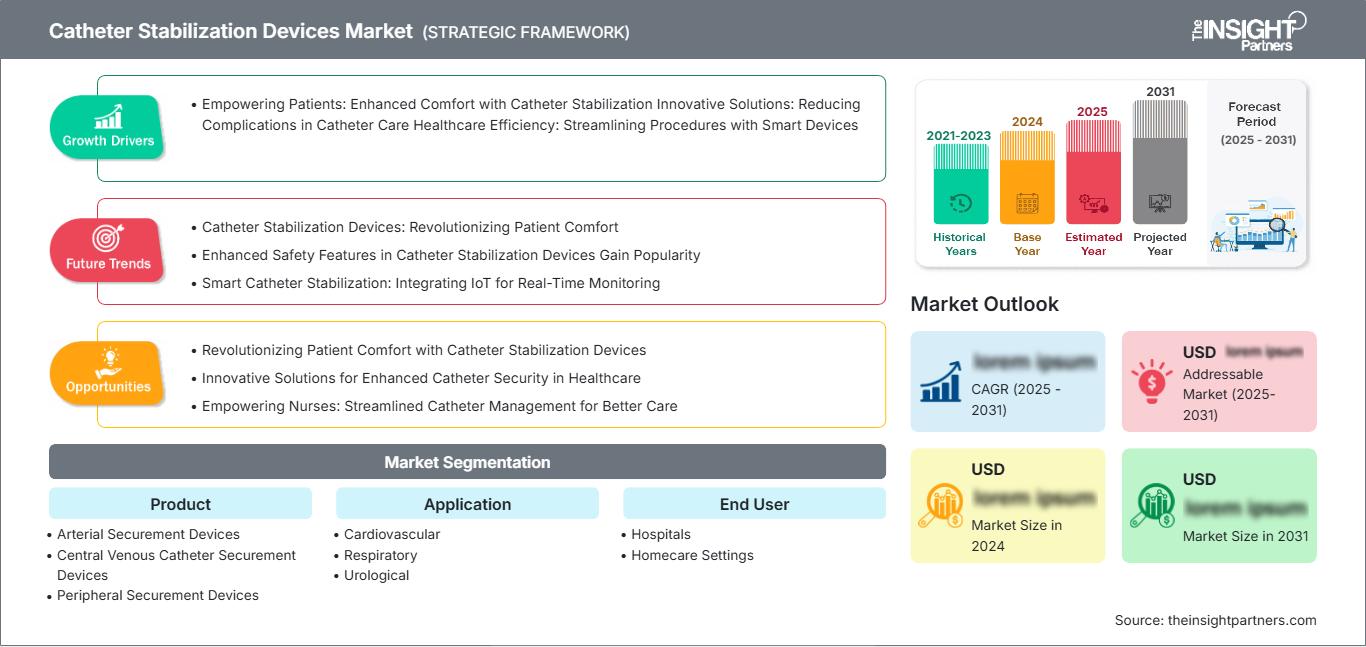
The Catheter Stabilization Devices Market was valued at US$ 1.54 Billion in 2025 and is projected to reach US$ 2.77 Billion by 2034. It is expected to record a CAGR of 6.74% during 2026–2034.Expansion is due to the increased clinical focus on preventing the movement, removal, disruption of treatment, and problems at the site of insertion of the catheter in vascular access, urine drainage, respiration, and interventional techniques.
North America is currently the dominant market, with the growth rate for the Catheter Stabilization Devices Market Size estimated at a modeled CAGR of 6.2–6.8% from 2026–2034. The high rate of usage of catheters, infection prevention programs in place, and the choice of sutureless devices drives demand. Hospitals in the United States are adopting the practice of choosing the devices since intravenous catheters taped in place may need replacement.
Catheter Stabilization Devices Market Assessment and Insights
- North America: North America represented a modelled 38–42% share in 2025 and is projected to grow at a CAGR of 6.2–6.8% during 2026–2034, supported by standardized vascular-access practices, infection surveillance, and strong supplier coverage.
- US: The US accounted for 82–86% of North American revenue in 2025 and is projected to record a CAGR of 6.3–6.9% during 2026–2034.
- Europe: Europe held a modelled 27–31% share in 2025 and is expected to expand at a CAGR of 5.8–6.4% during 2026–2034. Germany, the UK, France, Italy, and Spain lead adoption.
- Asia Pacific: Asia Pacific represented a modelled 21–25% share in 2025 and is anticipated to grow at a CAGR of 7.8–8.6% during 2026–2034. China, Japan, India, South Korea, and Australia are influential markets.
- Largest Segment: Peripheral securement devices held a modelled 30–34% market share in 2025 and are projected to expand at a CAGR of 6.5–7.1% during 2026–2034.
- High Growth Segment: Homecare settings represented a modelled 15–19% market share in 2025 and are forecast to grow at a CAGR of 8.0–8.8% during 2026–2034.
- Key companies analyzed in detail: Medtronic plc, Becton, Dickinson and Company, Solventum Corporation, B. Braun Melsungen AG, Baxter International Inc., Centurion Medical Products Corporation, Convatec Group Plc, Merit Medical Systems, Inc., ICU Medical, Inc., and TIDI Products, LLC.
Source: The Insight Partners' analysis based on proprietary research, government publications, company annual reports, investor presentations, industry databases, and expert interviews.
Product innovations are taking securement away from tape, sutures, and temporary fixation to sophisticated adhesives, stabilization dressings with securement integrated into them, and subcutaneous anchoring. Companies are constantly improving their products with integration of medical grade adhesives, breathable films, decreased retainers, and specific geometry of catheters. Portfolio innovations focus on changes in frequency of dressing, skin damage, speed of application by healthcare professionals, and versatility on different French sizes. Manufacturing involves knowledge of adhesive chemistry, non-wovens, shape molded retainers, ability to be sterilized and converting. Solvanta, BD, and Convatec provide various types of products covering vascular, urinary, drainage, and tube categories.
In the period from 2024 through 2034, purchasing decisions will gradually become linked to cost of therapy rather than cost of product itself. Localization of production in APAC, increasing numbers of home infusions and improved infection control in hospitals will increase addressable market. Peripheral Catheter Guideline for 2024 and Central Venous Catheter Guideline for 2026 developed by WHO emphasize standardization of insertion, maintenance, education, surveillance and care bundle.
Catheter Stabilization Devices Market Report Scope
| Report Attribute | Details |
|---|---|
| Market size in 2025 | US$ 1.54 Billion |
| Market Size by 2034 | US$ 2.77 Billion |
| Global CAGR (2026 - 2034) | 6.74% |
| Historical Data | 2021-2024 |
| Forecast period | 2026-2034 |
Catheter Stabilization Devices Market Analysis
The primary source of Catheter Stabilization Devices Market growth is the clinical need to maintain catheter position throughout therapy. Peripheral intravenous devices, central lines, arterial catheters, urinary catheters, and drainage tubes can fail when movement causes migration, kinking, infiltration, leakage, or dressing disruption. BD reports that up to 48% of tape-secured IV catheters develop complications such as phlebitis and infiltration.
Raw materials include silicone or acrylic adhesives, polymer films, fabrics, hydrocolloids, molded plastics, and release liners. The retainers and adhesive platforms are then assembled prior to packaging, sterilization, release, and distribution. Hence, the availability of the product is contingent upon its qualification of material, biocompatibility testing, sterilization, shelf life testing, and availability throughout the hospital buying network.
Competitive Catheter Stabilization Devices Market Report reveals that market differentiation includes catheter-specific fit, wear time, skin compatibility, securement performance, evidence, and portfolio diversity. Becton, Dickinson and Company is positioning StatLock in vascular, dialysis, drainage, epidural, and urinary applications whereas Solventum offers securement devices along with advanced dressings. B. Braun Melsungen AG is developing procedure-specific regional anesthesia securement devices.
Integrated Procedural Retention using SnapFix is the focus of Merit Medical Systems, Inc., while Convatec Group Plc offers Cath-Fix and Drain-Fix. Medtronic plc, Baxter International Inc., ICU Medical, Inc., Centurion Medical Products Corporation, and TIDI Products, LLC leverage existing clinical routes and catheter care product lines. Strategic investments involve distinctive adhesives, reduced profile, kits, evidence creation, and manufacturing flexibility.
● REPORT CUSTOMIZATION
Tailor This Report To Align With Your Specific Business Requirements
This report can be customized to align precisely with your business objectives, scope, and target markets. Customization options include tailored segmentation, geography, competitive analysis, and strategic insights to support informed decision-making.
Customize This Report →WHAT YOU CAN ADJUST
- ● Segmentations
- ● Geography
- ● Competitive Analysis
- ● Language Preferences
Catheter Stabilization Devices Market: Strategic Insights
Regional Insights
North America Catheter Stabilization Devices Market
North America is poised to exhibit a modelled 38-42% of the Catheter Stabilization Devices market report in 2025 and is estimated to witness a CAGR of 6.2-6.8% between 2026 and 2034. Factors driving the demand include high vascular access utilization rate, quality initiatives in hospitals, sophisticated procurement systems, and insurance coverage for inpatient and outpatient services. 18,165 cases of central line-associated bloodstream infections have been noted in US general acute care hospitals in 2024 based on CDC statistics, ensuring focus on catheter management and standardization.
The following criteria are used by the hospitals to evaluate devices – avoiding dislodgment, maintaining dressings, nurse efficiency, and unnecessary reinsertion of the catheters. The contribution of Canada is in standardizing the process of infusions and increase in outpatient treatment, while that of Mexico is in investing in private hospitals and manufacturing medical devices.
U.S. Catheter Stabilization Devices Market
The US generated 82–86% of North American revenue in 2025 and is projected to grow at a 6.3–6.9% CAGR through 2034. The country combines large procedure volumes, centralized health-system procurement, infection surveillance, and high adoption of catheter-specific securement. CDC estimates indicate that 2.6% of hospitalized US patients had at least one healthcare-associated infection in 2023, equivalent to approximately 518,000 infections in acute-care hospitals.
Companies such as Becton Dickinson and Company, Solventum Corporation, B. Braun Melsungen AG, Merit Medical Systems, and ICU Medical possess significant business presence. Their uses include but not limited to peripheral and central vascular access, urine collection, dialysis, anesthesia, and interventional radiology. The purchasing committees are now requiring information on skin tolerability, dislodgment, dwell time, training needs, and total cost of care.
Europe Catheter Stabilization Devices Market
Europe was estimated to have a modeled share of 27–31% in 2025 and is expected to grow at a CAGR of 5.8–6.4% during 2026-2034. Germany has the lead position due to its hospital size, medical technology distribution, and procedure standardization. The UK enjoys advantages of centralized product review and increasing focus on vascular access safety; moreover, procurement pressures drive clinically differentiated products with nursing and replacement cost advantages.
France, Italy, and Spain make up demand because of their elderly population, infusions from oncology, surgery, critical care, and home care services. Germany remains ahead, but adoption trends are moving more towards Southern Europe. EU regulations for medical devices tend to benefit manufacturers that have biocompatibility, risk management, traceability, and post-market surveillance. Compliance is costly, but benefits existing manufacturers with products and processes.
APAC Catheter Stabilization Devices Market
The Asia Pacific region captured modelled 21–25% share in 2025 and is forecasted to demonstrate the highest regional CAGR of 7.8–8.6% over 2026-2034. The leading position in the region is held by China due to hospital capacity and procedure volume, and Japan focuses on premium skin-friendly products.
India provides growth in demand for private healthcare services. South Korea and Australia promote the use of vascular access procedures and controlled distribution of the product. Investments of governments in hospital infrastructure, product manufacturing, oncology and critical care services improve access. Distribution company training and value positioning are vital in the presence of competition from tapes.
Middle East & Africa Catheter Stabilization Devices Market
The Middle East & Africa market is projected to grow with a modeled CAGR of 6.6–7.4% from 2026 to 2034. Saudi Arabia dominates owing to hospital development, investments in specialized medicine, and localization strategies, whereas the UAE drives the adoption of advanced technology among private and government hospitals.
South Africa drives sub-Saharan demand via existing tertiary hospitals and distribution networks. Adoption in Rest of MEA regions remains patchy due to differing procurement budgets, clinical training programs, and specialists’ availability. However, energy-financed infrastructure projects in the Gulf region facilitate the establishment of new cath labs, oncology clinics, and intensive care units.
Segmentation Analysis
Product
Product is projected to expand at a modelled CAGR of 6.5–7.1% during 2026–2034. The Catheter Stabilization Devices Market scope spans vascular, urinary, drainage, and tube-specific systems with substantial variation in securement geometry, adhesive chemistry, wear duration, and catheter compatibility. Peripheral devices lead through procedure frequency, while central venous and arterial products command higher clinical scrutiny because migration may interrupt critical treatment.
- Arterial Securement Devices: Demand arises from intensive care, hemodynamic monitoring, and interventional procedures. Products require dependable retention despite patient movement while preserving visibility and access to the arterial insertion site.
- Central Venous Catheter Securement Devices: These devices occupy a strategically important position because central lines may remain inserted for extended treatment. Hospitals prioritize migration control, dressing compatibility, and standardized maintenance.
- Peripheral Securement Devices: Peripheral products represent the largest category because intravenous access is routine across emergency, surgical, inpatient, and outpatient settings. High insertion frequency creates recurring demand for affordable, nurse-friendly systems.
- Urinary Catheter Securement Devices: Adoption is driven by the need to reduce traction, urethral pressure, and accidental Foley movement. Homecare compatibility and adjustable positioning strengthen their importance in long-term catheter management.
- Chest Drainage Tube Securement Devices: Chest tube stabilization supports postoperative, trauma, and respiratory care. Products must accommodate larger tube diameters, drainage-system movement, anatomical contours, and extended bedside management.
Application
Application demand is expected to record a modelled CAGR of 6.4–7.0% during 2026–2034. Cardiovascular and radiology procedures require reliable vascular access under frequent manipulation, while urological care produces recurring demand in hospitals and homes. Respiratory and gastric applications favor flexible, pressure-conscious designs because tubing often crosses mobile anatomical areas and remains connected to external collection or feeding equipment.
- Cardiovascular: Cardiovascular care generates strong demand from arterial monitoring, cardiac catheterization, central access, and infusion therapy. Securement performance can influence procedural continuity where frequent line manipulation occurs.
- Respiratory: Respiratory applications include chest drainage and related tubing used after thoracic procedures or trauma. Clinicians value retention strength, tube-size compatibility, and reduced pressure on surrounding skin.
- Urological: Urological demand spans acute Foley catheterization, postoperative care, rehabilitation, and chronic home management. Adjustable devices help control tubing direction while reducing patient discomfort associated with traction.
- Gastric: Gastric applications require securement for feeding, decompression, and drainage tubes. Skin-friendly materials and low-profile construction are important for patients requiring prolonged nutritional or gastrointestinal support.
- Radiology: Interventional radiology uses catheters, sheaths, and drains across image-guided procedures. Securement products support access stability during exchanges, patient repositioning, transport, and post-procedure observation.
End User
End-user demand is projected to grow at a modelled CAGR of 6.7–7.3% during 2026–2034. Hospitals remain dominant because they concentrate vascular access, surgery, critical care, radiology, urology, and respiratory procedures. Homecare settings are expanding faster as infusion, urinary drainage, nutrition, and chronic disease management migrate outside acute-care facilities, increasing demand for intuitive devices with longer wear and gentle removal.
- Hospitals: Hospitals provide the largest revenue contribution through procedure volume and protocol-driven purchasing. Multidisciplinary committees evaluate securement strength, infection-control compatibility, nursing workflow, standardization potential, and cost per completed therapy.
- Homecare Settings: Homecare demand is scaling as patients manage long-duration catheters outside hospitals. Simple application, comfort, moisture resistance, positional flexibility, and clear replacement instructions are decisive adoption considerations.
Opportunity Snapshot
| End User | Revenue Contribution (High/Medium/Low) | Trend Tag | Adoption Stage (Emerging/Scaling/Mature) |
| Hospitals | High | Protocol Standardization | Mature |
| Homecare Settings | Medium | Extended Wear | Scaling |
Catheter Stabilization Devices Market Growth Drivers and Impact Analysis
Rising Need to Prevent Catheter Failure and Therapy Interruption
Mechanical complications create direct costs through catheter replacement, additional supplies, clinician time, diagnostic assessment, and delayed treatment. Purpose-designed securement can reduce movement at the insertion site and support longer catheter dwell when used within appropriate care protocols. Peripheral IV failure is particularly important because intravenous access is used by a large proportion of hospitalized patients, while published product evidence indicates complication rates of up to 48% among tape-secured devices. Procurement decisions are consequently moving toward completed-therapy economics. Suppliers that document lower restart frequency, reliable adhesion, and simpler application can justify higher prices by demonstrating downstream savings.
Standardized Infection-Prevention and Vascular-Access Protocols
Clinical guidelines increasingly treat catheter management as a coordinated process covering insertion, securement, dressing, access, maintenance, surveillance, and removal. WHO guidance published in 2024 addresses peripheral catheters across acute, long-term, and primary-care settings, while its 2026 guidance extends evidence-based recommendations to central venous catheters. These frameworks encourage hospitals to reduce variability and train staff around consistent practices. Securement manufacturers benefit when products integrate with dressing protocols, antiseptic use, catheter assessment, and replacement policies. Commercial impact is strongest for suppliers offering clinical education, standardized kits, traceable evidence, and configurations suitable for adults, pediatric patients, and neonates.
Expansion of Long-Duration and Out-of-Hospital Catheter Care
Infusion therapy, urinary drainage, nutritional support, oncology care, and chronic disease management are increasingly delivered across outpatient clinics and homes. These environments require products that patients or caregivers can manage safely without continuous nursing supervision. Securement systems must therefore balance adhesion with gentle removal, tolerate routine movement, and provide intuitive positioning. Longer wear can reduce unscheduled visits, but it requires dependable skin compatibility and clear replacement instructions. Manufacturers can address this driver through homecare packaging, educational materials, adjustable retainers, and differentiated designs for fragile skin. Distribution partnerships with home-infusion providers and durable medical equipment channels will influence commercial reach.
Catheter Stabilization Devices Market Future Trends
Integrated Securement, Dressing, and Antimicrobial Protection
The leading Catheter Stabilization Devices Market trends will center on multifunctional systems that combine stabilization with site visibility, moisture management, dressing integrity, and antimicrobial protection. Hospitals prefer fewer components when integration reduces selection errors, inventory complexity, and application time. Product development will increasingly pair silicone or acrylic fixation platforms with transparent dressings and catheter-specific retainers. Evidence requirements will become more demanding, with buyers comparing migration, skin injury, unplanned dressing changes, infection outcomes, and completed dwell. Suppliers able to validate integrated performance across multiple catheter types will gain advantages in enterprise contracts and standardized procedure kits.
Data-Led Selection and Patient-Specific Securement
Future procurement will use complication data, dwell duration, restart events, and nursing time to select securement technologies by patient profile. Pediatric, geriatric, diaphoretic, mobile, and fragile-skin populations have different adhesive and retention requirements, limiting one-product strategies. Manufacturers will expand size ranges, adhesive options, and anatomical configurations while supporting hospitals with implementation dashboards and training. Sensor-enabled dressings may eventually track moisture, movement, or replacement status, although cost, workflow integration, and regulatory validation will determine adoption. Near-term progress will focus on coded documentation and electronic protocols that connect securement choice with measurable catheter outcomes.
Catheter Stabilization Devices Market Opportunities
Localized Portfolios for High-Growth Asian Healthcare Systems
Catheter Stabilization Devices Market Forecasts indicate that suppliers can capture above-average expansion by adapting portfolios for China, India, South Korea, and Southeast Asia. Successful investment requires more than distributor appointments. Companies should develop price-tiered configurations, local-language training, regional clinical evidence, and packaging suited to varying hospital volumes. Local converting or final assembly can improve lead times and tender competitiveness while reducing exposure to freight disruption. Partnerships with tertiary hospitals can establish reference sites for sutureless conversion and nursing education. The strongest opportunities will emerge where manufacturers combine affordable peripheral products with premium central-line, arterial, urinary, and drainage securement systems.
Homecare-Specific Platforms and Recurring Supply Models
Homecare settings provide a scalable opportunity for products designed around comfort, self-management, and predictable replacement. Manufacturers should invest in adjustable urinary fixation, extended-wear tube securement, sensitive-skin adhesives, and packaging that communicates application steps without specialist support. Recurring delivery models can align replacement intervals with catheter-care schedules and reduce missed changes. Partnerships with home-infusion pharmacies, continence providers, rehabilitation networks, and telehealth services can improve adherence and generate usage feedback. Commercial strategies should distinguish professional-use and patient-managed configurations, as complexity tolerated in hospitals may create errors at home. Evidence on comfort and unplanned care avoidance will support reimbursement discussions.
Recent Developments
- August 2025: Merit Medical Systems, Inc. announced the US commercial release of the Prelude Wave Hydrophilic Sheath Introducer with SnapFix Securement Technology. The low-profile radial-access sheath incorporates an integrated retention solution intended to reduce movement during catheter exchanges and support procedural efficiency. Company information states that SnapFix provides twice the adhesive strength of the referenced comparator.
- January 2025: B. Braun Medical Inc. launched the Clik-FIX Epidural/Peripheral Nerve Block Catheter Securement Device in the US. The low-profile product was developed to limit catheter displacement and dislodgement during regional-anesthesia procedures, expanding the company’s Clik-FIX family and supporting more standardized postoperative pain-control workflows.
- April 2024: Solventum Corporation began operating as an independent healthcare company following the completion of 3M’s healthcare-business spin-off. The transaction transferred established IV-site management, Tegaderm dressing, PICC/CVC securement, and tube-securement capabilities into a healthcare-focused organization with independent investment and portfolio-management priorities.
Frequently Asked Questions

- Comprehensive Market Sizing and Forecast Analysis
- Detailed Segmentation Analysis
- In-Depth Market Dynamics Assessment
- Regional and Country-Level Insights
- Competitive Landscape and Company Benchmarking
- Strategic Business Intelligence
Recent Reports
Testimonials

The Insight Partners' SCADA System Market report is comprehensive, with valuable insights on current trends and future forecasts. The team was highly professional, responsive, and supportive throughout. We are very satisfied and highly recommend their services.
RAN KEDEM Partner, Reali Technologies LTDs
I requested a report on a very specific software market and the team produced the report in a few days. The information was very relevant and well presented. I then requested some changes and additions to the report. The team was again very responsive and I got the final report in less than a week.
JEAN-HERVE JENN Chairman, Future Analytica
We worked with The Insight Partners for an important market study and forecast. They gave us clear insights into opportunities and risks, which helped shape our plans. Their research was easy to use and based on solid data. It helped us make smart, confident decisions. We highly recommend them.
PIYUSH NAGPAL Sr. Vice President, High Beam Global
The Insight Partners delivered insightful, well-structured market research with strong domain expertise. Their team was professional and responsive throughout. The user-friendly website made accessing industry reports seamless. We highly recommend them for reliable, high-quality research services
YUKIHIKO ADACHI CEO, Deep Blue, LLC.
This is the first time I have purchased a market report from The Insight Partners.While I was unsure at first, I visited their web site and felt more comfortable to take the risk and purchase a market report.I am completely satisfied with the quality of the report and customer service. I had several questions and comments with the initial report, but after a couple of dialogs over email with their analyst I believe I have a report that I can use as input to our strategic planning process.Thank you so much for taking the extra time and making this a positive experience.I will definitely recommend your service to others and you will be my first call when we need further market data.
JOHN SUZUKI President and Chief Executive Officer, Board Director, BK Technologies
I wish to appreciate your support and the professionalism you displayed in the course of attending to my request for information regarding to infectious disease IVD market in Nigeria. I appreciate your patience, your guidance, and the fact that you were willing to offer a discount, which eventually made it possible for us to close a deal. I look forward to engaging The Insight Partners in the future, all thanks to the impression you have created in me as a result of this first encounter.
DR CHIJIOKE ONYIA MANAGING DIRECTOR, PineCrest Healthcare Ltd.Reason to Buy
- Informed Decision-Making
- Understanding Market Dynamics
- Competitive Analysis
- Identifying Emerging Markets
- Customer Insights
- Market Forecasts
- Risk Mitigation
- Boosting Operational Efficiency
- Strategic Planning
- Investment Justification
- Tracking Industry Innovations
- Aligning with Regulatory Trends





 Get Free Sample for