
Cell-Based Immunotherapy Market Share, Size & Demand by 2034
Coverage: By Therapy (Autologous Cellular Immunotherapy, Chimeric Antigen Receptor (CAR) T-Cell Therapy, Dendritic Cell-based Vaccine Therapy); Indication (B-cell Malignancies, Prostate Cancer, Renal Cell Carcinoma, Liver Cancer, Others), and Geography (North America, Europe, Asia Pacific, and South and Central America)
- Status : Data Released
- Report Code : TIPRE00015536
- Category : Life Sciences
- No. of Pages : 150
- Available Report Formats :


- Last update date : September 07, 2026


2025 Market Size
US$ 9.72 Bn
Base year value
2034 Forecast
US$ 56.2 Bn
Projected by 2034
CAGR 2026-2034
21.53 %
Growth rate
Addressable Market
US$ 262.42 Bn
(2026-2034)
The Cell-Based Immunotherapy Market is projected to expand from US$ 9.72 Billion in 2025 to US$ 56.2 Billion by 2034, registering a CAGR of 21.53% during 2026–2034. Commercialization will be influenced by extended eligibility criteria for CAR T-cells, higher manufacturing consistency, growing personalized oncology usage, and the extension of the clinical pipeline for cell-based treatment of B-cell cancers to prostate, renal, hepatic, and solid cancers.
The Cell-Based Immunotherapy Market size in North America will progress at an estimated CAGR of 20.5–22.0% between 2026 and 2034. Favorable factors in North America include FDA-approved cellular products, experienced transplant and oncology centers, patient eligibility for coverage, and robust manufacturing capability. Growing use in earlier lines and de-centralized collections will gradually broaden the addressable market.
Cell-Based Immunotherapy Market Assessment and Insights
- North America: The region represented an estimated 40–44% share in 2025 and is projected to record a 20.5–22.0% CAGR between 2026–2034, supported by specialist treatment centers, regulatory experience, and commercial CAR T-cell availability.
- US: The country accounted for approximately 84–88% of North American revenue in 2025 and is expected to register a 20.8–22.3% CAGR between 2026–2034.
- Europe: Europe held an estimated 25–29% share in 2025 and is forecast to expand at a 19.5–21.0% CAGR between 2026–2034, led by Germany, the UK, France, Italy, and Spain.
- Asia Pacific: Asia Pacific represented approximately 21–25% share in 2025 and is anticipated to post a 23.0–25.0% CAGR between 2026–2034, with China, Japan, South Korea, India, and Australia strengthening adoption.
- Largest Segment: Chimeric Antigen Receptor T-Cell Therapy captured an estimated 62–66% market share in 2025 and is projected to expand at a 22.0–24.0% CAGR during 2026–2034.
- High Growth Segment: Liver Cancer represented an estimated 5–8% market share in 2025 and is forecast to register a 24.0–27.0% CAGR during 2026–2034, supported by solid-tumor targeting advances.
- Key companies analyzed in detail: AbbVie Inc., Genentech, Inc., Amgen Inc., Bayer AG, Boehringer Ingelheim International GmbH, Eli Lilly and Company, GSK plc, Novartis AG, Pfizer Inc., and Bio-Rad Laboratories, Inc.
Source: The Insight Partners' analysis based on proprietary research, government publications, company annual reports, investor presentations, industry databases, and expert interviews.
Trends in the development of market have changed the cellular immunotherapies from unique academic practices into industrial procedures that integrate apheresis, genetic manipulation, expansion, testing, transport, and administration. Autologous therapy is the most used practice; however, use of closed systems, automation, cryo-preservation, and digitization of the chain of identity are reducing variations. Products that have been approved by the FDA include CAR T-cell therapy, tumor-infiltrating lymphocyte therapy, and dendritic cell therapy.
During the forecast period, capital inflows will be directed towards regional manufacturing, in vivo programming, allogeneic therapies, and solid tumor treatments. China’s approval of satricabtagene autoleucel for advanced gastric or gastroesophageal junction adenocarcinoma in June 2026 set a valuable precedent for solid-tumor CAR T-cell commercialization. Development of treatment capabilities in emerging Asia and advanced therapy manufacturing facilities in Europe will eventually diminish the market concentration in US academic institutions.
Cell-Based Immunotherapy Market Report Scope
| Report Attribute | Details |
|---|---|
| Market size in 2025 | US$ 9.72 Billion |
| Market Size by 2034 | US$ 56.2 Billion |
| Global CAGR (2026 - 2034) | 21.53% |
| Historical Data | 2021-2024 |
| Forecast period | 2026-2034 |
Cell-Based Immunotherapy Market Analysis
The main driver behind the Cell-Based Immunotherapy Market development is the shift of cellular therapies toward early therapy lines and new hematologic indications. The demand comes from oncologists and transplant centers, however, supply involves an integrated process of identifying patients, harvesting cells, providing vectors, manufacturing, release testing, distribution, conditioning, infusion, and managing toxic effects. The growing number of approved products at the FDA, and the constant rise in the number of hematologic cancers guarantee a significant pool of patients.
There are still several limiting factors related to the vein-to-vein time, the possibility of failure of each batch, the limitation of specialists’ availability, and the need for viral vectors, cytokines, medium, and assays. Consequently, manufacturers invest in closed automation, local production facilities, consistent input material standards, and predictive scheduling to improve efficiency without diminishing chain-of-custody.
The analysis of Cell-Based Immunotherapy Market Report reveals the rivalry among traditional pharmaceuticals, platforms companies, diagnostics companies, and niche manufacturers. Novartis AG gained experience in commercialization of CAR T-cells via Kymriah, and Amgen Inc. operates in this market because of its oncology expertise and cellular and gene therapy ecosystem that can be licensed. In April 2026, Eli Lilly and Company strengthened its competitive edge as it reached an agreement on acquisition of Kelonia Therapeutics and its in vivo CAR T-cells technology platform.
AbbVie Inc., Genentech, Inc., Bayer AG, Boehringer Ingelheim International GmbH, GSK plc, and Pfizer Inc. are some other major competitors. They have an advantage in oncology development, partnering, translational science, and manufacturing capabilities. The company which supports the ecosystem includes Bio-Rad Laboratories, Inc., as it offers analytical and life-science instrumentation. The factors of competitiveness include turnaround time, outpatient therapy, target differentiation, toxicity profile, manufacturing yields, and durability evidence.
● REPORT CUSTOMIZATION
Tailor This Report To Align With Your Specific Business Requirements
This report can be customized to align precisely with your business objectives, scope, and target markets. Customization options include tailored segmentation, geography, competitive analysis, and strategic insights to support informed decision-making.
Customize This Report →WHAT YOU CAN ADJUST
- ● Segmentations
- ● Geography
- ● Competitive Analysis
- ● Language Preferences
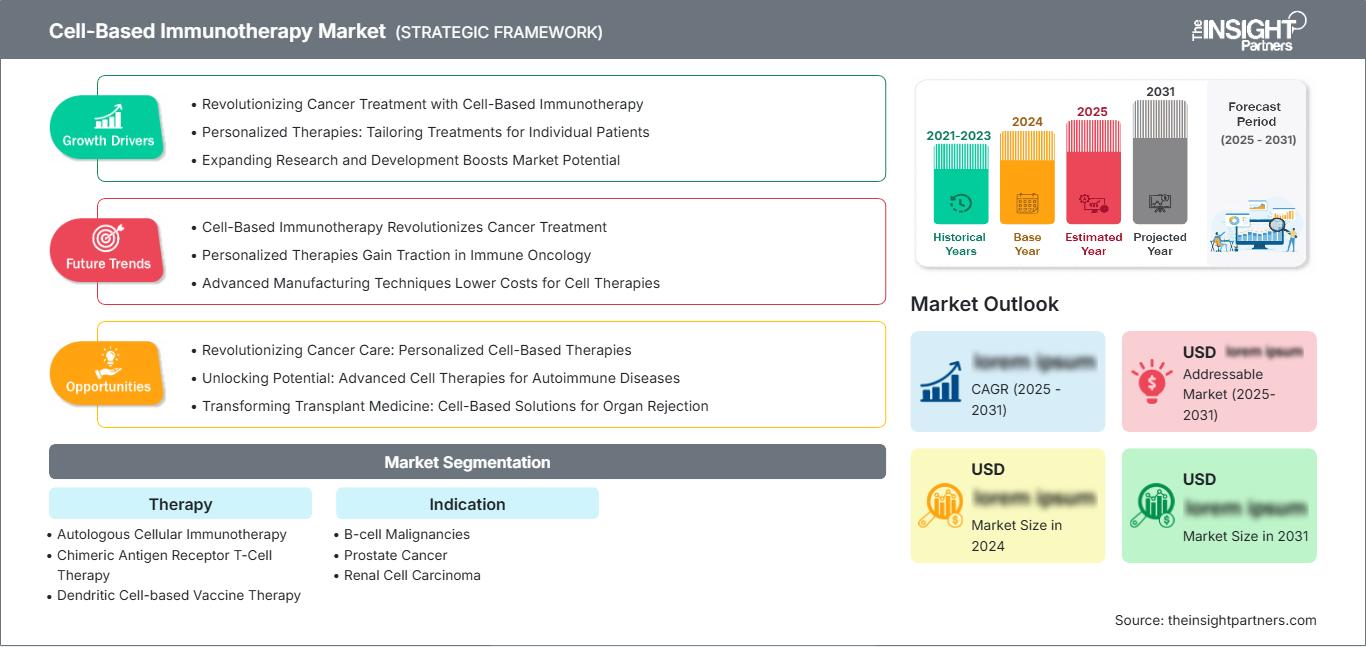
Cell-Based Immunotherapy Market: Strategic Insights
Regional Insights
North America Cell-Based Immunotherapy Market
The North America region constituted about 40-44% of the Cell-Based Immunotherapy Market share in 2025 and is expected to grow with a CAGR of 20.5-22.0% during 2026-2034. North America brings together the practical commercial experience with CAR T-cells, Centers of Excellence, specialized networks of hematology experts, manufacturing services, and regulatory framework for development of cell-based and gene therapy.
The adoption of the therapy has expanded due to its application in earlier treatment lines and other lymphomas. Canada is contributing to the market through reimbursement of the therapy in provinces and major oncology centers, whereas the USA is responsible for the main income. Moreover, growth will be influenced by fast manufacturing process, referring to community centers, outpatient management, and positive payers’ perspective on long-term outcomes.
U.S. Cell-Based Immunotherapy Market
In 2025, the US had accounted for 84-88% of North American market revenues and is expected to exhibit a CAGR of 20.8-22.3% during 2026-2034. Its dominance is on account of several FDA-approved products, robust leukapheresis facilities, advanced oncology networks, and company presence across various therapeutic areas, vectors, manufacturing, diagnostics, and logistics. FDA regulation involves cellular immunotherapies, cancer vaccines, and genetically engineered cells.
The dominant applications continue to be B-cell malignancies; however, developments are being seen with regard to multiple myeloma, autoimmune diseases, and solid tumors. Companies involved in the US market include Novartis AG, Amgen Inc., Eli Lilly and Company, Pfizer Inc., Genentech, Inc., and AbbVie Inc., which provide advanced oncology or therapy capabilities. Approval in December 2025 of Breyanzi for marginal zone lymphoma is a case in point.
Europe Cell-Based Immunotherapy Market
Europe is estimated to hold a share of 25-29% in 2025 and is expected to have a CAGR of 19.5-21.0% in the period of 2026-2034. Germany emerges as the leader among regions through its university hospitals, advanced therapy manufacturing, and reimbursement expertise. The UK takes advantage of its centralized health technology assessment along with the translational research process with patient numbers being dependent on the center’s capacity and budget.
France makes use of its coordination of cancer care and specialty hospitals. Italy and Spain develop their network of accredited treatment centers, depending on the different regions’ funding and referral speed. Germany is expected to continue leading the region because of its pharmaceutical expertise in the country and clinical development outside the country. Growth of Europe will depend on manufacturing localization, harmonization of evidence generation, scalable hospital process and reimbursement that recognizes long-term benefit irrespective of outcomes.
APAC Cell-Based Immunotherapy Market
Asia Pacific had a market share of about 21-25% in 2025, and the region is expected to experience a 23.0-25.0% CAGR in 2026-2034. The leading market player is China due to local commercialization, manufacturing, and regulatory initiatives, such as the June 2026 satri-cel approval for advanced solid tumor treatment.
Mature biotech industry infrastructure is found in Japan and South Korea, India develops manufacturing at lower costs, and Australia contributes expertise in clinical trials and oncology centers. Expansion in the region requires policy initiatives, local manufacturing, certified treatment centers, and affordability.
Middle East & Africa Cell-Based Immunotherapy Market
It is expected that the MEA market will experience a CAGR growth rate of 17.0-19.0% during 2026 and 2034. Saudi Arabia leads by investing in specialized hospitals, biotechnology, and healthcare infrastructure upgrading, whereas the UAE will focus on precision medicine and medical tourism.
In terms of the clinical research facilities, South Africa provides the best-in-class opportunities, however, cost concerns and lack of laboratory equipment restrict the utilization of these resources. Other countries from MEA will require cold storage, energy supply, processing facilities, specialists, and cross-border transportation. Adoption in the short term will be limited to tertiary hospitals supported by governments.
Segmentation Analysis
Therapy
Therapy categories are projected to expand at a combined 21.0–23.0% CAGR during 2026–2034. The Cell-Based Immunotherapy Market scope spans patient-derived immune-cell products, genetically engineered T cells, and antigen-presenting dendritic-cell vaccines. Adoption depends on indication-specific efficacy, manufacturing complexity, toxicity management, treatment-center readiness, and payer acceptance. Commercial activity remains concentrated in autologous workflows, although standardized processing and rapidly produced cellular products are improving scalability.
- Autologous Cellular Immunotherapy: Patient-derived products provide personalized biological compatibility and established regulatory precedent. Demand remains concentrated in specialist centers, with manufacturing turnaround, starting-cell quality, and reliable chain-of-identity controls determining commercial performance.
- Chimeric Antigen Receptor T-Cell Therapy: CAR T-cell therapy holds the strongest market position because of validated activity in B-cell cancers. Strategic priorities include earlier treatment, dual targeting, lower toxicity, outpatient administration, and solid-tumor penetration.
- Dendritic Cell-based Vaccine Therapy: This category offers antigen-specific immune activation and comparatively manageable administration. Its strategic relevance rests on combination regimens, biomarker-guided selection, manufacturing consistency, and opportunities in prostate and other solid cancers.
Indication
Indication-based demand is expected to increase at a 20.5–22.5% CAGR during 2026–2034. Commercial revenue is anchored in hematologic cancers because target antigens, response evidence, and treatment pathways are comparatively mature. Solid-tumor indications offer greater patient volume but face antigen heterogeneity, immune suppression, trafficking limitations, and safety challenges. Progress will depend on target selection, armored-cell engineering, combination strategies, and evidence demonstrating durable clinical benefit.
- B-cell Malignancies: This indication remains the commercial foundation because CD19-directed products address several leukemias and lymphomas. Continued label expansion, earlier-line use, and physician familiarity sustain its strategic importance.
- Prostate Cancer: Sipuleucel-T provides regulatory precedent for cellular immunotherapy in prostate cancer. Future demand depends on patient selection, sequencing with hormonal or radioligand treatments, and identification of predictive immune biomarkers.
- Renal Cell Carcinoma: Cellular approaches are being evaluated for patients with limited durable treatment options. Strategic potential centers on tumor-infiltrating lymphocytes, engineered receptors, combination immunotherapy, and overcoming the suppressive tumor microenvironment.
- Liver Cancer: Liver cancer offers the highest modeled growth potential among listed indications. Programs targeting tumor-associated antigens, regional disease burden, and China’s cellular-therapy capabilities could accelerate clinical and commercial development.
Opportunity Snapshot
The Cell-Based Immunotherapy Market Forecasts indicate that indication selection will determine capital efficiency because each cancer type presents different patient volumes, biomarker requirements, manufacturing economics, and clinical-development risks.
| Indication | Revenue Contribution | Trend Tag | Adoption Stage |
| B-cell Malignancies | High | Earlier Lines | Mature |
| Prostate Cancer | Medium | Immune Sequencing | Scaling |
| Renal Cell Carcinoma | Low | TIL Programs | Emerging |
| Liver Cancer | Medium | Solid Targets | Emerging |
Cell-Based Immunotherapy Market Growth Drivers and Impact Analysis
Expanding Eligibility Across B-cell Malignancies
The extension of regulatory indication into further lymphoma classes and early settings boosts the number of qualified candidates while enhancing knowledge of the physician about the process of referral, leukapheresis, conditioning, infusion, and the management of side effects. On December 31, 2025, the FDA gave approval to lisocabtagene maraleucel for the treatment of adult patients with relapsed or refractory marginal zone lymphoma who have received at least two lines of systemic therapy. This particular study showed responses in 95.5% of the enrolled patients in the primary analysis of efficacy. This kind of expansion of labeling enhances the utilization of manufacturing processes, boosts the economic aspect of centers and motivates them for investments.
Rising Global Cancer Burden and Unmet Treatment Need
The International Agency for Research on Cancer estimated nearly 20 million incident cancer cases and nearly 10 million cancer deaths in 2022 globally. Demographics suggest that annual incidence can potentially rise to 35 million cases by 2050, which is a rise of 77%. Liver cancer caused 7.8% of cancer mortality around the globe, emphasizing the need for innovation in therapy development in tough solid cancers. Rising and aging patients increase the potential pool of patients needing novel treatments after failure of conventional methods. The effect on cell-based therapy developers will be increased pool for recruitment, better chances of target discovery, and increased need for durable treatments. However, it is essential to show survival advantage against advancing antibodies, small molecules, and checkpoint inhibitors.
Manufacturing Automation and Regional Capacity Expansion
Automated closed processing, digital chain-of-identity systems, rapid release testing, and regional manufacturing suites are improving the operational feasibility of personalized therapy. Conventional autologous workflows require tightly synchronized collection, transport, modification, expansion, quality control, and reinfusion. Each transfer introduces time, cost, and failure risk. Regional capacity reduces transport distance and enables manufacturers to align output with hospital schedules. Standardized analytics from suppliers such as Bio-Rad Laboratories, Inc. can support process control, while pharmaceutical companies can apply established quality and distribution capabilities. The resulting market impact includes higher throughput, improved batch consistency, and broader geographic coverage. Capital requirements remain substantial because facilities must satisfy biologics standards while accommodating individualized production records and variable patient starting material.
Cell-Based Immunotherapy Market Future Trends
In Vivo Immune-Cell Programming
Among the most consequential Cell-Based Immunotherapy Market trends, in vivo programming could shift production from centralized ex vivo facilities into the patient’s body. Engineered viral particles or lipid nanoparticles are designed to deliver genetic instructions directly to selected immune cells, potentially avoiding leukapheresis, lengthy expansion, and complex return logistics. Eli Lilly and Company’s April 2026 agreement to acquire Kelonia Therapeutics highlights strategic interest in this approach. Kelonia’s lead program uses engineered lentiviral particles intended to generate CAR T cells in vivo. Clinical validation could reduce treatment delays, improve accessibility, and reshape manufacturing economics, although biodistribution, controllability, durability, and long-term safety require rigorous evidence.
Cellular Therapy Moves Into Solid Tumors
Solid tumors will become a central development frontier as companies apply dual targeting, armored receptors, regional administration, chemokine engineering, and microenvironment-resistant cells. The June 2026 Chinese approval of satricabtagene autoleucel for Claudin18.2-positive, HER2-negative advanced gastric or gastroesophageal junction adenocarcinoma provided a commercial precedent beyond hematologic disease.
Future programs will target antigen heterogeneity and immune suppression while using biomarkers to identify responsive patients. Success could materially expand addressable volume, but developers must differentiate against antibody-drug conjugates, bispecific antibodies, checkpoint combinations, and precision medicines. Manufacturing scalability will also matter because solid cancers create substantially larger potential patient pools.
Cell-Based Immunotherapy Market Opportunities
Regional Manufacturing Networks in Asia Pacific
Asia Pacific offers an investment opportunity through localized vector production, automated cell-processing facilities, cryogenic logistics, clinical-trial partnerships, and accredited infusion networks. China combines high disease burden with accelerating regulatory and commercial activity, while Japan, South Korea, Australia, and India provide complementary strengths in quality manufacturing, research, trials, and cost-efficient production. Investors can prioritize modular facilities serving several programs rather than single-product plants. Hospital partnerships should integrate patient identification, collection scheduling, toxicity management, and outcomes monitoring. Local capacity can shorten vein-to-vein time and reduce cross-border transport exposure. Sustainable returns will depend on utilization rates, regulatory comparability, reimbursement access, and technology-transfer agreements that preserve process consistency.
Integrated Diagnostics and Treatment-Orchestration Platforms
Commercial opportunity in the Cell-Based Immunotherapy Market Forecast extends beyond therapeutic products into companion diagnostics, immune monitoring, manufacturing analytics, scheduling software, and chain-of-custody infrastructure. Providers require interoperable systems that connect pathology, eligibility assessment, collection, manufacturing slots, release testing, shipment, infusion, and post-treatment surveillance. Bio-Rad Laboratories, Inc. is positioned within the analytical ecosystem, while therapy developers can use digital orchestration to reduce avoidable delays and improve capacity visibility. Investment should target platforms capable of supporting multiple therapies and regulatory jurisdictions. Revenue models may combine instrumentation, consumables, software subscriptions, and laboratory services. Adoption will accelerate where platforms demonstrate fewer identification errors, faster release decisions, better manufacturing predictability, and auditable patient-level records across institutional boundaries.
Recent Developments
- June 2026: CARsgen Therapeutics Holdings Limited announced that China’s National Medical Products Administration approved satricabtagene autoleucel for Claudin18.2-positive, HER2-negative advanced gastric or gastroesophageal junction adenocarcinoma after at least two prior treatment lines. The company described satri-cel as the world’s first approved CAR T-cell product for solid tumors.
- April 2026: Eli Lilly and Company entered a definitive agreement to acquire Kelonia Therapeutics, Inc., adding an in vivo gene-delivery platform intended to generate CAR T cells inside patients. The transaction includes KLN-1010, a Phase 1 investigational therapy targeting BCMA in relapsed or refractory multiple myeloma.
- December 2025: Bristol-Myers Squibb Company received FDA approval for Breyanzi as the first CAR T-cell therapy in the US for adults with relapsed or refractory marginal zone lymphoma following at least two prior systemic treatment lines, extending the product’s approved coverage across B-cell malignancies.
Frequently Asked Questions

- Comprehensive Market Sizing and Forecast Analysis
- Detailed Segmentation Analysis
- In-Depth Market Dynamics Assessment
- Regional and Country-Level Insights
- Competitive Landscape and Company Benchmarking
- Strategic Business Intelligence
Recent Reports
Testimonials

The Insight Partners provided valuable market intelligence that supported our global go-to-market strategy. Their team was professional, responsive, and attentive to our feedback, providing thoughtful analysis and helpful methodological clarifications throughout the project.
Junmo Kim Chief Financial Officer (CFO), Enertech Co., Ltd.
The Insight Partners' SCADA System Market report is comprehensive, with valuable insights on current trends and future forecasts. The team was highly professional, responsive, and supportive throughout. We are very satisfied and highly recommend their services.
RAN KEDEM Partner, Reali Technologies LTDs
I requested a report on a very specific software market and the team produced the report in a few days. The information was very relevant and well presented. I then requested some changes and additions to the report. The team was again very responsive and I got the final report in less than a week.
JEAN-HERVE JENN Chairman, Future Analytica
We worked with The Insight Partners for an important market study and forecast. They gave us clear insights into opportunities and risks, which helped shape our plans. Their research was easy to use and based on solid data. It helped us make smart, confident decisions. We highly recommend them.
PIYUSH NAGPAL Sr. Vice President, High Beam Global
The Insight Partners delivered insightful, well-structured market research with strong domain expertise. Their team was professional and responsive throughout. The user-friendly website made accessing industry reports seamless. We highly recommend them for reliable, high-quality research services
YUKIHIKO ADACHI CEO, Deep Blue, LLC.
This is the first time I have purchased a market report from The Insight Partners.While I was unsure at first, I visited their web site and felt more comfortable to take the risk and purchase a market report.I am completely satisfied with the quality of the report and customer service. I had several questions and comments with the initial report, but after a couple of dialogs over email with their analyst I believe I have a report that I can use as input to our strategic planning process.Thank you so much for taking the extra time and making this a positive experience.I will definitely recommend your service to others and you will be my first call when we need further market data.
JOHN SUZUKI President and Chief Executive Officer, Board Director, BK Technologies
I wish to appreciate your support and the professionalism you displayed in the course of attending to my request for information regarding to infectious disease IVD market in Nigeria. I appreciate your patience, your guidance, and the fact that you were willing to offer a discount, which eventually made it possible for us to close a deal. I look forward to engaging The Insight Partners in the future, all thanks to the impression you have created in me as a result of this first encounter.
DR CHIJIOKE ONYIA MANAGING DIRECTOR, PineCrest Healthcare Ltd.Reason to Buy
- Informed Decision-Making
- Understanding Market Dynamics
- Competitive Analysis
- Identifying Emerging Markets
- Customer Insights
- Market Forecasts
- Risk Mitigation
- Boosting Operational Efficiency
- Strategic Planning
- Investment Justification
- Tracking Industry Innovations
- Aligning with Regulatory Trends





 Get Free Sample for