
Cell Therapy Technologies Market Size, Growth & Demand by 2034
Coverage: By Product (Consumables, Equipment, Software); Cell Type (Human Stem cells And Differentiated, Animal Cells); End User (Life Science Research Companies, Research Institutes); , and Geography (North America, Europe, Asia Pacific, and South and Central America)
- Status : Data Released
- Report Code : TIPRE00019684
- Category : Life Sciences
- No. of Pages : 150
- Available Report Formats :


- Last update date : September 07, 2026


2025 Market Size
US$ 7.66 Bn
Base year value
2034 Forecast
US$ 17.37 Bn
Projected by 2034
CAGR 2026-2034
10.77 %
Growth rate
Addressable Market
US$ 119.02 Bn
(2026-2034)
The Cell Therapy Technologies Market is projected to expand from US$ 7.66 Billion in 2025 to US$ 17.37 Billion by 2034, registering a CAGR of 10.77% during 2026–2034. The need for expansion arises due to growing demands related to reproducibility, scalability, sensitivity, contaminant control and traceability within the cell processings, analysis and manufacturing within the discovery, translational research, process development and commercialization environments.
In North America, the Cell Therapy Technologies market Size is projected to grow at a CAGR of 9.8-10.8% from 2026 to 2034. This will be facilitated by the presence of a robust ecosystem of biopharmaceutical research, growing FDA regulation of cellular therapies and move towards closed automated processings. Increased usage of standardized consumables and integration of analytical tools improves site to site comparison as well.
Cell Therapy Technologies Market Assessment and Insights
- North America: North America accounted for an estimated 37–41% share in 2025 and is projected to record a 9.8–10.8% CAGR between 2026–2034, supported by clinical development density, advanced laboratory infrastructure, and manufacturing automation.
- US: The US represented 82–86% of North American revenue in 2025 and is forecast to grow at a 10.0–11.0% CAGR during 2026–2034.
- Europe: Europe held an estimated 27–31% share in 2025 and may expand at a 9.5–10.5% CAGR during 2026–2034, led by Germany, the UK, and France.
- Asia Pacific: Asia Pacific captured approximately 22–26% in 2025 and is projected to register an 11.8–12.8% CAGR during 2026–2034, with China, Japan, South Korea, and India supporting expansion.
- Largest Segment: Consumables represented an estimated 52–56% market share in 2025 and are forecast to grow at a 10.5–11.5% CAGR during 2026–2034.
- High Growth Segment: Software accounted for an estimated 8–12% market share in 2025 and is projected to register a 13.0–14.0% CAGR during 2026–2034.
- Key companies analyzed in detail: Beckman Coulter, Inc.; Becton, Dickinson and Company; GE HealthCare Technologies Inc.; Lonza Group AG; Merck KGaA; Miltenyi Biotec B.V. & Co. KG; STEMCELL Technologies Inc.; Terumo Blood and Cell Technologies; Thermo Fisher Scientific Inc.; Avantor, Inc.
Source: The Insight Partners' analysis based on proprietary research, government publications, company annual reports, investor presentations, industry databases, and expert interviews.
The market has moved from labor-intensive research workflows to partially or fully automated processes which include isolation, expansion, washing, concentration, characterization, and data acquisition of cells. Closed processing lowers operator contact and risks of contamination, whereas disposable processing simplifies changeover of facilities. The demand will also move from standalone instruments to open systems, using reagents and validated protocols as well as software for specific applications. Manufacturers will increasingly develop technologies which can be transferred from discovery labs to manufacturing processes without re-validation and equipment changes.
During the forecast period, spending will expand outside the traditional US and Western Europe cluster. China, South Korea, India, Singapore, and some countries in the Middle East will build translational research facilities, biomanufacturing facilities, and workforce. Regulations on comparability, potency testing, safety testing, and manufacturing change will help technology adoption by providing requirements for evidences. Spending will increasingly be focused on modular systems, able to process different types of cells, different batches, and different geographical locations.
Cell Therapy Technologies Market Report Scope
| Report Attribute | Details |
|---|---|
| Market size in 2025 | US$ 7.66 Billion |
| Market Size by 2034 | US$ 17.37 Billion |
| Global CAGR (2026 - 2034) | 10.77% |
| Historical Data | 2021-2024 |
| Forecast period | 2026-2034 |
Cell Therapy Technologies Market Analysis
Market growth in Cell Therapy Technologies is driven by the need for greater consistency in cell isolation, culture, activation, editing, expansion, harvest, and cryopreservation. The supply chain includes raw material producers, instrument manufacturers, software providers, contract development companies, research institutes, and therapy developers. Each participant has an impact on process reproducibility due to inherent variability and sensitivity of biological materials used at the beginning of the process.
In terms of supply, those vendors able to integrate the equipment with appropriate consumables, services, and process documentation will be in favor. The customers will tend to consider the total process cost over the lifetime rather than just the cost of instruments only. Access to media, cytokines, tubing kits, antibodies, and single-use consumables becomes a strategic advantage since their unavailability could disrupt research or manufacturing runs.
Cell Therapy Technologies Market Report shows competition on the basis of workflow comprehensiveness, regulatory backing, installed base, and consumables pulling. Competition between Thermo Fisher Scientific Inc., Merck KGaA, Lonza Group AG, and Avantor, Inc. is based on their comprehensive portfolios in laboratories and bioprocessing. Miltenyi Biotec B.V. & Co. KG and Terumo Blood and Cell Technologies have an edge on cell processing solutions.
While Beckman Coulter Inc. and Becton, Dickinson and Company lead in the area of cellular analysis and sorting processes, STEMCELL Technologies Inc. provides research services by supplying special media, reagents, and isolation kits for cells. GE HealthCare Technologies Inc. supplies imaging and analytical systems. The strategic investments will be focused on closed automation, digitalization, modularity, and collaboration in order to expedite technology transfer from research to production.
● REPORT CUSTOMIZATION
Tailor This Report To Align With Your Specific Business Requirements
This report can be customized to align precisely with your business objectives, scope, and target markets. Customization options include tailored segmentation, geography, competitive analysis, and strategic insights to support informed decision-making.
Customize This Report →WHAT YOU CAN ADJUST
- ● Segmentations
- ● Geography
- ● Competitive Analysis
- ● Language Preferences
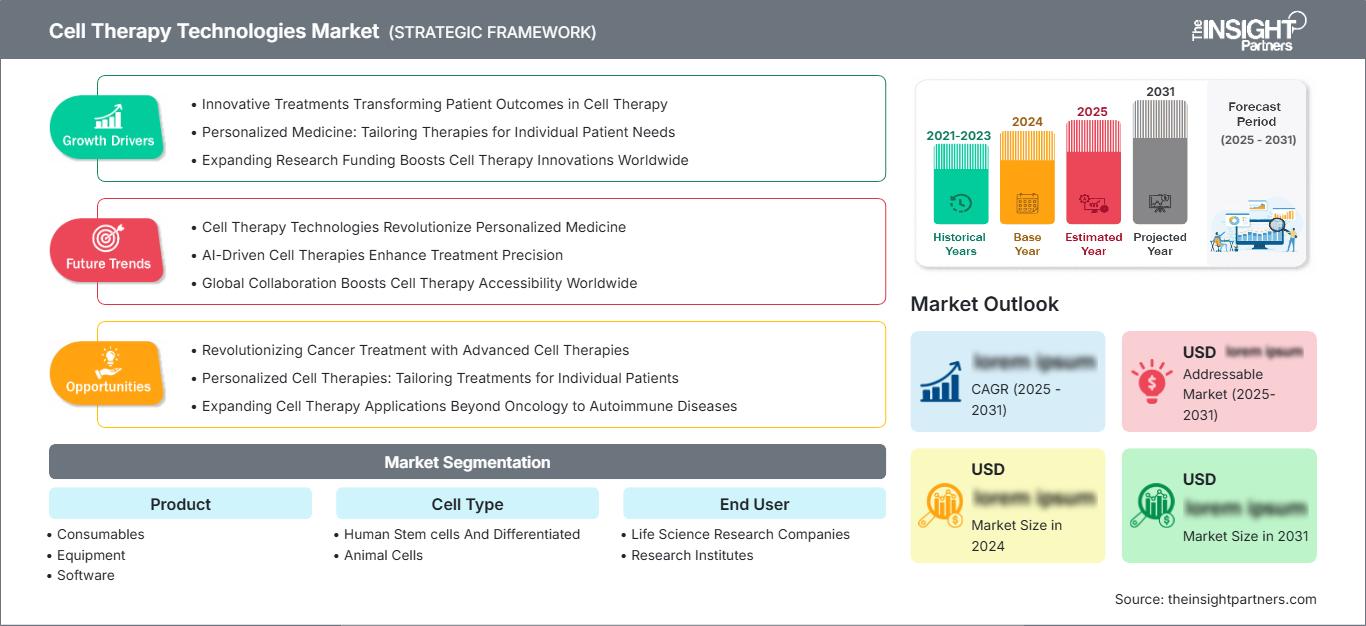
Cell Therapy Technologies Market: Strategic Insights
Regional Insights
North America Cell Therapy Technologies Market
In 2025, North America was responsible for approximately 37-41% of total worldwide revenue and is forecast to register a 9.8-10.8% CAGR between 2026 and 2034. Factors driving growth in North America include clustered biotech centers, well-established academic medicine networks, specialists in contract manufacturing, and early adaptation of closed processing technologies. Guidance from the FDA regarding the development of cellular and gene therapies will drive demand for validation technology.
The Cell Therapy Technologies Market Share in North America is further enhanced by established procurement paths for research and GMP products. Canada contributes by way of its regenerative medicine networks and funding for public research, and Mexico by way of its developing biomanufacturing capabilities. North American customers are increasingly demanding instruments that interface with electronic records, maintain chain-of-identity data, and utilize standardized single-use assemblies.
U.S. Cell Therapy Technologies Market
The US was an estimated 82–86% of North America’s revenues in 2025 and forecasted to grow at a CAGR of 10.0–11.0% till 2034. The demand will remain highly concentrated on biotech clusters in the states of Massachusetts, California, Maryland, New Jersey, Pennsylvania, North Carolina, and Texas. Researchers as well as therapy developers need equipment such as cell sorters, bioreactors, analysis tools, culture media, and software for control of processes in preclinical and clinical trials.
Some of the companies with significant commercial or applications support presence in the region include Thermo Fisher Scientific Inc., Becton, Dickinson and Company, Beckman Coulter, Inc., Avantor, Inc., and STEMCELL Technologies Inc. The use of technologies is moving from initial investigations involving stem cells to immune cell engineering, potency testing, translational disease models, and decentralized manufacturing validation.
Europe Cell Therapy Technologies Market
Europe accounted for 27–31% share in 2025 and is expected to register a 9.5–10.5% CAGR between 2026 and 2034. Germany is a frontrunner in regional consumption because of bioprocessing technologies, university hospitals, and manufacturing clusters. The consumers value workflow documentation, reliable equipment, and compliance with European regulations on advanced therapy medicinal products.
The UK capitalizes on well-coordinated networks of academic, clinical, and manufacturing sectors that support translational efforts and early-stage firms. France has public research organizations as well as pharmaceutical investments, whereas Italy and Spain are growing in terms of their hospitals' cell processing and regenerative medicine. Lonza Group AG, Merck KGaA, and Miltenyi Biotec B.V. & Co. KG enhance access to manufacturing technologies, research products, and expertise.
APAC Cell Therapy Technologies Market
The Asia-Pacific region had about 22%–26% of the market in 2025 and is forecasted to expand with a CAGR of 11.8%–12.8% between 2026 and 2034. China leads owing to laboratory expansion, biotechnology innovations in the country, and biomanufacturing development, while Japan assists in translating regenerative medicine through scientific and regulatory expertise.
South Korea focuses on bioprocessing technologies, India innovates in research and contract services, and Australia contributes through its clinical and academic strengths. The innovation districts created by policies, improved cold chains, and localization of reagents have helped the market thrive in the region despite varying regulations for transferring technology across borders.
Middle East and Africa Cell Therapy Technologies Market
MEA and Africa Markets are expected to grow at a CAGR of 8.0%-9.0% during the forecast period of 2026-2034. Saudi Arabia is making investments through healthcare reforms, research facilities, and advanced biotechnology infrastructure. UAE is building precision medicine, and its laboratory capabilities with the help of advanced logistics and energy systems.
South Africa drives sub-Saharan research through academic and clinical network, whereas the Rest of MEA region lags behind in the adoption process. Growth depends on workforce development, cold chain logistics, utility services, instrument maintenance, and availability of reagents for multicenter research programs.
Segmentation Analysis
Product
Product recorded a modelled 10.6–11.6% CAGR during 2026–2034. The Cell Therapy Technologies Market scope across products covers recurring laboratory inputs, capital equipment, and workflow management applications. Customers increasingly seek integrated offerings that reduce protocol variation and simplify procurement. Recurring consumable demand provides revenue stability, while equipment and software investment rises as laboratories automate multistep processing and strengthen data integrity.
- Consumables: Consumables hold the leading position because media, reagents, cytokines, antibodies, separation products, vessels, and tubing assemblies require frequent replenishment across research, process development, and manufacturing workflows.
- Equipment: Equipment demand centers on cell sorters, separation systems, incubators, bioreactors, centrifuges, imaging platforms, and automated processors that reduce manual handling and improve batch consistency.
- Software: Software has strategic importance for instrument control, electronic records, process monitoring, inventory management, analytics, and chain-of-identity functions, particularly as organizations connect previously isolated laboratory systems.
Cell Type
Cell Type is forecast to expand at a modelled 10.4–11.4% CAGR during 2026–2034. Technology selection depends on cell sensitivity, adherence, expansion characteristics, analytical endpoints, and biosafety requirements. Human cells generate higher workflow complexity because translational and therapeutic applications demand traceability and reproducibility. Animal cells remain essential for basic biology, preclinical testing, bioproduction research, and comparative studies.
- Human Stem cells And Differentiated: These cells command sustained attention in regenerative medicine, immunology, disease modelling, toxicity studies, and therapeutic development, creating demand for specialized media, gentle processing, and sensitive characterization.
- Animal Cells: Animal cells support discovery research, process optimization, vaccine development, biological production, and preclinical evaluation, sustaining demand for flexible culture systems and broadly applicable analytical instruments.
End User
End User is projected to register a modelled 10.2–11.2% CAGR during 2026–2034. Purchasing priorities differ by program maturity and funding model. Commercial research organizations emphasize throughput, scalability, documentation, and service continuity. Research institutes focus on experimental flexibility, shared-instrument utilization, publication-quality data, and affordability. Partnerships between these groups accelerate protocol transfer and broaden access to specialized infrastructure.
- Life Science Research Companies: These companies represent high-value purchasers of integrated platforms, qualified consumables, automation, and software because multiple development programs require standardized workflows, rapid scaling, and dependable supplier support.
- Research Institutes: Institutes generate diverse demand for flexible instruments, cell-specific reagents, and shared laboratory systems, while academic collaborations frequently provide early validation for emerging processing and analytical technologies.
Opportunity Snapshot
Cell Therapy Technologies Market Forecasts indicate that end-user strategies will increasingly differentiate suppliers able to support both exploratory and scale-up requirements.
| End User | Revenue Contribution (High/Medium/Low) | Trend Tag | Adoption Stage (Emerging/Scaling/Mature) |
| Life Science Research Companies | High | Closed Automation | Scaling |
| Research Institutes | Medium | Shared Platforms | Mature |
Cell Therapy Technologies Market Growth Drivers and Impact Analysis
Increasing Need for Reproducible Cell Manufacturing
Biological variation presents significant difficulties where process control depends on manual transfer, open handling, and human decisions. As a result, there is growing interest in automation for separation, expansion, washing, concentration, and filling of therapeutic cells. Closed systems may help in reducing exposure to contamination, minimize the need for cleanroom activities, and increase uniformity between batches and locations. The economic implication goes further than just purchasing the equipment since the installation of each system leads to ongoing demand for tubing sets, culture flasks, media, reagents, and technical assistance. Vendors that provide validated workflows are able to help in transferring the methods more quickly from discovery to process development.
Expansion of Translational Cell-Based Research
Studies are increasingly adopting stem cells, differentiated cells, immune cells, and cellular models to understand the underlying mechanisms of diseases and assess drug candidates. This results in the increased need for cell isolation, cell culture, cell characterization, cell imaging, and cell preservation tools not only from companies that develop therapies but also other laboratories. Cellular models using human cells may offer physiological information, whereas sophisticated phenotyping may help the researcher differentiate between heterogeneous cell populations and study their functional responses. The effect on the market is that a diversified customer base can be reached including biotech companies, pharmaceutical laboratories, universities, hospitals, and contract research organizations. Instrument manufacturers that can handle several types of cells have an edge as researchers seek versatility in equipment rather than specialization.
Greater Regulatory Focus on Process Control and Data Integrity
Regulatory expectations increasingly connect product quality with control of starting materials, manufacturing changes, potency methods, contamination safeguards, and electronic records. This encourages developers to introduce structured process controls earlier rather than retrofitting commercial requirements after clinical progression. Instruments with automated data capture, audit trails, controlled user access, and standardized operating recipes support this transition. Demand also rises for qualified raw materials and traceable single-use components that simplify documentation. Market impact is visible in longer supplier relationships because changing a critical technology can trigger comparability work and operational revalidation. Vendors that provide lifecycle documentation, service histories, software support, and change notifications are positioned to become embedded partners across clinical development and commercialization.
Cell Therapy Technologies Market Future Trends
Convergence of Automation, Analytics, and Artificial Intelligence
Cell Therapy Technologies Market trends will increasingly reflect convergence between physical processing equipment and computational decision support. Sensors, imaging, flow cytometry, and process-monitoring data can feed software that detects deviations, predicts culture performance, and recommends intervention windows. Artificial intelligence will initially support operator decisions rather than independently release batches, especially where datasets remain limited. Adoption should progress fastest in standardized expansion and analytical workflows with repeatable data structures. Technology providers will need transparent models, secure architecture, version control, and validation strategies. Platforms that combine automation with interpretable analytics can reduce failed experiments, improve resource scheduling, and enable knowledge transfer between development teams and manufacturing locations without relying exclusively on individual operator experience.
Growth of Modular and Decentralized Production Platforms
Manufacturing architectures are expected to shift toward compact, modular systems that can be deployed near treatment centers or replicated across regional hubs. This model responds to logistical constraints surrounding short shelf life, patient-specific starting materials, and chain-of-identity management. Technologies must integrate cell processing, environmental controls, in-process testing, and secure digital records within a smaller footprint. Standardized modules could allow organizations to add capacity incrementally rather than constructing large centralized facilities before demand is proven. Suppliers will compete on installation speed, remote service, consumable availability, and cross-site comparability. Decentralization remains operationally demanding, but validated platform approaches may make distributed manufacturing more practical for selected autologous and personalized cellular products.
Cell Therapy Technologies Market Opportunities
Localized Technology Ecosystems in High-Growth Asian Markets
Suppliers can capture growth by establishing application laboratories, reagent production, technical service teams, and training partnerships in China, India, South Korea, Japan, and Southeast Asia. Local infrastructure reduces lead times and helps customers adapt global platforms to regional protocols, languages, and regulatory expectations. Investment should prioritize frequently used consumables, modular instruments, and service models suitable for emerging biotechnology companies and shared research facilities. Partnerships with universities and manufacturing organizations can create reference sites and improve workforce familiarity. The opportunity is not limited to lower-cost supply. Companies that combine local responsiveness with consistent quality systems can support regional programs as they progress from discovery toward controlled production and international collaboration.
Integrated Offerings for Research-to-Manufacturing Transition
A significant opportunity in the Cell Therapy Technologies Market Forecast exists in reducing the technical discontinuity between early research methods and scalable manufacturing workflows. Developers frequently redesign processes when laboratory instruments, open vessels, or research-grade inputs cannot support controlled production. Vendors can address this gap by creating matched product families with compatible media, separation technologies, analytics, software, and closed processing components. Investment in protocol bridges, comparability packages, and application expertise can lower customer switching risk and shorten transfer timelines. Subscription software, consumable agreements, and milestone-based technical support also create recurring revenue. Suppliers that demonstrate continuity across development stages can deepen account penetration while helping customers avoid expensive process changes after clinical evidence has already been generated.
Recent Developments
- April 2026: Thermo Fisher Scientific Inc. introduced the Gibco CTS Compleo Fill and Finish System, an automated, functionally closed solution for cell therapy formulation and filling. The system was designed to reduce manual intervention, accommodate variability in cell concentration and viability, and improve dose consistency within small-volume manufacturing workflows.
- January 2026: Beckman Coulter, Inc. announced a strategic partnership with Automata to connect its liquid-handling, genomic, and cell-analysis technologies with an AI-ready laboratory automation platform. The collaboration targets more consistent, scalable experimentation and integrated data generation across research organizations adopting increasingly automated cellular workflows.
- November 2024: Miltenyi Biotec B.V. & Co. KG announced that it would commercially supply its CliniMACS Platform to Autolus Therapeutics for manufacturing AUCATZYL, an FDA-approved autologous T-cell therapy. The agreement demonstrated the role of specialized closed-processing platforms in supporting commercial cellular product manufacturing.
Frequently Asked Questions

- Comprehensive Market Sizing and Forecast Analysis
- Detailed Segmentation Analysis
- In-Depth Market Dynamics Assessment
- Regional and Country-Level Insights
- Competitive Landscape and Company Benchmarking
- Strategic Business Intelligence
Recent Reports
Testimonials

The Insight Partners' SCADA System Market report is comprehensive, with valuable insights on current trends and future forecasts. The team was highly professional, responsive, and supportive throughout. We are very satisfied and highly recommend their services.
RAN KEDEM Partner, Reali Technologies LTDs
I requested a report on a very specific software market and the team produced the report in a few days. The information was very relevant and well presented. I then requested some changes and additions to the report. The team was again very responsive and I got the final report in less than a week.
JEAN-HERVE JENN Chairman, Future Analytica
We worked with The Insight Partners for an important market study and forecast. They gave us clear insights into opportunities and risks, which helped shape our plans. Their research was easy to use and based on solid data. It helped us make smart, confident decisions. We highly recommend them.
PIYUSH NAGPAL Sr. Vice President, High Beam Global
The Insight Partners delivered insightful, well-structured market research with strong domain expertise. Their team was professional and responsive throughout. The user-friendly website made accessing industry reports seamless. We highly recommend them for reliable, high-quality research services
YUKIHIKO ADACHI CEO, Deep Blue, LLC.
This is the first time I have purchased a market report from The Insight Partners.While I was unsure at first, I visited their web site and felt more comfortable to take the risk and purchase a market report.I am completely satisfied with the quality of the report and customer service. I had several questions and comments with the initial report, but after a couple of dialogs over email with their analyst I believe I have a report that I can use as input to our strategic planning process.Thank you so much for taking the extra time and making this a positive experience.I will definitely recommend your service to others and you will be my first call when we need further market data.
JOHN SUZUKI President and Chief Executive Officer, Board Director, BK Technologies
I wish to appreciate your support and the professionalism you displayed in the course of attending to my request for information regarding to infectious disease IVD market in Nigeria. I appreciate your patience, your guidance, and the fact that you were willing to offer a discount, which eventually made it possible for us to close a deal. I look forward to engaging The Insight Partners in the future, all thanks to the impression you have created in me as a result of this first encounter.
DR CHIJIOKE ONYIA MANAGING DIRECTOR, PineCrest Healthcare Ltd.Reason to Buy
- Informed Decision-Making
- Understanding Market Dynamics
- Competitive Analysis
- Identifying Emerging Markets
- Customer Insights
- Market Forecasts
- Risk Mitigation
- Boosting Operational Efficiency
- Strategic Planning
- Investment Justification
- Tracking Industry Innovations
- Aligning with Regulatory Trends





 Get Free Sample for