
Cellular Modem Market Size, Trends & Growth by 2034
Cellular Modem Market Size and Forecasts (2021–2034), Global and Regional Share, Trends, and Growth Opportunity Analysis Report Coverage : By Type (Embedded Cellular Modem, and Box Portable Cellular Modem), Technology (3G, 4G, 5G, NB-IoT, and LTE-M), Vertical (Agriculture, Automotive & Transportation, Smart Cities, and Healthcare)
- Status : Data Released
- Report Code : TIPRE00039769
- Category : Electronics and Semiconductor
- No. of Pages : 150
- Available Report Formats :


- Last update date : July 24, 2026


2025 Market Size
US$ 4.96 Bn
Base year value
2034 Forecast
US$ 9.24 Bn
Projected by 2034
CAGR 2026-2034
8.09 %
Growth rate
Addressable Market
US$ 67.20 Bn
(2026-2034)
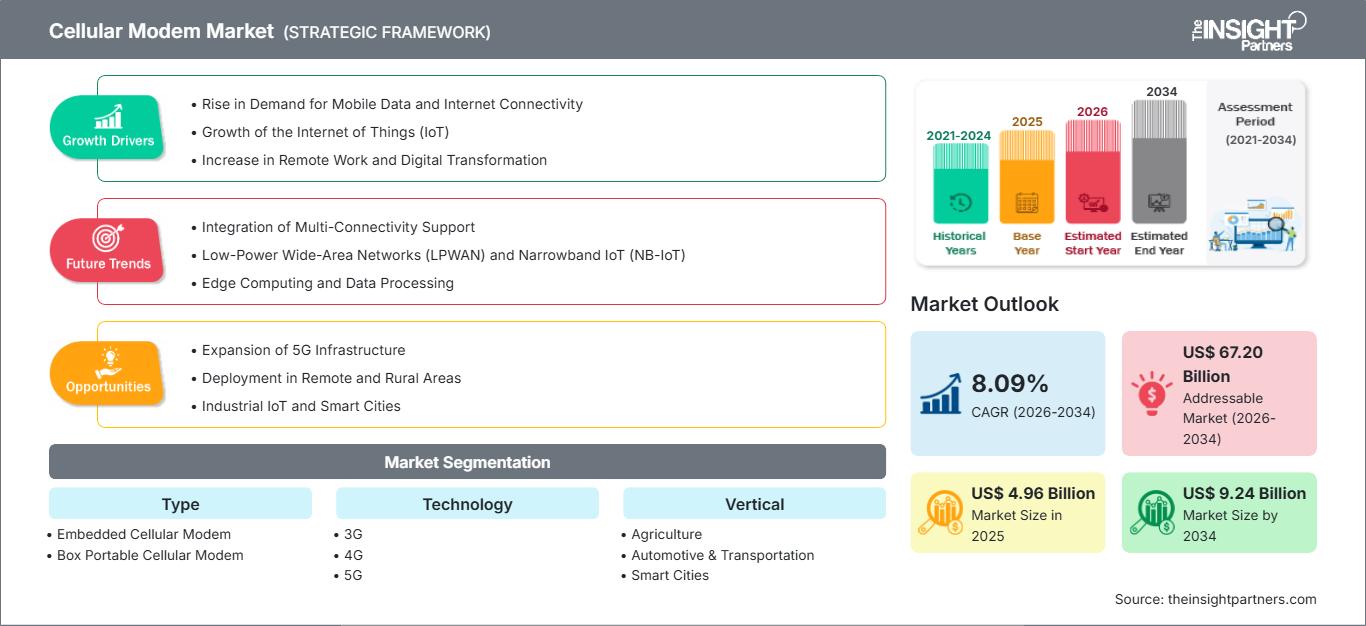
The Cellular Modem Market size stood at US$ 4.96 Billion in 2025 and is estimated to reach US$ 9.24 Billion by 2034, recording a CAGR of 8.09% during 2026-2034. The cellular modem facilitates wireless data transmission over wide areas through industrial devices, cars, medical instruments, infrastructure in the cities and other assets which are beyond the range of any wired network.
The North American region continues to be a region with considerable demand as the market size for the Cellular Modem Market is being driven by private wireless tests, utility upgrade projects, fleet telematics applications, and public safety connectivity. The region is forecasted to grow at a CAGR of 7.4-8.0% from 2026-2034, backed by the 4G refresh cycles, 5G industrial gateway deployments, eSIM management, and remote infrastructure monitoring.
Cellular Modem Market Assessment and Insights
- North America held 27–30% Cellular Modem Market share in 2025 and is projected to grow at a CAGR of 7.4–8.0% during 2026–2034, supported by utility telemetry, fleet digitization, industrial routers, and secure cellular failover.
- US represented 78–82% of North America in 2025 and is expected to grow at 7.6–8.2% CAGR, led by transportation, smart grid, and public safety deployments.
- Europe accounted for 21–24% share in 2025 and is forecast to grow at 7.0–7.7% CAGR, with Germany, the UK, France, Italy, and Spain leading adoption in industrial and mobility use cases.
- Asia Pacific held 34–38% share in 2025 and is expected to grow at 9.0–9.8% CAGR, led by China, Japan, South Korea, India, and Australia through cellular IoT scale and smart infrastructure programs.
- Largest Segment Embedded Cellular Modem held 58–62% market share in 2025 and is projected to grow at 7.7–8.4% CAGR due to OEM integration across machines and vehicles.
- High Growth Segment 5G held 16–20% market share in 2025 and is projected to grow at 12.0–13.2% CAGR as industrial video, edge computing, and private networks expand.
- Key companies analyzed in detail: CalAmp Corp., Digi International Inc., Campbell Scientific, Inc., Red Lion Controls, Inc., Shenzhen Wlink Technology Co., Ltd., Moxa Inc., Jinan USR IOT Technology Limited, Intercel Pty Ltd., InHand Networks, Robustel, and Sierra Wireless, a Semtech company.
Source: The Insight Partners' analysis based on proprietary research, government publications, company annual reports, investor presentations, industry databases, and expert interviews.
Cellular Modem Market trends are moving away from 2G and 3G dial-up telemetry towards LTE Cat 1, LTE-M, NB-IoT, 5G, and multi-carrier embedded modules. The production process is influenced by radio-frequency certification, carrier approvals, SIM card provisioning, antenna design, GNSS implementation, security needs, and chipset availability. Increasingly, customers seek modems that require less maintenance in the field and allow for firmware updates as well as long-term availability on the market.
Going forward, demand will increase as new geographies develop in smart metering, asset tracking, telehealth, cold chain monitoring, and ITS. Tailwinds in the regulatory environment are spectrum refarming of old networks, smart city projects, and utility resilience regulations. The investment is going towards the development of rugged gateways, embedded modules, and low-power devices operating without power source in remote places and securing encryption device-to-cloud communications.
Cellular Modem Market Report Scope
| Report Attribute | Details |
|---|---|
| Market size in 2025 | US$ 4.96 Billion |
| Market Size by 2034 | US$ 9.24 Billion |
| Global CAGR (2026 - 2034) | 8.09% |
| Historical Data | 2021-2024 |
| Forecast period | 2026-2034 |
Cellular Modem Market Analysis
Cellular Modem Market growth stems from the need to connect assets outside fixed broadband coverage. These applications include agriculture, logistics, utilities, healthcare, and municipal infrastructures. According to Ericsson, there were about 4.5 billion cellular IoT connections by the end of 2025, and 2G and 3G network closures are increasing the migration to LTE, LTE-M, NB-IoT, and 5G-compatible equipment.
The value chain includes manufacturers of chipsets, modules, modems, antennas, SIM/eSIM management systems, wireless carriers, cloud IoT services, system integrators, and vertical applications solutions providers. The market supply is impacted by global carrier certifications, rugged cases availability, firmware security, industrial-grade operation temperature, and long-term components sourcing. The buyers consider total deployment expenses, rather than just modem price.
The Cellular Modem Market analysis indicates competition among companies specializing in embedded modules, rugged routers, and telemetry platform solutions. Companies like Digi International Inc., Moxa Inc., InHand Networks, Robustel, and Sierra Wireless (Semtech Corporation) compete on the basis of industrial connectivity product lines, whereas CalAmp Corp., Campbell Scientific, Inc., Red Lion Controls, Inc., Shenzhen Wlink Technology Co., Ltd., Jinan USR IOT Technology Limited, and Intercel Pty Ltd. cater to fleet, environmental, automation, and machine connectivity verticals.
Investments are focusing on securing remote device management, multi-radio failover capability, power-saving mode operation, 5G RedCap compatibility, and cloud-based analytics capability. Companies with wide certification footprint, managed connectivity services capabilities, and industrial-grade field-tested designs will be able to defend pricing as their customers adopt standardized hardware families for regional connectivity, rugged environments, and long replacement cycles.
● REPORT CUSTOMIZATION
Tailor This Report To Align With Your Specific Business Requirements
This report can be customized to align precisely with your business objectives, scope, and target markets. Customization options include tailored segmentation, geography, competitive analysis, and strategic insights to support informed decision-making.
Customize This Report →WHAT YOU CAN ADJUST
- ● Segmentations
- ● Geography
- ● Competitive Analysis
- ● Language Preferences
Cellular Modem Market: Strategic Insights
Regional Insights
North America Cellular Modem Market
In 2025, North America held a market share of 27-30% in the Cellular Modems and is forecast to grow at a CAGR of 7.4-8.0%. The major drivers include smart grid end-points, safety applications for fleets, oil & gas telemetry, public safety communications and industrial fail-over applications where the licensed cellular network coverage exceeds short-range private radio.
The preferred products in regional spending are ruggedized routers, embedded LTE modules, 5G gateways and managed device platforms. Utilities and transportation departments are upgrading their 3G modems, whereas industries demand more security features, remote monitoring capabilities and multi-carrier fail-overs. Early adoption of 5G technology is seen in places where low-latency is needed.
U.S. Cellular Modem Market Market
The US represented 78–82% of North America in 2025 and is expected to grow at 7.6–8.2% CAGR. Demand is led by smart metering, connected fleet platforms, traffic systems, remote healthcare devices, and industrial monitoring. Domestic operators’ 3G retirement has increased replacement demand for LTE and 5G-compatible modems.
CalAmp Corp. and Digi International Inc. maintain strong US visibility, while Moxa Inc., InHand Networks, Robustel, and Sierra Wireless, a Semtech company, compete through industrial and enterprise channels. Application trends emphasize secure failover, fleet video, EV charging support, and utility data collection that needs reliable connectivity across urban and remote sites.
Europe Cellular Modem Market Market
Europe accounts for 21–24% market share and is estimated to grow at a CAGR of 7.0–7.7%. Leading the region is Germany, since factory automation, vehicle logistics, and energy solutions require cellular connectivity certifications. The UK will expand the market through fleet management, railway tracking, and government communication services that require secure remote access.
France, Italy, and Spain contribute through smart city initiatives, environmental sensors, retail payments, and farm monitoring solutions. Customers in Europe look for products with CE certification and security. The technologies of NB-IoT and LTE-M are still relevant for low power consumption solutions, while 5G gateways are increasingly popular in transport centers, ports, and utilities.
APAC Cellular Modem Market Market
The share of APAC region stood at 34–38% in 2025 and was expected to rise at a 9.0–9.8% CAGR during the forecast period. China dominates because of its massive deployment of cellular IoT, digitization, and module eco-systems domestically, whereas Japan and South Korea develop 5G industrial gateways, transport infrastructures, and health-related connected systems.
India expands its demand because of smart meters, logistic visibility, and rural digital infrastructures, while Australia focuses on mining, agriculture, emergency services, and remote utilities. Electronics manufacturing and digital infrastructures development policies boost regional supply depth; however, fierce price competition exists in the LTE Cat 1 and NB-IoT modems segments.
Middle East & Africa Cellular Modem Market Market
Middle East & Africa is expected to grow at 6.8–7.5% CAGR, led by Saudi Arabia, the UAE, South Africa, and Rest of MEA. Saudi Arabia leads demand through smart city, energy, utilities, and transport modernization linked to national digital infrastructure programs.
The UAE supports premium connected infrastructure and logistics visibility, while South Africa contributes through mining telemetry, fleet management, and utility monitoring. Harsh operating conditions increase demand for rugged modems with extended temperature tolerance, dual SIM redundancy, and remote management. Energy corridors, ports, and public safety networks sustain regional adoption.
Segmentation Analysis
Type
Type is projected to grow at 7.8–8.5% CAGR during 2026–2034. The Cellular Modem Market scope by type reflects whether connectivity is designed into equipment or deployed as a field-ready enclosure. Embedded formats dominate OEM designs, while box portable units serve retrofit, temporary, mobile, and harsh-site applications where fast installation and replaceability matter.
- Embedded Cellular Modem: Embedded units are favored by OEMs building connected meters, medical devices, vehicles, and industrial machines, as integration lowers footprint, improves certification control, and supports lifecycle product design.
- Box Portable Cellular Modem: Box portable devices serve field installations, temporary connectivity, transportation assets, and remote sites where rugged housings, external antennas, carrier flexibility, and simplified replacement are operationally valuable.
Technology
Technology is expected to grow at 8.2–8.9% CAGR during 2026–2034. Technology choices are shaped by bandwidth, latency, power consumption, module cost, operator coverage, and device life. 4G remains the workhorse, 5G expands high-throughput use cases, and NB-IoT plus LTE-M serve low-power sensors that need wide-area reach.
- 3G: 3G demand is declining as operators retire networks, but replacement programs remain relevant for legacy telemetry fleets requiring planned migration without service interruption.
- 4G: 4G modems retain broad adoption because coverage, cost, carrier certification, and mature chipset supply support fleet, industrial, payment, and remote monitoring deployments.
- 5G: 5G modems support high-bandwidth video, edge computing, robotics, private networks, and transportation systems where lower latency and higher throughput improve application performance.
- NB-IoT: NB-IoT serves low-data, long-life sensors in metering, parking, agriculture, and environmental monitoring, where deep coverage and battery efficiency are more important than speed.
- LTE-M: LTE-M balances mobility, voice support, lower power, and moderate data rates, making it strategically useful for wearables, logistics trackers, alarms, and mobile healthcare devices.
Vertical
Vertical is forecast to grow at 8.0–8.7% CAGR during 2026–2034. Vertical adoption is strongest where assets are distributed, mobile, or costly to inspect manually. Agriculture, automotive and transportation, smart cities, and healthcare all require secure cellular links that convert field data into operational decisions.
- Agriculture: Agriculture uses cellular modems for irrigation control, livestock monitoring, soil sensors, machinery telemetry, and cold-chain visibility, especially where farms lack reliable fixed broadband.
- Automotive & Transportation: Transportation demand is tied to telematics, fleet safety, route optimization, EV charging, transit systems, and roadside equipment that require persistent mobile connectivity.
- Smart Cities: Smart city deployments connect lighting, parking, surveillance, waste management, traffic signals, and environmental sensors, making scalable provisioning and remote management strategically important.
- Healthcare: Healthcare applications use modems for remote patient devices, mobile clinics, ambulance connectivity, medical asset tracking, and backup connectivity where uptime and data security are critical.
Opportunity Snapshot
| Vertical | Revenue Contribution | Trend Tag | Adoption Stage |
| Agriculture | Medium | Precision Farming | Scaling |
| Automotive & Transportation | High | Fleet Telematics | Mature |
| Smart Cities | High | Urban Sensors | Scaling |
| Healthcare | Medium | Remote Care | Emerging |
Cellular Modem Market Growth Drivers and Impact Analysis
Legacy Network Sunsets Accelerate Hardware Replacement
The operators are shutting down 2G and 3G networks to reuse the bandwidth for 4G and 5G, compelling businesses to upgrade the old telemetry modems in order to avoid disruption due to the lack of services. According to Ericsson, by the end of 2025, 80 service providers had shut down their 3G networks, thus resulting in some migration pressure on utilities, transportation organizations, security companies, and industry organizations. The effects are felt most in the installed base, which consists of long-lived equipment for which the modems were initially introduced for basic messaging purposes, but now they need firmware security, diagnostic capabilities, and greater network compatibility.
Industrial IoT Expands Demand for Rugged Connectivity
Industrial operators require dependable network access for machine condition monitoring, remote management, environmental data collection, and process visualization in locations where wired networking is unavailable. Compared to dedicated radio systems and Wi-Fi-only systems, cellular modems offer advantages in terms of licensed spectrum availability, tunneling capabilities, and easy deployment. Practical implications include an increasing need for sturdy housing, DIN rail mounting, wide temperature range, and cloud-based device management solutions. Industrial companies, including utilities, oil & gas facilities, manufacturing plants, mining operations, and transportation hubs, are increasingly looking for modems that will be compatible not only with the existing 4G networks but with the upcoming 5G as well.
Smart Infrastructure Creates Persistent Device Connectivity Needs
Smart city, health care, agriculture, and transportation applications require thousands of endpoint devices which should send small or moderate amounts of data without continuous human oversight. The cellular modem helps achieve this goal by enabling parking sensors, traffic cabinets, health care trolleys, cold chain equipment, irrigation control, and asset tracking solutions to connect via operator networks. It leads to increased procurement from municipalities, hospitals, fleet managers, and agricultural companies who require uniform connectivity. Low-power technologies (NB-IoT, LTE-M) improve the economics of battery-powered solutions, whereas 5G gateways support bandwidth-intensive use cases such as video surveillance and mobile command.
Cellular Modem Market Future Trends
5G RedCap Bridges High Performance and Lower Device Cost
Trends in the Cellular Modem Market are steadily moving towards the use of 5G RedCap and, eventually, eRedCap for applications that require more capability than LTE-M or NB-IoT but lower cost and complexity than a complete 5G module. Ericsson indicated commercial rollouts of 5G RedCap by 14 carriers and deployments in 27 countries. This makes it possible for industrial gateways, video-lite devices, wearables, payment terminals, and mid-range telematics to follow a migration path. Future cellular modem lines will have to be modular to permit the option of LTE, RedCap, and 5G in the same footprint.
eSIM and Remote Management Become Procurement Requirements
Futures deployments will see an increase in eSIM, Remote SIM Provisioning, security through firmware updates, and fleetwide configuration capabilities. Enterprises with tens of thousands of devices in different locations cannot expect to manually swap out SIM cards, perform site visits, or have carrier agreements locally inconsistent. Modems that are capable of centralized policy management, diagnostics, and lifecycle management over-the-air will help keep costs down and services continuous. This will be a factor when selecting suppliers in the transport, health care, utilities, and smart city sectors, where contract carriers may vary over time.
Cellular Modem Market Opportunities
Managed Connectivity Bundles for Industrial Fleets
Cellular Modem Market Forecasts indicate strong opportunity in managed connectivity bundles that combine modem hardware, SIM services, cloud monitoring, security policies, and lifecycle support for industrial fleets. Buyers in utilities, logistics, agriculture, and municipal operations want predictable uptime without managing carrier contracts and firmware updates separately. Vendors can differentiate by offering pre-certified devices, deployment templates, and dashboards that show signal quality, data use, alerts, and device health. The investment case improves when service providers convert one-time hardware sales into recurring connectivity revenue. Channel partners can also use bundles to reduce integration friction for small and mid-sized customers.
Vertical-Specific Modems for Healthcare and Smart Cities
Healthcare and smart city deployments create opportunities for modems designed around compliance, security, power efficiency, and environmental constraints. Medical device makers need reliable cellular backup, secure patient data transmission, and compact embedded formats, while cities require rugged gateways for outdoor equipment, traffic cabinets, lighting systems, and environmental sensors. Vendors should develop reference designs that reduce certification burden and simplify procurement for public agencies and healthcare technology suppliers. The opportunity is not only hardware volume but also long-term device management, cybersecurity updates, and analytics integration. Partners that prove reliability in regulated environments can command stronger margins.
Recent Developments
- July 2026: Digi International Inc. launched DANI, an AI agent embedded in Digi Remote Manager to improve diagnostics, automated troubleshooting, and proactive network operations for distributed IoT devices. The launch strengthens Digi’s value proposition around managed cellular infrastructure and remote device lifecycle management for industrial deployments.
- June 2026: Trasna, a global technology leader specialising in cellular IoT modules and mobile IoT solutions, is proud to announce the introduction of its new LTE-M and NB-IoT cellular module series, powered by the Qualcomm® E51 4G Modem-RF chipset from Qualcomm Technologies, Inc. This launch marks an important milestone, underscoring Trasna’s long-term commitment to the cellular IoT segment and provides strong continuity for customers and partners worldwide..
- November 2025: InHand Networks launched the IR624 5G industrial router for always-on IIoT connectivity, supporting 5G SA/NSA, 4G/3G backward compatibility, dual SIM redundancy, cloud management, and security features. The product targets manufacturing, energy, public services, and healthcare applications requiring resilient high-speed cellular access.
Frequently Asked Questions

- Comprehensive Market Sizing and Forecast Analysis
- Detailed Segmentation Analysis
- In-Depth Market Dynamics Assessment
- Regional and Country-Level Insights
- Competitive Landscape and Company Benchmarking
- Strategic Business Intelligence
Recent Reports
Testimonials

The Insight Partners' SCADA System Market report is comprehensive, with valuable insights on current trends and future forecasts. The team was highly professional, responsive, and supportive throughout. We are very satisfied and highly recommend their services.
RAN KEDEM Partner, Reali Technologies LTDs
I requested a report on a very specific software market and the team produced the report in a few days. The information was very relevant and well presented. I then requested some changes and additions to the report. The team was again very responsive and I got the final report in less than a week.
JEAN-HERVE JENN Chairman, Future Analytica
We worked with The Insight Partners for an important market study and forecast. They gave us clear insights into opportunities and risks, which helped shape our plans. Their research was easy to use and based on solid data. It helped us make smart, confident decisions. We highly recommend them.
PIYUSH NAGPAL Sr. Vice President, High Beam Global
The Insight Partners delivered insightful, well-structured market research with strong domain expertise. Their team was professional and responsive throughout. The user-friendly website made accessing industry reports seamless. We highly recommend them for reliable, high-quality research services
YUKIHIKO ADACHI CEO, Deep Blue, LLC.
This is the first time I have purchased a market report from The Insight Partners.While I was unsure at first, I visited their web site and felt more comfortable to take the risk and purchase a market report.I am completely satisfied with the quality of the report and customer service. I had several questions and comments with the initial report, but after a couple of dialogs over email with their analyst I believe I have a report that I can use as input to our strategic planning process.Thank you so much for taking the extra time and making this a positive experience.I will definitely recommend your service to others and you will be my first call when we need further market data.
JOHN SUZUKI President and Chief Executive Officer, Board Director, BK Technologies
I wish to appreciate your support and the professionalism you displayed in the course of attending to my request for information regarding to infectious disease IVD market in Nigeria. I appreciate your patience, your guidance, and the fact that you were willing to offer a discount, which eventually made it possible for us to close a deal. I look forward to engaging The Insight Partners in the future, all thanks to the impression you have created in me as a result of this first encounter.
DR CHIJIOKE ONYIA MANAGING DIRECTOR, PineCrest Healthcare Ltd.Reason to Buy
- Informed Decision-Making
- Understanding Market Dynamics
- Competitive Analysis
- Identifying Emerging Markets
- Customer Insights
- Market Forecasts
- Risk Mitigation
- Boosting Operational Efficiency
- Strategic Planning
- Investment Justification
- Tracking Industry Innovations
- Aligning with Regulatory Trends





 Get Free Sample for