
Central Lighting Inverters Market Size, Trends & Demand by 2034
Coverage: By Product Type (Commercial Grade Single Phase Central Lighting inverters, Commercial Grade Three Phase Central Lighting inverters); Application (Commercial Buildings, Residential Buildings) , and Geography (North America, Europe, Asia Pacific, and South and Central America)
- Status : Data Released
- Report Code : TIPRE00017025
- Category : Electronics and Semiconductor
- No. of Pages : 150
- Available Report Formats :


- Last update date : July 28, 2026


2025 Market Size
US$ 232.9 Mn
Base year value
2034 Forecast
US$ 447.49 Mn
Projected by 2034
CAGR 2026-2034
7.53 %
Growth rate
Addressable Market
US$ 3,066.64 Mn
(2026-2034)
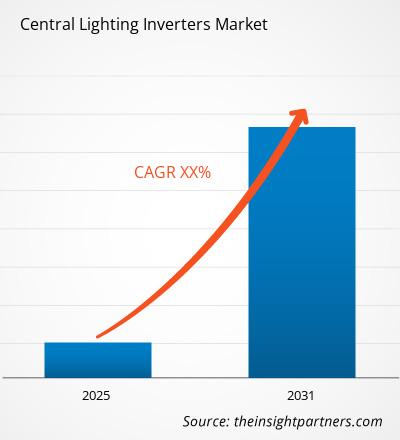
The Central Lighting Inverters Market is valued at US$ 232.9 Million in 2025 and will reach a market value of US$ 447.49 Million by 2034 at a CAGR of 7.53% during 2026–2034. The demand drivers are compliance with code requirements for emergency lighting, central battery back-up, commercial building projects, hospitals, educational campus facilities, data centers, and multi-family residential buildings where safe egress remains available in case of power outages.
The North America region is driven by the Central Lighting Inverters Market size growing at a 7.0-7.8% CAGR because of upgrading of UL 924 emergency power systems and the installation of central monitoring inverters to replace existing distributed battery packs. Structural demand is generated by NFPA 101 egress codes, commercial building upgrades, hospital resiliency initiatives, and greater use of LEDs which improve loads and inverter compatibility.
Central Lighting Inverters Market Assessment and Insights
- North America: North America held a 34–37% share in 2025 and is growing at a 7.0–7.8% CAGR between 2026–2034, supported by code enforcement, commercial retrofits, healthcare projects, and data center resilience spending.
- US: The US represented 78–82% of North America in 2025 and is growing at a 7.1–7.9% CAGR between 2026–2034, led by UL 924 compliance and renovation demand.
- Europe: Europe accounted for a 24–27% share in 2025 and is growing at a 6.6–7.4% CAGR between 2026–2034, with Germany, the UK, France, Italy, and Spain leading demand.
- Asia Pacific: Asia Pacific held a 25–28% share in 2025 and is growing at an 8.2–9.1% CAGR between 2026–2034, driven by China, India, Japan, South Korea, and Australia.
- Largest Segment: Commercial Grade Three Phase Central Lighting inverters led with a 57–61% market share in 2025 and a 7.4–8.2% CAGR between 2026–2034.
- High Growth Segment: Commercial Buildings held a 68–72% market share in 2025 and are growing at a 7.8–8.7% CAGR between 2026–2034 due to compliance-led retrofits.
- Key companies analyzed in detail: Eaton Corporation plc, DSP Manufacturing, Inc., Crucial Power Products, LLC, Controlled Power Company, Hubbell Incorporated, Acuity Brands, Inc., Myers Emergency Power Systems, LLC, Staco Energy Products Co., Trystar, LLC, and ABB Ltd.
Source: The Insight Partners' analysis based on proprietary research, government publications, company annual reports, investor presentations, industry databases, and expert interviews.
The central lighting inverter technology has evolved from basic battery boxes to intelligent, modular, LED-ready emergency lighting systems. The Central Lighting Inverters market share is driven by the need for self-test, digital alarm systems, output flexibility, earthquake versions, and high overload capacity for LED drivers. Manufacturing trends include small form factors, front access maintenance, battery longevity, and configuration of systems to make it easier to inspect, test, and service the systems throughout their lifecycle in occupied buildings.
Future demand drivers are likely to be urban commercial redevelopments, healthcare expansions, new airports and transport hubs, and high-rise residential safety regulations. UL Solutions points out that emergency lighting equipment needs to work during evacuation procedures, and NFPA 101 requires emergency lighting for no less than 90 minutes. This safety need leads to repeated purchases of inverters, batteries, and related equipment.
Central Lighting Inverters Market Report Scope
| Report Attribute | Details |
|---|---|
| Market size in 2025 | US$ 232.9 Million |
| Market Size by 2034 | US$ 447.49 Million |
| Global CAGR (2026 - 2034) | 7.53% |
| Historical Data | 2021-2024 |
| Forecast period | 2026-2034 |
Central Lighting Inverters Market Analysis
The Central Lighting Inverters Market growth is fueled by the need for egress lighting, building electrification, the updating of old emergency systems, and battery pack replacement. Centralized systems are favored by owners, as the maintenance crew will have to check fewer battery sites. The highest demand comes from facilities with high occupancy risks, such as hospitals, campuses, airports, hotels, public buildings, and data centers that require a safe evacuation route during emergencies.
Power electronics suppliers, battery suppliers, enclosure makers, lighting providers, electrical wholesalers, consulting engineers, installers, inspection personnel, and facilities managers are part of the supply chain. The supply chain is impacted by factors such as batteries, UL 924 certification, variable voltages, and factory startup support. New demands include self-diagnosing ability, data logging capacity, remote contacts, and LED, fluorescent, high-intensity discharge, and switched load lamps.
Central Lighting Inverters market report suggests that the competitive environment is characterized by companies specializing in power quality, emergency lights and building electricals. These include Eaton Corporation plc, Hubbell Incorporated, Acuity Brands, Inc., Myers Emergency Power Systems, LLC, Staco Energy Products Co., Trystar, LLC, ABB Ltd., DSP Manufacturing, Inc., Controlled Power Company and Crucial Power Products, LLC.
Investment directions point at three phase technology for bigger buildings, inverters monitoring, proximity to energy storage batteries and inclusion of control emergency devices. Positioning factors include engineering capabilities, variable runtimes, quick quotes, startup certification and distribution channels. Companies capable of providing code compliance and eliminating inspection risks can protect their margins as building owners move from buying components to ensuring life safety systems.
● REPORT CUSTOMIZATION
Tailor This Report To Align With Your Specific Business Requirements
This report can be customized to align precisely with your business objectives, scope, and target markets. Customization options include tailored segmentation, geography, competitive analysis, and strategic insights to support informed decision-making.
Customize This Report →WHAT YOU CAN ADJUST
- ● Segmentations
- ● Geography
- ● Competitive Analysis
- ● Language Preferences
Central Lighting Inverters Market: Strategic Insights
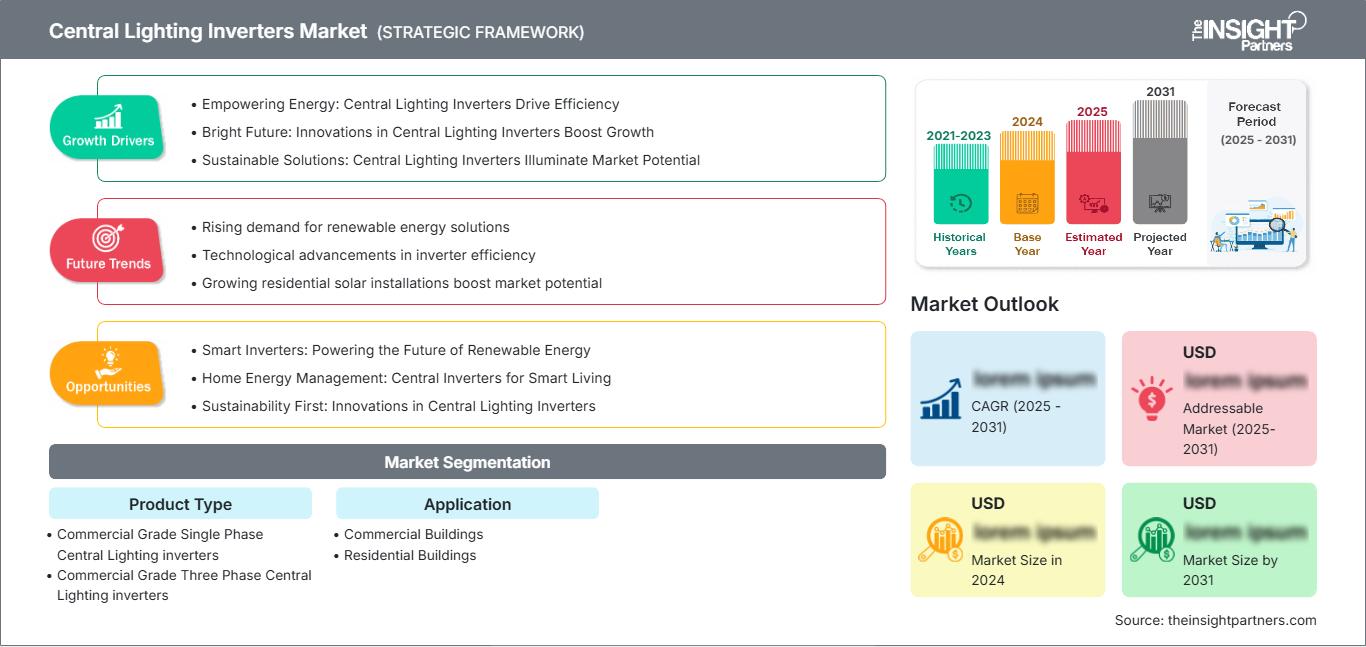
Regional Insights
North America Central Lighting Inverters Market
North America accounted for a 34–37% share in 2025 and is expected to grow at a 7.0–7.8% CAGR during 2026–2034. The market share is supported by NFPA 101 compliance, UL 924 certification requirements, healthcare infrastructure upgrades, and the replacement of aging emergency lighting power systems in commercial portfolios.
Procurement is led by the US, with Canada adding demand from institutional retrofits and mixed-use construction. Facility owners prioritize 90-minute runtime, automated testing, and centralized reporting because inspection failures delay occupancy approvals. Commercial grade three phase systems are favored in hospitals, airports, campuses, and data centers where distributed battery maintenance becomes inefficient across large floor areas.
U.S. Central Lighting Inverters Market
North America consists of 78%–82% of the US in 2025, where growth will be at a 7.1%–7.9% CAGR from 2026 to 2034. Market demand is for commercial buildings, hospitals, educational institutions, warehouses, government properties, and data centers requiring inspections and maintenance records for emergency lighting.
Industry players include Eaton Corporation plc, Hubbell Incorporated, Acuity Brands, Inc., Myers Emergency Power Systems, LLC, Staco Energy Products Co., and Controlled Power Company. Emerging trends are toward UL 924 listed inverters, digitally logged self-test features, LED in-rush capabilities, and configurable output circuit breakers. Contractors are looking for a quick-ship capability, since such equipment often lies on the critical path before occupancy.
Europe Central Lighting Inverters Market
Europe occupied 24–27% in 2025 and is expected to register a 6.6–7.4% CAGR from 2026 to 2034. The dominant market in Europe is Germany due to dense public infrastructure, industrial estates, and renovation works enabling the centralized purchase of emergency power. In the UK, life safety codes apply to office spaces, hospitals, universities, and transport infrastructures.
In France, Italy, and Spain, the contribution includes hotel renovations, metro systems, renovations of public buildings, and retail facilities modernization. Standards conformance, battery functionality, cabinet size, and efficiency of conversions are prioritized by European customers due to costs of energy and space. ABB Ltd., Eaton Corporation plc, and regional distributors enhance the market through specifying and maintenance collaborations.
APAC Central Lighting Inverters Market
The APAC region accounted for a 25-28% share in 2025 and will grow at an 8.2-9.1% CAGR during 2026-2034. China drives demand through its commercial towers, transportation facilities, hospitals, and industrial estates. Demand is supplemented by India due to rapid installation in metros, airports, data centers, and luxurious residential constructions.
Japan, South Korea, and Australia sustain their demand due to strict building standards, robust public utilities, and high penetration of LEDs. Policy factors involve city safety, energy-saving buildings, and emergency response plans. Partnerships at local levels continue to be vital since the installers require voltage settings, battery replacements, startups, and inspections consistent with national electrical regulations.
Middle East & Africa Central Lighting Inverters Market
The Middle East & Africa region will have a growth rate of 6.9-7.8% CAGR from 2026-2034. Demand in the Middle East & Africa region will be driven by airports, healthcare expansion, hospitality construction, and large scale mixed-use construction. Premium adoption is supported in the UAE through commercial towers and hotels whereas reliable systems are needed in South Africa for malls, hospitals, and civic buildings.
The energy and infrastructure context means inverters need to withstand heat, dust, generators, and longer maintenance periods. Adoptions continue to be project-based although demand comes from new airports, rail corridors, healthcare facilities, and residential towers. Inverters companies with local partners to handle batteries and inspect-driven maintenance have more advantages.
Segmentation Analysis
Product Type
The Product Type segment is forecast to grow at a 7.2–8.1% CAGR during 2026–2034. Central Lighting Inverters Market scope by product type is defined by building load size, phase availability, redundancy requirements, and installation footprint. Single phase units serve smaller facilities and localized emergency circuits, while three phase systems address larger commercial buildings requiring higher capacity, better distribution flexibility, and centralized monitoring.
- Commercial Grade Single Phase Central Lighting inverters: Single phase systems remain important for clinics, schools, retail units, and mid-size residential buildings where emergency lighting loads are moderate and installation teams need compact cabinets.
- Commercial Grade Three Phase Central Lighting inverters: Three phase systems hold the leading position in large commercial assets because they support higher lighting loads, output breaker flexibility, generator coordination, and centralized service access.
Application
The Application segment is projected to grow at a 7.5–8.4% CAGR during 2026–2034. Commercial buildings dominate because code inspections, dense occupancy, and larger lighting circuits make centralized inverter systems economically attractive. Residential buildings are gaining relevance in high-rise and multi-family projects where developers seek reliable emergency illumination, lower maintenance complexity, and compliance-ready battery backup.
- Commercial Buildings: Commercial buildings generate the highest revenue contribution due to hospitals, data centers, offices, schools, hotels, warehouses, and transit assets requiring inspected, centralized emergency lighting backup.
- Residential Buildings: Residential buildings create steady demand in apartments, condominiums, senior living facilities, and mixed-use towers where emergency egress lighting supports safety, occupancy approvals, and building insurance expectations.
Opportunity Snapshot
| Application | Revenue Contribution | Trend Tag | Adoption Stage |
| Commercial Buildings | High | Compliance Retrofit | Mature |
| Residential Buildings | Medium | High-Rise Safety | Scaling |
Central Lighting Inverters Market Growth Drivers and Impact Analysis
Life Safety Codes Accelerate Centralized Backup Adoption
Emergency lighting is compulsory in such buildings which come under regulation. NFPA 101 stipulates that there should be proper egress lighting in case of power failure, while the use of UL 924 listed devices helps to prove that the emergency power system functions properly. It is an important factor that has a direct bearing on the Central Lighting Inverters Market, since owners of buildings have to test, document and maintain their emergency lighting systems in order to get clearance for occupancy. Central lighting inverters save them from having numerous battery packs to manage, help maintain inspection documents automatically and enable existing lights to function at maximum capacity.
LED Retrofit Programs Change Emergency Power Requirements
The use of LEDs reduces the load on the lighting system, but it creates new issues such as driver inrush, dimming interaction, and compatibility issues with which the old systems never had to contend. The central lighting inverter with pure sine wave power, overload protection, and the ability to be programmed for testing will help facilities managers upgrade their emergency systems without changing out architectural fixtures. This device causes increased need for replacement in those buildings that have lighting retrofits paid for due to energy savings. It is also useful in specifying three phase systems in bigger facilities since reduced wattage expands capacity.
Large Building Renovation Expands Three Phase Demand
The renovation of hospitals, educational institutions, data centers, distribution centers, and mixed-use buildings has increased the need for emergency power generation equipment capable of supplying electricity to various lighting circuits from one point of maintenance. Three-phase central inverters are preferred since they have the capability of handling higher load capacities, output circuit breakers, integration with generators, and better use of space in the electrical room. This trend is seen in building renovations where the owner needs to keep running the business as they renovate their life safety systems.
Central Lighting Inverters Market Future Trends
Connected Self-Testing Becomes a Procurement Baseline
Central Lighting Inverters Market trends point toward connected self-testing becoming a baseline requirement rather than a premium option. Facility teams increasingly need timestamped test logs, alarm history, battery status, and remote notifications to support inspections across multi-site portfolios. Future systems will integrate with building management platforms, emergency control devices, and maintenance dashboards. This shift will favor suppliers that combine certified hardware with clear reporting interfaces and secure communications. The value proposition will move beyond backup power toward evidence-based compliance, reduced manual testing labor, and faster corrective action before annual inspection cycles expose system deficiencies.
Battery Chemistry and Cabinet Design Continue to Evolve
Battery strategy will become more important as owners seek longer service intervals, lower maintenance exposure, and better thermal performance. VRLA batteries remain widely used, but lithium-based and advanced monitoring options will gain attention where lifecycle cost, space, and weight matter. Cabinet design will also evolve toward smaller footprints, front access, modular replacements, and improved ventilation for electrical rooms with limited space. Suppliers that document battery safety, replacement economics, and compatibility with emergency lighting standards will be better positioned as facility managers evaluate total ownership cost rather than only purchase price.
Central Lighting Inverters Market Opportunities
Retrofit Packages for Multi-Site Commercial Portfolios
Central Lighting Inverters Market Forecasts indicate an opportunity in standardized retrofit packages for owners operating hospitals, retail chains, education campuses, hotels, and office portfolios. Many sites still rely on aging battery packs, inconsistent documentation, and manual testing procedures. Suppliers can bundle inverters, emergency control devices, commissioning, battery replacement schedules, and inspection-ready reporting. This action-oriented approach reduces project complexity for facilities teams and creates repeatable revenue for manufacturers, distributors, and electrical contractors. The strongest opportunity lies in converting fragmented emergency lighting maintenance into a planned capital program across multiple buildings.
Specification Support for High-Rise Residential Projects
High-rise residential and mixed-use projects offer a practical opportunity because emergency illumination is essential in stairs, corridors, lobbies, parking areas, and shared amenity spaces. Developers often need compact systems that satisfy code requirements without consuming premium mechanical room space. Manufacturers can support adoption by offering early-stage load calculations, voltage configuration guidance, battery room planning, and contractor training. Positioning should focus on inspection certainty, resident safety, reduced maintenance visits, and lifecycle documentation. Partnerships with consulting engineers and design-build contractors can improve specification rates before product selection becomes price-driven.
Recent Developments
- July 2026: Ingeteam announced the Ingecon Sun Storage M Series, a modular central inverter platform for utility-scale battery energy storage systems (BESS). The solution delivers up to 4.54 MVA through a scalable architecture, achieves 98.9% maximum efficiency, features an IP65-rated sealed enclosure with integrated protection and cooling, and is designed to improve reliability, installation flexibility, and power density for large-scale energy storage projects. The launch reflects the growing demand for high-efficiency, modular power conversion solutions supporting grid-scale renewable energy integration.
- May 2026: FIMER India entered into a strategic Pan-India distribution partnership with Redington Solar to expand the nationwide availability of its string inverter portfolio. The collaboration will accelerate the adoption of residential and commercial solar inverter solutions, including products under the PM Surya Ghar initiative, by leveraging Redington Solar’s extensive distribution network, financing capabilities, and logistics support. The partnership reflects the growing focus on strengthening solar supply chains and improving access to advanced inverter technologies across India.
- February 2026: Hoymiles launched the HIS-(3–6)L-G3 Series single-phase hybrid inverter for residential solar and energy storage systems. Available in 3 kW to 6 kW capacities, the inverter features AI-based Energy Management System (EMS), dual MPPT, a 100 V startup voltage for improved low-light performance, S-Miles Cloud remote monitoring, support for parallel operation of up to 10 units, UPS-level backup switching, and IP66 protection. The launch reflects the increasing demand for intelligent hybrid inverters that optimize self-consumption, backup power, and residential energy management through AI-driven controls.
Frequently Asked Questions

- Comprehensive Market Sizing and Forecast Analysis
- Detailed Segmentation Analysis
- In-Depth Market Dynamics Assessment
- Regional and Country-Level Insights
- Competitive Landscape and Company Benchmarking
- Strategic Business Intelligence
Recent Reports
Testimonials

The Insight Partners' SCADA System Market report is comprehensive, with valuable insights on current trends and future forecasts. The team was highly professional, responsive, and supportive throughout. We are very satisfied and highly recommend their services.
RAN KEDEM Partner, Reali Technologies LTDs
I requested a report on a very specific software market and the team produced the report in a few days. The information was very relevant and well presented. I then requested some changes and additions to the report. The team was again very responsive and I got the final report in less than a week.
JEAN-HERVE JENN Chairman, Future Analytica
We worked with The Insight Partners for an important market study and forecast. They gave us clear insights into opportunities and risks, which helped shape our plans. Their research was easy to use and based on solid data. It helped us make smart, confident decisions. We highly recommend them.
PIYUSH NAGPAL Sr. Vice President, High Beam Global
The Insight Partners delivered insightful, well-structured market research with strong domain expertise. Their team was professional and responsive throughout. The user-friendly website made accessing industry reports seamless. We highly recommend them for reliable, high-quality research services
YUKIHIKO ADACHI CEO, Deep Blue, LLC.
This is the first time I have purchased a market report from The Insight Partners.While I was unsure at first, I visited their web site and felt more comfortable to take the risk and purchase a market report.I am completely satisfied with the quality of the report and customer service. I had several questions and comments with the initial report, but after a couple of dialogs over email with their analyst I believe I have a report that I can use as input to our strategic planning process.Thank you so much for taking the extra time and making this a positive experience.I will definitely recommend your service to others and you will be my first call when we need further market data.
JOHN SUZUKI President and Chief Executive Officer, Board Director, BK Technologies
I wish to appreciate your support and the professionalism you displayed in the course of attending to my request for information regarding to infectious disease IVD market in Nigeria. I appreciate your patience, your guidance, and the fact that you were willing to offer a discount, which eventually made it possible for us to close a deal. I look forward to engaging The Insight Partners in the future, all thanks to the impression you have created in me as a result of this first encounter.
DR CHIJIOKE ONYIA MANAGING DIRECTOR, PineCrest Healthcare Ltd.Reason to Buy
- Informed Decision-Making
- Understanding Market Dynamics
- Competitive Analysis
- Identifying Emerging Markets
- Customer Insights
- Market Forecasts
- Risk Mitigation
- Boosting Operational Efficiency
- Strategic Planning
- Investment Justification
- Tracking Industry Innovations
- Aligning with Regulatory Trends





 Get Free Sample for