
Ceramic Capacitor Market Trends, Size & Forecast by 2034
Coverage: By Product Type (MLCC, Ceramic Disc Capacitor, Feedthrough Ceramic Capacitor, Ceramic Power Capacitor); End-User (Consumer Electronics, Automotive, Telecommunications, Energy and Power, Others) , and Geography (North America, Europe, Asia Pacific, and South and Central America)
- Status : Data Released
- Report Code : TIPRE00026562
- Category : Electronics and Semiconductor
- No. of Pages : 150
- Available Report Formats :


- Last update date : July 28, 2026


2025 Market Size
US$ 16.47 Bn
Base year value
2034 Forecast
US$ 30.41 Bn
Projected by 2034
CAGR 2026-2034
7.05 %
Growth rate
Addressable Market
US$ 211.63 Bn
(2026-2034)
The Ceramic Capacitor market was valued at US$ 16.47 billion in 2025 and is expected to reach US$ 30.41 billion by 2034; it is estimated to record a CAGR of 7.05% during 2026-2034.
Ceramic Capacitor Market Assessment and Insights
- North America accounted for 21–23% share in 2025 and is projected to grow at a CAGR range of 6.8–7.4% during 2026–2034, supported by EV platforms, aerospace electronics, and reshoring of critical components.
- US represented 78–82% of North America in 2025 and is expected to grow at 6.9–7.5% CAGR during 2026–2034, led by automotive, defense, and data center demand.
- Europe held 18–20% share in 2025 and is forecast to expand at 6.4–7.0% CAGR during 2026–2034, with Germany, France, the UK, Italy, and Spain leading industrial and mobility applications.
- Asia Pacific captured 44–47% share in 2025 and is expected to grow at 8.6–9.2% CAGR during 2026–2034, driven by China, Japan, South Korea, India, and Taiwan electronics manufacturing.
- Largest Segment MLCC held 68–72% market share in 2025 and is projected to grow at 8.1–8.7% CAGR during 2026–2034 due to compact device architectures.
- High Growth Segment Automotive accounted for 24–27% market share in 2025 and is expected to grow at 9.0–9.6% CAGR during 2026–2034 as EV and ADAS content rises.
- Key companies analyzed in detail: AFM Microelectronics Inc., Kyocera AVX Components Corporation, Johanson Dielectrics, Inc., KEMET Corporation, Murata Manufacturing Co., Ltd., Samsung Electro-Mechanics Co., Ltd., TDK Corporation, Taiyo Yuden Co., Ltd., Vishay Intertechnology, Inc., and Yageo Corporation.
Source: The Insight Partners' analysis based on proprietary research, government publications, company annual reports, investor presentations, industry databases, and expert interviews.
Migration of technology is changing priorities in procurement as buyers shift from commoditized capacitance toward higher levels of reliability, reduced equivalent series resistance, increased temperature stability, and smaller packages. The Ceramic Capacitor Market is developing through miniaturization of MLCC stacking, advanced dielectric engineering, and increased automation of processes such as sintering and testing. Although production still takes place in Asia, qualification demands of the automotive industry, aerospace sector, and other industrial applications have created a gap in value between generic and application-oriented capacitors.
During the coming years, capacity expansion will most likely be tied to developments related to electric vehicles, servers used for artificial intelligence processing, 5G communications infrastructure, and power storage installations. Governments of the US, the European Union, Japan, India, and South Korea may provide support to semiconductor and electronic component industries and thus encourage testing, packaging, and inventory localization. As a result, growth in the market will depend on material sourcing, customer qualification cycles, and the balancing act of manufacturers.
Ceramic Capacitor Market Report Scope
| Report Attribute | Details |
|---|---|
| Market size in 2025 | US$ 16.47 Billion |
| Market Size by 2034 | US$ 30.41 Billion |
| Global CAGR (2026 - 2034) | 7.05% |
| Historical Data | 2021-2024 |
| Forecast period | 2026-2034 |
Ceramic Capacitor Market Analysis
The Ceramic Capacitor Market growth is being fueled by the increase in the number of capacitors used per device, automobile, base station, and power modules. In order to provide stable filtration, electric cars will need it in battery management systems, inverters, onboard chargers, and ADAS controllers. Also, 5G radio units and AI servers will demand low loss decoupling at high density boards. According to the IEA, more than 17 million electric cars were sold in 2024.
The dynamics of supply depend on the quality of ceramic powder, electrode metals, yield during the process of firing, and qualification periods. Producers will have to shift their capacities from low margin consumer products to the higher margin automotive, industrial, energy, and telecommunication products where the margins of error are not high. Selection of ceramic dielectrics, stacking accuracy, and electrical testing will become the major factor in selecting suppliers.
The Ceramic Capacitor market report reveals the competitive landscape dominated by Murata Manufacturing Co., Ltd., Samsung Electro-Mechanics Co., Ltd., TDK Corporation, Taiyo Yuden Co., Ltd., Yageo Corporation, Kyocera AVX Components Corporation, KEMET Corporation, Vishay Intertechnology, Inc., Johanson Dielectrics, Inc., and AFM Microelectronics Inc. The positioning strategy varies across voltage category, automotive compliance, high capacitance miniaturization, and customer base geographically.
Capital spending is shifting to higher value-added activities including material innovation, rapid testing, and portfolio of 48-V architectures, artificial intelligence servers, and EV power electronics. TDK's 2025 100-V MLCC launch and Murata's 2026 automotive MLCC volume production reveal the focus on reducing component count and board space. Scale will matter, but it is the design in and application engineering that will generate pricing stickiness.
● REPORT CUSTOMIZATION
Tailor This Report To Align With Your Specific Business Requirements
This report can be customized to align precisely with your business objectives, scope, and target markets. Customization options include tailored segmentation, geography, competitive analysis, and strategic insights to support informed decision-making.
Customize This Report →WHAT YOU CAN ADJUST
- ● Segmentations
- ● Geography
- ● Competitive Analysis
- ● Language Preferences
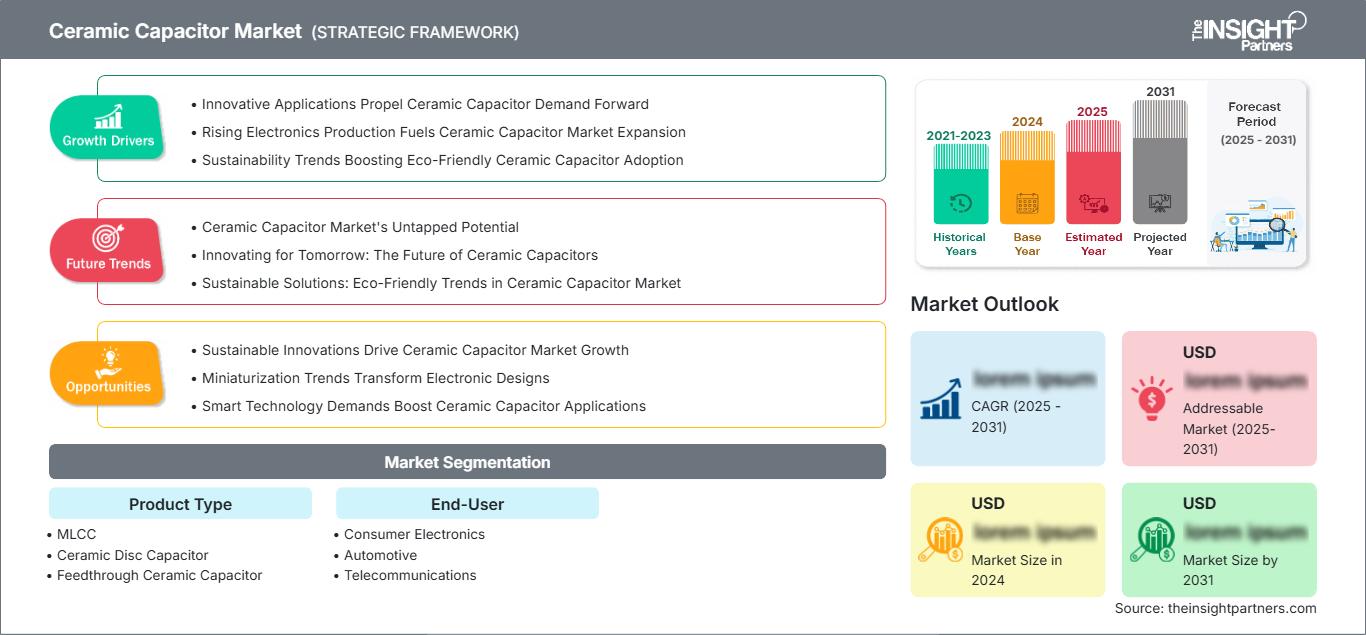
Ceramic Capacitor Market: Strategic Insights
Regional Insights
North America Ceramic Capacitor Market
The share of North America stood at 21-23% in 2025 and is forecasted to grow at 6.8-7.4% CAGR during 2026-2034. The market share growth comes from demand for EV power electronics, defense communication equipment, medical equipment, and AI data center applications in the US. Vehicle manufacturers prefer to use AEC-Q200-compliant MLCCs to ensure voltage stability in advanced control modules.
Regional procurement strategy favors dual sourcing, traceability, and stockpiling in response to electronics shortages. Increased manufacturing capacity in Mexico and investment in clean energy technologies in Canada increase demand outside the US. Buyers look for suppliers that have automotive certifications, local sales engineers, and high-reliability product portfolio. Growth will continue at a lower rate than APAC due to lower manufacturing scale but high ASP levels.
U.S. Ceramic Capacitor Market
USA accounted for 78–82% of the North American region in 2025 and will have a CAGR of 6.9-7.5% from 2026-2034. The demand emanates from the following segments: Electric vehicles, Aerospace electronics, Industrial automation, Telecom infrastructure and Data Centers. The high-frequency boards will need reliable decoupling, while power electronics will demand high-voltage ceramic components.
The company presence in the market is through design capabilities, distribution channels, and applications engineering instead of wide domestic manufacturing. The companies are; Murata Manufacturing Co., Ltd., TDK Corporation, Kyocera AVX Components Corporation, KEMET Corporation, and Vishay Intertechnology, Inc., catering for automotive, defense and industrial segments. In the US market, documentation, reliability and fast technical services are essential in component replacement.
Europe Ceramic Capacitor Market
Europe had a share of 18-20% in 2025, and the region is expected to witness a CAGR of 6.4-7.0% during 2026-2034. The dominant country is Germany because of applications like automotive electronics, industrial drives, automation, and renewable power converters. In the UK, application areas are aerospace, defense electronics, telecom systems, and instrumentation, where qualification criteria matter more than cost-effective procurement.
Those applications that are more favorable to France are aerospace, rail transport, energy, and defense. Those applications that are more favorable to Italy and Spain are automation, consumer electronics, components for the automotive industry, and power generation. Energy-efficiency and electrification regulations within Europe increase demand for capacitors in converters, chargers, and grid applications. Long-term availability, RoHS compliance, and capability for multi-year programs are important criteria in Europe.
APAC Ceramic Capacitor Market
APAC accounted for 44-47% in 2025 and is projected to grow at a CAGR of 8.6-9.2% during 2026-2034. China is the dominant region with consumption in smartphones, electric vehicles, solar inverters, and telecoms equipment, whereas Japan and South Korea are the leading MLCC technology markets. Taiwan manufactures electronics assemblies and India expands mobile devices and auto electronics.
The push towards the manufacturing of electronics, batteries, and renewable power in the region boosts APAC consumption of Ceramic Capacitors. There is smaller, but stable demand coming from Australia due to energy storage applications, mining automation, and grid systems. The demand for Ceramic Capacitors in APAC is bolstered by proximity of supply chains, high-volume production, and fast feedback loops among components manufacturers, EMS companies, and device OEMs.
Middle East & Africa Ceramic Capacitor Market
5.8-6.4% CAGR is forecast for Middle East & Africa through 2026-2034, driven by demand from energy grids, telecommunications, smart building technology, and industrial controls. Saudi Arabia drives investment through its grid, renewable, and industrial diversification initiatives, whereas the UAE facilitates investment through its electronics for data centers, logistics, and smart cities initiatives.
Demand from power equipment, mining automation, telecommunications, and industrial maintenance is driven by South Africa. The "Rest of MEA" market segment is fragmented, but will benefit from improved infrastructure in mobile broadband and distributed energy. For suppliers, the key issue is the breadth and quality of their distribution in terms of heat, dust, voltage changes, and infrastructural constraints.
Segmentation Analysis
Product Type
The product type segment is projected to grow at a 7.8–8.4% CAGR during 2026–2034. The Ceramic Capacitor Market scope across products is shaped by capacitance density, voltage rating, form factor, and reliability class. MLCC dominates compact electronics, while disc, feedthrough, and power capacitors serve filtering, EMI suppression, and higher-energy circuit requirements.
- MLCC remains the core product category because multilayer stacking enables high capacitance in compact packages, supporting smartphones, EV modules, AI servers, 5G radios, and industrial controllers.
- Ceramic Disc Capacitor is used where ruggedness, low cost, and simple construction matter, particularly in power supplies, appliances, lighting circuits, and general-purpose filtering applications.
- Feedthrough Ceramic Capacitor addresses EMI filtering in shielded enclosures, defense electronics, medical equipment, and communication systems where noise suppression and signal integrity are critical.
- Ceramic Power Capacitor supports higher-voltage and higher-current applications, including power electronics, industrial drives, grid devices, induction systems, and energy infrastructure requiring thermal stability.
End-User
The end-user segment is expected to grow at a 8.0–8.6% CAGR during 2026–2034 as electronics content rises across mobility, communications, consumer devices, and power infrastructure. Automotive is the highest-growth user base, while consumer electronics retains volume leadership. Telecommunications and energy applications increasingly demand high-reliability capacitors for dense, always-on equipment.
- Consumer Electronics generates high-volume demand from smartphones, wearables, laptops, tablets, gaming devices, and smart home products, with miniaturization and fast product refresh cycles shaping procurement.
- Automotive is strategically important as EVs, ADAS, infotainment, body electronics, and charging systems increase capacitor counts and require qualified components for temperature and vibration exposure.
- Telecommunications relies on ceramic capacitors for RF circuits, base stations, routers, optical transport systems, and small cells where signal stability and compact boards are essential.
- Energy and Power uses ceramic capacitors in inverters, converters, grid equipment, charging stations, storage systems, and industrial power supplies requiring stable performance under electrical stress.
Opportunity Snapshot
| End-User | Revenue Contribution | Trend Tag | Adoption Stage |
| Consumer Electronics | High | Mini Devices | Mature |
| Automotive | High | EV Power | Scaling |
| Telecommunications | Medium | 5G Radios | Scaling |
| Energy and Power | Medium | Grid Storage | Emerging |
Ceramic Capacitor Market Growth Drivers and Impact Analysis
Rising Electronics Content in Electric Vehicles
Vehicle electrification is increasing capacitor density across traction inverters, battery management systems, onboard chargers, DC-DC converters, sensors, and domain controllers. The IEA stated that electric car sales exceeded 17 million in 2024 and are expected to exceed 20 million in 2025, creating a clear pathway for higher passive component demand. The market benefits because EV circuits require compact, high-reliability parts that tolerate heat, vibration, and voltage fluctuation. Automakers also need multi-year supply assurance once a component is qualified. This shifts purchasing away from spot buying and toward strategic agreements with suppliers capable of AEC-Q200 testing, global logistics, and application engineering support.
Expansion of 5G, AI Servers, and High-Density Computing
Data traffic growth, AI accelerator deployment, and 5G radio densification are increasing demand for low-loss decoupling and high-frequency filtering components. Servers and base stations use dense power delivery networks where ceramic capacitors stabilize voltage near processors, memory, RF modules, and power ICs. TDK Corporation’s 2025 expansion of 100-V MLCCs for 48-V commercial and industrial systems illustrates how suppliers are targeting compact high-capacitance designs. The impact is twofold: board designers can reduce component count, and suppliers can differentiate through voltage stability, miniaturized packages, and thermal performance rather than commodity pricing alone.
Grid Modernization and Power Electronics Adoption
Renewable generation, charging infrastructure, industrial drives, and energy storage systems are expanding the use of converters, inverters, and power management electronics. Ceramic capacitors are used in snubber circuits, EMI suppression, voltage smoothing, and control-board decoupling, especially where equipment must operate continuously in demanding environments. Energy and power applications value stability, long operating life, and resistance to thermal stress. The market impact is stronger demand for medium-voltage and high-voltage ceramic capacitors, supported by utilities, equipment manufacturers, and industrial customers upgrading aging power infrastructure and adopting digitally controlled energy systems.
Ceramic Capacitor Market Future Trends
Shift Toward Ultra-Compact High-Capacitance MLCCs
Ceramic Capacitor Market trends will increasingly center on higher capacitance in smaller footprints as engineers compress boards in EV modules, wearables, medical devices, and AI servers. Murata Manufacturing Co., Ltd. began 2026 mass production of automotive MLCCs that reduce mounting area while raising capacitance, demonstrating the direction of premium product development. Future demand will favor suppliers that combine dielectric particle control, multilayer precision, and high-yield production. Miniaturization will also influence procurement because fewer components can reduce assembly complexity, improve layout flexibility, and support thinner end products without compromising electrical stability.
Application-Specific Reliability Becomes a Buying Criterion
Capacitor selection is moving from catalog matching toward platform-specific reliability analysis. Automotive, aerospace, medical, energy, and telecom customers increasingly evaluate failure modes, derating behavior, thermal cycling, acoustic noise, and long-term supply continuity before approving parts. This creates demand for suppliers with testing transparency and design-support teams. Over time, the market will separate into volume products for consumer electronics and engineered solutions for mission-critical platforms. Companies with qualified portfolios across voltage classes and temperature ranges are likely to capture stronger margins and longer customer relationships.
Ceramic Capacitor Market Opportunities
Strategic Supply Agreements for Automotive Platforms
Automotive OEMs and Tier-1 suppliers offer a major opportunity for capacitor makers that can support qualification, traceability, and long-term availability. Ceramic Capacitor Market Forecasts point to stronger demand from EV powertrains, 48-V systems, ADAS, infotainment, and charging networks. Suppliers can invest in automotive-grade MLCCs, medium-voltage parts, and application engineering teams to secure design wins before vehicle platforms enter production. The payoff is attractive because approved components often remain embedded for several model years. Capacity planning, regional warehousing, and joint roadmaps with automakers can also reduce shortage risk and strengthen pricing stability.
Localized Technical Support for Industrial and Energy Customers
Industrial automation, renewable energy, and power infrastructure customers often need technical guidance on derating, EMI suppression, thermal exposure, and substitution when boards are redesigned. Capacitor suppliers can differentiate by building regional engineering teams and distributor partnerships that support converters, inverters, chargers, storage systems, and grid equipment. This opportunity is especially relevant outside mature electronics hubs, where customers value rapid component selection and reliability guidance. Strong support can convert fragmented demand into recurring programs, particularly when manufacturers provide documented performance data, samples, and lifecycle visibility for critical power electronics applications.
Recent Developments
- February 2025: Murata Manufacturing announced the world's first 15 nF, 1.25 kV C0G multilayer ceramic capacitor (MLCC) in a compact 1210 package. The new capacitor is designed for high-voltage, high-efficiency power conversion applications such as EV onboard chargers and SiC MOSFET-based power circuits, offering stable capacitance and low power loss over a wide temperature range.
- June 2026: Exxelia acquired a 90% stake in CalRamic Technologies, a U.S.-based manufacturer of high-voltage ceramic capacitors. The acquisition expands Exxelia's high-voltage capacitor portfolio and strengthens its manufacturing footprint in North America, particularly for aerospace, defense, and industrial applications.
- May 2026: TAIYO YUDEN commercialized a 220 µF multilayer ceramic capacitor (MLCC) in the compact 3225 size for automotive applications. The product delivers one of the industry's highest capacitance levels in its class, supporting the growing demand for high-capacitance, space-saving components in advanced automotive electronic systems.
Frequently Asked Questions

- Comprehensive Market Sizing and Forecast Analysis
- Detailed Segmentation Analysis
- In-Depth Market Dynamics Assessment
- Regional and Country-Level Insights
- Competitive Landscape and Company Benchmarking
- Strategic Business Intelligence
Recent Reports
Testimonials

The Insight Partners' SCADA System Market report is comprehensive, with valuable insights on current trends and future forecasts. The team was highly professional, responsive, and supportive throughout. We are very satisfied and highly recommend their services.
RAN KEDEM Partner, Reali Technologies LTDs
I requested a report on a very specific software market and the team produced the report in a few days. The information was very relevant and well presented. I then requested some changes and additions to the report. The team was again very responsive and I got the final report in less than a week.
JEAN-HERVE JENN Chairman, Future Analytica
We worked with The Insight Partners for an important market study and forecast. They gave us clear insights into opportunities and risks, which helped shape our plans. Their research was easy to use and based on solid data. It helped us make smart, confident decisions. We highly recommend them.
PIYUSH NAGPAL Sr. Vice President, High Beam Global
The Insight Partners delivered insightful, well-structured market research with strong domain expertise. Their team was professional and responsive throughout. The user-friendly website made accessing industry reports seamless. We highly recommend them for reliable, high-quality research services
YUKIHIKO ADACHI CEO, Deep Blue, LLC.
This is the first time I have purchased a market report from The Insight Partners.While I was unsure at first, I visited their web site and felt more comfortable to take the risk and purchase a market report.I am completely satisfied with the quality of the report and customer service. I had several questions and comments with the initial report, but after a couple of dialogs over email with their analyst I believe I have a report that I can use as input to our strategic planning process.Thank you so much for taking the extra time and making this a positive experience.I will definitely recommend your service to others and you will be my first call when we need further market data.
JOHN SUZUKI President and Chief Executive Officer, Board Director, BK Technologies
I wish to appreciate your support and the professionalism you displayed in the course of attending to my request for information regarding to infectious disease IVD market in Nigeria. I appreciate your patience, your guidance, and the fact that you were willing to offer a discount, which eventually made it possible for us to close a deal. I look forward to engaging The Insight Partners in the future, all thanks to the impression you have created in me as a result of this first encounter.
DR CHIJIOKE ONYIA MANAGING DIRECTOR, PineCrest Healthcare Ltd.Reason to Buy
- Informed Decision-Making
- Understanding Market Dynamics
- Competitive Analysis
- Identifying Emerging Markets
- Customer Insights
- Market Forecasts
- Risk Mitigation
- Boosting Operational Efficiency
- Strategic Planning
- Investment Justification
- Tracking Industry Innovations
- Aligning with Regulatory Trends





 Get Free Sample for