
Ceramified Cable Market Size, Share & Trends by 2034
Coverage: By Voltage (Low Voltage, Medium Voltage, High Voltage); Application (Fire and Smoke Detection System, Emergency Lighting and Signage, Emergency Communication, Rescue Elevators, Emergency Generators); End-user (Building, Industrial, Transit, Defense) , and Geography (North America, Europe, Asia Pacific, and South and Central America)
- Status : Data Released
- Report Code : TIPRE00017495
- Category : Electronics and Semiconductor
- No. of Pages : 150
- Available Report Formats :


- Last update date : July 24, 2026


2025 Market Size
US$ 2.31 Bn
Base year value
2034 Forecast
US$ 4.17 Bn
Projected by 2034
CAGR 2026-2034
6.80 %
Growth rate
Addressable Market
US$ 29.31 Bn
(2026-2034)
The Ceramified Cable Market size reached a value of US$ 2.31 Billion in 2025, and it is expected to reach US$ 4.17 Billion by 2034, registering a compound annual growth rate (CAGR) of 6.80% during 2026-2034. Ceramified cables are fire-resistant cables that create a ceramic layer under high temperatures, assisting in maintaining the operation of emergency circuits in buildings, industrial structures, transit assets, and military structures during fires.
North America continues to be the spec-driven market due to the impact of retrofits for the sake of building safety, modernization of transit infrastructure, improved data centers’ reliability, and increased requirements for fire alarms’, emergency lighting’s, and communication circuits' continuity. North America is expected to witness a CAGR of 6.2-6.8% during 2026-2034.
Ceramified Cable Market Assessment and Insights
- North America held 24–27% Ceramified Cable Market share in 2025 and is projected to grow at a CAGR of 6.2–6.8% during 2026–2034, supported by hospital, airport, data center, tunnel, and high-rise safety upgrades.
- US represented 76–80% of North America in 2025 and is expected to grow at 6.3–6.9% CAGR, led by commercial construction and infrastructure retrofits.
- Europe accounted for 28–31% share in 2025 and is forecast to grow at 5.8–6.4% CAGR, with Germany, the UK, France, Italy, and Spain leading safety-critical demand.
- Asia Pacific held 30–34% share in 2025 and is expected to grow at 7.4–8.2% CAGR, led by China, India, Japan, South Korea, and Australia through urban infrastructure expansion.
- Largest Segment Low Voltage held 54–58% market share in 2025 and is projected to grow at 6.1–6.7% CAGR because life-safety circuits dominate installed demand.
- High Growth Segment Transit held 12–15% market share in 2025 and is projected to grow at 7.8–8.6% CAGR as metro, airport, tunnel, and rail projects expand.
- Key companies analyzed in detail: Avtoprovod, Bhuwal Insulation Cable Pvt. Ltd., Cavicel S.p.A., Cerrini S.r.l., Marmon Electrical, Nexans S.A., Prysmian S.p.A., S.I.C.C.E.T. S.r.l., TEKAB Co. Ltd., and Wacker Chemie AG.
Source: The Insight Partners' analysis based on proprietary research, government publications, company annual reports, investor presentations, industry databases, and expert interviews.
Product development has developed from the conventional fire retardant compounds to the use of mica silicone cables, the ceramification of polymers, use of LSZH jackets, and proving of circuit integrity with flame, water, and mechanical shock resistance. Production dynamics rely on conductor quality, insulation extrusion quality, chemical nature of the compound, certification process, and regional standards such as IEC 60331, BS 7846, BS 7629, and EN 50200.
Future demand for products will increase owing to the increasing use of the aforementioned emerging geographies in adding metro rails, airports, hospitals, data centers, industrial zones, and energy infrastructure where the circuit needs to survive in a fire situation. The regulatory headwinds get augmented by the need for evacuation safety, green buildings, and the resiliency of public infrastructure. Investments will go into low smoke certified material, high voltage fire survival design, and localized production.
Ceramified Cable Market Report Scope
| Report Attribute | Details |
|---|---|
| Market size in 2025 | US$ 2.31 Billion |
| Market Size by 2034 | US$ 4.17 Billion |
| Global CAGR (2026 - 2034) | 6.80% |
| Historical Data | 2021-2024 |
| Forecast period | 2026-2034 |
Ceramified Cable Market Analysis
The market is fueled by the requirement to maintain the working of fire alarms, smoke detectors, evacuation lifts, emergency lights, generators, and communications systems when exposed to fire. There is maximum demand in applications where the loss of function would impede emergency evacuation and response. Building owners see fireproof cables not just as electrical equipment but as risk management tools whose associated costs may outweigh the costs of replacing the cables.
The supply chain starts with copper and aluminum conductors, companies manufacturing compounds to ceramify silicone, producers of mica tape, LSZH compound producers, cable makers, test labs, electrical engineers, contractors, and system integrators. The dynamics of supply are based on the performance of compound at over 600 degrees C, conductor performance, jacket smoking characteristics, and certification documentation.
The Ceramified Cable Market analysis highlights a competitive landscape characterized by global cable companies, regional fire-resistant cable makers, and materials technology companies. Prysmian S.p.A., Nexans S.A., Marmon Electrical, Cavicel S.p.A., S.I.C.C.E.T. S.r.l., TEKAB Co. Ltd., Bhuwal Insulation Cable Pvt. Ltd., Cerrini S.r.l., Avtoprovod, and Wacker Chemie AG are competitors through certification coverage, project experience, compound development knowledge, and distribution capabilities.
There is a focus on investments on products which provide lower smoke toxicity, easy termination, cable flexibility, longer circuit integrity life and regional certification. Competitors that have good laboratory capabilities, engineering expertise, and compliance credentials can protect their margins in technical specifications-based bidding. Positioning is increasingly dependent on providing early service to consultants, assisting contractors with installations, and demonstrating performance in fire resistance, water-spray resistance, impact resistance, and mechanical stress resistance.
● REPORT CUSTOMIZATION
Tailor This Report To Align With Your Specific Business Requirements
This report can be customized to align precisely with your business objectives, scope, and target markets. Customization options include tailored segmentation, geography, competitive analysis, and strategic insights to support informed decision-making.
Customize This Report →WHAT YOU CAN ADJUST
- ● Segmentations
- ● Geography
- ● Competitive Analysis
- ● Language Preferences
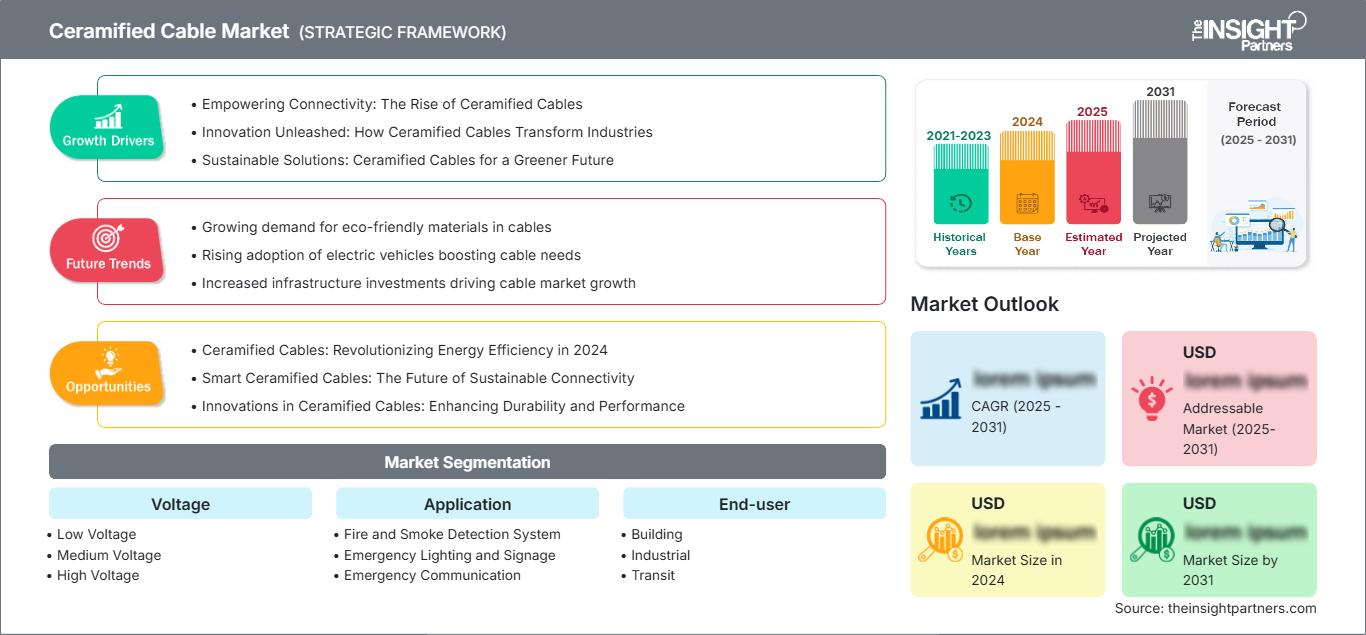
Ceramified Cable Market: Strategic Insights
Regional Insights
North America Ceramified Cable Market
North America constituted 24-27% share in 2025 and is expected to grow at a 6.2-6.8% CAGR. The demand for this product is primarily limited to applications such as hospitals, airports, tall buildings, data centers, tunnels, and industries, where circuit integrity ensures evacuation, smoke control, PA system operation, and emergency power continuity.
Regional purchasing trends are driven by insurance needs, building inspections, and the modernization of the old commercial building stock. It is common practice that consultants specify tested cable systems for fire alarm loops, emergency lighting feeders, and generator circuits. The market is aided by the contractors’ preference for products having installation instructions, good distributorship, and approval documents.
U.S. Ceramified Cable Market Market
North America in 2025 saw the US account for 76-80%, and is forecasted to register 6.3-6.9% CAGR. The application segments include commercial towers, healthcare facilities, airport terminals, rail transport, data centers, and emergency response facilities.
US projects will be served by Marmon Electrical, along with other global players including Nexans S.A. and Prysmian S.p.A. via specification route, distribution and engineered cable programs. The application trends focus on fire and smoke detection systems, emergency communications, rescue elevators, and generator feeders. Low smoke and halogen-free jackets are preferred by buyers when occupant density and equipment sensitivity are high.
Europe Ceramified Cable Market Market
Europe accounted for 28-31% market share in 2025, and it is predicted to experience CAGR of 5.8-6.4%. Germany accounts for the highest market share due to applications in industrial safety, transport infrastructure and premium construction projects. The importance of the UK sector will be due to BS-compliant fire cables, railway enhancements, hospital estates and renovation of infrastructure.
Other countries contributing to the market include France, Italy and Spain, due to applications in airport construction, railways, metros, commercial buildings and power stations that require circuit survivability. Cavicel S.p.A., Cerrini S.r.l., S.I.C.C.E.T. S.r.l., Prysmian S.p.A., and Nexans S.A. help support local supply of cables.
APAC Ceramified Cable Market Market
The APAC region had market share of 30%-34% in 2025 and forecasted to register growth rate of 7.4%-8.2% CAGR. China dominates the market due to demand from metros, data centers, high-rise buildings, and industrial constructions, while India has growing demand from airports, transit corridors, hospitals, commercial towers, and manufacturing units needing certified fire survival wiring.
Japan, South Korea, and Australia bring demand from tunnel, rail, military installation, and critical infrastructure refurbishment projects. APAC policies on safety of public property and manufacturing of wires in region favor better access to supplies. While price sensitivity is high, there is greater preference for tested fire resistance wiring where required.
Middle East & Africa Ceramified Cable Market Market
Middle East & Africa is expected to grow at 6.5–7.2% CAGR, led by Saudi Arabia, the UAE, South Africa, and Rest of MEA. Saudi Arabia leads demand through airports, smart cities, energy facilities, and transport projects tied to large infrastructure programs.
The UAE supports premium commercial, hospitality, and logistics infrastructure, while South Africa contributes through mining, industrial plants, and utility assets. Harsh conditions increase interest in robust jackets and proven circuit integrity. The Ceramified Cable Market gains from energy corridors, ports, tunnels, and public safety networks requiring reliable emergency systems.
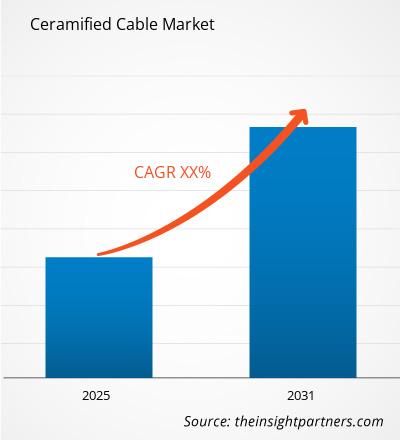
Segmentation Analysis
Voltage
Voltage is projected to grow at 6.3–7.0% CAGR during 2026–2034. The Ceramified Cable Market scope by voltage reflects circuit criticality, load requirement, installation environment, and code-driven continuity duration. Low voltage dominates life-safety systems, medium voltage supports larger facilities and transit power distribution, and high voltage remains specialized for critical energy and defense infrastructure.
- Low Voltage: Low voltage cables lead demand because fire alarms, emergency lighting, signage, public address, and control circuits require reliable operation across buildings, transit stations, and healthcare facilities.
- Medium Voltage: Medium voltage demand is linked to large industrial plants, rail networks, airports, and energy facilities where emergency power distribution must remain stable under fire exposure.
- High Voltage: High voltage usage is selective but strategically important in defense, substations, tunnels, and critical energy assets where fire survival and mechanical durability are essential.
Application
Application is expected to grow at 6.5–7.2% CAGR during 2026–2034. Application demand is shaped by the need to preserve evacuation, alarm, communication, and emergency power functions when surrounding systems are under thermal stress. Fire and smoke detection remains core, while rescue elevators and emergency generators gain importance in taller buildings and complex infrastructure.
- Fire and Smoke Detection System: This application remains the anchor use case because early warning circuits must function during fire spread, smoke movement, and evacuation management.
- Emergency Lighting and Signage: Emergency lighting and signage require reliable low-voltage cable routes that continue guiding occupants when normal power and visibility are compromised.
- Emergency Communication: Emergency communication cables support voice alarms, command centers, public address, and firefighter communication, making continuity vital in large public and commercial buildings.
- Rescue Elevators: Rescue elevator circuits are increasingly specified in high-rise buildings, hospitals, airports, and transit hubs where controlled evacuation and firefighter access are critical.
- Emergency Generators: Emergency generator connections require fire-survival cabling to keep backup power available for pumps, alarms, smoke control, lighting, and essential operational systems.
End-user
End-user is forecast to grow at 6.6–7.4% CAGR during 2026–2034. Buildings lead installed volume due to life-safety circuit density, while industrial, transit, and defense users specify higher durability and longer service expectations. The Ceramified Cable Market increasingly reflects a shift from minimum compliance toward resilience-based procurement.
- Building: Building demand is driven by high-rise, healthcare, education, hospitality, retail, and data center projects requiring alarms, evacuation systems, lighting, and generator continuity.
- Industrial: Industrial users adopt ceramified cables for process safety, emergency shutdown, fire pumps, hazardous areas, and power continuity in plants with high asset concentration.
- Transit: Transit applications include rail stations, tunnels, airports, metros, and depots where evacuation routes, communications, smoke control, and emergency power must remain functional.
- Defense: Defense demand is specialized but high-value, focusing on hardened facilities, naval assets, command centers, and mission-critical systems requiring reliable operation under extreme conditions.
Opportunity Snapshot
| Application | Revenue Contribution | Trend Tag | Adoption Stage |
| Fire and Smoke Detection System | High | Alarm Continuity | Mature |
| Emergency Lighting and Signage | High | Evacuation Lighting | Mature |
| Emergency Communication | Medium | Voice Alarm | Scaling |
| Rescue Elevators | Medium | Lift Evacuation | Scaling |
| Emergency Generators | High | Backup Power | Mature |
Ceramified Cable Market Growth Drivers and Impact Analysis
Stricter Life-Safety Codes Raise Specification Intensity
Circuit and structural codes have steadily required emergency circuits to keep the system functional in the event of fire exposure, water spraying, and mechanical damage. This creates a direct increase in demand for certified ceramified cables in hospitals, airports, towers, tunnels, and other public institutions. This demand effect is evident through procurement practices, whereby contractors are now required to provide compliance documents, consultants compare performance tests, and owners reduce their exposure to liability risks. In light of this situation, cable procurement has now moved away from low-cost fire-resistant cables to cables that ensure circuit integrity.
Infrastructure Modernization Expands Fire-Survival Wiring Demand
Transit systems, airport systems, utilities, data centers, and industries are becoming more sophisticated to accommodate higher occupancies, digital control, and higher demands. Fire-resistant wiring becomes crucial if the wiring circuits of alarms, smoke extraction, lighting, communication, and power backup systems run through highly sophisticated buildings. The effect is not merely on individual products but rather on higher-value projects. Consulting engineers have started using certified cables in all packages to ease approval and maintenance. This driver helps meet high-value demand due to the fact that modernization projects usually call for low-smoke jackets and fire resistance properties.
Material Innovation Improves Performance and Installability
Developments in ceramifying silicones, mica reinforcement, LSZH compounds, and conductor insulation technologies have enhanced cable flexibility, termination capabilities, flame resistance, and circuit survivability. For example, Wacker Chemie AG has showcased ceramifying silicone technologies that create a protective ceramic layer at temperatures above 600°C, demonstrating how science can enhance fire protection capabilities. This means that the real-world effect for contractors will be more reliable cables and fewer installation difficulties. As for the owners, the result will be higher reliability of the installation. Suppliers with both compound and cable knowledge will have an advantage in the competitive bidding process.
Ceramified Cable Market Future Trends
Low-Smoke and Halogen-Free Designs Become Default Specifications
Ceramified Cable Market trends point toward broader default use of LSZH jackets and lower toxicity materials in dense public and commercial assets. Future specifications will increasingly treat smoke behavior as important as flame survival because evacuation safety depends on visibility and breathable conditions. Manufacturers will refine compounds that balance low smoke, mechanical strength, flexibility, and ceramic barrier formation. This trend should favor suppliers with validated formulations, repeatable extrusion quality, and test evidence across international standards, especially in airports, hospitals, data centers, metro systems, and high-rise buildings.
Project Owners Shift Toward System-Level Fire Resilience
Future procurement will move beyond cable-only compliance toward coordinated system resilience covering routing, supports, penetrations, terminations, alarms, backup power, and smoke control. This will influence how consultants specify ceramified cables alongside fire-rated enclosures, trays, and emergency power architectures. Suppliers that provide technical documentation, installation support, and cross-standard evidence will gain influence earlier in design. The shift creates opportunity for premium products because owners increasingly want defensible continuity performance rather than isolated component certificates that do not fully address real fire conditions.
Ceramified Cable Market Opportunities
Transit and Tunnel Projects Create Premium Specification Openings
Ceramified Cable Market Forecasts indicate strong opportunity in transit systems because tunnels, metros, airports, and rail stations require continuous power, lighting, communication, and smoke control during emergencies. Suppliers can win by offering tested cable families for multiple circuits, clear installation guidance, and documentation aligned with regional approvals. Contractors value availability across voltage classes and accessories that simplify installation. Investment should focus on project specification teams, local inventory, and partnerships with fire system integrators. Transit work is attractive because projects are multi-year, safety-focused, and less likely to substitute uncertified products.
Localized Manufacturing for Fast-Growing Construction Markets
Emerging construction markets present opportunity for manufacturers that can localize production, testing, and distribution while maintaining international performance standards. Local capacity reduces lead times for contractors, supports public procurement preferences, and improves responsiveness to project changes. Companies can target hospitals, commercial towers, industrial parks, and transport corridors where fire safety requirements are becoming more formal. The investment case improves when cable makers combine regional extrusion, certified compounds, technical training, and distributor networks. This approach helps premium suppliers compete against low-cost alternatives without sacrificing compliance assurance or project reliability.
Recent Developments
- June 2026: Wacker Chemie AG presented a ceramifying silicone for thermal barrier applications at the Battery Show in Stuttgart. The company stated that the material forms a ceramic above 600°C and that coated fabric reduced radiant heat from a 1,300°C flame to below 150°C, supporting broader fire-protection material innovation.
- October 2025: Wacker Chemie AG showcased high-tech silicones at K 2025, including new ceramifying silicones for electromobility safety and silicone materials for power-grid expansion. The announcement reinforced how ceramifying polymer chemistry is moving into high-temperature protection, insulation, and safety-critical electrical applications relevant to cable material development.
- April 2024: Tolsa will highlight the latest advancements in flame retardant additives for the wire and cable market at the Wire 2024 (International Wire and Cable Trade Fair). The company will showcase its ADINS® Clay and ADINS® Fireproof range of high-performance flame retardant (FR) synergists which have won strong adoption in the wire and cable industry.
Frequently Asked Questions

- Comprehensive Market Sizing and Forecast Analysis
- Detailed Segmentation Analysis
- In-Depth Market Dynamics Assessment
- Regional and Country-Level Insights
- Competitive Landscape and Company Benchmarking
- Strategic Business Intelligence
Recent Reports
Testimonials

The Insight Partners provided valuable market intelligence that supported our global go-to-market strategy. Their team was professional, responsive, and attentive to our feedback, providing thoughtful analysis and helpful methodological clarifications throughout the project.
Junmo Kim Chief Financial Officer (CFO), Enertech Co., Ltd.
The Insight Partners' SCADA System Market report is comprehensive, with valuable insights on current trends and future forecasts. The team was highly professional, responsive, and supportive throughout. We are very satisfied and highly recommend their services.
RAN KEDEM Partner, Reali Technologies LTDs
I requested a report on a very specific software market and the team produced the report in a few days. The information was very relevant and well presented. I then requested some changes and additions to the report. The team was again very responsive and I got the final report in less than a week.
JEAN-HERVE JENN Chairman, Future Analytica
We worked with The Insight Partners for an important market study and forecast. They gave us clear insights into opportunities and risks, which helped shape our plans. Their research was easy to use and based on solid data. It helped us make smart, confident decisions. We highly recommend them.
PIYUSH NAGPAL Sr. Vice President, High Beam Global
The Insight Partners delivered insightful, well-structured market research with strong domain expertise. Their team was professional and responsive throughout. The user-friendly website made accessing industry reports seamless. We highly recommend them for reliable, high-quality research services
YUKIHIKO ADACHI CEO, Deep Blue, LLC.
This is the first time I have purchased a market report from The Insight Partners.While I was unsure at first, I visited their web site and felt more comfortable to take the risk and purchase a market report.I am completely satisfied with the quality of the report and customer service. I had several questions and comments with the initial report, but after a couple of dialogs over email with their analyst I believe I have a report that I can use as input to our strategic planning process.Thank you so much for taking the extra time and making this a positive experience.I will definitely recommend your service to others and you will be my first call when we need further market data.
JOHN SUZUKI President and Chief Executive Officer, Board Director, BK Technologies
I wish to appreciate your support and the professionalism you displayed in the course of attending to my request for information regarding to infectious disease IVD market in Nigeria. I appreciate your patience, your guidance, and the fact that you were willing to offer a discount, which eventually made it possible for us to close a deal. I look forward to engaging The Insight Partners in the future, all thanks to the impression you have created in me as a result of this first encounter.
DR CHIJIOKE ONYIA MANAGING DIRECTOR, PineCrest Healthcare Ltd.Reason to Buy
- Informed Decision-Making
- Understanding Market Dynamics
- Competitive Analysis
- Identifying Emerging Markets
- Customer Insights
- Market Forecasts
- Risk Mitigation
- Boosting Operational Efficiency
- Strategic Planning
- Investment Justification
- Tracking Industry Innovations
- Aligning with Regulatory Trends





 Get Free Sample for