
CFD in Industrial Machinery Market Size, Growth & Demand by 2034
Coverage: By Type (Gases, Liquids); End Use (Light Industry, Heavy Industry), and Geography (North America, Europe, Asia Pacific, and South and Central America)
- Status : Data Released
- Report Code : TIPRE00016684
- Category : Electronics and Semiconductor
- No. of Pages : 150
- Available Report Formats :


- Last update date : July 21, 2026


2025 Market Size
US$ 6.34 Bn
Base year value
2034 Forecast
US$ 11.38 Bn
Projected by 2034
CAGR 2026-2034
6.72 %
Growth rate
Addressable Market
US$ 80.11 Bn
(2026-2034)
The CFD in Industrial Machinery market was valued at US$ 6.34 Billion in 2025 and is projected to reach US$ 11.38 Billion by 2034, registering a CAGR of 6.72% during 2026–2034. Demand is shaped by virtual prototyping, heat-transfer modeling, multiphase flow simulation, pump and compressor optimization, and digital engineering programs across manufacturers seeking shorter development cycles and lower test costs.
North America CFD in Industrial Machinery Market size is expected to expand at a CAGR of 6.1–6.9% during 2026–2034, supported by the reshoring of advanced manufacturing, high-performance computing access, and the strong adoption of simulation-led design in energy equipment, HVAC, electronics cooling, and process machinery. Cloud solvers and GPU acceleration are improving access for mid-sized machinery manufacturers.
CFD in Industrial Machinery Market Assessment and Insights
- North America held 28–32% share in 2025 and is growing at a CAGR of 6.1–6.9% during 2026–2034, led by industrial digitalization, cloud simulation, and strong machinery engineering capacity.
- US represented 76–80% of North American revenue in 2025 and is growing at a CAGR of 6.2–7.0% during 2026–2034, supported by advanced manufacturing.
- Europe accounted for 24–28% share in 2025 and is growing at a CAGR of 5.7–6.5% during 2026–2034, with Germany, the UK, France, Italy, and Spain leading machinery simulation adoption.
- Asia Pacific held 34–38% share in 2025 and is growing at a CAGR of 7.2–8.1% during 2026–2034, led by China, Japan, South Korea, India, and Australia.
- Largest Segment Liquids held 58–62% market share in 2025 and is growing at a CAGR of 6.5–7.3% during 2026–2034 as pumps, valves, and process systems dominate use cases.
- High Growth Segment Heavy Industry represented 54–58% market share in 2025 and is growing at a CAGR of 7.1–8.0% during 2026–2034, helped by energy, metals, and large equipment projects.
- Key companies analyzed in detail: Ansys, Inc.; Siemens Digital Industries Software; Siemens EDA; Aspen Technology, Inc.; Bentley Systems, Incorporated; Autodesk, Inc.; COMSOL AB; Dassault Systèmes SE; ESI Group; Exa Corporation.
Source: The Insight Partners' analysis based on proprietary research, government publications, company annual reports, investor presentations, industry databases, and expert interviews.
Industrial machinery simulation has evolved from specialist fluid studies into a central engineering workflow for rotating equipment, thermal systems, mixers, filtration units, valves, compressors, and heavy process assets. CFD in Industrial Machinery growth is reinforced by rising product complexity, tighter energy-efficiency targets, and the need to evaluate liquid and gas behavior before tooling or field testing. GPU solvers, automated meshing, and multiphysics platforms are changing production dynamics by enabling faster design iteration.
Forward demand will be shaped by machinery electrification, industrial decarbonization, modular equipment design, and wider use of cloud-based engineering capacity in emerging manufacturing hubs. Regulatory pressure on energy use and emissions will keep simulation relevant for pumps, fans, turbines, heat exchangers, industrial ovens, and process equipment. Investment should move toward interoperable platforms that connect CAD, CAE, digital twins, and plant performance data.
CFD in Industrial Machinery Market Report Scope
| Report Attribute | Details |
|---|---|
| Market size in 2025 | US$ 6.34 Billion |
| Market Size by 2034 | US$ 11.38 Billion |
| Global CAGR (2026 - 2034) | 6.72% |
| Historical Data | 2021-2024 |
| Forecast period | 2026-2034 |
CFD in Industrial Machinery Market Analysis
CFD in the Industrial Machinery Market growth is driven by manufacturers seeking fewer physical prototypes, better thermal performance, and faster validation of fluid-intensive systems. Demand concentrates around pumps, compressors, turbines, fans, mixers, valves, HVAC equipment, and process machinery where pressure drop, cavitation, turbulence, heat transfer, and multiphase behavior directly influence operating reliability and warranty exposure.
The ecosystem includes CAD vendors, CAE platform developers, semiconductor providers, HPC infrastructure suppliers, cloud service providers, engineering consultants, OEM design teams, and plant operators. Supply dynamics are shaped by solver performance, licensing flexibility, model fidelity, training availability, and integration with digital twin environments. Buyers increasingly evaluate lifecycle value rather than standalone software cost.
CFD in Industrial Machinery Market analysis indicates a competitive landscape anchored by solver accuracy, workflow automation, multiphysics breadth, and enterprise integration. Ansys, Inc., Siemens Digital Industries Software, COMSOL AB, Dassault Systèmes SE, Autodesk, Inc., and Bentley Systems, Incorporated compete through engineering suites that connect geometry, meshing, simulation, optimization, and collaboration.
Specialists and portfolio vendors such as Aspen Technology, Inc., Siemens EDA, ESI Group, and Exa Corporation support industrial users through process engineering, electronics cooling, virtual prototyping, and legacy simulation capabilities. Investment is moving toward GPU acceleration, AI-assisted setup, cloud burst capacity, automated design exploration, and service-led implementation for machinery makers with limited simulation teams.
● REPORT CUSTOMIZATION
Tailor This Report To Align With Your Specific Business Requirements
This report can be customized to align precisely with your business objectives, scope, and target markets. Customization options include tailored segmentation, geography, competitive analysis, and strategic insights to support informed decision-making.
Customize This Report →WHAT YOU CAN ADJUST
- ● Segmentations
- ● Geography
- ● Competitive Analysis
- ● Language Preferences
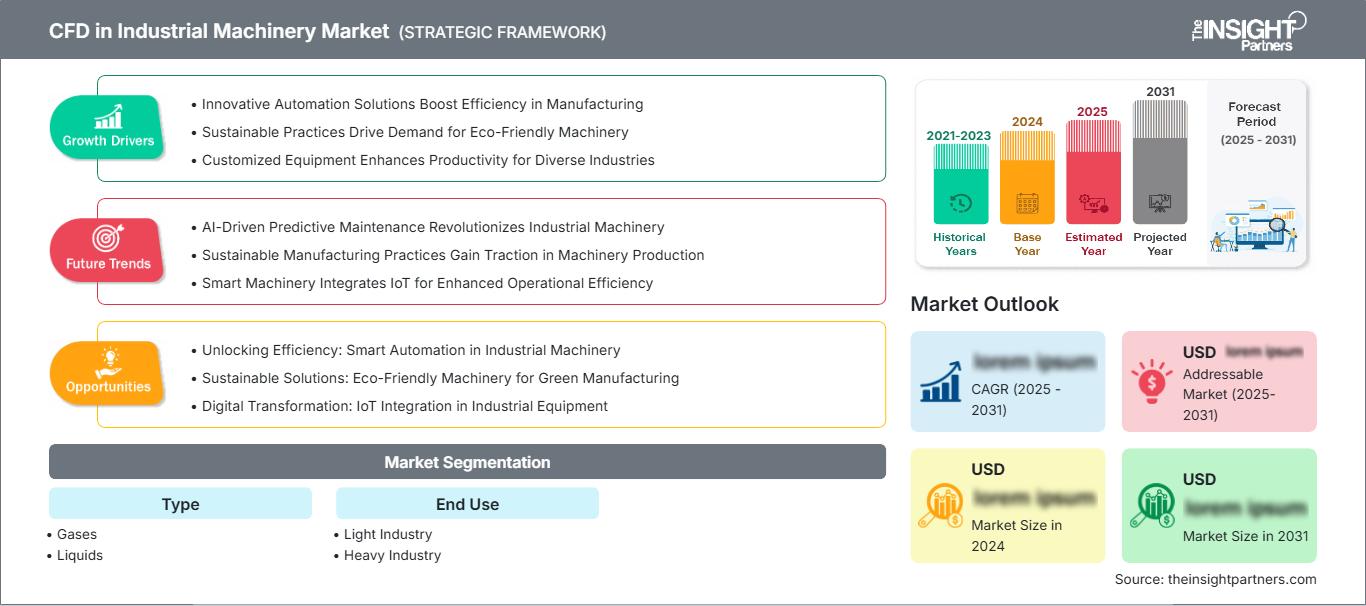
CFD in Industrial Machinery Market: Strategic Insights
Regional Insights
North America CFD in Industrial Machinery Market
North America accounted for 28–32% of CFD in the Industrial Machinery Market share in 2025 and is projected to expand at a CAGR of 6.1–6.9% during 2026–2034. Adoption is supported by high-value machinery design, energy equipment upgrades, electronics cooling, HVAC efficiency programs, and broad access to cloud computing and engineering services.
Industrial buyers in the region use simulation to reduce test loops, validate thermal margins, and improve machinery reliability before release. The U.S. leads regional spending, while Canada and Mexico add demand through manufacturing automation, energy infrastructure, and supplier networks. Vendor presence and university-industry engineering programs strengthen adoption.
U.S. CFD in Industrial Machinery Market
The U.S. represented 76–80% of North American revenue in 2025 and is expected to grow at a CAGR of 6.2–7.0% during 2026–2034. Application trends center on turbomachinery, pumps, compressors, industrial ventilation, data-center cooling equipment, process skids, and advanced manufacturing systems requiring validated gas and liquid flow modeling.
Ansys, Inc., Autodesk, Inc., Aspen Technology, Inc., and the operations of Siemens Digital Industries Software support U.S. adoption through software, services, and enterprise relationships. Buyers prioritize cybersecurity, solver scalability, and integration with product lifecycle management because simulation outputs increasingly guide procurement, certification, and service decisions.
Europe CFD in Industrial Machinery Market
Europe held 24–28% share in 2025 and is projected to grow at a CAGR of 5.7–6.5% during 2026–2034. Germany is the leading country because machinery exports, energy-efficiency rules, and advanced manufacturing clusters create sustained demand for CFD-led design validation in pumps, compressors, turbines, heat exchangers, and factory systems.
The UK supports adoption through energy systems, motorsport engineering, and process equipment design. France, Italy, and Spain add demand through aerospace suppliers, industrial equipment manufacturers, and water infrastructure projects. European buyers emphasize energy performance, emissions reduction, documentation quality, and interoperability with standards-based engineering platforms.
APAC CFD in Industrial Machinery Market
Asia Pacific accounted for 34–38% share in 2025 and is forecast to grow at a CAGR of 7.2–8.1% during 2026–2034. China leads through machinery production scale, industrial software investment, and energy equipment manufacturing.
Japan and South Korea support high-precision applications in electronics cooling, compressors, and robotics. India and Australia add demand through infrastructure, mining equipment, process industries, and manufacturing policy support. Regional growth is strengthened by lower cloud-computing barriers and expanding simulation talent pools.
Middle East & Africa CFD in Industrial Machinery Market
The Middle East & Africa market is projected to grow at a CAGR of 5.0–5.9% during 2026–2034. Saudi Arabia leads in energy, petrochemicals, water, and industrial diversification programs, which require better process machinery performance.
The UAE supports demand through infrastructure, district cooling, and advanced engineering services, while South Africa remains important for mining, water systems, and industrial maintenance. The rest of MEA adoption depends on project financing, local engineering capability, and reliable access to software support.
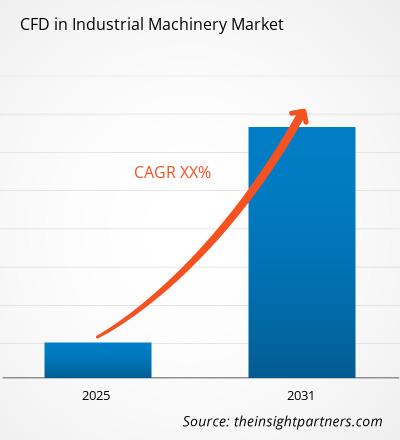
Segmentation Analysis
Type
Type is projected to grow at a CAGR of 6.3–7.1% during 2026–2034. The CFD in Industrial Machinery scope spans gas and liquid simulations used to evaluate pressure loss, turbulence, heat exchange, cavitation, mixing, filtration, and phase interaction. Liquids dominate current spending because process equipment, pumps, valves, cooling loops, and hydraulic systems require repeated flow validation.
- Gases support ventilation, combustion, drying, pneumatic conveying, compressor, fan, and exhaust applications where turbulence, heat transfer, acoustics, and pressure distribution influence efficiency and operating safety.
- Liquids lead adoption across pumps, valves, mixers, cooling circuits, filtration equipment, and chemical process machinery because cavitation, viscosity, multiphase behavior, and flow uniformity directly affect reliability.
End Use
End Use is forecast to grow at a CAGR of 6.6–7.4% during 2026–2034. Heavy industry accounts for higher simulation intensity because large equipment failures can create major downtime, energy losses, and safety exposure. Light industry adoption is rising as packaged equipment makers use cloud CFD to improve compact designs, reduce noise, and meet efficiency expectations.
- Light Industry includes food processing, packaging, consumer equipment, electronics, and HVAC products, where compact geometry, thermal control, airflow comfort, and lower prototype budgets shape simulation use.
- Heavy Industry covers energy, metals, chemicals, mining, water, and large machinery, where CFD supports risk reduction, process stability, equipment uptime, and energy-efficiency improvement.
Opportunity Snapshot
| End Use | Revenue Contribution | Trend Tag | Adoption Stage |
| Light Industry | Medium | Compact Cooling | Scaling |
| Heavy Industry | High | Energy Retrofit | Mature |
CFD in Industrial Machinery Market Growth Drivers and Impact Analysis
Virtual prototyping reduces machinery development cost
Machinery OEMs are under pressure to shorten engineering cycles while proving performance across more operating conditions. CFD helps teams test geometry, flow paths, heat-transfer surfaces, and rotating components before tooling, fabrication, or field trials. The impact is strongest where prototypes are expensive, slow, or difficult to instrument, such as pumps, turbines, compressors, large mixers, and industrial heat exchangers. Simulation also improves collaboration between design, manufacturing, and service teams because performance assumptions can be reviewed before a product reaches the customer. As solver automation improves, more organizations can use CFD earlier in concept screening rather than only during late-stage troubleshooting. In addition, CFD enables engineers to evaluate multiple design alternatives rapidly, reduce material waste, optimize energy efficiency, and minimize costly redesigns. The growing use of digital engineering workflows and high-performance computing is further expanding the role of CFD in accelerating product innovation and reducing development risk.
Energy-efficiency mandates increase flow optimization demand
The energy consumed by industrial machines for pumping, compression, ventilation, cooling, and circulation is considerable, which makes even minor improvements in machine performance result in lifecycle cost savings. With the use of CFD, engineers get the ability to detect pressure loss areas, recirculation, thermal limits, and cavitation that can be hard to detect during physical tests. The demands from regulators and customers regarding energy efficiency require vendors to provide documentation on the improvements made. The driver applies to both the manufacture of new machines and the re-fitment of the existing ones, especially in the areas of water, chemicals, oil and gas, HVAC, and manufacturing sectors. The providers that link their CFD results with the digital twin monitoring system will be able to assist their customers in validating the efficiency gain after installing their machines.
Cloud and GPU computing expand simulation access
High-performance computing has historically limited CFD adoption among smaller machinery manufacturers because complex models require specialist infrastructure and long solve times. Cloud access and GPU acceleration are reducing that barrier by allowing teams to run larger cases, compare more design alternatives, and scale capacity without permanent hardware investment. The market impact is practical: engineering managers can justify simulation for more projects, consultants can serve customers faster, and software vendors can offer flexible subscription models. As web interfaces and AI-assisted setup mature, CFD in the Industrial Machinery Market should become less dependent on scarce expert users and more embedded in standard design workflows. In addition, improved collaboration tools, remote access capabilities, and automated meshing technologies are helping multidisciplinary teams evaluate designs more efficiently. These advancements are enabling faster decision-making, shortening development timelines, and expanding simulation use across small and mid-sized manufacturing organizations.
CFD in Industrial Machinery Market Future Trends
AI-assisted simulation setup becomes mainstream
CFD in Industrial Machinery Market trends point toward AI-assisted workflows that help engineers prepare meshes, choose turbulence models, interpret convergence, and identify promising design changes. This trend matters because many machinery companies have limited simulation specialists but are under growing pressure to evaluate more design variants. Future platforms will combine knowledge assistants, automated boundary-condition checks, reduced-order models, and reusable templates for pumps, fans, valves, heat exchangers, and mixers. The result should be broader use by product engineers, not only CAE experts. Vendors that maintain accuracy while simplifying setup will gain stronger relevance in mid-market machinery design teams.
Digital twins link simulation to operating data
The adoption of digital twins will turn the CFD technology from the design stage into the performance stage during the whole lifecycle. The providers of machinery and plant owners are starting to link simulation models with information collected through sensors that monitor pumps, compressors, turbines, and coolers in order to analyze degradation, fouling, overheating, and abnormal flow behavior. In future implementations, reduced order models will be applied in order to have a quicker view of the operation than only full simulations. These kinds of implementations will be helpful for service agreements, predictive maintenance, and performance guarantees. This will also have an impact on the software purchase since customers will consider integration capabilities with industry data platforms, asset management systems, and remote monitoring environments. As adoption increases, more and more companies will use feedback from operations to improve simulation models, optimize maintenance plans, minimize unforeseen downtime, and increase asset utilization.
CFD in Industrial Machinery Market Opportunities
Simulation packages for mid-sized machinery OEMs
CFD in Industrial Machinery Market Forecasts support investment in packaged solutions for mid-sized OEMs that need faster design validation but lack enterprise-scale CAE departments. Vendors can combine cloud credits, solver templates, training, consulting, and post-processing dashboards for common machinery categories. This opportunity is attractive because many firms understand the value of simulation but struggle with skills, licensing complexity, and project setup. A packaged model reduces adoption risk and creates recurring revenue through support, upgrades, and workflow expansion. Suppliers that align packages with pumps, HVAC equipment, filtration, and process machinery can reach customers beyond traditional expert users.
Efficiency retrofits for heavy industrial equipment
The field of heavy industry provides a significant opportunity, as the operators have to cut down on energy consumption, but without having to replace all their assets. Using CFD, one could assess changes in impellers, ducting, heat transfer, balance of cooling water, and process flow prior to committing any capital expenditure. The engineering service providers could make use of simulation for building business cases for retrofits based on specific performance levels and risks of operation. This is an area that provides significant opportunities in chemicals, mining, water, metals, oil and gas, and power industry equipment.
Recent Developments
- March 2026: Cadence announced the release of Cradle CFD 2026. This offers improved laser welding, GPU-native computing, support for Linux environments, and new AI capabilities, along with many more enhancements. These new features highlight once more our constant dedication to make Cradle CFD the best tool to solve real-world fluid dynamics and thermal management problems with accuracy, easiness and confidence.
- April 2025: Concepts NREC and ADS CFD have formed a partnership which will allow the combination of the Agile Engineering Design System for Turbomachinery and the ADS GPU Accelerated CFD software suite to enable turbomachinery designers to perform Computational Fluid Dynamics (CFD) calculations 15-120X faster than traditional solvers at a fraction of the hardware cost.
- March 2025: EnginSoft USA announced a new partnership with Cadence, further expanding our computational fluid dynamics (CFD) portfolio to serve a wider range of customers better. This collaboration strengthens our ability to provide cutting-edge simulation solutions, helping engineers and designers tackle even the most complex fluid dynamics challenges.
Frequently Asked Questions

- Comprehensive Market Sizing and Forecast Analysis
- Detailed Segmentation Analysis
- In-Depth Market Dynamics Assessment
- Regional and Country-Level Insights
- Competitive Landscape and Company Benchmarking
- Strategic Business Intelligence
Recent Reports
Testimonials

The Insight Partners provided valuable market intelligence that supported our global go-to-market strategy. Their team was professional, responsive, and attentive to our feedback, providing thoughtful analysis and helpful methodological clarifications throughout the project.
Junmo Kim Chief Financial Officer (CFO), Enertech Co., Ltd.
The Insight Partners' SCADA System Market report is comprehensive, with valuable insights on current trends and future forecasts. The team was highly professional, responsive, and supportive throughout. We are very satisfied and highly recommend their services.
RAN KEDEM Partner, Reali Technologies LTDs
I requested a report on a very specific software market and the team produced the report in a few days. The information was very relevant and well presented. I then requested some changes and additions to the report. The team was again very responsive and I got the final report in less than a week.
JEAN-HERVE JENN Chairman, Future Analytica
We worked with The Insight Partners for an important market study and forecast. They gave us clear insights into opportunities and risks, which helped shape our plans. Their research was easy to use and based on solid data. It helped us make smart, confident decisions. We highly recommend them.
PIYUSH NAGPAL Sr. Vice President, High Beam Global
The Insight Partners delivered insightful, well-structured market research with strong domain expertise. Their team was professional and responsive throughout. The user-friendly website made accessing industry reports seamless. We highly recommend them for reliable, high-quality research services
YUKIHIKO ADACHI CEO, Deep Blue, LLC.
This is the first time I have purchased a market report from The Insight Partners.While I was unsure at first, I visited their web site and felt more comfortable to take the risk and purchase a market report.I am completely satisfied with the quality of the report and customer service. I had several questions and comments with the initial report, but after a couple of dialogs over email with their analyst I believe I have a report that I can use as input to our strategic planning process.Thank you so much for taking the extra time and making this a positive experience.I will definitely recommend your service to others and you will be my first call when we need further market data.
JOHN SUZUKI President and Chief Executive Officer, Board Director, BK Technologies
I wish to appreciate your support and the professionalism you displayed in the course of attending to my request for information regarding to infectious disease IVD market in Nigeria. I appreciate your patience, your guidance, and the fact that you were willing to offer a discount, which eventually made it possible for us to close a deal. I look forward to engaging The Insight Partners in the future, all thanks to the impression you have created in me as a result of this first encounter.
DR CHIJIOKE ONYIA MANAGING DIRECTOR, PineCrest Healthcare Ltd.Reason to Buy
- Informed Decision-Making
- Understanding Market Dynamics
- Competitive Analysis
- Identifying Emerging Markets
- Customer Insights
- Market Forecasts
- Risk Mitigation
- Boosting Operational Efficiency
- Strategic Planning
- Investment Justification
- Tracking Industry Innovations
- Aligning with Regulatory Trends





 Get Free Sample for