
Charge-coupled Devices (CCDs) Market Trends, Demand & Growth by 2034
Coverage: By Product Type (Line CCD, Interline CCD, Full-Frame CCD, Frame-Transfer CCD); Application (Digital Cameras, Optical Scanners, High-End Scientific Applications, Others), and Geography (North America, Europe, Asia Pacific, and South and Central America)
- Status : Data Released
- Report Code : TIPRE00016960
- Category : Electronics and Semiconductor
- No. of Pages : 150
- Available Report Formats :


- Last update date : July 28, 2026


2025 Market Size
US$ 3.52 Bn
Base year value
2034 Forecast
US$ 6.55 Bn
Projected by 2034
CAGR 2026-2034
7.13 %
Growth rate
Addressable Market
US$ 45.41 Bn
(2026-2034)
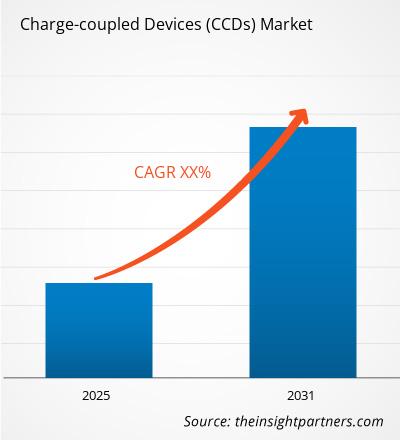
Charge-coupled Devices (CCDs) Market is forecasted to be worth US$ 3.52 Billion in 2025 and is anticipated to attain US$ 6.55 Billion by 2034, growing at a CAGR of 7.13%. This is fueled by the need for high-resolution imagery that can be achieved through such devices in digital cameras, optical scanners, astronomy, spectroscopy, microscopy, medical diagnosis, industrial inspection, and space observation systems.
In North America, Charge-coupled Devices (CCDs) Market size is being driven by demand from scientific instruments, defense imaging, life sciences research, and industrial metrology applications. The market is predicted to continue growing at a CAGR between 6.4 and 7.1% during 2026 and 2034 owing to lab automation, semiconductor inspection, aerospace procurements, and premium imaging upgrades in academic institutions, observatories, hospitals, and specialist manufacturing facilities.
Charge-coupled Devices (CCDs) Market Assessment and Insights
- North America: The region is estimated to hold 29–33% share in 2025 and grow at a CAGR of 6.4–7.1% during 2026–2034, supported by scientific imaging, aerospace programs, and semiconductor inspection.
- US: The country represents 76–80% of North America in 2025 and is projected to grow at a CAGR of 6.5–7.2% during 2026–2034.
- Europe: Europe accounts for 24–28% share in 2025 and is expected to grow at a CAGR of 6.0–6.8% during 2026–2034, led by Germany, the UK, France, Italy, and Spain.
- Asia Pacific: Asia Pacific represents 32–36% share in 2025 and is forecast to grow at a CAGR of 7.8–8.6% during 2026–2034, with Japan, China, South Korea, India, and Australia expanding advanced imaging supply chains.
- Largest Segment: Interline CCD holds 36–40% market share in 2025 and is expected to grow at a CAGR of 6.7–7.5% during 2026–2034.
- High Growth Segment: High-End Scientific Applications holds 28–32% market share in 2025 and is expected to grow at a CAGR of 8.0–8.8% during 2026–2034.
- Key companies analyzed in detail: Eastman Kodak Company; FUJIFILM Corporation; Koninklijke Philips N.V.; LG Electronics Inc.; Nikon Corporation; Panasonic Holdings Corporation; Sharp Corporation; Sony Group Corporation; Spectral Instruments, Inc.; Toshiba Corporation.
Source: The Insight Partners' analysis based on proprietary research, government publications, company annual reports, investor presentations, industry databases, and expert interviews.
The use of imaging technology has been transformed from the mass market uptake of CCDs to applications that are critical for high performances where charge transfer efficiency, pixel uniformity, and read noise levels warrant further acquisition. The production environment is currently characterized by mature wafer technologies, specialist packaging, thermal control systems, extended lifetime supply contracts, and sensors customizing. The market continues to be significant since several scientific, aerospace, and industrial players prefer stability to speed and noise.
Future demand will be driven by astronomical projects, microscopic improvements, archive scanners, machine visions, and military imaging systems which involve lengthy validation procedures. New geographies have been developing from standard imaging purchases to laboratory-grade systems as the semiconductor, medical science, and materials research capabilities grow. Favorable regulations regarding diagnostics traceability, food quality, and security imaging contribute indirectly to CCDs, as well as developments in cooled and spectroscopic cameras.
Charge-coupled Devices (CCDs) Market Report Scope
| Report Attribute | Details |
|---|---|
| Market size in 2025 | US$ 3.52 Billion |
| Market Size by 2034 | US$ 6.55 Billion |
| Global CAGR (2026 - 2034) | 7.13% |
| Historical Data | 2021-2024 |
| Forecast period | 2026-2034 |
Charge-coupled Devices (CCDs) Market Analysis
Applications that need high quantum efficiency, pixel-to-pixel consistency, high dynamic range, and reliable low-light performance drive demand. The Charge-coupled Devices (CCDs) market growth comes from astronomy, spectroscopy, fluorescence microscopy, document scanning, and precision inspection applications where imaging quality is more critical than cost and readout speed. The value chain comprises wafer providers, sensor designers, camera OEMs, cooling unit manufacturers, optical components providers, systems integration companies, research labs, and end-users in the industry.
Market supply is characterized by vendors able to provide continuous supply for old CCD types and development of customized sensors with robust packaging. Factors considered during procurement include dark current, blooming capability, smear performance, spectral response, calibration, and product life cycle availability. Low volumes of CCDs compared to consumer-grade CMOS make pricing stable and long-term supply planning important for equipment makers.
The competitive environment in the Charge-coupled Devices (CCDs) Market Report includes diversified electronics companies, camera manufacturers, and specialized instrument providers. Sony Group Corporation, Toshiba Corporation, Sharp Corporation, Panasonic Holdings Corporation, Nikon Corporation, FUJIFILM Corporation, Eastman Kodak Company, LG Electronics Inc., Koninklijke Philips N.V., and Spectral Instruments, Inc. offer varied roles in terms of sensors, imaging equipment, scanners, optics, cameras, and scientific instruments.
In terms of investment opportunities, cooled scientific cameras, sensitive line sensors, space-qualified focal planes, and imaging modules accompanied by analytics software emerge as dominant options. In market analysis, it is evident that strategic positioning does not depend on sales volumes but rather on application reliability, calibration information, technical assistance, and replacement period. Proven vendors can retain margins in laboratories and mission critical environments.
● REPORT CUSTOMIZATION
Tailor This Report To Align With Your Specific Business Requirements
This report can be customized to align precisely with your business objectives, scope, and target markets. Customization options include tailored segmentation, geography, competitive analysis, and strategic insights to support informed decision-making.
Customize This Report →WHAT YOU CAN ADJUST
- ● Segmentations
- ● Geography
- ● Competitive Analysis
- ● Language Preferences
Charge-coupled Devices (CCDs) Market: Strategic Insights

Regional Insights
North America Charge-coupled Devices (CCDs) Market
North America holds 29–33% share in 2025 and is projected to expand at a CAGR of 6.4–7.1% during 2026–2034. The market share is supported by aerospace imaging, high-energy physics, biomedical research, industrial inspection, and archival scanning programs.
Procurement emphasizes low-noise sensors, cooled camera assemblies, validated spectral response, and long service lives. Universities, observatories, national laboratories, hospitals, and defense contractors continue to purchase CCD-based systems where qualification history reduces technical risk. North American buyers also value domestic technical support and secure supply for mission-sensitive instrumentation.
U.S. Charge-coupled Devices (CCDs) Market
The US accounts for 76–80% of North American demand in 2025 and is expected to grow at a CAGR of 6.5–7.2% during 2026–2034. Application trends include astronomical cameras, spectroscopy, fluorescence imaging, digital pathology support, industrial metrology, security inspection, and optical scanning.
Company presence is reinforced through Eastman Kodak Company legacy imaging expertise, Spectral Instruments, Inc. scientific camera systems, Sony Group Corporation sensor supply, and Nikon Corporation optics platforms. Buyers prioritize validated imaging performance, upgrade compatibility, and service continuity because many installations support grant-funded research or regulated production workflows.
Europe Charge-coupled Devices (CCDs) Market
Europe represents 24–28% share in 2025 and is projected to grow at a CAGR of 6.0–6.8% during 2026–2034. Germany leads because semiconductor tools, machine vision, laboratory instrumentation, and automotive inspection require stable imaging. The UK contributes through astronomy, spectroscopy, and defense research, while France supports aerospace and biomedical imaging.
Italy and Spain add demand through cultural heritage digitization, medical imaging, and industrial automation upgrades. European procurement often stresses CE compliance, traceable calibration, data integrity, and long lifecycle documentation. Koninklijke Philips N.V., Nikon Corporation, FUJIFILM Corporation, Sony Group Corporation, and Panasonic Holdings Corporation support regional customers through imaging platforms, optics, scanners, and electronics channels.
APAC Charge-coupled Devices (CCDs) Market
APAC accounts for 32–36% share in 2025 and is expected to grow at a CAGR of 7.8–8.6% during 2026–2034. Japan is the leading country, supported by Sony Group Corporation, Toshiba Corporation, Sharp Corporation, Panasonic Holdings Corporation, Nikon Corporation, and FUJIFILM Corporation.
China, South Korea, India, and Australia add growth through semiconductor inspection, biomedical research, astronomy facilities, and advanced manufacturing. Industrial and policy drivers include domestic instrumentation programs, university research funding, machine vision adoption, and electronics localization. The Charge-coupled Devices (CCDs) Market benefits when specialized imaging capability is embedded in national technology roadmaps.
Middle East & Africa Charge-coupled Devices (CCDs) Market
Middle East & Africa is projected to grow at a CAGR of 5.6–6.4% during 2026–2034. Saudi Arabia is the leading country as universities, energy research centers, and industrial inspection facilities invest in advanced imaging. The UAE supports space, security, and smart infrastructure programs, while South Africa adds astronomy demand.
Energy and infrastructure contexts create demand for reliable optical inspection, corrosion analysis, spectroscopy, and remote sensing. Rest of MEA adoption remains project-led, especially where research institutions and private laboratories upgrade cameras. Suppliers need training, calibration service, and durable distribution channels to sustain utilization beyond initial capital procurement.
Segmentation Analysis
Product Type
The Product Type segment is projected to grow at a CAGR of 6.9–7.7% during 2026–2034 as buyers match sensor architecture with exposure control, resolution, smear tolerance, and readout requirements. Charge-coupled Devices (CCDs) Market scope covers line, interline, full-frame, and frame-transfer devices used in scanning, imaging, microscopy, and precision inspection systems.
- Line CCD devices serve optical scanners, document digitization, spectroscopy, and web inspection where continuous linear capture, high uniformity, and stable illumination response are more important than area imaging.
- Interline CCD devices lead demand because electronic shuttering, lower smear, and compact designs support digital cameras, machine vision, surveillance, and industrial inspection systems.
- Full-Frame CCD devices remain important in astronomy, microscopy, and spectroscopy because they maximize photosensitive area and deliver high sensitivity when paired with controlled exposure and shutters.
- Frame-Transfer CCD devices support high-quality imaging where rapid charge storage and reduced mechanical shutter dependence improve acquisition in scientific cameras, biomedical imaging, and low-light observation.
Application
The Application segment is estimated to grow at a CAGR of 7.2–8.0% during 2026–2034 as demand shifts toward specialized imaging. Digital cameras remain selective, optical scanners provide stable industrial and archival usage, and high-end scientific applications expand as research institutions need calibrated low-light data for quantitative analysis.
- Digital Cameras retain demand in professional, industrial, and legacy platforms where color fidelity, sensitivity, and established optical designs justify CCD use despite CMOS competition.
- Optical Scanners rely on line CCD arrays for consistent resolution, linearity, and repeatable illumination capture in documents, textiles, printed electronics, and inspection workflows.
- High-End Scientific Applications represent the strongest strategic pull because astronomy, spectroscopy, microscopy, and space imaging require low noise, high dynamic range, and calibrated long-exposure performance.
Opportunity Snapshot
| Application | Revenue Contribution | Trend Tag | Adoption Stage |
| Digital Cameras | Medium | Pro Imaging | Mature |
| Optical Scanners | Medium | Archival Scan | Mature |
| High-End Scientific Applications | High | Low Noise | Scaling |
Charge-coupled Devices (CCDs) Market Growth Drivers and Impact Analysis
Scientific Imaging Requires Low-Noise Signal Integrity
Despite the availability of newer CMOS camera technology, the research lab continues to favor CCD cameras when there is a need for high image quality over speed and size. The areas of astronomy, fluorescence microscopy, spectroscopy, and high energy physics require low read noise, low dark current, and consistent pixel response during prolonged exposure. This driver will have market implications due to its ability to justify higher prices of cooled camera systems and repeated calibration services as well as lengthy equipment upgrade cycles. Providers who offer quantum efficiency charts, cooling performance data, and expertise in specific applications may gain market share even in the presence of competing CMOS solutions.
Optical Scanning and Industrial Inspection Stay Resilient
Line CCDs are still used within scanners, sorters, textiles inspection, print inspection and machine vision lines which need consistent linear imaging. The effect will be that of stability of sales rather than exponential increase in sales volume, since a lot of installed systems are built on optical and electronic characteristics which do not change easily. New purchases result from increasing production capacity in factories, improving defect detection capabilities and archiving existing paperwork. The manufacturers can ensure their revenue through production of pin-compatible components and long-term availability as well as support for OEMs in redesigning their products.
Aerospace, Defense, and Space Programs Extend Lifecycle Demand
Long qualification periods, radiation-hardened technology, and focus plane requirements that are particular to each application are typical attributes of aerospace and defense imaging systems. When the qualified CCD architecture for the telescope, the satellite payload, surveillance tool, or laboratory imaging system is known, technology change entails significant requalification expenses. The effect on the market is increased demand for specialized detectors, specific packaging, and engineering data. The supplier who has expertise in harsh environments and has long-term supply commitments may sign a contract for several years. This factor can contribute to cooperation among sensor providers, optics providers, and scientific camera makers.
Charge-coupled Devices (CCDs) Market Future Trends
Hybrid Imaging Platforms Combining CCD Precision and Analytics
Charge-coupled Devices (CCDs) Market trends will increasingly favor systems that combine CCD capture with software correction, automated calibration, and AI-assisted image interpretation. Future platforms will use CCDs for stable photon collection while analytics improve defect classification, spectral interpretation, and research reproducibility. This trend will not convert CCDs into mass-market devices, but it can raise system value in laboratories and factories. Buyers will assess the full workflow, including acquisition software, metadata control, image archiving, cybersecurity, and integration with laboratory information systems. Suppliers that link precision sensors with usable analytics can defend relevance against faster CMOS alternatives.
Specialty CCD Supply Chains Built Around Longevity
In future acquisitions, availability, second sourcing, and lifecycle data will become increasingly important considerations. As consumer electronics shifts towards CMOS, those that buy CCDs for their scientific, industrial, and defense applications will demand assurance from their suppliers of production continuity. This presents opportunities for niche camera manufacturers, distribution firms, and packaging services. The design-in of sensors could be simplified with fewer sensor generations used by OEMs to mitigate supply chain risks. It is possible for companies that can offer transparency in product obsolescence and calibration/repair services to develop a service-driven business from mature technologies.
Charge-coupled Devices (CCDs) Market Opportunities
Cooled Cameras for Astronomy, Microscopy, and Spectroscopy
Charge-coupled Devices (CCDs) Market Forecasts point to investment potential in cooled scientific camera systems where sensor performance, thermal management, and calibration are sold as a complete solution. Astronomy observatories, microscopy labs, materials research centers, and spectroscopy users need dependable long-exposure imaging. Suppliers should focus on low dark current, stable cooling, software compatibility, and documented spectral response. The opportunity is strongest where research grants fund instruments with multi-year utilization. Companies can improve conversion by pairing hardware with application notes, installation support, and service contracts that reduce operational uncertainty for principal investigators and facility managers.
Line CCD Modernization in Scanning and Inspection Systems
For scanner and inspection original equipment manufacturers (OEMs), there are possibilities for adding value through upgrading line CCD modules without requiring their customers to completely redo their whole system platforms. Possibilities exist with respect to more sophisticated line CCD arrays, better lighting compatibility, miniature electronics, and calibration equipment that extends the life of legacy systems. Document scanning, archiving cultural heritage, textile inspection, food segregation, and printed circuit board inspection all benefit from reliable line CCD imaging. Providers of migration kits, firmware services, and extended lifetimes of their products will be able to tap replacement budget funds while keeping validation issues to a minimum.
Recent Developments
- September 2006: Eastman Kodak introduced two new CCD image sensors for digital radiography, the 9-megapixel KAF-09000 and 16-megapixel KAF-16803, designed to deliver higher sensitivity, lower noise, and improved image resolution at a lower cost than conventional amorphous silicon and amorphous selenium flat-panel detectors. The sensors were made available as evaluation units for OEMs and offered compatibility with existing CCD-based radiography systems, supporting the development of more affordable high-quality digital X-ray equipment. The launch reflected the industry's focus on reducing the cost of digital radiography while maintaining diagnostic imaging performance.
- December 2024: imec unveiled a 3D charge-coupled device (CCD) memory architecture for Compute Express Link (CXL) Type-3 buffer memory targeting AI data centers. Built using IGZO (indium gallium zinc oxide) channels in a 3D NAND-inspired architecture, the technology is designed to deliver up to 5× higher bit density than projected DRAM while offering long data retention, high endurance, and cost-efficient scalability. The development highlights the industry's focus on next-generation memory technologies to address the growing data-intensive requirements of AI and hyperscale computing.
Frequently Asked Questions

- Comprehensive Market Sizing and Forecast Analysis
- Detailed Segmentation Analysis
- In-Depth Market Dynamics Assessment
- Regional and Country-Level Insights
- Competitive Landscape and Company Benchmarking
- Strategic Business Intelligence
Recent Reports
Testimonials

The Insight Partners provided valuable market intelligence that supported our global go-to-market strategy. Their team was professional, responsive, and attentive to our feedback, providing thoughtful analysis and helpful methodological clarifications throughout the project.
Junmo Kim Chief Financial Officer (CFO), Enertech Co., Ltd.
The Insight Partners' SCADA System Market report is comprehensive, with valuable insights on current trends and future forecasts. The team was highly professional, responsive, and supportive throughout. We are very satisfied and highly recommend their services.
RAN KEDEM Partner, Reali Technologies LTDs
I requested a report on a very specific software market and the team produced the report in a few days. The information was very relevant and well presented. I then requested some changes and additions to the report. The team was again very responsive and I got the final report in less than a week.
JEAN-HERVE JENN Chairman, Future Analytica
We worked with The Insight Partners for an important market study and forecast. They gave us clear insights into opportunities and risks, which helped shape our plans. Their research was easy to use and based on solid data. It helped us make smart, confident decisions. We highly recommend them.
PIYUSH NAGPAL Sr. Vice President, High Beam Global
The Insight Partners delivered insightful, well-structured market research with strong domain expertise. Their team was professional and responsive throughout. The user-friendly website made accessing industry reports seamless. We highly recommend them for reliable, high-quality research services
YUKIHIKO ADACHI CEO, Deep Blue, LLC.
This is the first time I have purchased a market report from The Insight Partners.While I was unsure at first, I visited their web site and felt more comfortable to take the risk and purchase a market report.I am completely satisfied with the quality of the report and customer service. I had several questions and comments with the initial report, but after a couple of dialogs over email with their analyst I believe I have a report that I can use as input to our strategic planning process.Thank you so much for taking the extra time and making this a positive experience.I will definitely recommend your service to others and you will be my first call when we need further market data.
JOHN SUZUKI President and Chief Executive Officer, Board Director, BK Technologies
I wish to appreciate your support and the professionalism you displayed in the course of attending to my request for information regarding to infectious disease IVD market in Nigeria. I appreciate your patience, your guidance, and the fact that you were willing to offer a discount, which eventually made it possible for us to close a deal. I look forward to engaging The Insight Partners in the future, all thanks to the impression you have created in me as a result of this first encounter.
DR CHIJIOKE ONYIA MANAGING DIRECTOR, PineCrest Healthcare Ltd.Reason to Buy
- Informed Decision-Making
- Understanding Market Dynamics
- Competitive Analysis
- Identifying Emerging Markets
- Customer Insights
- Market Forecasts
- Risk Mitigation
- Boosting Operational Efficiency
- Strategic Planning
- Investment Justification
- Tracking Industry Innovations
- Aligning with Regulatory Trends





 Get Free Sample for