
Chemical Detection Equipment Market Demand, Share & Growth by 2034
Coverage: By Product (Ion Mobility Spectroscopy (IMS), Raman Spectroscopy, Infra-red Spectroscopy, Others); Application (Defense, Civil) , and Geography (North America, Europe, Asia Pacific, and South and Central America)
- Status : Data Released
- Report Code : TIPRE00021931
- Category : Electronics and Semiconductor
- No. of Pages : 150
- Available Report Formats :


- Last update date : July 28, 2026


2025 Market Size
US$ 3.84 Bn
Base year value
2034 Forecast
US$ 6.8 Bn
Projected by 2034
CAGR 2026-2034
7.40 %
Growth rate
Addressable Market
US$ 50.23 Bn
(2026-2034)
The Chemical Detection Equipment Market is expected to reach US$ 3.84 Billion in 2025, and grow up to US$ 6.8 Billion in 2034, at a CAGR of 7.40% between 2026 and 2034. Market drivers include the requirement for fast detection of hazardous/toxic industrial chemicals, warfare agents, residue of explosives and vapors in civil and defense environments.
In North America, Chemical Detection Equipment Market growth is driven by ongoing defense modernization, airport screenings improvements, and industrial compliance initiatives. It is projected that North America will record CAGR between 6.8% and 7.3% in 2034, due to growing procurement of CBRN protection equipment, chemical weapons protection equipment, and border screening systems. Growth of handheld systems based on IMS and spectroscopic technologies continues to boost replacement rates.
Chemical Detection Equipment Market Assessment and Insights
- North America accounted for 34–37% share in 2025 and is expected to grow at a CAGR range of 6.8–7.3% during 2026–2034, supported by defense, airport, and emergency-response budgets.
- US represented 78–82% of North America in 2025 and is projected to grow at a CAGR range of 6.7–7.2% during 2026–2034.
- Europe held 25–28% share in 2025 and is forecast to grow at a CAGR range of 6.9–7.4%, led by Germany, the UK, France, Italy, and Spain.
- Asia Pacific represented 23–26% share in 2025 and is expected to grow at a CAGR range of 8.1–8.7%, driven by China, Japan, South Korea, India, and Australia.
- Largest Segment Ion Mobility Spectroscopy held 44–48% market share in 2025 and is projected to record a CAGR range of 7.0–7.5% during 2026–2034.
- High Growth Segment Raman Spectroscopy held 26–30% market share in 2025 and is forecast to expand at a CAGR range of 8.0–8.6% during 2026–2034.
- Key companies analyzed in detail: 3M Company, Agilent Technologies, Inc., Bruker Corporation, Argon Electronics (UK) Ltd., Environics Oy, Teledyne FLIR LLC, QIAGEN N.V., Smiths Detection Group Ltd., Remedios Ltd., Thermo Fisher Scientific Inc.
Source: The Insight Partners' analysis based on proprietary research, government publications, company annual reports, investor presentations, industry databases, and expert interviews.
Migration of technology trends towards integration of sampling, identification, wireless communication of data, and command center analysis is taking place in the market for chemical detection equipment. Priority of production is changing towards decreasing false alarms, fast startup, robustness of construction, and consumables modularity. The suppliers also balance military-qualifications cycles with demands for easy maintenance and low ownership costs in the civil sector and for compatibility with security procedures.
Growth of the market will most probably happen in places where passenger restoration at airports, handling of hazardous materials, and national preparedness funding converge. The APAC and Middle Eastern regions show an increase in orders for border protection, petrochemical facilities, and events security. Occupational exposure levels, CBRN preparedness, and transportation of dangerous goods regulations can support replacement cycles and further civil deployment.
Chemical Detection Equipment Market Report Scope
| Report Attribute | Details |
|---|---|
| Market size in 2025 | US$ 3.84 Billion |
| Market Size by 2034 | US$ 6.8 Billion |
| Global CAGR (2026 - 2034) | 7.40% |
| Historical Data | 2021-2024 |
| Forecast period | 2026-2034 |
Chemical Detection Equipment Market Analysis
The Chemical Detection Equipment Market Growth depends on the demands of defense forces, airport authorities, first responders, and industry safety personnel who need timely decisions to be made in the field. Customers look for products that can detect vapor, aerosol, and surface contamination without the involvement of specialists in laboratory settings. The supply chain includes companies that make sensors, spectroscopic platforms, consumables, calibration laboratories, integrators of systems, and training/lifecycle validation authorities.
Determining factors within the supply chain include detector sensitivity, library of validated threats, battery life, and after-sales service. The popularity of IMS continues to remain due to its ability to conduct fast screening in high-volume facilities, while Raman and IR spectroscopy technologies offer a non-invasive/confirmatory solution. An increased software dependence is becoming characteristic of the value chain.
According to the Chemical Detection Equipment Market report, this market is characterized by competitive presence of diversified instrumentation players and specialized CBRN providers. Bruker Corporation and Smiths Detection Group Ltd. are focusing on defense and aviation markets, while Thermo Fisher Scientific Inc., Agilent Technologies, Inc. and QIAGEN N.V. have the advantage of expertise in analytical chemistry. Moreover, Teledyne FLIR LLC, Environics Oy and Argon Electronics (UK) Ltd. possess specialized capabilities in the field and in training.
The key factors for investment are becoming portable detectors, connectivity platforms, additional chemicals in databases and readiness for deployment. 3M Company and Remedios Ltd. operate in the related markets of safety and detection, and the purchasing organizations start to consider vendors based on total costs over the life cycle, interoperability and experience of deployment.
● REPORT CUSTOMIZATION
Tailor This Report To Align With Your Specific Business Requirements
This report can be customized to align precisely with your business objectives, scope, and target markets. Customization options include tailored segmentation, geography, competitive analysis, and strategic insights to support informed decision-making.
Customize This Report →WHAT YOU CAN ADJUST
- ● Segmentations
- ● Geography
- ● Competitive Analysis
- ● Language Preferences
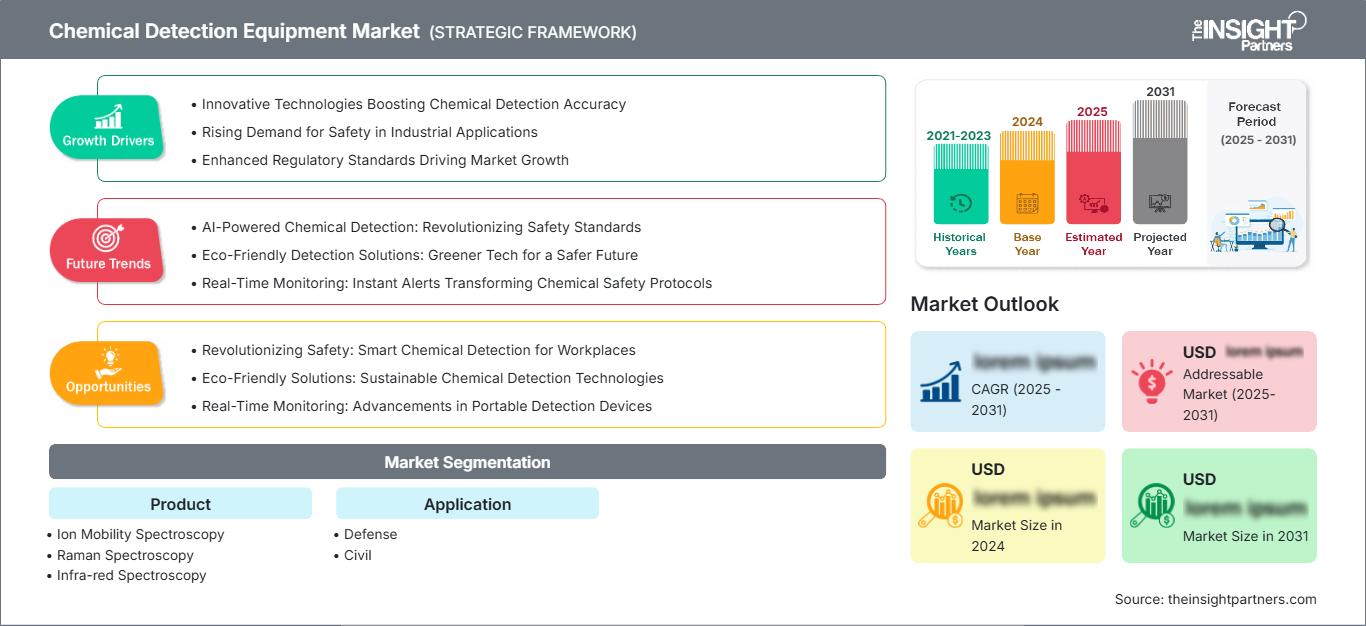
Chemical Detection Equipment Market: Strategic Insights
Regional Insights
North America Chemical Detection Equipment Market
North America held 34–37% share in 2025, giving the region the leading market share position. Growth is estimated at a CAGR range of 6.8–7.3% during 2026–2034. Demand is underpinned by federal preparedness programs, airport trace screening, defense modernization, and hazardous-material emergency response.
Procurement favors rugged IMS devices, handheld Raman units, and networked fixed detectors for ports, bases, laboratories, and chemical facilities. Replacement demand is reinforced by training requirements, consumable cycles, and software upgrades. Canada and Mexico add demand through border management, industrial safety, and petrochemical monitoring, while the US remains the anchor market.
U.S. Chemical Detection Equipment Market
The US constituted 78–82% of the share in North America by 2025 and was forecasted to grow at a CAGR of 6.7–7.2% from 2026 to 2034. Defense logistics, homeland security grants, passenger baggage checks, and industrial emergency responses make up the diversified base of demand with involvement of federal, state, and private agencies.
The market includes multiple players such as Thermo Fisher Scientific Inc., Agilent Technologies, Inc., 3M Company, Teledyne FLIR LLC, and Smiths Detection Group Ltd. who cater to civil and military users by sales, services, and integration solutions. Trends include applications in portability, cargo scanning, incident response communication, and laboratory analysis workflows.
Europe Chemical Detection Equipment Market
Europe represented 25–28% share in 2025 and is expected to grow at a CAGR range of 6.9–7.4% through 2034. Germany is the leading country because of defense procurement, industrial safety adoption, and supplier depth. The UK emphasizes airport security and emergency preparedness, while France supports civil protection and military modernization.
Italy and Spain contribute through transport hubs, chemical manufacturing, and public safety programs. Bruker Corporation’s European detection footprint and Environics Oy’s CBRN specialization support regional competitiveness. Demand is shaped by NATO readiness, border-control cooperation, and safety expectations across ports, airports, energy sites, and public-event venues.
APAC Chemical Detection Equipment Market
In 2025, the market held a 23–26% market share in Asia Pacific and is expected to register the highest CAGR in the range of 8.1–8.7%. In Asia Pacific, China is the most prominent country backed by the need for industrial surveillance and border security. In addition, Japan, South Korea, India, and Australia are procuring these products for defense preparedness, airports, ports, and hazardous material detection.
The focus of the government on public safety, infrastructural protection, and chemicals manufacturing industry drives the adoption in the region. The market is driven by the increased number of civil aviation, transportation security, and emergency services. Companies offering products with local language interface, distributors, and service training are expected to earn service revenues.
Middle East & Africa Chemical Detection Equipment Market
Middle East & Africa is forecast to achieve a CAGR between 7.4% and 7.9% for 2026-2034, with Saudi Arabia being the largest country. Factors driving the market include petrochemical facilities, airports, vital infrastructure, and military modernization efforts. The UAE focuses on aviation and event security, whereas South Africa concentrates on mining, industry, and emergency applications.
Rest of MEA demand is also project-oriented and strategic along energy corridors and border security needs. Customers focus on rugged instruments, quick training, and maintenance of service continuity. Oil, gas, and chemicals handling exposure in the region makes fixed installations and incident kits good combinations of investments.
Segmentation Analysis
Product
The Product segment is expected to grow at a CAGR range of 7.2–7.7% during 2026–2034. Chemical Detection Equipment Market scope across products is defined by speed, selectivity, portability, and suitability for screening or confirmation. IMS dominates rapid field detection, while Raman and infrared platforms support non-contact identification and safer handling of unknown substances.
- Ion Mobility Spectroscopy remains the leading product because it offers rapid vapor detection, low sample preparation, and proven use in airports, defense patrols, and emergency-response kits.
- Raman Spectroscopy gains strategic importance where operators need through-container identification, reduced exposure risk, and confirmatory analysis for powders, liquids, and suspicious packages.
- Infra-red Spectroscopy supports civil and industrial users needing molecular fingerprinting, non-destructive checks, and reliable identification of chemicals in laboratories, plants, and response vehicles.
Application
The Application segment is forecast to grow at a CAGR range of 7.3–7.8% during 2026–2034. Defense remains procurement-intensive because chemical threats require rapid warning and confirmation in contested environments. Civil applications are expanding as airports, hazardous-material teams, ports, and industrial operators seek faster identification, better documentation, and coordinated response capability.
- Defense continues to command high revenue contribution because armed forces require wearable, vehicle-mounted, and reconnaissance systems that support chemical warning, mapping, and mission continuity.
- Civil adoption is scaling in airports, public safety, industrial facilities, and border operations where rapid triage, operator safety, and evidence-quality records are increasingly required.
Opportunity Snapshot
| Application | Revenue Contribution | Trend Tag | Adoption Stage |
| Defense | High | CBRN Readiness | Mature |
| Civil | Medium | Airport Screening | Scaling |
Chemical Detection Equipment Market Growth Drivers and Impact Analysis
Rising CBRN Preparedness Spending
Readiness against CBRNE events continues to rise due to the persistence of risks such as geopolitical instability, asymmetric threats, and critical infrastructure vulnerabilities. This has a direct effect on the market for Chemical Detection Equipment since ministries of defense and homeland security authorities will need reliable equipment, training courses, consumables, and support contracts. There is an ongoing demand for detection systems which can function while being worn by protective clothing, be able to transmit information back to headquarters, and be able to differentiate between industrial toxins and warfare chemicals.
Expansion of Aviation and Border Screening
Upgrades have been implemented to increase screening capability to handle the passenger recovery process, increased parcel volume, and ongoing threats from chemicals. The systems being deployed require rapid response without causing disruptions, thus trace detection by IMS and handheld spectroscopy are vital tools for checkpoints, cargo facilities, and secondary screenings. The practical consequences include an increase in the number of fleet, consumables, calibration, and maintenance requirements. Operators also appreciate the benefit of software solutions that centralize alarm management and audit preparedness among various facilities.
Industrial Safety and Environmental Compliance
There is growing pressure on chemical facilities, refineries, laboratories, and logistics companies to increase safety standards, document incidents, and quickly respond to hazardous material releases. Portables and fixed monitors will shorten exposure time, facilitate decision making about evacuations, and aid in root cause analysis of leak/spill incidents. This factor widens the market from military organizations to civilian infrastructure and other regulated businesses. Vendors who can offer tough equipment along with proven calibration techniques and training will be successful.
Chemical Detection Equipment Market Future Trends
Connected Detector Fleets
Chemical Detection Equipment Market trends are moving toward connected fleets that transmit alarms, location, calibration status, and operator actions into command systems. Future deployments will emphasize secure data sharing between handheld detectors, fixed sensors, and emergency operations centers. This shift should improve situational awareness during multi-site incidents and reduce fragmented reporting. Vendors will need cybersecurity controls, open integration interfaces, and analytics that help supervisors distinguish isolated alarms from coordinated hazards without slowing field response.
Hybrid Spectroscopy Workflows
Future users will increasingly combine IMS, Raman, and infrared methods to balance speed, selectivity, and operator safety. Screening may begin with rapid vapor or trace detection, followed by non-contact molecular confirmation when the substance is sealed, unknown, or potentially unstable. This hybrid workflow can reduce false positives, improve confidence, and support evidence-quality documentation. Suppliers that package complementary instruments with common training, data formats, and service models will be better placed than vendors offering isolated devices.
Chemical Detection Equipment Market Opportunities
Lifecycle Service and Training Platforms
Chemical Detection Equipment Market Forecasts point to attractive opportunities in service-led models that include calibration, consumables, software updates, operator certification, and readiness audits. Many agencies struggle to maintain detector fleets after initial procurement, creating demand for structured lifecycle support. Suppliers can differentiate by offering regional service hubs, simulation-based training, and performance dashboards that show device availability. This opportunity is especially relevant in emerging markets where procurement is rising but technical support infrastructure remains uneven.
Civil Infrastructure Monitoring Programs
Public transport systems, stadiums, ports, and chemical logistics corridors offer a practical opportunity for fixed and portable detection networks. Decision-makers are looking for faster evacuation triggers, better incident records, and tools that can integrate with building management or security platforms. Vendors can address this opportunity through scalable packages that start with high-risk zones and expand over time. Partnerships with system integrators, emergency-management consultants, and safety regulators will be important for converting pilot projects into recurring deployments.
Recent Developments
- June 2026: Teledyne FLIR Defense launched CheMSense Protect, a continuous air-monitoring chemical detection system based on its proprietary Multi-Dimensional Mass Spectrometry (MDMS™) technology. The system detects and identifies chemical warfare agents (CWAs) and toxic industrial chemicals (TICs) in under 20 seconds, enabling rapid threat response for defense, public transportation, and critical infrastructure applications.
- June 2026: The Defense Post highlighted Teledyne FLIR Defense's CheMSense Protect, emphasizing its breakthrough capability to reduce chemical threat detection times from several minutes to less than 20 seconds. The system provides continuous air monitoring, improving personnel safety and operational readiness in military vehicles, public venues, and other high-risk environments.
- June 2025: Rigaku Analytical Devices introduced the Icon-X, its fourth-generation handheld 1064 nm Raman analyzer for chemical threat detection. The device is the first handheld Raman analyzer to offer standoff chemical analysis, enabling users to identify hazardous substances such as explosives and chemical warfare agents from a safe distance while featuring enhanced processing, GPS, and an expanded onboard chemical library.
Frequently Asked Questions

- Comprehensive Market Sizing and Forecast Analysis
- Detailed Segmentation Analysis
- In-Depth Market Dynamics Assessment
- Regional and Country-Level Insights
- Competitive Landscape and Company Benchmarking
- Strategic Business Intelligence
Recent Reports
Testimonials

The Insight Partners' SCADA System Market report is comprehensive, with valuable insights on current trends and future forecasts. The team was highly professional, responsive, and supportive throughout. We are very satisfied and highly recommend their services.
RAN KEDEM Partner, Reali Technologies LTDs
I requested a report on a very specific software market and the team produced the report in a few days. The information was very relevant and well presented. I then requested some changes and additions to the report. The team was again very responsive and I got the final report in less than a week.
JEAN-HERVE JENN Chairman, Future Analytica
We worked with The Insight Partners for an important market study and forecast. They gave us clear insights into opportunities and risks, which helped shape our plans. Their research was easy to use and based on solid data. It helped us make smart, confident decisions. We highly recommend them.
PIYUSH NAGPAL Sr. Vice President, High Beam Global
The Insight Partners delivered insightful, well-structured market research with strong domain expertise. Their team was professional and responsive throughout. The user-friendly website made accessing industry reports seamless. We highly recommend them for reliable, high-quality research services
YUKIHIKO ADACHI CEO, Deep Blue, LLC.
This is the first time I have purchased a market report from The Insight Partners.While I was unsure at first, I visited their web site and felt more comfortable to take the risk and purchase a market report.I am completely satisfied with the quality of the report and customer service. I had several questions and comments with the initial report, but after a couple of dialogs over email with their analyst I believe I have a report that I can use as input to our strategic planning process.Thank you so much for taking the extra time and making this a positive experience.I will definitely recommend your service to others and you will be my first call when we need further market data.
JOHN SUZUKI President and Chief Executive Officer, Board Director, BK Technologies
I wish to appreciate your support and the professionalism you displayed in the course of attending to my request for information regarding to infectious disease IVD market in Nigeria. I appreciate your patience, your guidance, and the fact that you were willing to offer a discount, which eventually made it possible for us to close a deal. I look forward to engaging The Insight Partners in the future, all thanks to the impression you have created in me as a result of this first encounter.
DR CHIJIOKE ONYIA MANAGING DIRECTOR, PineCrest Healthcare Ltd.Reason to Buy
- Informed Decision-Making
- Understanding Market Dynamics
- Competitive Analysis
- Identifying Emerging Markets
- Customer Insights
- Market Forecasts
- Risk Mitigation
- Boosting Operational Efficiency
- Strategic Planning
- Investment Justification
- Tracking Industry Innovations
- Aligning with Regulatory Trends





 Get Free Sample for