
Chemical Tankers Market Trends, Size & Forecast by 2034
Coverage: By Product Type (Organic Chemicals, Inorganic Chemicals, Others); Type (Type 1, Type 2, Type 3); Fleet Material (Galvanised steel, Stainless Steel, Epoxy Coated, Others) , and Geography (North America, Europe, Asia Pacific, and South and Central America)
- Status : Data Released
- Report Code : TIPRE00004663
- Category : Chemicals and Materials
- No. of Pages : 150
- Available Report Formats :


- Last update date : August 28, 2026


2025 Market Size
US$ 38.03 Bn
Base year value
2034 Forecast
US$ 52.76 Bn
Projected by 2034
CAGR 2026-2034
3.71 %
Growth rate
Addressable Market
US$ 412.47 Bn
(2026-2034)
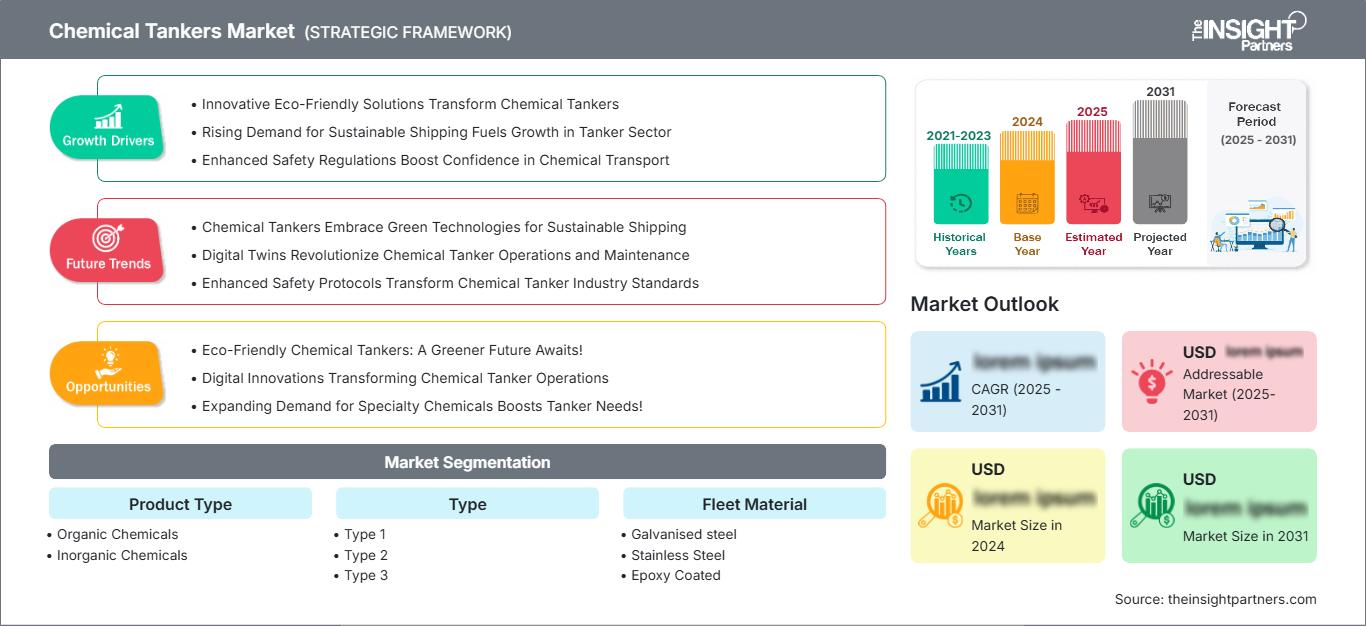
The Chemical Tankers Market was valued at US$ 38.03 Billion in 2025 and is projected to reach US$ 52.76 Billion by 2034, registering a CAGR of 3.71% during 2026–2034. The Market reflects demand for marine transportation of organic and inorganic liquid chemicals across international trade routes. Vessel configuration, tank segregation, fleet material, cargo compatibility, regulatory compliance, and operating efficiency remain important factors influencing vessel deployment and investment decisions across the global chemical shipping ecosystem.
North America Chemical Tankers Market Size is expected to maintain a substantial position during the forecast period, supported by chemical production, petrochemical exports, refinery integration, and established maritime infrastructure. The region is projected to register a CAGR of 3.2–3.6% during 2026–2034. Gulf Coast export terminals, increasing downstream chemical capacity, vessel replacement requirements, and demand for compliant cargo-flexible ships are expected to support regional fleet utilization and investment.
Chemical Tankers Market Assessment and Insights
- North America: North America is estimated to account for a 24–28% share in 2025 and is projected to expand at a CAGR of 3.2–3.6% during 2026–2034, supported by Gulf Coast chemical production, exports, port infrastructure, and fleet modernization.
- U.S.: The U.S. is estimated to represent 68–72% of North American demand in 2025 and is expected to grow at a CAGR of 3.3–3.7% during 2026–2034, led by Gulf Coast chemical trade.
- Europe: Europe is estimated to hold a 25–29% share in 2025 and expand at a CAGR of 3.0–3.4% during 2026–2034, with Germany, the Netherlands, Belgium, the UK, France, Italy, and Spain supporting chemical transportation.
- Asia Pacific: Asia Pacific is estimated to command a 32–36% share in 2025 and grow at a CAGR of 4.0–4.4% during 2026–2034, led by China, Japan, South Korea, India, Singapore, and Australia.
- Largest Segment: Organic Chemicals is estimated to hold a 62–66% market share in 2025 and grow at a CAGR of 3.4–3.8% during 2026–2034, supported by diversified petrochemical cargo flows.
- High Growth Segment: Stainless Steel is estimated to account for a 31–35% market share in 2025 and grow at a CAGR of 4.2–4.6% during 2026–2034, supported by cargo flexibility and corrosion resistance.
- Key companies analyzed in detail: Nordic Tankers, IINO KAIUN KAISHA, LTD., Maersk Tankers A/S, PT Berlian Laju Tanker Tbk, Tokio Marine Asia Pte. Ltd., TSM Group, Global Chemical Co., Ltd., Chemical Manufacturers, Inc., Market Actives, LLC, Global Pump Marketing, Inc., Odfjell SE, and Stolt-Nielsen Limited.
Source: The Insight Partners' analysis based on proprietary research, government publications, company annual reports, investor presentations, industry databases, and expert interviews.
The international tanker sector continues to adapt through cargo flexibility, better segregation of tanks, enhanced corrosion resistance, and improved propulsive efficiency. The use of stainless steel is critical for certain sensitive and corrosive cargoes, while epoxy coating continues to benefit other types of compatible commodity cargoes. Digital voyage management, cargo management systems, predictive maintenance, and sophisticated tank cleaning systems are adding to operational controls. Fleet modernization will be increasingly associated with environmental compliance as owners will take into account capital investment, fuel consumption, asset utilization, customer demands, and economics of ownership.
For the future outlook, increased chemicals production in Asia, continued exports from North America, specialty chemicals transport in Europe, and downstream industrial investments in the Middle East are expected. Environmental regulations will motivate owners to look at energy-efficient equipment, streamlined hull designs, alternative fuels, and shore power connection capabilities. Increased voyage distances might increase tonne-mile demand, while additional deliveries will have an adverse impact on asset utilization. The Chemical Tankers Market Forecasts show that fleet flexibility, chartering strategy, technical parameters, regulation compliance, financing, and customer relations will be increasingly important for investment decisions.
Chemical Tankers Market Report Scope
| Report Attribute | Details |
|---|---|
| Market size in 2025 | US$ 38.03 Billion |
| Market Size by 2034 | US$ 52.76 Billion |
| Global CAGR (2026 - 2034) | 3.71% |
| Historical Data | 2021-2024 |
| Forecast period | 2026-2034 |
Chemical Tankers Market Analysis
The Chemical Tankers Market growth prospects depend very much on international manufacturing and consumption of petrochemicals, solvents, acids, alcohols, vegetable oils, and other liquid cargoes. Ecosystem consists of chemical producers, traders, charterers, shipowners, ports, terminals, yards, classification societies, and marine services. The factors influencing the demand include volume of chemicals, trade distance, parcel size, cargo compatibility, cleaning needs, ports accessibility, and segregation tanks quantity onboard each ship.
The factors influencing supply include yards capacity, construction costs, finance availability, ship availability, fleet age, and environmental restrictions. The replacement need forms a structural base, since older ships may be less competitive due to increased maintenance costs and more stringent technical requirements from charterers. The ships with stainless-steel tanks are more flexible regarding cargo compatibility, while coated ships are efficient carriers for suitable cargoes. Fleet optimization is therefore based on cargo mix, ships' age, shipping lines, term of chartering, and tank arrangement.
According to the Chemical Tankers Market report, competition is characterized by specialist ship operators and diverse shipping companies. IINO KAIUN KAISHA, LTD. owns an extensive chemical tanker fleet. Odfjell SE and Stolt-Nielsen Limited hold leading market positions in international parcel and specialty chemicals carriage. Maersk Tankers A/S offers tanker management services and Nordic Tankers is known for chemical shipping experience.
Competitive investments involve modern tonnage, efficiency, fleet digitalization, and expansion based on contracts. Odfjell SE has invested in advanced stainless-steel vessels and Stolt-Nielsen Limited makes investments in the tanker fleet through building new ships and joint ventures. IINO KAIUN KAISHA, LTD. conducts operations with chemical tankers as well as other kinds of shipping and sustainability projects. Competition today involves such factors as reliability in cargo handling, vessel age, environment, technical management, charter relations, and effective parcel movement management.
● REPORT CUSTOMIZATION
Tailor This Report To Align With Your Specific Business Requirements
This report can be customized to align precisely with your business objectives, scope, and target markets. Customization options include tailored segmentation, geography, competitive analysis, and strategic insights to support informed decision-making.
Customize This Report →WHAT YOU CAN ADJUST
- ● Segmentations
- ● Geography
- ● Competitive Analysis
- ● Language Preferences
Chemical Tankers Market: Strategic Insights
Regional Insights
North America Chemical Tankers Market
North America is estimated to hold a 24–28% Chemical Tankers Market share in 2025 and is projected to expand at a CAGR of 3.2–3.6% during 2026–2034. The U.S. Gulf Coast remains the principal regional hub because of integrated petrochemical production, refining infrastructure, export terminals, and access to international shipping routes. Houston, Corpus Christi, and surrounding ports support recurring chemical cargo movements and vessel activity.
The regional market benefits from the export of chemicals, specialized manufacturing, and vessel replacement. Canada provides support in terms of chemical and energy transport by sea, although its role is less significant than that played by the United States. Operators should look out for ships made of stainless steel and coated material, which can accommodate varied cargo needs. Diversified exports and increased journey distances may help utilization, whereas more deliveries may help control freight rates during times of increased orders.
U.S. Chemical Tankers Market
U.S. is estimated to account for 68-72% of North America's demand in 2025 and expected to have a CAGR growth rate of 3.3-3.7% during 2026-2034. Gulf Coast production hubs are important as they link up chemical manufacturing plants to deep-water export facilities and customers across the world. The region helps transport petrochemical intermediaries, solvents, acids, alcohols, and other specialty chemicals.
US-connected activities have port infrastructure, chemical producers, storage facilities, and connections to foreign trade. Vessel replacements are done in response to environmental regulations and customer expectations for efficient and cargo flexible vessels. Operators of the fleets operating in this region are more concerned about technical compliance, cargo separation, and voyage optimization. Growth in downstream capacity and export diversification are likely to keep U.S. as the dominant contributor to vessel demand in North America through 2025.
Europe Chemical Tankers Market
It is forecasted that Europe will contribute to the market at 25% to 29% share in 2025 and is predicted to grow at a rate of 3.0% to 3.4% CAGR in 2026-2034. Germany and the Netherlands have emerged as major players in the industry on account of integrated chemical cluster, port facilities, inland waterways, refineries, and international trading links. Belgium and the UK add further strength to regional demand.
In the UK, chemical tanker operations are supported through petrochemicals, industrial chemicals, and specialty products movements along the Atlantic and European route. In Germany, integrated manufacturing base and export-oriented chemical production has facilitated demand. France adds to the regional demand through Mediterranean and Atlantic ports, while Italy and Spain add through refining, petrochemicals production, specialty chemicals, and Mediterranean trading links. There is an increase in environmental performance expectations for operators in Europe.
APAC Chemical Tankers Market
Asia Pacific is estimated to hold a 32–36% share in 2025 and is expected to grow at a CAGR of 4.0–4.4% during 2026–2034, making it the leading regional market. China, Japan, South Korea, India, Singapore, and Australia contribute through chemical manufacturing, refining, port infrastructure, and maritime trade.
It is still China that stands out due to its vast base of chemical production, whereas Japan and South Korea offer the advanced shipbuilding and fleet management services. India has been developing its facilities in petrochemicals and chemicals, while Australia is contributing through the resource-oriented industrial cargo. The policy backing for manufacturing capacities, port development, clean shipping, and industrial corridors will further stimulate demand for vessels.
Middle East & Africa Chemical Tankers Market
MEA region is expected to witness a growth rate of 3.4-3.8% CAGR from 2026-2034. Saudi Arabia is the foremost country owing to its production and exports of petrochemicals, while UAE is favored due to its ports, warehousing, and international trade activities. South Africa offers a gateway to regional industrial cargo shipments.
Energy-dependent manufacturing and petrochemical development will generate consistent demand for chemical shipments by sea. The industrial diversification of Saudi Arabia, logistics developments of UAE, and manufacturing activities of South Africa could be harnessed to serve the regional demand. The other MEA markets offer limited market potential but opportunities through infrastructure development, development of logistics corridors, chemical import, and industrial diversification.
Segmentation Analysis
Product Type
Product Type consists of Organic Chemicals and Inorganic Chemicals. Organic Chemicals are projected to grow at a CAGR of 3.4–3.8% during 2026–2034, supported by extensive petrochemical and specialty-product trade. Inorganic Chemicals are projected to expand at 3.8–4.2%, supported by acids, industrial intermediates, and chemical feedstock movements. The Chemical Tankers Market scope covers both cargo categories and their associated vessel requirements.
- Organic Chemicals: Organic cargoes form the broader transportation base because petrochemicals, alcohols, solvents, and related products move through established international trade corridors. Cargo diversity supports flexible vessel deployment and recurring charter requirements.
- Inorganic Chemicals: Inorganic cargo transportation requires stringent compatibility, cleaning, and safety procedures. Demand is concentrated around industrial production centers and established chemical ports, making specialized vessel availability strategically important for reliable supply.
Type
Types comprise Type 1, Type 2, and Type 3. Type 1 is projected to grow at a CAGR of 3.2–3.6%, Type 2 at 3.8–4.2%, and Type 3 at 4.1–4.5% during 2026–2034. Differences reflect cargo flexibility, technical specifications, vessel configuration, and operating requirements.
- Type 1: Type 1 vessels serve established chemical transportation requirements where cargo specifications and route patterns are comparatively standardized. Their commercial relevance is supported by established charter relationships and predictable regional movements.
- Type 2: Type 2 vessels provide broader operating suitability and benefit from diversified chemical trade. Their strategic value increases where operators balance commodity cargoes with higher-value industrial products across multiple routes.
- Type 3: Type 3 vessels address specialized transportation requirements involving greater operational control and cargo-handling capability. Adoption is supported by customers seeking dependable transportation for technically demanding liquid products.
Fleet Material
Fleet Material includes Galvanized steel, Stainless Steel, and Epoxy Coated. Galvanized steel is projected to grow at a CAGR of 2.8–3.2%, Stainless Steel at 4.2–4.6%, and Epoxy Coated at 3.3–3.7% during 2026–2034. Material selection directly influences cargo compatibility, maintenance requirements, vessel cost, and fleet flexibility.
- Galvanized steel: Galvanized steel provides economical corrosion protection for suitable applications and remains relevant where cargo compatibility does not require premium stainless-steel construction. Cost considerations support continued deployment in selected fleets.
- Stainless Steel: Stainless Steel provides strong corrosion resistance and cargo flexibility, supporting acids, methanol, specialty chemicals, vegetable oils, and other demanding products. Higher capital expenditure is balanced by broader trading potential.
- Epoxy Coated: Epoxy Coated tanks provide a practical balance between protection, cost, and cargo suitability. They remain important for commodity-oriented transportation where corrosion resistance and operating economics must be balanced.
Opportunity Snapshot
| Product Type | Revenue Contribution | Trend Tag | Adoption Stage |
| Organic Chemicals | High | Petrochemical Flows | Mature |
| Inorganic Chemicals | Medium | Acid Logistics | Scaling |
Chemical Tankers Market Growth Drivers and Impact Analysis
Expansion of Global Chemical Production and Cross-Border Trade
Global chemical production continues to expand across Asia, North America, and the Middle East, increasing the requirement to connect manufacturing centers with downstream users and international customers. Marine transportation provides an economical option for long-distance movement of liquid chemicals, particularly when cargo volumes are unsuitable for alternative transport modes. The effect is strongest for organic chemical products because petrochemical intermediates and industrial liquids represent a broad cargo base. Increasing trade between production hubs and importing regions can raise tonne-mile requirements even when physical volumes grow moderately. Operators with flexible fleets and established charter relationships can capture incremental demand. Greater geographical diversification also reduces dependence on individual trade corridors and encourages owners to maintain vessels capable of serving multiple destinations.
Fleet Renewal Driven by Safety, Efficiency, and Regulatory Compliance
Fleet renewal is becoming a significant capital-allocation priority as owners balance vessel age, operating efficiency, maintenance expenditure, and environmental requirements. Chemical vessels require demanding tank, pumping, segregation, cleaning, and cargo-quality systems, making equipment condition important to commercial availability. Older ships can face higher maintenance costs and customer restrictions when charterers impose stricter technical or environmental requirements. Newbuildings increasingly incorporate energy-saving devices, optimized hull forms, improved propulsion systems, and alternative-fuel readiness. Replacement activity supports shipyards, equipment manufacturers, classification services, technical managers, and financing institutions. It also creates opportunities in the second-hand market, although vessel values can fluctuate with freight conditions and interest rates. The modernization cycle is expected to sustain investment in specialized tonnage.
Increasing Demand for Cargo Flexibility and Specialized Vessel Capability
Chemical manufacturers and traders increasingly require transportation solutions capable of handling changing cargo portfolios, smaller parcels, multiple destinations, and strict contamination controls. Stainless-steel vessels with numerous segregated tanks are particularly valuable because they can transport diverse products while reducing restrictions associated with cargo compatibility. This flexibility can improve utilization and enable participation in specialized trades where freight economics are less dependent on one commodity. Operators are also strengthening digital fleet-management platforms to monitor cargo, voyage performance, maintenance, and compliance. The impact extends to terminals, cleaning facilities, inspection providers, and port services, which must accommodate sophisticated vessel operations. Companies combining flexible tonnage with strong technical management can improve customer retention and capture higher-value cargo opportunities.
Chemical Tankers Market Future Trends
Digitally Managed Cargo Segregation and Voyage Optimization
Digitalization is expected to become increasingly embedded in tanker operations as owners seek stronger control over cargo compatibility, tank utilization, routing, fuel consumption, and maintenance. Advanced voyage-planning platforms can combine weather, port congestion, vessel condition, and cargo schedules to improve operating decisions. Digital cargo records can strengthen traceability and reduce administrative errors associated with complex parcel movements. Predictive maintenance can reduce unexpected downtime by identifying equipment anomalies before failures occur. Integration between vessel systems, shore-based control centers, terminals, and chartering platforms is likely to become more important through 2034. These Chemical Tankers Market trends indicate that operators with diversified fleets will increasingly use digital systems to coordinate multiple cargoes and routes while improving utilization, safety, operational visibility, and customer service consistency.
Low-Emission Propulsion Readiness in New Chemical Tankers
Environmental performance is expected to influence vessel specifications more strongly as owners prepare for tighter emissions requirements and changing customer procurement standards. New vessels are likely to incorporate energy-saving technologies, improved propulsion efficiency, shore-power capability, and designs accommodating lower-carbon fuels. Methanol readiness is relevant because fuel-flexible technologies can reduce future conversion risk. Wind-assisted technologies and optimized hull forms may gain traction where operating profiles justify investment. Adoption will depend on fuel availability, infrastructure, vessel economics, and regulatory certainty. Owners are therefore likely to prioritize technologies that provide immediate efficiency benefits while preserving options for future propulsion changes. This approach can reduce technology risk and support longer asset lives while strengthening environmental performance.
Chemical Tankers Market Opportunities
Strategic Fleet Expansion Through Long-Term Charter Structures
Long-term charter and pool arrangements provide operators with an opportunity to expand specialized capacity while reducing exposure to short-term freight-rate volatility. Customers with predictable chemical flows can secure dedicated tonnage, while owners obtain greater visibility into utilization and cash generation. This structure is particularly relevant to stainless-steel vessels because higher acquisition costs can be supported by contracted specialty cargoes. Asian shipyards remain important construction partners for advanced chemical vessels, while global operators can combine newbuildings with existing fleet assets. Investors can assess opportunities through contracted revenue visibility, vessel specifications, customer quality, delivery schedules, and expected residual values rather than fleet size alone. Carefully structured agreements can improve financing prospects and support disciplined fleet replacement.
Integrated Chemical Logistics Across Ships, Terminals, and Tank Containers
An additional opportunity lies in integrating ocean transportation with terminals, tank containers, inland logistics, storage, and cargo-management platforms. Chemical customers increasingly value fewer handoffs and stronger supply-chain visibility, creating opportunities for operators that provide coordinated logistics rather than isolated vessel capacity. Integrated services can improve asset utilization by aligning vessel arrivals with storage availability and inland distribution schedules. Terminal partnerships can create additional resilience during weaker freight markets while strengthening customer relationships. Companies with established chemical trade networks can extend these capabilities into emerging production regions where logistics infrastructure is developing. The strongest opportunities are likely to involve specialized corridors linking manufacturing centers with strategically located ports, storage facilities, and downstream markets.
Recent Developments
- March 2025: Mitsui O.S.K. Lines, Ltd. (MOL) announced a joint initiative with MOL Chemical Tankers Pte. Ltd. and CMB.TECH NV to deploy the world's first ammonia dual-fuel chemical tankers. The program includes two ammonia dual-fuel chemical tankers scheduled for delivery in 2028–2029, along with four ammonia-ready chemical tankers. The vessels are intended to support MOL's long-term decarbonization strategy and net-zero GHG emissions target.
- January 2026: Swan Defense and Heavy Industries signed a US$227 million contract with European shipowner Rederiet Stenersen AS for six chemical tankers, marking the first large commercial chemical tanker order awarded to an Indian shipyard. The contract includes an option for six additional sister vessels. The approximately 150-meter vessels will feature dual-fuel, LNG-ready hybrid propulsion, Ice Class 1A certification, and high levels of automation.
Frequently Asked Questions

- Comprehensive Market Sizing and Forecast Analysis
- Detailed Segmentation Analysis
- In-Depth Market Dynamics Assessment
- Regional and Country-Level Insights
- Competitive Landscape and Company Benchmarking
- Strategic Business Intelligence
Recent Reports
Testimonials

The Insight Partners' SCADA System Market report is comprehensive, with valuable insights on current trends and future forecasts. The team was highly professional, responsive, and supportive throughout. We are very satisfied and highly recommend their services.
RAN KEDEM Partner, Reali Technologies LTDs
I requested a report on a very specific software market and the team produced the report in a few days. The information was very relevant and well presented. I then requested some changes and additions to the report. The team was again very responsive and I got the final report in less than a week.
JEAN-HERVE JENN Chairman, Future Analytica
We worked with The Insight Partners for an important market study and forecast. They gave us clear insights into opportunities and risks, which helped shape our plans. Their research was easy to use and based on solid data. It helped us make smart, confident decisions. We highly recommend them.
PIYUSH NAGPAL Sr. Vice President, High Beam Global
The Insight Partners delivered insightful, well-structured market research with strong domain expertise. Their team was professional and responsive throughout. The user-friendly website made accessing industry reports seamless. We highly recommend them for reliable, high-quality research services
YUKIHIKO ADACHI CEO, Deep Blue, LLC.
This is the first time I have purchased a market report from The Insight Partners.While I was unsure at first, I visited their web site and felt more comfortable to take the risk and purchase a market report.I am completely satisfied with the quality of the report and customer service. I had several questions and comments with the initial report, but after a couple of dialogs over email with their analyst I believe I have a report that I can use as input to our strategic planning process.Thank you so much for taking the extra time and making this a positive experience.I will definitely recommend your service to others and you will be my first call when we need further market data.
JOHN SUZUKI President and Chief Executive Officer, Board Director, BK Technologies
I wish to appreciate your support and the professionalism you displayed in the course of attending to my request for information regarding to infectious disease IVD market in Nigeria. I appreciate your patience, your guidance, and the fact that you were willing to offer a discount, which eventually made it possible for us to close a deal. I look forward to engaging The Insight Partners in the future, all thanks to the impression you have created in me as a result of this first encounter.
DR CHIJIOKE ONYIA MANAGING DIRECTOR, PineCrest Healthcare Ltd.Reason to Buy
- Informed Decision-Making
- Understanding Market Dynamics
- Competitive Analysis
- Identifying Emerging Markets
- Customer Insights
- Market Forecasts
- Risk Mitigation
- Boosting Operational Efficiency
- Strategic Planning
- Investment Justification
- Tracking Industry Innovations
- Aligning with Regulatory Trends





 Get Free Sample for