
Chilled Beam System Market Size, Demand & Growth by 2034
Coverage: by Design (Active Chilled Beam, Passive Chilled Beam, Multi-Service Chilled Beam); Application (Commercial Offices, Educational Institutions, Hotels Healthcare Facilities, Others) , and Geography (North America, Europe, Asia Pacific, and South and Central America)
- Status : Data Released
- Report Code : TIPRE00012527
- Category : Electronics and Semiconductor
- No. of Pages : 150
- Available Report Formats :


- Last update date : July 28, 2026


2025 Market Size
US$ 420.12 Mn
Base year value
2034 Forecast
US$ 637.04 Mn
Projected by 2034
CAGR 2026-2034
4.73 %
Growth rate
Addressable Market
US$ 4,797.98 Mn
(2026-2034)
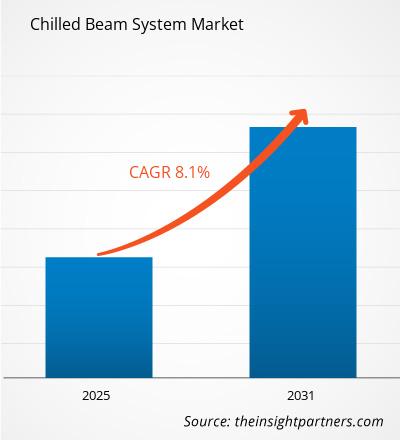
The global Chilled Beam System market was valued at US$ 420.12 million in 2025 and is expected to reach US$ 637.04 million by 2034; it is estimated to record a CAGR of 4.73% during 2026-2034.
Chilled Beam System Market Assessment and Insights
- North America accounted for 24–28% share in 2025 and is projected to grow at a CAGR of 4.8–5.6% during 2026–2034, supported by office retrofits and healthcare decarbonization.
- US represented 78–82% of North America in 2025 and is expected to grow at 4.9–5.7% CAGR during 2026–2034 as high-performance buildings adopt air-water HVAC.
- Europe held 38–42% share in 2025 and is forecast to grow at 4.6–5.4% CAGR during 2026–2034, led by Germany, the UK, France, Italy, and Spain.
- Asia Pacific captured 21–25% share in 2025 and is expected to grow at 6.0–6.8% CAGR during 2026–2034, led by China, Japan, South Korea, India, and Australia.
- Largest Segment Active Chilled Beam held 56–60% market share in 2025 and is projected to grow at 5.1–5.8% CAGR during 2026–2034.
- High Growth Segment Multi-Service Chilled Beam held 12–16% market share in 2025 and is projected to grow at 6.2–7.0% CAGR during 2026–2034.
- Key companies analyzed in detail: Barcol-Air Group AG, Caverion Corporation, Dadanco, FläktGroup Holding GmbH, FTF Group Climate, Halton Group, Johnson Controls International plc, Lindab International AB, Swegon Group AB, TROX GmbH.
Source: The Insight Partners' analysis based on proprietary research, government publications, company annual reports, investor presentations, industry databases, and expert interviews.
The evolution of the market has proceeded from simple ceiling coils to advanced and multifunctional beams with a mixture of ventilation, sensible cooling, heating, lighting integration, and controls. Market players are adapting their manufacturing processes according to modular casings, valves installed on site, silent nozzles, and digital commissioning. Another factor influencing the Chilled Beam System Market is high raw material cost of copper and aluminum that prompts the companies to produce standardized product lines and conduct value engineering on a project basis.
Future demand is anticipated to be growing in the commercial spaces of cities, university campuses, and healthcare facilities because of the synergy between ventilation criteria, acoustics, and low energy footprint during the life cycle of the product. The new markets will make use of beams selectively using pioneering projects before applying them institutionally. Favorable conditions arising from building standards and corporate carbon reduction targets will spur specification activity without ignoring the need for humidification systems.
Chilled Beam System Market Report Scope
| Report Attribute | Details |
|---|---|
| Market size in 2025 | US$ 420.12 Million |
| Market Size by 2034 | US$ 637.04 Million |
| Global CAGR (2026 - 2034) | 4.73% |
| Historical Data | 2021-2024 |
| Forecast period | 2026-2034 |
Chilled Beam System Market Analysis
Market for the Chilled Beam Systems is driven by commercial buildings with the need for decreased fan power consumption, smaller duct area, and better thermal zoning. Water is a more efficient medium to transfer cooling compared to air, thus projects having medium latent load have an opportunity to decrease the intensity of air handling when used together with dedicated outdoor air systems. Strongest demand comes from regions where energy codes, sustainability standards, and occupant comfort criteria are included into purchasing decisions.
Supply factors include manufacture of the coils, metalwork, control systems, and contractors’ capabilities. Industry ecosystem consists of consulting engineers, ceiling manufacturers, valve manufacturers, commissioning companies, and building automation providers. The success of implementation relies on early planning due to the fact that beams need condensation management, proper chilled water temperature, and careful ventilation planning.
According to the Chilled Beam System Market report, the market features a consolidated competitive environment with competition among TROX GmbH, Swegon Group AB, Halton Group, Lindab International AB, and FläktGroup Holding GmbH on acoustics, modularity, control, and engineering. Barcol-Air Group AG, Dadanco, Johnson Controls International plc, Caverion Corporation, and FTF Group Climate have an edge in regional distribution and retrofitting.
Future investments will be in favor of platforms that offer easy installation and connectivity with building management systems. The market positioning has become more inclined towards room climate systems than individual terminal units. Those suppliers that have expertise in applications engineering are better positioned since the owners are increasingly considering energy consumption, flexibility of ceiling, and comfort performance.
● REPORT CUSTOMIZATION
Tailor This Report To Align With Your Specific Business Requirements
This report can be customized to align precisely with your business objectives, scope, and target markets. Customization options include tailored segmentation, geography, competitive analysis, and strategic insights to support informed decision-making.
Customize This Report →WHAT YOU CAN ADJUST
- ● Segmentations
- ● Geography
- ● Competitive Analysis
- ● Language Preferences
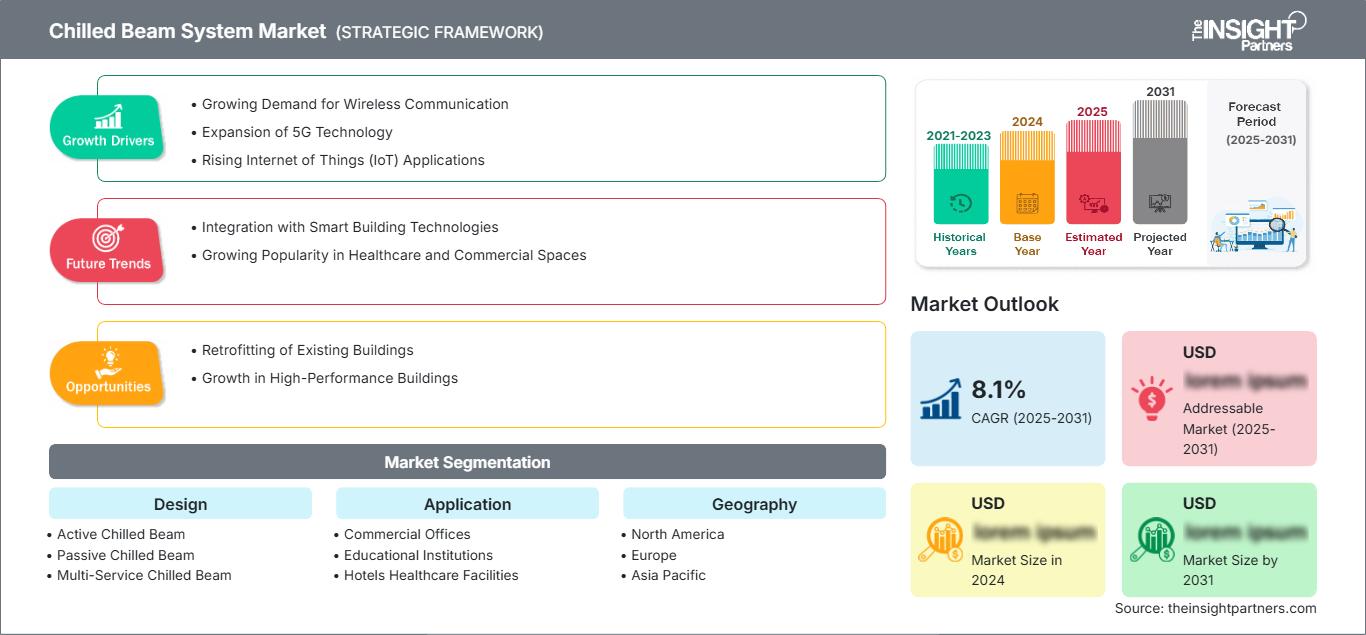
Chilled Beam System Market: Strategic Insights
Regional Insights
North America Chilled Beam System Market
North America represented 24–28% share in 2025 and is expected to record 4.8–5.6% CAGR during 2026–2034. The Chilled Beam System Market share is supported by federal building modernization, hospital energy projects, and premium office upgrades where high ventilation quality must be balanced with lower fan energy.
Adoption occurs mostly in the US and Canada with limited adoption in laboratories, universities, airports, and healthcare institutions. Engineers select active beams in cases where dedicated outdoor air systems can handle humidity effectively. Growth will be controlled because retrofits depend on the nature of ceilings and control integration by the owners.
U.S. Chilled Beam System Market
In the year 2025, the United States represented 78%-82% of North America, while growth rate projection of the US is 4.9%-5.7% CAGR between 2026-2034. The demand is high in institutional healthcare facilities, university research buildings, and Class A office buildings where energy codes and indoor air quality necessitates greater coordination.
Presence in companies is widespread with Johnson Controls International plc, TROX GmbH, Swegon Group AB, Dadanco, and dedicated representatives. Application trends highlight the use of active beams with demand controlled ventilation where low noise, zone control, and less air handling unit size without jeopardizing dehumidification capability are required.
Europe Chilled Beam System Market
In Europe, market share accounted for 38-42% in 2025 and expected to expand at 4.6-5.4% CAGR in the period from 2026 to 2034. Germany is the dominant player backed by high performance requirements of buildings, highly developed HVAC engineering processes and close proximity of manufacturers in Germany, Sweden, Finland and the Netherlands.
Beam systems are favored in the UK in high-end office applications and education facilities due to their flexibility of ceiling and low noise level. In Germany, industrial engineering expertise is combined with efficient public building programs. In France, Italy, Spain – growing popularity in hospitality, healthcare, and commercial renovation projects.
APAC Chilled Beam System Market
In 2025, APAC had a share of 21-25%, and the CAGR is estimated to be 6.0-6.8% for 2026-2034. China drives the demand from the region by virtue of its commercial towers, hospitals, and public infrastructure. Meanwhile, Japan and South Korea prefer highly efficient and quiet indoor climate management systems.
India and Australia drive the growth owing to green buildings and office buildings, and improvements in healthcare institutions. The drivers include energy efficiency requirements and corporate sustainability requirements, but the technology is adopted project-wise due to humidity issues.
Middle East & Africa Chilled Beam System Market
Middle East & Africa region is anticipated to register a CAGR between 4.2% and 5.0% in the period 2026–2034, driven by projects in premium commercial, hospitality, and healthcare segments in UAE and Saudi Arabia.
South Africa and rest of Middle East & Africa will see selective uptake in institutional buildings and high-end office buildings. Growth in the region will be driven by the integration of beams with ventilation systems, and proper project commissioning.
Segmentation Analysis
Design
The design segment is expected to grow at 5.0–5.8% CAGR during 2026–2034. The Chilled Beam System Market scope within design is led by active beams because they combine ventilation and sensible cooling in one ceiling unit. Passive beams remain relevant for low-ventilation spaces, while multi-service beams gain attention where ceiling integration and architectural coordination are strategic priorities.
- Active Chilled Beam leads adoption in offices, education, and healthcare because primary air induction improves cooling capacity, ventilation coordination, and zone-level control where humidity is actively managed.
- Passive Chilled Beam serves spaces with sensible cooling dominance and limited ventilation loads, offering quiet operation, fewer moving parts, and lower maintenance needs in suitable building layouts.
- Multi-Service Chilled Beam integrates cooling, heating, lighting, sensors, and services, making it strategically important for premium interiors where ceiling congestion and installation speed matter.
Application
The application segment is projected to expand at 5.2–6.0% CAGR during 2026–2034. Commercial offices remain the largest demand base because tenants value acoustic comfort, usable ceiling height, and lower energy intensity. Education and healthcare applications benefit from stable occupancy profiles, while hotels adopt beams selectively to balance comfort, maintenance access, and room-level control.
- Commercial Offices generate the highest revenue contribution as developers pursue efficient cooling, premium indoor comfort, flexible ceiling design, and lower air distribution space in high-density workplaces.
- Educational Institutions adopt beams in classrooms, laboratories, and campus buildings where quiet operation, ventilation quality, and lifecycle energy performance support long-term public infrastructure planning.
- Hotels Healthcare Facilities show specialized demand as hotels prioritize guest comfort and healthcare projects require stable indoor conditions, low noise, and carefully managed ventilation strategies.
Opportunity Snapshot
| Application | Revenue Contribution | Trend Tag | Adoption Stage |
| Commercial Offices | High | Hybrid Offices | Mature |
| Educational Institutions | Medium | Campus Retrofit | Scaling |
| Hotels Healthcare Facilities | Medium | Quiet Comfort | Scaling |
Chilled Beam System Market Growth Drivers and Impact Analysis
Energy Codes Push Water-Based Cooling
Increasingly, there is a drive among building owners to reduce operational energy consumption while maintaining the performance of the building's ventilation system. Chilled beams result in the reduction of the amount of conditioned air that flows through ducts since the flow of water is more efficient in carrying heat than air. This is especially important in office buildings, institutions of higher learning, and healthcare facilities where there are substantial loads in fan power and reheat energy. The market effect will be an alteration of mechanical system design choices from all-air systems to air-water systems.
Premium Offices Demand Quiet Comfort
Workplace design is now also judged by its acoustics, thermal comfort, and the flexibility of the ceiling structure. Chilled beams do not have any terminal fans, making them easier to lower room noise and help maintain controllable room environment. Architects designing high-quality offices now can design narrower ducts and clearer ceilings. Commercial benefits will be seen mostly in urban designs where the efficiency of the space and the experience of the occupants will determine the positioning of the rental. Active beams are being specified more often in the early stages of design.
Healthcare and Education Modernization Accelerates Adoption
Hospital facilities and education facilities require a stable indoor environment, dependable air-conditioning and ventilation, and a life cycle cost management perspective. Chilled beams can serve all these requirements in hospital patient rooms, laboratories, educational rooms, and administrative rooms where the moisture load is managed via special air-conditioning systems. Private or public owners tend to consider cost over the entire lifecycle of the assets, so low maintenance costs and savings on fan operation become important considerations. The effect of such an approach will be the development of a more robust basis of projects other than speculative office buildings.
Chilled Beam System Market Future Trends
Controls-Enabled Beams Become Standard
Chilled Beam System Market trends are moving toward factory-ready controls, occupancy sensing, and demand-controlled ventilation compatibility. Future beams will increasingly communicate with building management systems to adjust airflow, water flow, and room conditions based on real-time loads. This improves commissioning confidence and allows owners to verify comfort and energy outcomes after occupancy. The trend also changes supplier differentiation, since mechanical performance alone will be insufficient. Companies with integrated controls, digital documentation, and remote diagnostics will be better positioned for multi-building portfolios and performance-based maintenance contracts.
Multi-Service Ceilings Gain Design Relevance
Multi-service chilled beams are expected to gain relevance as building interiors become more service-dense. By integrating lighting, sensors, air diffusion, cooling, heating, and sometimes acoustic elements, these systems can reduce coordination conflicts above occupied spaces. The opportunity is particularly strong in offices, airports, and education facilities where construction schedules and ceiling aesthetics influence specification decisions. Future adoption will depend on modular product families that simplify maintenance access and allow architects, contractors, and mechanical engineers to coordinate early without increasing project complexity.
Chilled Beam System Market Opportunities
Retrofit Packages for Institutional Portfolios
Institutional owners can create repeatable retrofit programs by standardizing active beam layouts, humidity control sequences, and commissioning checklists across campuses or hospital networks. This opportunity is attractive because many buildings face rising ventilation expectations while operating with aging all-air systems. Suppliers can increase conversion rates by offering packaged design support, prefabricated connections, and lifecycle cost tools that help owners compare fan energy, maintenance, and space savings. The most actionable projects will be phased renovations where occupied operations require quiet installation and predictable commissioning outcomes.
Premium Hospitality and Healthcare Comfort Zones
Hotels and healthcare facilities provide a targeted opportunity for beams that deliver quiet operation, room-level comfort, and low maintenance. Guest rooms, patient rooms, consultation areas, and executive suites can justify higher initial investment when comfort quality affects satisfaction and facility reputation. Vendors should focus on application-specific packages that combine beams with dehumidified primary air, simple access panels, and clear facility guidance. Growth will be strongest where developers seek differentiated indoor environments and operators can quantify energy savings without compromising moisture control or serviceability.
Recent Developments
- January 2023: Aermec launched its next-generation EHT active chilled beam technology, integrating cooling, heating, ventilation, and fresh air distribution into a single compact unit. Designed for energy-efficient buildings, the system delivers high induction performance, improved indoor air quality, acoustic comfort, and reduced energy consumption, supporting net-zero building goals.
- March 2025: Swegon North America expanded its chilled beam portfolio with the launch of the ADRIATIC active chilled beam. The new solution combines ventilation, cooling, and heating with optional demand-controlled ventilation, offering flexible ceiling-free installation, enhanced occupant comfort, and improved energy efficiency for commercial buildings.
- January 2023: Aermec highlighted the benefits of its EHT active chilled beams for healthcare facilities, emphasizing the use of 100% outside air, reduced risk of airborne contamination, and lower energy consumption. The technology supports hospitals in improving indoor environmental quality while advancing carbon reduction and sustainability objectives.
Frequently Asked Questions

- Comprehensive Market Sizing and Forecast Analysis
- Detailed Segmentation Analysis
- In-Depth Market Dynamics Assessment
- Regional and Country-Level Insights
- Competitive Landscape and Company Benchmarking
- Strategic Business Intelligence
Recent Reports
Testimonials

The Insight Partners' SCADA System Market report is comprehensive, with valuable insights on current trends and future forecasts. The team was highly professional, responsive, and supportive throughout. We are very satisfied and highly recommend their services.
RAN KEDEM Partner, Reali Technologies LTDs
I requested a report on a very specific software market and the team produced the report in a few days. The information was very relevant and well presented. I then requested some changes and additions to the report. The team was again very responsive and I got the final report in less than a week.
JEAN-HERVE JENN Chairman, Future Analytica
We worked with The Insight Partners for an important market study and forecast. They gave us clear insights into opportunities and risks, which helped shape our plans. Their research was easy to use and based on solid data. It helped us make smart, confident decisions. We highly recommend them.
PIYUSH NAGPAL Sr. Vice President, High Beam Global
The Insight Partners delivered insightful, well-structured market research with strong domain expertise. Their team was professional and responsive throughout. The user-friendly website made accessing industry reports seamless. We highly recommend them for reliable, high-quality research services
YUKIHIKO ADACHI CEO, Deep Blue, LLC.
This is the first time I have purchased a market report from The Insight Partners.While I was unsure at first, I visited their web site and felt more comfortable to take the risk and purchase a market report.I am completely satisfied with the quality of the report and customer service. I had several questions and comments with the initial report, but after a couple of dialogs over email with their analyst I believe I have a report that I can use as input to our strategic planning process.Thank you so much for taking the extra time and making this a positive experience.I will definitely recommend your service to others and you will be my first call when we need further market data.
JOHN SUZUKI President and Chief Executive Officer, Board Director, BK Technologies
I wish to appreciate your support and the professionalism you displayed in the course of attending to my request for information regarding to infectious disease IVD market in Nigeria. I appreciate your patience, your guidance, and the fact that you were willing to offer a discount, which eventually made it possible for us to close a deal. I look forward to engaging The Insight Partners in the future, all thanks to the impression you have created in me as a result of this first encounter.
DR CHIJIOKE ONYIA MANAGING DIRECTOR, PineCrest Healthcare Ltd.Reason to Buy
- Informed Decision-Making
- Understanding Market Dynamics
- Competitive Analysis
- Identifying Emerging Markets
- Customer Insights
- Market Forecasts
- Risk Mitigation
- Boosting Operational Efficiency
- Strategic Planning
- Investment Justification
- Tracking Industry Innovations
- Aligning with Regulatory Trends





 Get Free Sample for