
CMOS Power Amplifier Market Size, Growth & Trends by 2034
Coverage: By Module (GSM/EDGE, UMTS, LTE, TD-SCDMA, Others); Application (Smartphone, Connected Tablet, Feature Phone, Others), and Geography (North America, Europe, Asia Pacific, and South and Central America)
- Status : Data Released
- Report Code : TIPRE00015007
- Category : Electronics and Semiconductor
- No. of Pages : 150
- Available Report Formats :


- Last update date : July 27, 2026


2025 Market Size
US$ 3.14 Bn
Base year value
2034 Forecast
US$ 7.27 Bn
Projected by 2034
CAGR 2026-2034
9.78 %
Growth rate
Addressable Market
US$ 46.38 Bn
(2026-2034)
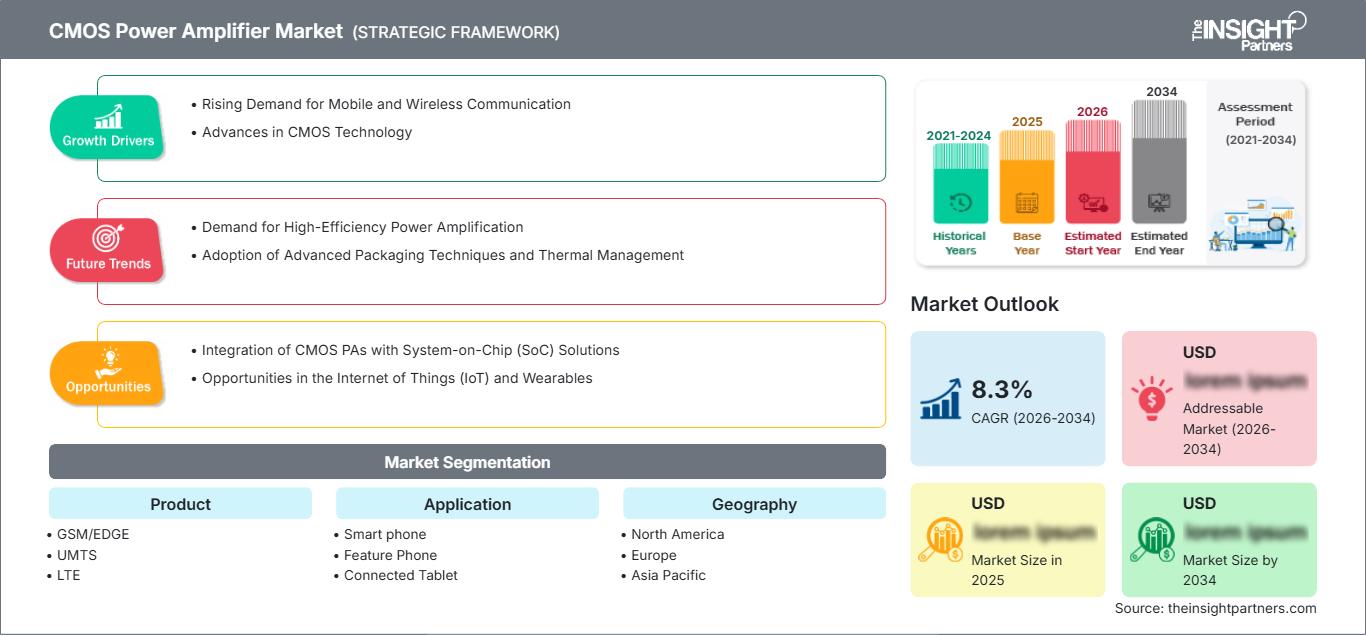
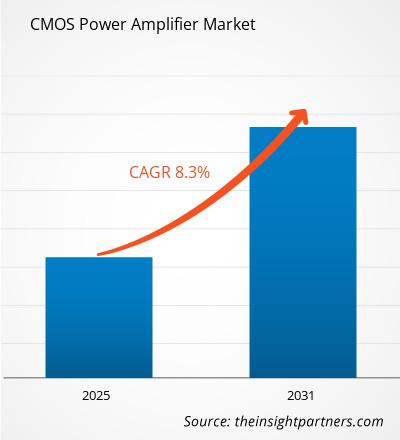
The CMOS Power Amplifier Market size in 2025 is pegged at US$ 3.14 Billion and forecasted to grow to US$ 7.27 Billion in 2034, thereby growing at a CAGR of 9.78% during 2026–2034. The growth drivers are increasing need for radio-frequency integration in mobile devices, increased support for LTE bands and shift towards smaller sized amplifiers which help reduce the board space while keeping the performance of the amplifier in terms of signal linearity and power efficiency intact.
North America continues to remain one of the value-demand driven regions wherein the size of the CMOS Power Amplifier Market is being driven by premium smartphones, cellular IoTs, military communication devices and carrier aggregation applications. North America market is forecasted to grow at a rate of 8.9%–9.4% CAGR during 2026–2034.
CMOS Power Amplifier Market Assessment and Insights
- North America accounted for 30–33% share in 2025 and is growing at a CAGR of 8.9–9.4% between 2026–2034, supported by premium handset demand and RF front-end design activity.
- US represented 78–82% of North America in 2025 and is growing at a CAGR of 8.7–9.2% between 2026–2034, led by fabless RF design and flagship smartphone platforms.
- Europe held 18–21% share in 2025 and is growing at a CAGR of 8.1–8.7% between 2026–2034, with Germany, the UK, and France leading connected device adoption.
- Asia Pacific captured 39–42% share in 2025 and is growing at a CAGR of 10.6–11.2% between 2026–2034, driven by China, Japan, South Korea, and India.
- Largest Segment LTE held 42–45% market share in 2025 and is growing at a CAGR of 9.3–9.8% between 2026–2034 as multi-band smartphones remain volume anchors.
- High Growth Segment Connected Tablet held 14–17% market share in 2025 and is growing at a CAGR of 10.8–11.4% between 2026–2034 due to enterprise mobility and education deployments.
- Key companies analyzed in detail: DSP Group, Inc.; Qualcomm Incorporated; Skyworks Solutions, Inc.; Toshiba Corporation; Murata Manufacturing Co., Ltd.; Broadcom Inc.; ACCO Semiconductor, Inc.; Texas Instruments Incorporated; Qorvo, Inc.; NXP Semiconductors N.V.
Source: The Insight Partners' analysis based on proprietary research, government publications, company annual reports, investor presentations, industry databases, and expert interviews.
The market has moved from separate amplification systems for specific protocols to integrated CMOS systems that fit well into tighter handsets, support more bands, and meet cost-oriented mass-manufacturing needs. Foundries, improvements in RF-CMOS processes, envelope tracking, and packaging advancements are affecting suppliers' economics. In terms of CMOS Power Amplifier Market, there will be more gains for those who can deliver linearity, temperature performance, and low current consumption without putting additional pressure on the bill-of-materials in the smartphones and tablets.
From now until 2034, the demand is likely to extend to India, Southeast Asia, Gulf countries, and some regions of Eastern Europe, owing to the densification of 4G networks, 5G coexistence and affordability of smart devices. Digitalization efforts by the government, refarming of the spectrum, and electronics incentives in those regions are expected to enable regional sourcing.
CMOS Power Amplifier Market Report Scope
| Report Attribute | Details |
|---|---|
| Market size in 2025 | US$ 3.14 Billion |
| Market Size by 2034 | US$ 7.27 Billion |
| Global CAGR (2026 - 2034) | 9.78% |
| Historical Data | 2021-2024 |
| Forecast period | 2026-2034 |
CMOS Power Amplifier Market Analysis
Demand is centered on smartphones that need to have effective signal transmission through LTE, old cellular networks, and regional bands. The growth of the CMOS Power Amplifier Market is also affected by connected tablets and feature phones, for which cost, battery life, and an efficient RF path are critical purchase considerations. Buyers look at the performance of the amplifier based on power-added efficiency, adjacent channel leakage, and footprint of the package.
The value chain includes RF design companies, wafer fabs, outsourced assembly and testing companies, module makers, handsets OEMs, and telecom certification systems. The supply chain dynamics are still responsive to the availability of advanced node capacities, substrates, and qualifications. Suppliers who can co-design their amplifiers with switches, filters, and tuners can minimize insertion loss.
The competitive environment centers on Qualcomm Incorporated, Skyworks Solutions, Inc., Qorvo, Inc., Broadcom Inc., Murata Manufacturing Co., Ltd., and NXP Semiconductors N.V., whereas ACCO Semiconductor, Inc. and DSP Group, Inc. represent specialized expertise in distinct architectures. CMOS Power Amplifier Market analysis suggests that strategic positioning is being driven by RF front-end portfolio strategies rather than amplifier-only positioning.
Funding trends point towards design wins in premium smartphones, reference designs, and multi-year supply contracts. Texas Instruments Incorporated and Toshiba Corporation provide relevant analog, power, and semiconductor know-how, yet mobile RF experts have more influence in the case of complicated bands. Mergers, including planned RF mergers, are indicative of an effort to find scale, utilization, and wider reach of customers.
● REPORT CUSTOMIZATION
Tailor This Report To Align With Your Specific Business Requirements
This report can be customized to align precisely with your business objectives, scope, and target markets. Customization options include tailored segmentation, geography, competitive analysis, and strategic insights to support informed decision-making.
Customize This Report →WHAT YOU CAN ADJUST
- ● Segmentations
- ● Geography
- ● Competitive Analysis
- ● Language Preferences
CMOS Power Amplifier Market: Strategic Insights
Regional Insights
North America CMOS Power Amplifier Market
North America represented 30–33% share in 2025, making it the second-largest regional base for the CMOS Power Amplifier Market share after Asia Pacific. The region is forecast to grow at an 8.9–9.4% CAGR during 2026–2034 as premium smartphones, private wireless pilots, defense communications, and connected tablets sustain demand for high-efficiency RF transmit components.
Structural drivers include high mobile data usage, strong semiconductor design clusters, and enterprise adoption of always-connected devices. The U.S. Federal Communications Commission’s continued spectrum activity supports multi-band equipment requirements, while carrier investments in 5G standalone and LTE optimization create demand for amplifiers that balance linearity, thermal behavior, and energy efficiency.
U.S. CMOS Power Amplifier Market
The U.S. held a share of 78%–82% of North America in 2025 and is estimated to witness an 8.7%–9.2% CAGR through 2026-2034. The importance of this region is accentuated with the help of Qualcomm Incorporated, Skyworks Solutions, Inc., Qorvo, Inc., Broadcom Inc., Texas Instruments Incorporated, and ACCO Semiconductor, Inc. These players help in the RF designs and modules integration and customer qualification.
Trends in the application involve flagship smartphones, connected tablets for business processes, and feature phones for prepaid and rugged usage. Designers are now calling for amplifiers that facilitate carrier aggregation, extended battery life, and heat management. The homegrown design activities are further bolstered by government focus on robust semiconductor supply chains and communication infrastructure.
Europe CMOS Power Amplifier Market
The region accounted for 18-21% market share in 2025 and is expected to grow at a 8.1-8.7% CAGR during 2026-2034. Germany is leading in the region through automotive connectivity, industrial handhelds, and premium consumer communication devices. The UK helps due to telecom testing, trials of private networks, and usage of tablets in the enterprise sector. France gains benefit from the nation-wide 5G coverage programs and communication demands of the aerospace industry.
Though Italy and Spain are smaller in size, their significance lies in high public safety communication needs, mobile traffic from the tourism industry, and programs for broadband access for everyone, which result in increased RF chain demand. Customers of the region place special emphasis on energy-saving performance, compliance with standards and longevity of devices.
APAC CMOS Power Amplifier Market
The APAC region is responsible for 39–42% of the market share in 2025 and is estimated to record a 10.6–11.2% CAGR over the period from 2026 to 2034, where the dominant country within the region is China. The countries of China, Japan, South Korea, India, and Australia offer combination capabilities of handset manufacturing, 5G subscriber switching, and connected tablets usage in education, logistics, and governmental services sectors.
Local electronics manufacturing policies, semiconductors' self-reliance initiatives, smart manufacturing, and increasing low-end smartphones manufacturing drive the market in the region. Japan and South Korea are focused on advanced radio frequency performance, and India's production-linked incentives drive manufacturing and component sourcing of the devices.
Middle East & Africa CMOS Power Amplifier Market
Growth rate for the Middle East & Africa market will be at 8.4–9.0% CAGR from 2026 to 2034, driven by the UAE for premium mobile and enterprise connectivity and by Saudi Arabia for infrastructure-driven demand. South Africa and the Rest of MEA are contributing via expanding mobile broadband, low-cost mobiles, and government-led digital inclusion.
Energy and infrastructure investments are driving field operations, smart city connections, and logistics transformation, increasing the requirement for mobile transmit reliability. Heat resistance, battery efficiency, and rugged mobile requirements are more applicable in Gulf and African environments. Vendors that manage to balance cost efficiency with high-quality RF capabilities can meet varied regional demand.
Segmentation Analysis
Product
The Product segment is expected to grow at a 9.4–10.0% CAGR during 2026–2034 as OEMs balance LTE persistence with legacy cellular compatibility. CMOS Power Amplifier Market scope covers GSM/EDGE, UMTS, LTE, CDMA 2000, TD-SCDMA, and FOMA, reflecting regional network heterogeneity and installed device bases that require efficient, low-cost amplification.
- GSM/EDGE remains relevant in low-cost and fallback connectivity devices, especially where 2G voice coverage persists and component affordability is critical for entry-level phones.
- UMTS supports transitional demand in markets where 3G networks remain active, though replacement cycles increasingly push suppliers toward integrated multi-mode RF modules.
- LTE is the largest product sub-segment because smartphones and tablets still rely on broad LTE band support even as 5G device penetration rises.
- CDMA 2000 demand is narrow but persists in legacy network environments, replacement modules, and specialized devices requiring continuity across older cellular infrastructure.
- TD-SCDMA is concentrated in specific regional technology histories, with strategic importance tied to replacement demand and compatibility within legacy Chinese device ecosystems.
- FOMA addresses limited legacy Japanese network requirements and contributes mainly through maintenance, replacement, and niche device compatibility rather than new volume growth.
Application
The Application segment is projected to expand at a 9.7–10.3% CAGR during 2026–2034 as mobile computing remains the central use case. Smartphones dominate demand, while connected tablets gain traction in enterprise, education, healthcare, and logistics workflows. Feature phones continue to sustain cost-driven volumes in emerging markets and rugged communication environments.
- Smart phone applications account for the primary demand base because multi-band connectivity, carrier aggregation, and compact handset layouts increase dependence on efficient CMOS-based RF amplification.
- Feature Phone demand is concentrated in price-sensitive markets where long battery life, basic voice reliability, and low component cost remain more important than advanced data performance.
- Connected Tablet adoption is scaling as enterprises, schools, field-service teams, and public agencies deploy cellular-enabled devices for mobility, documentation, payments, and remote operations.
Opportunity Snapshot
| Application | Revenue Contribution | Trend Tag | Adoption Stage |
| Smart phone | High | Multi-Band | Mature |
| Feature Phone | Low | Battery Life | Mature |
| Connected Tablet | Medium | Enterprise Mobility | Scaling |
CMOS Power Amplifier Market Growth Drivers and Impact Analysis
Rising Multi-Band Smartphone Complexity
The newer smartphones have the capability to work with more bands, paths, and carrier combinations as compared to previous generations, creating a higher level of pressure for RF front end optimization. Every additional band adds another layer of difficulty in the design process since the transmit power, isolation, and thermal management need to be optimized in the constrained PCB area. CMOS technology amplifiers offer a solution to this problem via their integration capabilities and cost advantages. The greatest market influence is felt in mid-tier and high-end smartphones.
Cost Pressure in High-Volume Device Manufacturing
OEMs of mobile devices operate under significant pressure for price reductions during inclusion of connectivity functions, increased memory capacity, and better display capabilities. Thus, RF components need to deliver performance improvements without having a substantial effect on their bill-of-materials cost. Compatibility with CMOS process helps to ensure high volume production, integration with control circuits, and possibly cost advantages compared to certain compound semiconductor alternatives in some applications. This creates the trend towards increased use of RF components in mid-range smartphones, tablets, and budget feature phones.
Expansion of Cellular-Enabled Tablets and Field Devices
Connected tablets and rugged mobile terminals are moving beyond consumer use into logistics, healthcare, education, retail, and field service. These devices need dependable uplink performance in warehouses, outdoor sites, and public networks where signal strength varies. CMOS power amplifiers contribute by improving power efficiency and enabling compact RF designs suitable for thin tablets or sealed rugged devices. The impact is visible in enterprise procurement, where device fleets are evaluated on battery life, network reliability, and lifecycle cost. This creates a durable demand layer outside the smartphone replacement cycle.
CMOS Power Amplifier Market Future Trends
Greater RF Front-End Integration
CMOS Power Amplifier Market trends indicate deeper integration of amplifiers with switches, tuners, filters, and control logic as device makers simplify procurement and improve total RF efficiency. Future designs will favor platform-level optimization rather than isolated component performance. This will increase collaboration between chipset suppliers, module vendors, and handset OEMs during early design stages. Integration also supports faster qualification cycles because fewer discrete interfaces require separate validation. Vendors with strong simulation tools, packaging expertise, and customer application engineering will gain an advantage as RF chains become denser and more software-configurable.
AI-Assisted RF Design Optimization
AI-assisted design workflows are expected to influence RF amplifier development by accelerating layout exploration, thermal modeling, and performance trade-off analysis. As band combinations multiply, engineering teams need faster methods to identify architectures that meet power, size, and linearity requirements. Machine learning can support yield prediction, adaptive calibration, and test-time reduction in high-volume manufacturing. Over the forecast period, this trend may narrow development cycles and improve first-pass success rates. Suppliers that combine RF domain expertise with advanced design automation should reduce cost and improve responsiveness to OEM platform schedules.
CMOS Power Amplifier Market Opportunities
Design Wins in Emerging Smartphone Platforms
Emerging-market smartphone brands are increasing shipment scale while demanding efficient RF components that support regional band portfolios and aggressive retail pricing. CMOS Power Amplifier Market Forecasts indicate opportunity for suppliers that can offer reference-ready amplifier modules, local technical support, and reliable volume availability. India, Southeast Asia, Africa, and Latin America are especially attractive because 4G replacement demand remains active while affordable 5G devices gradually expand. Winning these platforms requires cost control, fast qualification, and adaptable designs. Vendors that align with contract manufacturers and chipset roadmaps can capture multi-year sockets.
Enterprise Mobility and Rugged Device Expansion
Enterprise buyers are deploying cellular tablets, handheld terminals, and rugged devices for real-time inventory, remote diagnostics, public safety, and field maintenance. These use cases create opportunities for amplifier suppliers that can meet durability, battery, and connectivity requirements beyond consumer product cycles. Procurement decisions often consider lifecycle support, certification stability, and performance in weak-signal environments. Specialized RF designs for enterprise mobility can deliver higher margins than commodity handset sockets. Partnerships with rugged device OEMs, module integrators, and telecom carriers can open differentiated revenue streams.
Recent Developments
- September 2025: ROHM’s ultra-compact CMOS Operational Amplifier (op amp) TLR1901GXZ achieves the industry’s lowest operating circuit current. This IC is optimized to be applied as a measurement sensing amplifier in size-constrained applications such as handheld measurement instruments, wearable devices, and indoor motion detectors.
- March 2026: ROHM Semiconductor has introduced a new family of 17 CMOS operational amplifiers, expanding its analog product portfolio with the TLRx728 and BD728x series. Designed to support automotive, industrial, and consumer electronics applications, the new lineup offers engineers greater flexibility by providing multiple channel configurations and package options for a wide range of system designs. As modern electronic systems demand higher precision, faster response times, and improved energy efficiency, operational amplifiers must deliver an optimal balance of accuracy and speed.
- July 2026: ROHM (headquartered in Kyoto, Japan), a globally recognized semiconductor manufacturer, has announced the launch of the TLR1901GXZ, an ultra-compact CMOS operational amplifier designed to achieve the industry's lowest circuit current consumption during operation. The device is ideally suited for use as an instrumentation amplifier in compact applications, including portable measuring instruments, wearable devices, and indoor detectors powered by batteries or rechargeable batteries.
Frequently Asked Questions

- Comprehensive Market Sizing and Forecast Analysis
- Detailed Segmentation Analysis
- In-Depth Market Dynamics Assessment
- Regional and Country-Level Insights
- Competitive Landscape and Company Benchmarking
- Strategic Business Intelligence
Recent Reports
Testimonials

The Insight Partners' SCADA System Market report is comprehensive, with valuable insights on current trends and future forecasts. The team was highly professional, responsive, and supportive throughout. We are very satisfied and highly recommend their services.
RAN KEDEM Partner, Reali Technologies LTDs
I requested a report on a very specific software market and the team produced the report in a few days. The information was very relevant and well presented. I then requested some changes and additions to the report. The team was again very responsive and I got the final report in less than a week.
JEAN-HERVE JENN Chairman, Future Analytica
We worked with The Insight Partners for an important market study and forecast. They gave us clear insights into opportunities and risks, which helped shape our plans. Their research was easy to use and based on solid data. It helped us make smart, confident decisions. We highly recommend them.
PIYUSH NAGPAL Sr. Vice President, High Beam Global
The Insight Partners delivered insightful, well-structured market research with strong domain expertise. Their team was professional and responsive throughout. The user-friendly website made accessing industry reports seamless. We highly recommend them for reliable, high-quality research services
YUKIHIKO ADACHI CEO, Deep Blue, LLC.
This is the first time I have purchased a market report from The Insight Partners.While I was unsure at first, I visited their web site and felt more comfortable to take the risk and purchase a market report.I am completely satisfied with the quality of the report and customer service. I had several questions and comments with the initial report, but after a couple of dialogs over email with their analyst I believe I have a report that I can use as input to our strategic planning process.Thank you so much for taking the extra time and making this a positive experience.I will definitely recommend your service to others and you will be my first call when we need further market data.
JOHN SUZUKI President and Chief Executive Officer, Board Director, BK Technologies
I wish to appreciate your support and the professionalism you displayed in the course of attending to my request for information regarding to infectious disease IVD market in Nigeria. I appreciate your patience, your guidance, and the fact that you were willing to offer a discount, which eventually made it possible for us to close a deal. I look forward to engaging The Insight Partners in the future, all thanks to the impression you have created in me as a result of this first encounter.
DR CHIJIOKE ONYIA MANAGING DIRECTOR, PineCrest Healthcare Ltd.Reason to Buy
- Informed Decision-Making
- Understanding Market Dynamics
- Competitive Analysis
- Identifying Emerging Markets
- Customer Insights
- Market Forecasts
- Risk Mitigation
- Boosting Operational Efficiency
- Strategic Planning
- Investment Justification
- Tracking Industry Innovations
- Aligning with Regulatory Trends





 Get Free Sample for