
Coherent Optical Equipment Market Size, Share & Trends by 2034
Coverage: by Technology (100G, 200G, 400G+, 400G ZR); Equipment (WDM, Modules and Chips, Test and Measurement Equipment, Optical Switches, Optical Amplifiers, Others); Application (Networking, Data Centre, OEMs); Industry Vertical (Internet service provider, Telecom Service provider, Aviation, Energy, Railways, Others) , and Geography (North America, Europe, Asia Pacific, and South and Central America)
- Status : Data Released
- Report Code : TIPRE00005703
- Category : Electronics and Semiconductor
- No. of Pages : 150
- Available Report Formats :


- Last update date : July 28, 2026


2025 Market Size
US$ 15.89 Bn
Base year value
2034 Forecast
US$ 45.54 Bn
Projected by 2034
CAGR 2026-2034
12.41 %
Growth rate
Addressable Market
US$ 268.55 Bn
(2026-2034)
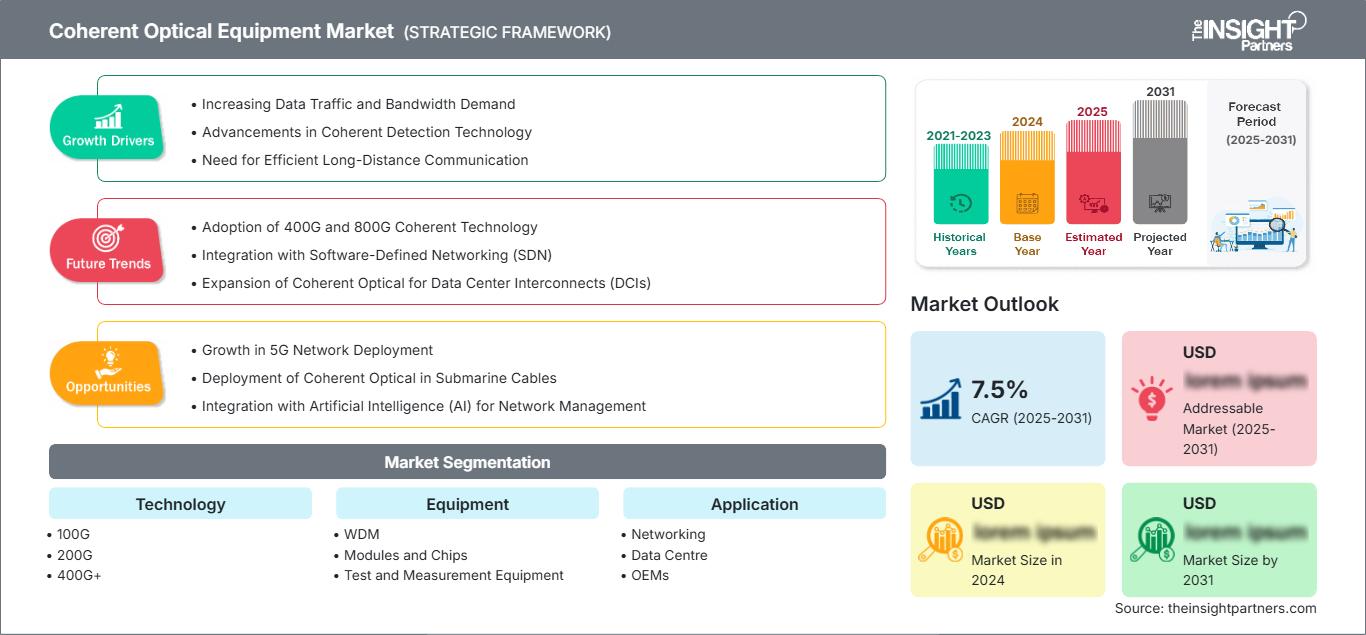
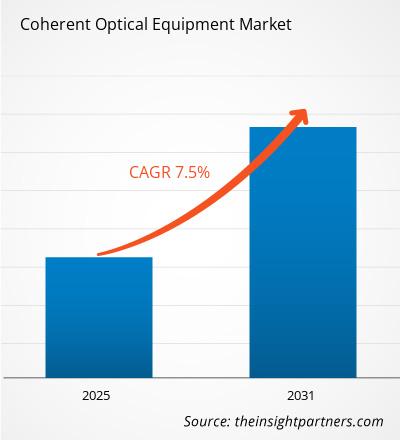
The Coherent Optical Equipment Market in 2025 is assessed to be US$ 15.89 billion and further forecast to grow to reach US$ 45.54 billion by 2034, exhibiting CAGR of 12.41% between 2026 and 2034. Driving factors include growing demands for higher bandwidth, increase in traffic in cloud environments, 5G network transport, data center interconnectivity, metro enhancement, and coherent modulation systems.
In North America, the Coherent Optical Equipment Market size is driven by a CAGR of 11.2–12.0% with growth coming from 400G and 800G network transport deployments by hyperscale operators, telecom service providers, and internet backbone companies. Momentum drivers include AI data centers, routed optical networks, metro wavelength requirements, and fiber-rich interconnect facilities with coherent pluggables reducing the space and operational footprint.
Coherent Optical Equipment Market Assessment and Insights
- North America: North America held a 32–35% share in 2025 and is growing at an 11.2–12.0% CAGR between 2026–2034, supported by hyperscale DCI, AI clusters, routed optical networking, and carrier backbone modernization.
- US: The US represented 79–83% of North America in 2025 and is growing at an 11.4–12.2% CAGR between 2026–2034, led by cloud campuses and 400G ZR adoption.
- Europe: Europe accounted for a 22–25% share in 2025 and is growing at a 10.4–11.2% CAGR between 2026–2034, with Germany, the UK, France, Italy, and Spain leading coherent upgrades.
- Asia Pacific: Asia Pacific held a 29–32% share in 2025 and is growing at a 13.0–14.1% CAGR between 2026–2034, driven by China, Japan, South Korea, India, and Australia.
- Largest Segment: WDM equipment led with a 33–37% market share in 2025 and an 11.6–12.5% CAGR between 2026–2034, reflecting backbone and metro spectrum expansion.
- High Growth Segment: 400G ZR held a 13–17% market share in 2025 and is growing at a 16.2–17.8% CAGR between 2026–2034 due to pluggable DCI adoption.
- Key companies analyzed in detail: ADTRAN Holdings, Inc., Cisco Systems, Inc., Ribbon Communications Inc., Fujitsu Optical Components Limited, Huawei Technologies Co., Ltd., Infinera Corporation, NEC Corporation, Nokia Corporation, Telefonaktiebolaget LM Ericsson, and ZTE Corporation.
Source: The Insight Partners' analysis based on proprietary research, government publications, company annual reports, investor presentations, industry databases, and expert interviews.
Coherent optics have made a transition from large form factors in chassis-based long-haul solutions to smaller solutions that employ digital signal processing (DSPs), silicon photonic chips, and pluggable interoperability solutions. The Coherent Optical Equipment Market will represent a manufacturing landscape comprising embedded line cards, WDM platforms, amplifier cascades, optical switching devices, and QSFP-DD or OSFP pluggables. Manufacturing needs will comprise less watts per gigabit, proven multi-vendor interoperability, thermal management, and quick qualification cycles.
The future demand will include campuses for AI preparedness, investment in sovereign clouds, expansion of sub-sea networks, and evolution of the telecommunications industry from 100G/200G wavelengths to 400G+ wavelengths for transport. The industry standards of OIF 400ZR, OIF 800ZR, and open line systems will allow making purchases. New geographies will raise demand due to requirements of data localization, 5G standalone core, and regional internet exchange requiring coherent optics capacity.
Coherent Optical Equipment Market Report Scope
| Report Attribute | Details |
|---|---|
| Market size in 2025 | US$ 15.89 Billion |
| Market Size by 2034 | US$ 45.54 Billion |
| Global CAGR (2026 - 2034) | 12.41% |
| Historical Data | 2021-2024 |
| Forecast period | 2026-2034 |
Coherent Optical Equipment Market Analysis
The drivers of Coherent Optical Equipment Market include Data Center Interconnect, Mobile X-Haul, subsea systems upgrades, and metro backbone densification. There is a need to increase capacity without any increase in the number of fiber pairs, shelf numbers, or energy usage. Coherent modulation improves spectral efficiency, while pluggable modulation ensures transport through routers.
The value chain comprises DSP providers, photonic components manufacturers, module assemblers, WDM systems providers, test equipment providers, carriers, cloud providers, and optical integration partners. The supply chain is sensitive to CMOS technology advancements, tunable laser technology advancements, coherent driver technology advancements, manufacturing yields, and conformance testing requirements. Customers are placing greater emphasis on interoperability, telemetry, remote diagnostics, and lifecycle power efficiency.
The Coherent Optical Equipment Market Report highlights the competitive environment that is characterized by the size, optical silicon, route planning capabilities, and hyperscale purchasing cycles. Companies like Cisco Systems, Inc., Huawei Technologies Co., Ltd., Nokia Corporation, Infinera Corporation, ZTE Corporation, NEC Corporation, Fujitsu Optical Components Limited, ADTRAN Holdings, Inc., Ribbon Communications Inc., and Telefonaktiebolaget LM Ericsson compete across platforms and modules.
Capital flows towards coherent pluggables, open optical line systems, C+L band, and automated assurance tools. Effective positioning should be based on reduced 400G ZR deployment friction, 800G migration readiness, and optics alignment with the router refreshing cycles. Having a wide portfolio of products allows vendors to address demands from telecommunications, internet service providers, data centers, airlines, energy industry, and railway transportation.
● REPORT CUSTOMIZATION
Tailor This Report To Align With Your Specific Business Requirements
This report can be customized to align precisely with your business objectives, scope, and target markets. Customization options include tailored segmentation, geography, competitive analysis, and strategic insights to support informed decision-making.
Customize This Report →WHAT YOU CAN ADJUST
- ● Segmentations
- ● Geography
- ● Competitive Analysis
- ● Language Preferences
Coherent Optical Equipment Market: Strategic Insights
Regional Insights
North America Coherent Optical Equipment Market
North America accounted for a 32–35% share in 2025 and is expected to grow at an 11.2–12.0% CAGR during 2026–2034. Coherent Optical Equipment Market share is supported by hyperscale cloud regions, AI training clusters, 400G ZR deployments, and routed optical networking programs that collapse routing and transport economics.
There is high demand in the US, while Canada is contributing its share through metro, enterprise, and backbone carrier investments. This region takes advantage of abundant fiber routes, internet exchanges, and coherent pluggables. These operators make use of WDM systems, amplifiers, modules, and testing solutions in order to enhance bandwidth at minimal cost.
U.S. Coherent Optical Equipment Market
The US had a market share of 79 to 83% in 2025 and continues to witness growth at a compound annual growth rate of 11.4 to 12.2% from 2026 to 2034. Internet service providers require coherent line systems and pluggable optics for cloud regions, content delivery networks, telecom aggregations, defense communications, and financial exchanges.
Some of the companies in this space include Cisco Systems, Inc., Nokia Corporation, Infinera Corporation, ADTRAN Holdings, Inc., and Ribbon Communications Inc. Trends in applications include 400G ZR for metro DCI, 400G+ wavelengths for backbones, and test beds for verifying interoperability before mass deployments.
Europe Coherent Optical Equipment Market
The European market had a share of 22-25% in 2025, which is anticipated to grow at a CAGR of 10.4-11.2% during 2026-2034. Dominance of the European market is due to carrier backbone network upgrades, industrial clouds, and enterprise networking. The United Kingdom generates an extra demand due to financial networks, subsea cable landing stations, and cloud zones requiring metro optical bandwidth.
France, Italy, and Spain provide contribution via their national broadband rollouts, regional data centers, and telco infrastructure updates. Energy efficiency, open interfaces, and secured transport for governmental and corporate traffic become important criteria for European buyers. Nokia Corporation, Telefonaktiebolaget LM Ericsson, ADTRAN Holdings, Inc., and Huawei Technologies Co., Ltd. back the European market with platform offerings and carrier partnerships.
APAC Coherent Optical Equipment Market
In 2025, APAC held the market share in the range of 29% to 32%, which is expected to grow at a CAGR of 13.0% to 14.1% for the period 2026 to 2034. China drives APAC by way of backbone, cloud, and manufacturing eco-systems. Japan and South Korea are also driven by bandwidth services, sub-marine cables, and electronics supply chain.
India and Australia are growing their metros, data centers, and corporate connectivity eco-systems. Policy factors driving the market are digital infrastructure, 5G densification, and data localization. Huawei Technologies Co., Ltd., ZTE Corporation, NEC Corporation, and Fujitsu Optical Components Limited continue to be significant players through national operators, OEMs, and modules.
Middle East & Africa Coherent Optical Equipment Market
CAGR of Middle East & Africa Market lies between 10.0% - 10.9% during 2026 - 2034. Saudi Arabia leads due to cloud regions, smart city networks, energy corridors, and expansion of carrier backbones. The UAE facilitates adoption through hosting in hyperscale datacenters, undersea networks, and digitization of enterprises.
Other parts of MEA such as South Africa will bring demands through internet exchanges, mobile transportation, and national fiber deployments. Users of energy and infrastructure segments require robust optical connections for control networks, remote operations, and secure data transfers. Vendor success will be determined by engineering presence and spare parts availability.
Segmentation Analysis
Technology
The Technology segment is forecast to grow at an 11.8–12.9% CAGR during 2026–2034. Coherent Optical Equipment Market scope by technology is shaped by migration from 100G and 200G wavelengths toward 400G+, while 400G ZR expands pluggable adoption in metro DCI. Network operators balance reach, power, port density, and interoperability when selecting coherent transmission speeds.
- 100G: 100G remains relevant in access aggregation, enterprise routes, and cost-sensitive upgrades where fiber reach and installed line systems make incremental coherent capacity practical.
- 200G: 200G supports metro and regional routes needing higher throughput than legacy 100G, while preserving operational familiarity for carriers managing mixed-generation optical networks.
- 400G+: 400G+ wavelengths are central to long-haul, subsea, and backbone scaling because they improve spectrum utilization, reduce cost per bit, and align with router upgrades.
- 400G ZR: 400G ZR is strategically important for pluggable DCI, allowing cloud and telecom operators to deploy coherent capacity directly through standardized module form factors.
Equipment
The Equipment segment is projected to grow at an 11.5–12.6% CAGR during 2026–2034. WDM systems, modules, chips, amplifiers, switches, and test platforms work together to deliver scalable coherent capacity. Buyers increasingly prefer open interfaces, compact modules, and automated testing because large deployments require repeatability across vendors, routes, and operating teams.
- WDM: WDM equipment holds the leading position because carriers and hyperscalers require multi-wavelength transport to expand capacity over existing fiber routes.
- Modules and Chips: Modules and chips gain strategic importance as DSPs, silicon photonics, and tunable lasers determine power efficiency, reach, and cost per transmitted bit.
- Test and Measurement Equipment: Test systems are essential for validating interoperability, optical signal quality, link margins, and production readiness before coherent networks scale commercially.
- Optical Switches: Optical switches support dynamic routing, protection, and traffic engineering in metro and backbone networks where capacity must be reallocated efficiently.
- Optical Amplifiers: Optical amplifiers remain critical for long spans, ROADM networks, and high-capacity routes where signal reach and wavelength performance affect service reliability.
Application
The Application segment is expected to grow at a 12.0–13.1% CAGR during 2026–2034. Networking remains the largest application, while data centre demand accelerates as AI clusters and cloud regions require shorter deployment cycles. OEMs use coherent modules and chips to embed transport capability into switches, routers, and optical platforms.
- Networking: Networking applications dominate carrier backbone, metro aggregation, and internet exchange routes where coherent optics increase bandwidth without proportional fiber expansion.
- Data Centre: Data centre use is scaling rapidly as AI workloads, cloud replication, and inter-campus connectivity require compact 400G and 800G coherent links.
- OEMs: OEM demand reflects integration of coherent chips, modules, and line-side optics into routers, switches, and transport platforms serving multiple operator segments.
Industry Vertical
The Industry Vertical segment is forecast to grow at an 11.7–12.8% CAGR during 2026–2034. Internet service providers and telecom service providers anchor procurement because traffic growth is continuous and route economics are measurable. Aviation, energy, and railways adopt coherent systems for resilient communications, control networks, and high-capacity operational data movement.
- Internet service provider: Internet service providers need scalable coherent transport for peering, broadband aggregation, content delivery, and regional route expansion tied to rising residential and enterprise traffic.
- Telecom Service provider: Telecom service providers invest in coherent platforms for 5G transport, metro aggregation, long-haul modernization, and wholesale wavelength services.
- Aviation: Aviation networks require resilient optical connectivity for airports, operations control, surveillance data, and passenger digital services across complex transport hubs.
- Energy: Energy users deploy coherent systems for grid communications, offshore connectivity, pipeline monitoring, and secure data movement across remote infrastructure.
- Railways: Railways use optical transport for signaling, station communications, surveillance, passenger information, and operations centers requiring dependable high-capacity backhaul.
Opportunity Snapshot
| Application | Revenue Contribution | Trend Tag | Adoption Stage |
| Networking | High | Metro Scaling | Mature |
| Data Centre | High | AI DCI | Scaling |
| OEMs | Medium | Pluggable Integration | Scaling |
Coherent Optical Equipment Market Growth Drivers and Impact Analysis
AI Data Traffic Raises Metro and DCI Capacity Requirements
Training, inference, and cloud replication activities are driving up east-west traffic between data centers and regional campuses. Coherent connectivity enables service providers to transport hundreds of gigabits per wavelength over metropolitan and regional routes with minimal equipment. This will have a huge effect on the Coherent Optical Equipment Market in applications where there are needs for rapid capacity provisioning, link margin predictability, and energy efficiency. The 400ZR and upcoming 800ZR interfaces aligned to OIF specifications enable multi-vendor procurements.
Router-Hosted Coherent Optics Reshape Transport Economics
The use of IP over DWDM makes it possible for coherent pluggables to be housed in the router, thereby making less of a reliance on separate transponder shelves for the right path selection. This approach results in savings in terms of space, power, and cable needs, along with fewer operations handoffs between IP and optical experts. There is a market impact evident in metro DCI, regional network, and service provider aggregation scenarios where it is possible to align router and optics upgrades.
Fiber Scarcity Increases Value of Spectral Efficiency
Construction of new fibers is costly and time-consuming in dense urban paths, undersea pathways, and regulated paths. Using coherent equipment enables service providers to gain additional capacity from existing fiber by applying higher-order modulation, flexible grid operation, and C+L bands extension. This trend drives the need for WDM equipment, amplifiers, optical switches, and test instruments. Commercially, this trend holds importance as service providers will be able to save on civil work expenses, improve economic viability of the route, and utilize the capacity sooner.
Coherent Optical Equipment Market Future Trends
800G Coherent Pluggables Move Toward Multi-Haul Deployment
Coherent Optical Equipment Market trends point to 800G coherent pluggables expanding from trials into multi-haul deployment as DSP efficiency, interoperability, and thermal design improve. Future networks will use 800G modules for dense DCI, regional transport, and selected long-haul applications where fewer wavelengths reduce operational complexity. Adoption will depend on route validation, power envelopes, and line-system compatibility. Suppliers with credible migration paths from 400G ZR to 800G ZR and beyond will influence procurement roadmaps as AI traffic pushes capacity planning beyond conventional metro assumptions.
Open Line Systems and Automation Gain Procurement Weight
Open optical line systems will become more relevant as operators seek vendor diversity, faster wavelength activation, and better asset utilization. Automation will shift from basic monitoring toward intent-based provisioning, margin analytics, and predictive maintenance. This trend matters because coherent deployments are becoming more numerous and operationally distributed. Platforms that expose telemetry, support open APIs, and validate multi-vendor modules can reduce manual engineering effort. Over time, optical planning will increasingly integrate with IP control, service assurance, and energy optimization workflows.
Coherent Optical Equipment Market Opportunities
Standardized 400G ZR Packages for Regional Data Centers
Coherent Optical Equipment Market Forecasts indicate an opportunity in repeatable 400G ZR packages for cloud regions, colocation campuses, and carrier-neutral facilities. Vendors can bundle pluggables, line-system guidance, test validation, monitoring templates, and deployment playbooks. This approach reduces engineering friction for operators that must connect multiple sites within tight construction windows. Channel partners and system integrators can create recurring services around route audits, module qualification, and ongoing performance assurance, converting one-time optics purchases into managed capacity enablement programs.
Coherent Upgrades for Critical Infrastructure Networks
Aviation, energy, and railway operators represent a practical opportunity because their communications networks need high availability, long route reach, and secure data transfer. Suppliers can position coherent systems for surveillance video, operational technology backhaul, control center connectivity, and disaster-resilient routes. Winning strategies include ruggedized engineering support, lifecycle spares planning, cybersecurity alignment, and integration with existing fiber assets. These users may not match hyperscale purchase volume, but they provide stable, specification-led demand where reliability and route performance outweigh lowest upfront equipment cost.
Recent Developments
- March 2026: NVIDIA and Coherent Corp. announced a multiyear strategic partnership to advance next-generation optical technologies for AI data center infrastructure. Under the non-exclusive agreement, NVIDIA will make a US$ 2 billion investment in Coherent, alongside a multibillion-dollar purchase commitment and long-term capacity access for advanced laser and optical networking products. The collaboration expands Coherent's U.S.-based manufacturing capacity and R&D capabilities, strengthening the development of high-bandwidth, energy-efficient optical interconnects and photonic technologies required to scale next-generation AI infrastructure.
- March 2026: Coherent Corp. launched the WaveMaker 4000A Programmable Optical Spectrum Synthesizer for Super C-Band DWDM system testing, enabling optical communications engineers to generate programmable test spectra for transmission systems, transceivers, and amplifier validation. The compact instrument supports full Super C-Band spectrum generation, programmable noise channels, Flexgrid configurations, and realistic optical noise loading to replicate real-world network conditions. Designed for long-haul terrestrial and submarine networks, the WaveMaker 4000A reduces test complexity by replacing large custom-built setups with an integrated solution featuring automated test interfaces and a user-friendly graphical interface, helping accelerate optical system development and reduce cost of testing.
- March 2026: Nokia launched a new suite of application-optimized optical networking solutions designed to address the rapidly increasing connectivity demands of AI workloads, hyperscale data centers, and cloud infrastructure. The portfolio introduces a new generation of coherent optical transport solutions featuring advanced digital signal processors and optical front ends based on Indium Phosphide and Silicon Photonics technologies, enabling up to 70% lower total cost of ownership through improved power, space, and operational efficiency. The launch includes 1.6T-capable coherent pluggables, 2.4T and 3.2T optical solutions, double-sided pluggables optimized for CPO/LPO/NPO-based switches, and a new multi-rail in-line amplifier that can support up to 40x more services in the same footprint for multi-fiber networks.
Frequently Asked Questions

- Comprehensive Market Sizing and Forecast Analysis
- Detailed Segmentation Analysis
- In-Depth Market Dynamics Assessment
- Regional and Country-Level Insights
- Competitive Landscape and Company Benchmarking
- Strategic Business Intelligence
Recent Reports
Testimonials

The Insight Partners provided valuable market intelligence that supported our global go-to-market strategy. Their team was professional, responsive, and attentive to our feedback, providing thoughtful analysis and helpful methodological clarifications throughout the project.
Junmo Kim Chief Financial Officer (CFO), Enertech Co., Ltd.
The Insight Partners' SCADA System Market report is comprehensive, with valuable insights on current trends and future forecasts. The team was highly professional, responsive, and supportive throughout. We are very satisfied and highly recommend their services.
RAN KEDEM Partner, Reali Technologies LTDs
I requested a report on a very specific software market and the team produced the report in a few days. The information was very relevant and well presented. I then requested some changes and additions to the report. The team was again very responsive and I got the final report in less than a week.
JEAN-HERVE JENN Chairman, Future Analytica
We worked with The Insight Partners for an important market study and forecast. They gave us clear insights into opportunities and risks, which helped shape our plans. Their research was easy to use and based on solid data. It helped us make smart, confident decisions. We highly recommend them.
PIYUSH NAGPAL Sr. Vice President, High Beam Global
The Insight Partners delivered insightful, well-structured market research with strong domain expertise. Their team was professional and responsive throughout. The user-friendly website made accessing industry reports seamless. We highly recommend them for reliable, high-quality research services
YUKIHIKO ADACHI CEO, Deep Blue, LLC.
This is the first time I have purchased a market report from The Insight Partners.While I was unsure at first, I visited their web site and felt more comfortable to take the risk and purchase a market report.I am completely satisfied with the quality of the report and customer service. I had several questions and comments with the initial report, but after a couple of dialogs over email with their analyst I believe I have a report that I can use as input to our strategic planning process.Thank you so much for taking the extra time and making this a positive experience.I will definitely recommend your service to others and you will be my first call when we need further market data.
JOHN SUZUKI President and Chief Executive Officer, Board Director, BK Technologies
I wish to appreciate your support and the professionalism you displayed in the course of attending to my request for information regarding to infectious disease IVD market in Nigeria. I appreciate your patience, your guidance, and the fact that you were willing to offer a discount, which eventually made it possible for us to close a deal. I look forward to engaging The Insight Partners in the future, all thanks to the impression you have created in me as a result of this first encounter.
DR CHIJIOKE ONYIA MANAGING DIRECTOR, PineCrest Healthcare Ltd.Reason to Buy
- Informed Decision-Making
- Understanding Market Dynamics
- Competitive Analysis
- Identifying Emerging Markets
- Customer Insights
- Market Forecasts
- Risk Mitigation
- Boosting Operational Efficiency
- Strategic Planning
- Investment Justification
- Tracking Industry Innovations
- Aligning with Regulatory Trends





 Get Free Sample for