
Collision Avoidance System Market Size, Growth & Demand by 2034
Coverage: by Function (Adaptive Cruise Control, Blind Spot Detection, Forward Collision Warning, Lane Departure Warning System, Autonomous Emergency Braking, and Parking Assistance); Component (Radar, Lidar, Camera and Ultrasonic); and Application (Automotive, Aerospace, Railway and Marine), and Geography (North America, Europe, Asia Pacific, and South and Central America)
- Status : Data Released
- Report Code : TIPTE100001330
- Category : Electronics and Semiconductor
- No. of Pages : 150
- Available Report Formats :


- Last update date : July 28, 2026


2025 Market Size
US$ 70.95 Bn
Base year value
2034 Forecast
US$ 155.31 Bn
Projected by 2034
CAGR 2026-2034
9.10 %
Growth rate
Addressable Market
US$ 1,012.15 Bn
(2026-2034)
The Collision Avoidance System Market size in 2025 was valued at US$ 70.95 billion and is expected to grow and reach a value of US$ 155.31 billion in 2034 at a CAGR of 9.10%. This growth will be due to various factors such as regulations, multisensory architecture, automation in braking systems, and use in the automotive, aerospace, railway, and marine segments.
North America continues to be a valuable market for collision avoidance systems because of the increased adoption of active safety systems in vehicles. This is fueled by a regional CAGR ranging from 8.6–9.0%, based on compliance in the United States in automatic emergency braking, luxury cars, fleet safety, and radar-cameras integration systems.
Collision Avoidance System Market Assessment and Insights
- North America accounted for 31–33% share in 2025 and is growing at a CAGR of 8.6–9.0% during 2026–2034, supported by AEB regulation, ADAS penetration, and commercial fleet retrofit demand.
- US represented 78–82% of North America in 2025 and is growing at a CAGR of 8.7–9.1% during 2026–2034, led by federal AEB rules and OEM localization.
- Europe held 27–29% share in 2025 and is growing at a CAGR of 8.4–8.8% during 2026–2034, with Germany, France, the UK, Italy, and Spain leading safety validation.
- Asia Pacific captured 24–26% share in 2025 and is growing at a CAGR of 10.2–10.7% during 2026–2034, led by China, Japan, South Korea, India, and Australia.
- Largest Segment Automotive held 66–69% market share in 2025 and is growing at a CAGR of 9.2–9.6% during 2026–2034, reflecting ADAS standardization.
- High Growth Segment Lidar held 12–15% market share in 2025 and is growing at a CAGR of 11.8–12.6% during 2026–2034, supported by higher automation requirements.
- Key companies analyzed in detail: Continental AG, BorgWarner Inc., Robert Bosch GmbH, ZF Friedrichshafen AG, Honeywell International Inc., Siemens AG, Alstom SA, DENSO Corporation, Autoliv Inc., General Electric Company.
Source: The Insight Partners' analysis based on proprietary research, government publications, company annual reports, investor presentations, industry databases, and expert interviews.
The evolution of technology is away from single-use alerts towards perception and intervention stacks. Radar is still used for all-weather detection, cameras help with classification, and lidar aids in high-resolution mapping. There is a shift in production trends with integration of software, sensor calibration, and electronic control units into platforms that can be used in passenger cars, rail signaling, port equipment, aircraft ground movements, and marine navigation.
The future demand is bound to increase because of new laws regarding vehicle safety in developing countries and economic value calculations by transport companies when avoiding accidents. Investments are expected in sensor fusion, cost-effective lidar, railway object detection, and port automation. Regulatory tailwinds from AEB legislation in the United States and Euro NCAP 2026 are likely to increase performance standards and reduce supplier qualification cycles.
Collision Avoidance System Market Report Scope
| Report Attribute | Details |
|---|---|
| Market size in 2025 | US$ 70.95 Billion |
| Market Size by 2034 | US$ 155.31 Billion |
| Global CAGR (2026 - 2034) | 9.10% |
| Historical Data | 2021-2024 |
| Forecast period | 2026-2034 |
Collision Avoidance System Market Analysis
The demand is growing because safety is changing from an element that helps distinguish itself from others to a regulated requirement for baseline capability. Collision Avoidance System Market growth is driven by fatality reduction objectives, pressures on insurers and original equipment manufacturers to reach standards related to automatic breaking, lane assistance and identification of vulnerable road users.
The value chain consists of semiconductor makers, optical component producers, Tier 1 suppliers, vehicle OEMs, testing facilities, and fleet operators. The supply conditions are becoming more favorable with the scaling of radar chipsets, camera systems and ultrasonic sensors on various vehicles. However, price of lidars, software testing, and performance in adverse weather conditions will define the purchase criteria.
Competitive positioning centers on sensor set, embedded software, OEM partnerships, and compliance readiness. Companies such as Continental AG, Robert Bosch GmbH, ZF Friedrichshafen AG, DENSO Corporation, and Autoliv Inc. engage in competition in automotive ADAS solutions, whereas Siemens AG, Alstom SA, Honeywell International Inc., and General Electric Company cater to transport infrastructure, rail, aerospace, and industrial safety applications.
The Collision Avoidance System Market analysis reveals that more emphasis is being placed on software-based perception, calibration over-the-air, and validation data sets. Firms which can integrate capabilities like radar, camera, lidar, and ultrasonic sensors together with functional safety certification are in a favorable position as OEMs streamline suppliers and require global safety performance standardization.
● REPORT CUSTOMIZATION
Tailor This Report To Align With Your Specific Business Requirements
This report can be customized to align precisely with your business objectives, scope, and target markets. Customization options include tailored segmentation, geography, competitive analysis, and strategic insights to support informed decision-making.
Customize This Report →WHAT YOU CAN ADJUST
- ● Segmentations
- ● Geography
- ● Competitive Analysis
- ● Language Preferences
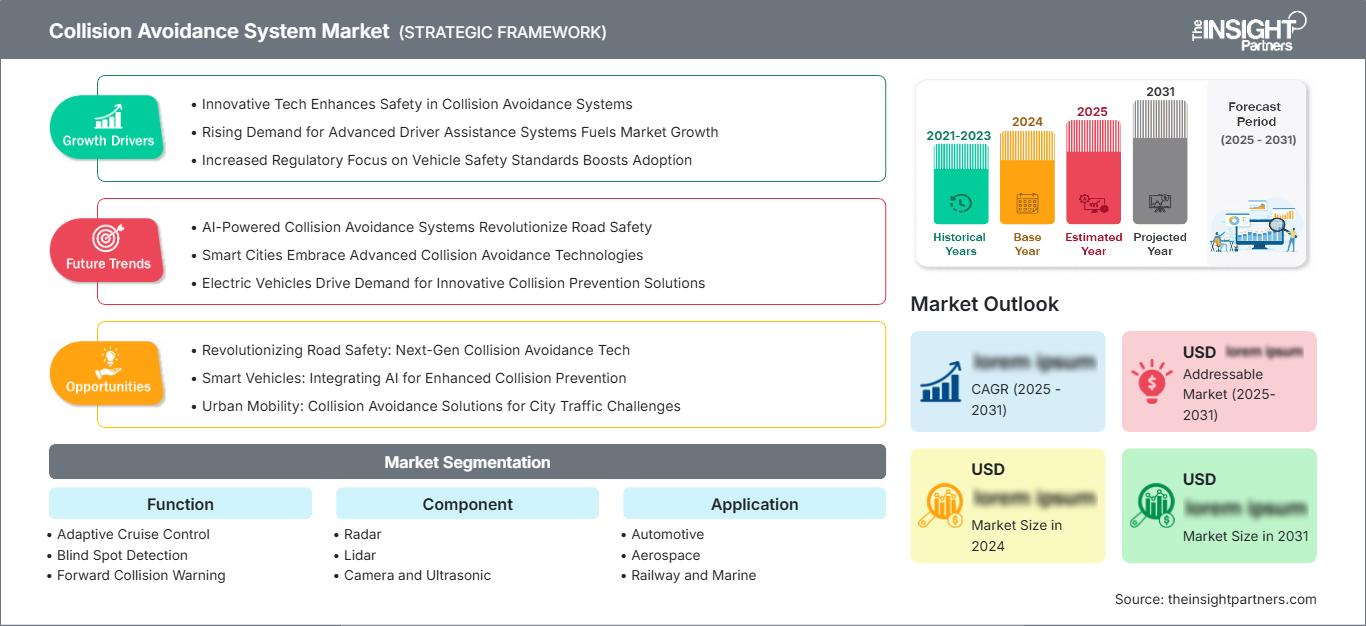
Collision Avoidance System Market: Strategic Insights
Regional Insights
North America Collision Avoidance System Market
North America held 31–33% share in 2025 and is projected to expand at an 8.6–9.0% CAGR during 2026–2034. The region benefits from NHTSA’s FMVSS No. 127 automatic emergency braking rule, which requires compliant systems on most light vehicles by September 2029 and targets at least 360 lives saved annually.
The Collision Avoidance System Market share in North America is reinforced by high ADAS fitment, commercial fleet telematics, and early adoption in premium vehicles. Suppliers also benefit from local engineering centers, proving grounds, and strong links with aerospace, railway, and marine operators seeking collision-risk reduction.
U.S. Collision Avoidance System Market
The United States constituted 78-82% of North America in 2025 and is forecast to expand at an 8.7-9.1% CAGR from 2026 to 2034. The Federal requirement for AEB technology, the high volume of light trucks, and the insurance sector’s emphasis on minimizing crashes fuel the need for systems such as FCW, pedestrian detection, and AEB.
Company presence is well established through engineering units such as Robert Bosch GmbH, Continental AG, ZF Friedrichshafen AG, Autoliv Inc., and DENSO Corporation. Applications remain centered on automotive but rail yards, airports, port and military logistics facilities are assessing proximity warning and automated stopping capability.
Europe Collision Avoidance System Market
Europe accounted for 27–29% share in 2025 and is projected to grow at an 8.4–8.8% CAGR during 2026–2034. Germany is the leading country because premium OEMs, Tier 1 suppliers, and validation labs are concentrated around radar, camera, braking, and safety electronics development.
The UK benefits from connected and automated mobility trials, safety testing services, and insurance-led ADAS assessment. Germany anchors the supply base through Bosch, Continental, ZF, and Siemens capabilities. France, Italy, and Spain support demand through rail modernization, marine traffic management, and vehicle production clusters aligned with Euro NCAP 2026 crash-avoidance protocols.
APAC Collision Avoidance System Market
The APAC region had 24-26% market share in 2025 and is expected to register 10.2-10.7% CAGR between 2026 and 2034. Leading nations within the segment include China, with its large-scale manufacturing of electric vehicles, intelligent connected vehicle policies, and rapid adoption of camera-radar fusion in mass-produced models.
Japanese and South Korean countries make contributions in the form of sensor producers and OEMs' focus on vehicle safety, whereas India and Australia have demands for industrial automation, railway infrastructure enhancement, port electrification, and strict vehicle assessment programs.
Middle East & Africa Collision Avoidance System Market
Middle East & Africa is projected to grow at an 8.1–8.6% CAGR during 2026–2034, led by Saudi Arabia and the UAE. Energy projects, ports, airports, and logistics corridors are increasing demand for heavy-vehicle proximity warning and automated intervention technologies.
South Africa and the Rest of MEA support adoption through mining, rail freight, and municipal fleet safety programs. Harsh operating environments make radar and ultrasonic technologies important, while premium vehicle imports create early demand for forward collision warning and parking assistance.
Segmentation Analysis
Function
Function is expected to grow at a 9.0–9.4% CAGR during 2026–2034 as safety systems transition from warning-only capabilities to automated response. Collision Avoidance System Market scope across this segment includes speed control, lateral monitoring, forward threat detection, automated braking, and low-speed maneuvering support.
- Adaptive Cruise Control remains important in highway safety packages, using radar and camera data to manage following distance, reduce driver workload, and support semi-automated driving comfort.
- Blind Spot Detection addresses lane-change risk in passenger cars, trucks, buses, and marine docking, with strong value in dense traffic and mixed-visibility operating environments.
- Forward Collision Warning serves as a foundational alert function, helping drivers react earlier to lead vehicles, pedestrians, or fixed obstacles before automated braking becomes necessary.
- Lane Departure Warning System supports roadway safety by detecting unintended drift, particularly for commercial fleets, long-distance driving, and rail-adjacent maintenance vehicles exposed to fatigue risk.
- Autonomous Emergency Braking is gaining strategic importance as mandates and consumer ratings increasingly reward automated intervention in front-impact, pedestrian, and low-speed parking scenarios.
- Parking Assistance is gaining traction as urban congestion and tight parking spaces drive demand for automated maneuvering and collision avoidance features.
Component
Component demand is projected to expand at a 9.5–10.0% CAGR during 2026–2034 as sensor fusion becomes essential for reliability. Radar provides range, cameras improve object classification, lidar supports spatial accuracy, and ultrasonic sensors remain cost-effective for close-range safety and parking assistance.
- Radar holds a central position due to all-weather performance, scalable cost, and suitability for adaptive cruise control, forward collision warning, blind spot monitoring, and heavy-duty fleet applications.
- Lidar is strategically relevant for higher automation, rail obstacle detection, port operations, and precise three-dimensional mapping where camera-only systems face classification or depth limitations.
- Camera demand is driven by object recognition, lane marking detection, pedestrian classification, and regulatory tests that increasingly require visual interpretation across daylight and low-light scenarios.
- Ultrasonic sensors remain important for near-field detection, parking assistance, low-speed maneuvering, marine docking support, and cost-sensitive vehicle models requiring reliable short-range proximity awareness.
Application
Application is expected to grow at a 9.1–9.5% CAGR during 2026–2034, with automotive retaining the largest base and transport infrastructure adding specialized demand. Collision Avoidance System Market adoption across aerospace, railway, and marine applications is tied to safety assurance, asset utilization, and operator liability reduction.
- Automotive leads adoption because ADAS features are becoming standard in passenger cars, commercial vehicles, and electric platforms, with OEMs integrating multi-sensor packages across model ranges.
- Aerospace uses collision avoidance for aircraft traffic awareness, runway safety, ground support equipment, and unmanned systems where situational awareness supports operational safety and regulatory compliance.
- Railway applications include obstacle detection, train control interfaces, yard safety, and level-crossing monitoring, particularly where operators are modernizing signaling and reducing human-error exposure.
- Marine demand is rising in ports, offshore vessels, ferries, and autonomous navigation trials, where radar, lidar, and camera systems improve docking, route planning, and near-object awareness.
Opportunity Snapshot
| Application | Revenue Contribution | Trend Tag | Adoption Stage |
| Automotive | High | AEB Standardization | Mature |
| Aerospace | Medium | Runway Safety | Scaling |
| Railway | Medium | Yard Automation | Scaling |
| Marine | Low | Port Navigation | Emerging |
Collision Avoidance System Market Growth Drivers and Impact Analysis
Regulatory Mandates Shift Active Safety into Standard Equipment
Vehicle safety regulations have led to making vehicle crash avoidance mandatory rather than optional. US regulation No. 127 mandates Automatic Emergency Braking systems, including pedestrian AEB, in the vast majority of light vehicles starting from September 2029, whereas Euro NCAP protocols for 2026 cover vehicle crash avoidance, safe driving, and performance after a crash. These regulations impact the timing of OEM sourcing plans many years prior to actual implementation deadlines. Concretely, more sensors are fitted, more validation is done, and there is a need for suppliers capable of doing radars, cameras, braking and software integration worldwide.
Fleet Economics Strengthen the Case for Preventive Safety
Commercial fleet operators analyze safety systems based on downtime, number of claims, repairs, retention, and asset utilization. Fleets including trucks, buses, rail yards, ports, and industrial vehicles have high exposure to collisions at low speeds and to rear-end collisions. Warning and automation technology become justified in terms of economics due to that risk. The need for Collision Avoidance System Market increases with fewer incidents, reduced insurance rates, and better performance. The driver mentioned above is useful not only for installation into new vehicles but also for retrofitting purposes where vehicle turnover periods are extended.
Sensor Fusion Improves Performance Across Complex Conditions
Individual sensors are not able to deal with issues related to glare, rain, fog, lane clutter, pedestrian motion, or slow-moving vehicles. Multi-sensor fusion uses radar for distance, vision for classification, laser for depth perception, and ultrasonics for near-range detection to increase the confidence level prior to making any warnings or initiating braking maneuvers. Such a feature becomes absolutely necessary now, since the testing regime includes higher speeds, pedestrians, intersections, and real-world driving conditions.
Collision Avoidance System Market Future Trends
Software-Defined Perception Platforms
Collision Avoidance System Market trends will increasingly center on software-defined perception stacks that can be updated without major hardware redesign. OEMs are expected to prioritize modular sensor inputs, common middleware, and automated validation pipelines that support multiple vehicle classes and regions. This trend favors suppliers with strong simulation datasets, cybersecurity capability, and over-the-air calibration processes. It also changes procurement from component buying toward lifecycle performance management, where accuracy, false-positive reduction, and maintainability become as important as unit price.
Cross-Modal Safety Integration Beyond Automotive
Future systems will move beyond road vehicles into integrated transport safety networks. Rail operators can connect obstacle detection with signaling, ports can link vessel awareness with automated cranes, and airports can coordinate ground vehicles with aircraft movement areas. These cross-modal deployments will require interoperability, ruggedized hardware, and clear liability frameworks. Vendors able to adapt automotive-grade sensors for infrastructure, marine, and aerospace environments can access longer service contracts and reduce dependence on passenger vehicle production cycles.
Collision Avoidance System Market Opportunities
Localized ADAS Platforms for Emerging Vehicle Programs
Emerging markets create an opportunity for cost-optimized safety packages that meet tightening regulations without pricing mass-market vehicles out of reach. Suppliers can localize camera-radar modules, simplify electronic control units, and use scalable software to serve compact cars, two-axle commercial vehicles, and electric platforms. Collision Avoidance System Market Forecasts indicate that APAC and selected Middle East markets will reward vendors that balance regulatory compliance, repairability, and affordability. Partnerships with local OEMs and testing agencies can accelerate homologation and increase platform retention.
Retrofit Safety Solutions for Industrial and Transport Fleets
Large installed bases of trucks, mining vehicles, port equipment, rail maintenance units, and marine support vessels will remain in service for years. Retrofit systems that combine proximity detection, driver alerts, automatic slowdown, and telematics reporting can address safety gaps before full fleet renewal. Vendors should target applications where incident costs are measurable and operational disruption is costly. Service models covering installation, calibration, training, and analytics can generate recurring revenue while helping operators document safety performance for insurers, regulators, and customers.
Recent Developments
- December 2025: Sinoboom has developed CARS (Collision Avoidance Radar System), a collision detection and avoidance system for its range of boom lifts. The system uses a set of sensors positioned around the boom lift platform to create a three-dimensional sensing array that detects both stationary and moving collision risks in the surrounding area in real time. When a risk is detected, the system initiates a multi-layered series of immediate automated actions to help protect both the machine and the operator from a potential incident. The sensors incorporate solid-state ultrasonic and dual-fusion radar technology, enabling the system to respond quickly, accurately, and intelligently with proactive action.
- August 2025: Epiroc AB, a leading productivity and sustainability partner for the mining and infrastructure industries, has entered a strategic partnership with Hindustan Zinc Limited in India to provide it with Epiroc’s Collision Avoidance System. The digital solution goes a long way to strengthen safety in mines.
- February 2026: GMV is leading a new activity aimed at deploying an integrated ground-based Autonomous Collision Avoidance system, addressing the growing operational challenges posed by space debris and the rapid increase in satellite numbers. Today, more than 30,000 space objects bigger than 5 cm are catalogued and routinely tracked, including more than 10,000 operational satellites, while hundreds of thousands of smaller debris objects are estimated to exist in Earth orbit. This rapidly evolving environment represents a significant and increasing risk to space infrastructure, particularly for large fleets and satellite constellations.
Frequently Asked Questions

- Comprehensive Market Sizing and Forecast Analysis
- Detailed Segmentation Analysis
- In-Depth Market Dynamics Assessment
- Regional and Country-Level Insights
- Competitive Landscape and Company Benchmarking
- Strategic Business Intelligence
Recent Reports
Testimonials

The Insight Partners provided valuable market intelligence that supported our global go-to-market strategy. Their team was professional, responsive, and attentive to our feedback, providing thoughtful analysis and helpful methodological clarifications throughout the project.
Junmo Kim Chief Financial Officer (CFO), Enertech Co., Ltd.
The Insight Partners' SCADA System Market report is comprehensive, with valuable insights on current trends and future forecasts. The team was highly professional, responsive, and supportive throughout. We are very satisfied and highly recommend their services.
RAN KEDEM Partner, Reali Technologies LTDs
I requested a report on a very specific software market and the team produced the report in a few days. The information was very relevant and well presented. I then requested some changes and additions to the report. The team was again very responsive and I got the final report in less than a week.
JEAN-HERVE JENN Chairman, Future Analytica
We worked with The Insight Partners for an important market study and forecast. They gave us clear insights into opportunities and risks, which helped shape our plans. Their research was easy to use and based on solid data. It helped us make smart, confident decisions. We highly recommend them.
PIYUSH NAGPAL Sr. Vice President, High Beam Global
The Insight Partners delivered insightful, well-structured market research with strong domain expertise. Their team was professional and responsive throughout. The user-friendly website made accessing industry reports seamless. We highly recommend them for reliable, high-quality research services
YUKIHIKO ADACHI CEO, Deep Blue, LLC.
This is the first time I have purchased a market report from The Insight Partners.While I was unsure at first, I visited their web site and felt more comfortable to take the risk and purchase a market report.I am completely satisfied with the quality of the report and customer service. I had several questions and comments with the initial report, but after a couple of dialogs over email with their analyst I believe I have a report that I can use as input to our strategic planning process.Thank you so much for taking the extra time and making this a positive experience.I will definitely recommend your service to others and you will be my first call when we need further market data.
JOHN SUZUKI President and Chief Executive Officer, Board Director, BK Technologies
I wish to appreciate your support and the professionalism you displayed in the course of attending to my request for information regarding to infectious disease IVD market in Nigeria. I appreciate your patience, your guidance, and the fact that you were willing to offer a discount, which eventually made it possible for us to close a deal. I look forward to engaging The Insight Partners in the future, all thanks to the impression you have created in me as a result of this first encounter.
DR CHIJIOKE ONYIA MANAGING DIRECTOR, PineCrest Healthcare Ltd.Reason to Buy
- Informed Decision-Making
- Understanding Market Dynamics
- Competitive Analysis
- Identifying Emerging Markets
- Customer Insights
- Market Forecasts
- Risk Mitigation
- Boosting Operational Efficiency
- Strategic Planning
- Investment Justification
- Tracking Industry Innovations
- Aligning with Regulatory Trends





 Get Free Sample for