
Combi Boiler Market Demand, Trends & Forecast by 2034
Coverage: by Fuel Type (Natural Gas, Oil, Other); Technology (Condensing, Non-Condensing) , and Geography (North America, Europe, Asia Pacific, and South and Central America)
- Status : Data Released
- Report Code : TIPRE00009356
- Category : Electronics and Semiconductor
- No. of Pages : 150
- Available Report Formats :


- Last update date : July 28, 2026


2025 Market Size
US$ 20.16 Bn
Base year value
2034 Forecast
US$ 25.88 Bn
Projected by 2034
CAGR 2026-2034
2.81 %
Growth rate
Addressable Market
US$ 208.94 Bn
(2026-2034)
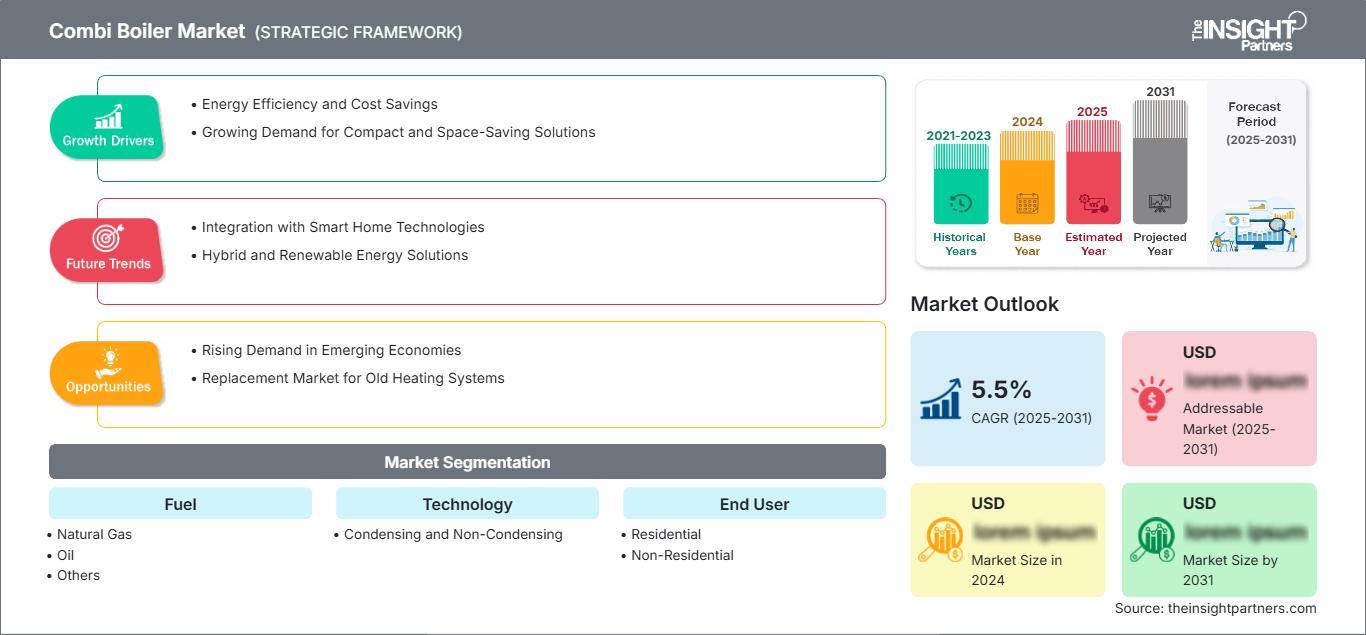
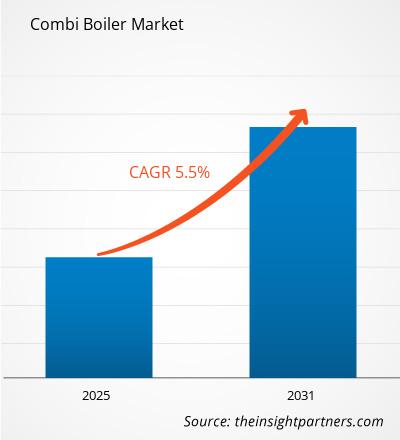
The Combi Boiler Market stood at US$ 20.16 Billion in 2025 and is forecasted to grow to US$ 25.88 Billion by 2034, exhibiting a CAGR of 2.81% between 2026 and 2034. The scope of this market includes compact boilers that are capable of providing central heating along with on-demand domestic hot water in both residential and non-residential properties.
In North America, the need for replacing old gas boilers and hydronics along with small housing units makes it a replacement market, with a growth rate of 2.4–3.0% CAGR between 2026 and 2034.
Combi Boiler Market Assessment and Insights
- North America: The region holds 20–24% share in 2025 and grows at a CAGR range of 2.4–3.0% during 2026–2034, led by replacement demand, condensing upgrades, and compact residential applications.
- US: The country represents 74–78% of North America in 2025 and grows at a CAGR range of 2.5–3.1% during 2026–2034, supported by retrofit heating and installer networks.
- Europe: The region accounts for 38–42% share in 2025 and grows at a CAGR range of 2.0–2.6% during 2026–2034, with the UK, Germany, France, Italy, and Spain leading adoption.
- Asia Pacific: The region holds 25–29% share in 2025 and grows at a CAGR range of 3.4–4.0% during 2026–2034, led by China, Japan, South Korea, India, and Australia.
- Largest Segment: Natural Gas holds 68–72% market share in 2025 and grows at a CAGR range of 2.3–2.9% during 2026–2034 due to established gas networks.
- High Growth Segment: Condensing holds 58–62% market share in 2025 and grows at a CAGR range of 3.1–3.7% during 2026–2034 as efficiency rules tighten.
- Key companies analyzed in detail: Daikin Industries, Ltd.; Groupe Atlantic; HTP Comfort Solutions LLC; Navien, Inc.; Rheem Manufacturing Company; Rinnai America Corporation; Robert Bosch LLC; Vaillant Group; Viessmann Climate Solutions SE; Weil-McLain.
Source: The Insight Partners' analysis based on proprietary research, government publications, company annual reports, investor presentations, industry databases, and expert interviews.
From compact heating to condensing, digital control and easy installation, Combi boilers have evolved. The growth in the Combi Boiler Market is driven by the need to reduce fuel consumption, smaller mechanical rooms, and provision of domestic hot water integration. Current production trends are characterized by stainless steel heat exchangers, low-NOx burners, modulation control, easy service access, and fewer platforms that help manufacturers with components' cost while assisting the installers.
The future demand will be influenced by retrofit schedules, housing density, and policy concerns for energy efficiency of buildings. According to IEA, buildings consume about 30% of world's total energy, and space and water heating make up a significant portion in developed countries. Growth in the future will be most evident in regions where there is existing gas infrastructure, construction of apartments, and installer training.
Combi Boiler Market Report Scope
| Report Attribute | Details |
|---|---|
| Market size in 2025 | US$ 20.16 Billion |
| Market Size by 2034 | US$ 25.88 Billion |
| Global CAGR (2026 - 2034) | 2.81% |
| Historical Data | 2021-2024 |
| Forecast period | 2026-2034 |
Combi Boiler Market Analysis
Demand is driven by households and small-scale commercial premises where the heating units need to be space-saving, fuel-efficient, and provide instant access to hot water. The growth prospects of the Combi Boiler Market rely on the demand for boiler replacement in developed countries, small urban dwellings, and consumers’ desire to have tankless domestic water heaters.
The market consists of companies supplying burners, heat exchangers, pumps and valves, electronics, installation, distribution, utilities, and building contractors. The supply factors include metal pricing, supply of control boards, gas certification, and after-sales. Demand-side considerations involve season energy efficiency, modulation ratio, water flow rate, size, warranty period, noise, emission performance, and service network.
Combi Boiler Market report indicates competition amongst the international heating organizations and regional experts. Organizations like Daikin Industries, Ltd., Vaillant Group, Viessmann Climate Solutions SE, Robert Bosch LLC, and Groupe Atlantic compete in terms of product offering and installation programs, whereas Navien, Inc., Rinnai America Corporation, Rheem Manufacturing Company, HTP Comfort Solutions LLC, and Weil-McLain compete in terms of efficiency of hydronic and water heating systems.
Areas of investments comprise condensing technologies, connectivity for diagnostics, hydrogen-ready design approaches, reduced emission combustion technology, and easy-to-commission products. The strategy of positioning is different for different regions as Europe concentrates on compliance with renovations and installer support, North America focuses on combi and tankless crossovers' benefits, and Asia Pacific appreciates small-sized products.
● REPORT CUSTOMIZATION
Tailor This Report To Align With Your Specific Business Requirements
This report can be customized to align precisely with your business objectives, scope, and target markets. Customization options include tailored segmentation, geography, competitive analysis, and strategic insights to support informed decision-making.
Customize This Report →WHAT YOU CAN ADJUST
- ● Segmentations
- ● Geography
- ● Competitive Analysis
- ● Language Preferences
Combi Boiler Market: Strategic Insights
Regional Insights
North America Combi Boiler Market
North America holds 20–24% share in 2025 and is projected to grow at a CAGR range of 2.4–3.0% during 2026–2034. Combi Boiler Market share is supported by residential replacement, multifamily construction, hydronic heating upgrades, and interest in combined space-heating and hot-water systems.
The demand is helped by the concentration of housing in urban areas, the experience of contractors with efficient gas burners and rebates for replacement equipment. The U.S. and Canadian consumers compare fuel utilization efficiency per year, water-flow capabilities, venting capabilities, and warranty coverage. The non-residential sector is found in small offices, clinics, hotels, and service buildings that require small-mechanical room solutions.
U.S. Combi Boiler Market
The U.S. represents 74–78% of North America in 2025 and is expected to grow at a CAGR range of 2.5–3.1% during 2026–2034. Rinnai America Corporation, Navien, Inc., Rheem Manufacturing Company, HTP Comfort Solutions LLC, Robert Bosch LLC, and Weil-McLain maintain channel presence through distributors, contractors, and hydronic specialists.
Trends in applications include townhouses, apartments, replacement boilers, small commercial buildings, and those that require individual storage tanks to be unreasonable. Consumers are attracted by wall-mounted condensing systems with dependable hot water generation capability, outdoor reset capability, and flexible ventilation and diagnostic services. The regional preference is more common in cold-state regions with hydronic heating history.
Europe Combi Boiler Market
The Europe region represents the 38 to 42% market share in 2025 with a CAGR between 2.0 to 2.6%. The United Kingdom represents one of the leading countries as the wall hung combi boilers have been entrenched into the housing stock, installer practices, and domestic hot water requirements.
Germany uses efficiency upgrades to create demand, whereas the contribution from replacement quantities is made by France, Italy, and Spain owing to apartments, single-family dwellings, and light commercial buildings. Some of the companies taking advantage of this situation include the Vaillant Group, Viessmann Climate Solutions SE, Robert Bosch LLC, Groupe Atlantic, and Daikin Industries, Ltd.
APAC Combi Boiler Market
Asia Pacific accounts for 25–29% market share in 2025 and will register growth in the range of 3.4–4.0% CAGR over 2026–2034. China drives via apartment construction, gas network development, and heating needs. Japan and South Korea participate owing to controls and efficient water-heating practices.
India and Australia will be responsible for select demand from housing, hospitality, and premium residential markets. The Combi Boiler Market thrives when government policies supporting energy-efficient buildings work hand in hand with gas availability and installation professionals. Localized products that are corrosion-resistant, small-footprint, and repairable electronics should fare better than generic products.
Middle East & Africa Combi Boiler Market
MEA and Africa are expected to have CAGR growth rates ranging from 2.6-3.2% in 2026-2034. Saudi Arabia has the leading selective demand for hotels, employee housing, and multi-use facilities, whereas UAE adopts compact hot water and heating systems in luxury residential and serviced accommodation.
Rest of South Africa and Rest of MEA have less significance but still important for regions that focus on gas supply, refurbishment of buildings, and water heating requirements. Factors like corrosion resistance, service, certification, and robustness due to varying quality of water are important in procurement process.
Segmentation Analysis
Fuel
Fuel is projected to grow at a CAGR range of 2.2–2.8% during 2026–2034. The Combi Boiler Market scope by fuel is shaped by gas grid coverage, oil replacement cycles, and decarbonization policies. Natural gas remains the dominant fuel in mature heating markets, while oil demand persists in off-grid homes and rural non-residential sites where alternatives remain limited.
- Natural Gas: Natural gas dominates demand where pipelines are established, offering familiar installation, competitive running costs, and compatibility with condensing designs for homes and light commercial buildings.
- Oil: Oil-fired models serve rural and off-grid buildings where gas access is limited, but replacement demand is constrained by fuel-price volatility, emissions concerns, and policy pressure.
Technology
Technology is expected to grow at a CAGR range of 2.7–3.3% during 2026–2034. Condensing technology is gaining because it extracts more heat from flue gases, lowers fuel consumption, and aligns with efficiency standards. Non-condensing units remain present in cost-sensitive replacements, but regulatory direction and operating economics favor condensing platforms.
- Condensing: Condensing systems lead upgrades because high seasonal efficiency, lower emissions, and compatibility with advanced controls support building-code compliance and lifecycle cost savings.
- Non-Condensing: Non-condensing systems remain in legacy replacement settings where installation cost, venting constraints, or limited renovation budgets outweigh efficiency gains.
End User
End User is forecast to grow at a CAGR range of 2.5–3.1% during 2026–2034. Residential users represent the largest demand base because combi boilers suit apartments, townhouses, and compact homes requiring heating and hot water from one unit. Non-residential adoption is concentrated in small commercial, hospitality, education, and healthcare buildings needing space-efficient hydronic systems.
- Residential: Residential demand is driven by boiler replacement, apartment living, limited plant-room space, and homeowner preference for instant domestic hot water without separate storage cylinders.
- Non-Residential: Non-residential users adopt compact systems in small offices, clinics, hotels, schools, and service facilities where installation flexibility and reliable hot-water output matter.
Opportunity Snapshot
| End User | Revenue Contribution | Trend Tag | Adoption Stage |
| Residential | High | Compact Heat | Mature |
| Non-Residential | Medium | Service Rooms | Scaling |
Combi Boiler Market Growth Drivers and Impact Analysis
Replacement of Aging Heating Systems
Replacement demand is the most stable source due to the growing number of boilers already in use in Europe and North America that have reached limits with respect to efficiency, dependability, and parts availability. The combi boiler can replace the existing systems for heating and water, requiring less mechanical room space. The practical significance of this trend is best shown in the case of apartments, terraced houses, and townhouses where there is less mechanical room space available.
Efficiency Regulation Favors Condensing Platforms
Energy building policy is directing consumers towards increased season efficiency and reduced emissions. Condensing combi boilers make use of exhaust gas to capture additional heat, thus requiring less fuel usage than the earlier non-condensing ones. The IEA has observed that around 70% of energy used in space and water heating in the developed world is by residences. Such a policy driver will benefit heat exchangers, burner modulation, efficient controls, and performance documentation, while limiting demand for inefficient replacement products.
Urban Housing Supports Compact Integrated Systems
Heat solutions for urban flats and small homes should save on space and provide effective hot water production. Combi boilers fulfill this requirement by not using separate cylinders and tanks, and thus make the task easier for developers, landlords, and householders. The demand for combi boilers is fueled by the renovation of multi-family buildings, improvement of rental housing and utility room planning. Manufacturers benefit from having silent wall-hung boilers which are easy to install and compatible with standard controls.
Combi Boiler Market Future Trends
Connected Diagnostics Become Standard
Combi Boiler Market trends will increasingly include remote diagnostics, fault alerts, and app-based commissioning as installers seek faster service visits and fewer repeat calls. Connected controls can monitor burner operation, water temperature, pressure, and maintenance needs, giving contractors better information before arriving onsite. The next phase will link boilers with smart thermostats, utility demand programs, and homeowner energy dashboards. Suppliers that make connectivity simple and secure can improve loyalty without adding excessive installation complexity.
Hybrid-Ready Heating Architectures Expand
Future product strategies will increasingly position combi boilers within hybrid systems that can work with heat pumps, solar thermal units, or advanced controls. This approach allows building owners to reduce emissions while retaining dependable peak-load heating and domestic hot-water performance. Hybrid-ready designs will be especially relevant in colder climates, older homes, and buildings where full electrification is costly. Manufacturers that provide compatible controls, clear system diagrams, and installer training can protect relevance during gradual heating transitions.
Combi Boiler Market Opportunities
Installer-Led Retrofit Packages
Combi Boiler Market Forecasts support investment in installer-led retrofit packages that bundle equipment, controls, venting accessories, commissioning support, and warranty registration. Many homeowners rely on contractors to select heating systems, so manufacturers can influence demand through training, loyalty programs, sizing software, and rapid parts availability. The opportunity is strongest in mature replacement markets where speed, reliability, and financing matter. Clear packages reduce installer risk and help distributors maintain inventory discipline across common output ratings.
Compact Solutions for Light Commercial Buildings
Light commercial buildings create an actionable opportunity because clinics, shops, small offices, schools, and hospitality properties often need reliable heating and hot water without large plant rooms. Manufacturers can target this segment with cascade-capable units, service-friendly components, robust warranties, and documentation for consultants. Distributors benefit from standardized kits that simplify replacement and expansion. The strongest value proposition combines lower space use, predictable hot-water delivery, and easier maintenance compared with separate boiler and cylinder arrangements.
Recent Developments
- September 2024: Sunamp partnered with tepeo to deliver a complete low-carbon heat battery solution for residential heating and hot water applications. The collaboration combines tepeo’s ZEB heat battery boiler, which provides space heating by storing electricity as heat during lower-cost and greener periods, with Sunamp’s Thermino heat batteries that use phase change material technology for compact hot water storage. The combined system is designed as a combi-boiler replacement for homes that lack space for traditional hot water cylinders, enabling a simpler installation process, reduced carbon emissions, and an efficient pathway for homeowners transitioning away from fossil fuel heating systems.
- April 2026: Babcock Power Services (BPS), Riley Power Inc. (RPI), and IHI Corporation signed a strategic collaboration agreement to accelerate low-carbon fuel conversion and co-firing retrofits for power plant boilers worldwide, with a focus on ammonia-based fuel conversion solutions. The partnership combines BPS and RPI’s extensive boiler retrofit expertise, including more than 17 GW of completed fuel conversion projects, with IHI’s advanced ammonia combustion technologies and demonstration experience. The collaboration aims to help power producers reduce carbon emissions while extending the operational life of existing assets through scalable conversion solutions that maintain reliability, efficiency, and compliance with emissions requirements.
- July 2025: Rheem launched the FT Series Super High-Efficiency Condensing Boiler, expanding its boiler portfolio with advanced condensing technology designed for residential and commercial heating applications. The new series delivers up to 95% AFUE efficiency and includes features such as a full-color touchscreen display, four-zone control capability, compact design, and enhanced safety features to simplify installation, operation, and maintenance. Equipped with an ultra-low NOx burner, the FT Series can reduce greenhouse gas NOx emissions by up to 75% compared with minimum efficiency boilers and up to 65% compared with standard residential tanks. The launch supports Rheem’s sustainability strategy by providing energy-efficient hydronic heating solutions and reducing environmental impact while maintaining reliable performance.
Frequently Asked Questions

- Comprehensive Market Sizing and Forecast Analysis
- Detailed Segmentation Analysis
- In-Depth Market Dynamics Assessment
- Regional and Country-Level Insights
- Competitive Landscape and Company Benchmarking
- Strategic Business Intelligence
Recent Reports
Testimonials

The Insight Partners' SCADA System Market report is comprehensive, with valuable insights on current trends and future forecasts. The team was highly professional, responsive, and supportive throughout. We are very satisfied and highly recommend their services.
RAN KEDEM Partner, Reali Technologies LTDs
I requested a report on a very specific software market and the team produced the report in a few days. The information was very relevant and well presented. I then requested some changes and additions to the report. The team was again very responsive and I got the final report in less than a week.
JEAN-HERVE JENN Chairman, Future Analytica
We worked with The Insight Partners for an important market study and forecast. They gave us clear insights into opportunities and risks, which helped shape our plans. Their research was easy to use and based on solid data. It helped us make smart, confident decisions. We highly recommend them.
PIYUSH NAGPAL Sr. Vice President, High Beam Global
The Insight Partners delivered insightful, well-structured market research with strong domain expertise. Their team was professional and responsive throughout. The user-friendly website made accessing industry reports seamless. We highly recommend them for reliable, high-quality research services
YUKIHIKO ADACHI CEO, Deep Blue, LLC.
This is the first time I have purchased a market report from The Insight Partners.While I was unsure at first, I visited their web site and felt more comfortable to take the risk and purchase a market report.I am completely satisfied with the quality of the report and customer service. I had several questions and comments with the initial report, but after a couple of dialogs over email with their analyst I believe I have a report that I can use as input to our strategic planning process.Thank you so much for taking the extra time and making this a positive experience.I will definitely recommend your service to others and you will be my first call when we need further market data.
JOHN SUZUKI President and Chief Executive Officer, Board Director, BK Technologies
I wish to appreciate your support and the professionalism you displayed in the course of attending to my request for information regarding to infectious disease IVD market in Nigeria. I appreciate your patience, your guidance, and the fact that you were willing to offer a discount, which eventually made it possible for us to close a deal. I look forward to engaging The Insight Partners in the future, all thanks to the impression you have created in me as a result of this first encounter.
DR CHIJIOKE ONYIA MANAGING DIRECTOR, PineCrest Healthcare Ltd.Reason to Buy
- Informed Decision-Making
- Understanding Market Dynamics
- Competitive Analysis
- Identifying Emerging Markets
- Customer Insights
- Market Forecasts
- Risk Mitigation
- Boosting Operational Efficiency
- Strategic Planning
- Investment Justification
- Tracking Industry Innovations
- Aligning with Regulatory Trends





 Get Free Sample for