
Combiner Projected Head-Up Display Market Size, Trends & Demand by 2034
Coverage: By Type (2D, 3D); Application (Premium Cars, Mid Segment Car, Civil Cars) , and Geography (North America, Europe, Asia Pacific, and South and Central America)
- Status : Data Released
- Report Code : TIPRE00022603
- Category : Electronics and Semiconductor
- No. of Pages : 150
- Available Report Formats :


- Last update date : July 27, 2026


2025 Market Size
US$ 1.38 Bn
Base year value
2034 Forecast
US$ 3.55 Bn
Projected by 2034
CAGR 2026-2034
12.54 %
Growth rate
Addressable Market
US$ 23.48 Bn
(2026-2034)
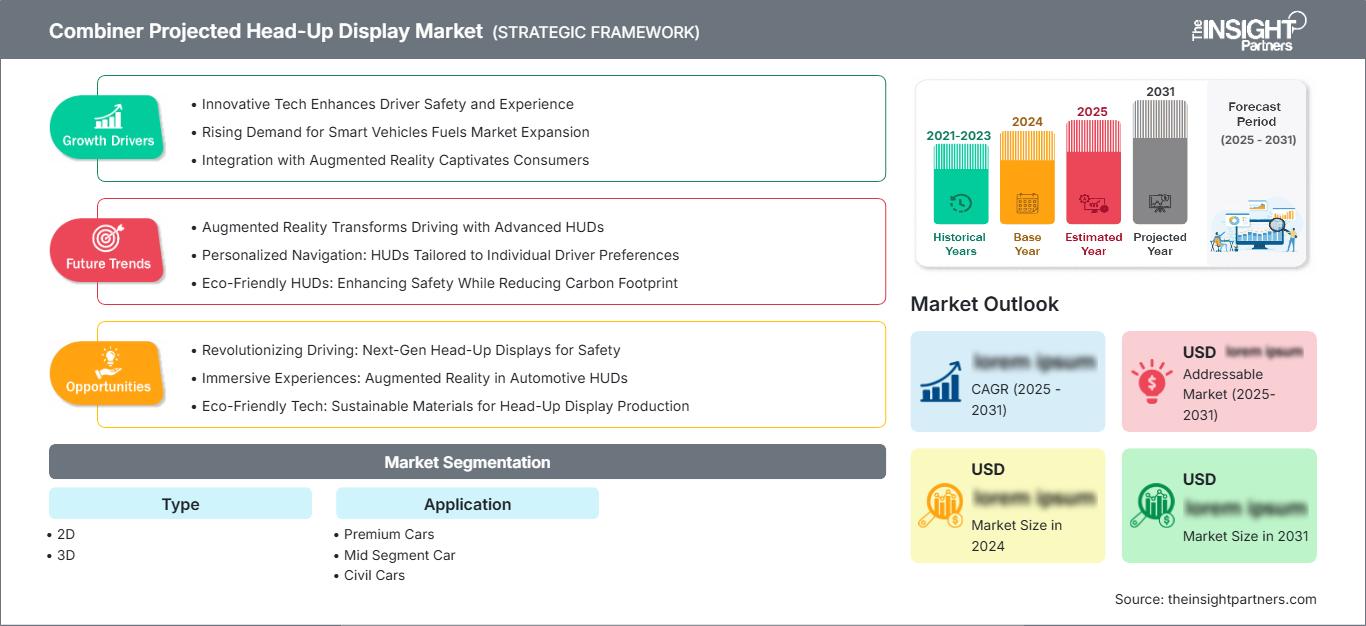
The Combiner Projected Head-Up Display Market is valued at US$ 1.38 Billion in 2025 and is expected to achieve US$ 3.55 Billion by 2034, reflecting a CAGR of 12.54% in 2026-2034. The increasing prevalence of small driver information display screens, the growing use of more driver assistance features, and the need for cost-effective optical projector solutions by auto-OEMs drive market growth.
North America continues to be an important market segment due to the positive impact of the premium car population, software-defined cockpits initiatives, and regulations to minimize driver distractions in the Combiner Projected Head-Up Display Market size. This region is expected to exhibit CAGR of 10.8-11.6% during 2026-2034, backed by U.S. and Canadian demands for ADAS display contents, electric cars launch, and engineering capabilities of suppliers.
Combiner Projected Head-Up Display Market Assessment and Insights
- North America held a 31–34% share in 2025 and is expected to grow at a CAGR of 10.8–11.6% between 2026–2034, driven by premium SUVs, EV cockpit upgrades, and ADAS visualization.
- US represented 76–80% of North America in 2025 and is projected to grow at a CAGR of 10.6–11.3% during 2026–2034, supported by software-defined vehicle programs.
- Europe accounted for 27–30% share in 2025 and is forecast to grow at a CAGR of 11.0–11.8% through 2034, with Germany, the UK, France, Italy, and Spain leading adoption.
- Asia Pacific captured a 30–33% share in 2025 and is anticipated to grow at a CAGR of 14.0–14.8% during 2026–2034, led by China, Japan, South Korea, and India.
- Largest Segment 2D held a 67–71% market share in 2025 and is expected to grow at a CAGR of 10.7–11.5%, reflecting cost-effective integration in premium and mid-segment cars.
- High Growth Segment 3D held a 29–33% of the Combiner Projected Head-Up Display Market share in 2025 and is forecast to grow at a CAGR of 15.4–16.2%, driven by depth perception and AR-ready display architectures.
- Key companies analyzed in detail: Nippon Seiki Co., Ltd., Continental AG, DENSO Corporation, Visteon Corporation, Robert Bosch GmbH, Panasonic Holdings Corporation, BAE Systems plc, STMicroelectronics N.V., Elbit Systems Ltd., Yazaki Corporation, Mitsubishi Electric Corporation, and Valeo SE.
Source: The Insight Partners' analysis based on proprietary research, government publications, company annual reports, investor presentations, industry databases, and expert interviews.
The usage of Combiner HUDs has progressed from aftermarket devices to customized cockpit modules to aid in navigation, speed display, ADAS alerts, and energy consumption alerts. Factors such as the need for shorter package cycles of instrument panels have created trends of production towards smaller optical engines, brighter displays, molded combiners, and electronics. Therefore, the Combiner Projected Head-Up Display Market is evolving into a market of human-machine interface systems, which are compatible with digital cockpit solutions.
The demand in the future will be driven by factors such as electric cars, connected navigation systems, visibility requirements for elderly drivers, and safety concerns in certain regions. Certain emerging regions are opting for more feature-packed cockpits rather than using windshield projection, leaving space for Combiner HUDs. The investments will be done in optics miniaturization, calibration software development, local manufacturing, and OEM collaborations.
Combiner Projected Head-Up Display Market Report Scope
| Report Attribute | Details |
|---|---|
| Market size in 2025 | US$ 1.38 Billion |
| Market Size by 2034 | US$ 3.55 Billion |
| Global CAGR (2026 - 2034) | 12.54% |
| Historical Data | 2021-2024 |
| Forecast period | 2026-2034 |
Combiner Projected Head-Up Display Market Analysis
The market is growing due to the necessity to provide speed, navigation, lane guidance, and warning information in proximity to the driver’s forward vision without the expenses of bigger HUD systems and its dependence on the windscreen. Highest demand comes from premium and mid-segment vehicles featuring ADAS bundles, digital instrument clusters, and connected navigation as either standard or available option.
The supply chain encompasses optical components manufacturers, display panel providers, semiconductor companies, cockpit information systems integrators, first-tier module manufacturers, and vehicle OEMs. Glare management, temperature resistance, vibration stability, and software calibration across different vehicle platforms are the advantages for suppliers. Discussions regarding the UN ECE Safety Regulations and Euro NCAP Driver Assistance Systems Rating stimulate the development of cockpit information systems with decreased off-road glance time.
According to Combiner Projected Head-Up Display Market report, the competitive environment will be dominated by suppliers having expertise in optics, display electronics, and automotive software. Competitors include Nippon Seiki Co., Ltd., Continental AG, DENSO Corporation, Visteon Corporation, Robert Bosch GmbH, Panasonic Holdings Corporation, Yazaki Corporation, Mitsubishi Electric Corporation, and Valeo SE who will compete on package, brightness, reliability, and OEM program win.
In addition, strategic positioning will be affected by military and avionics display technology from BAE Systems plc and Elbit Systems Ltd. and semiconductors for sensing, control and display processing from STMicroelectronics N.V.. Investors’ interests in head-up displays will focus on 3D visualization, manufacturing in Asia and cockpit integration through software that will allow car manufacturers to utilize optical platform across trims.
● REPORT CUSTOMIZATION
Tailor This Report To Align With Your Specific Business Requirements
This report can be customized to align precisely with your business objectives, scope, and target markets. Customization options include tailored segmentation, geography, competitive analysis, and strategic insights to support informed decision-making.
Customize This Report →WHAT YOU CAN ADJUST
- ● Segmentations
- ● Geography
- ● Competitive Analysis
- ● Language Preferences
Combiner Projected Head-Up Display Market: Strategic Insights
Regional Insights
North America Combiner Projected Head-Up Display Market
The North American market segment of the market had a share of 31-34% in 2025, and is forecast to expand at a CAGR of 10.8-11.6% from 2025 through 2034. The technology is popularized in premium SUV, pickup trim, electric, and performance vehicles due to cockpit differentiation.
Key factors that drive the development of the technology are the availability of ADAS option packs, consumers' demands for digital cockpits, and fleet demand for safety-related visual cues. Combiner HUD is utilized in cases when car makers require a lower cost for their systems compared to windshield HUDs, yet have higher perceived value than cluster-based displays.
U.S. Combiner Projected Head-Up Display Market
Market share held by the U.S. was between 76%-80% in 2025 and is forecasted to witness growth at a rate of 10.6–11.3% CAGR during the period 2026-2034. There are a few companies present that include Visteon Corporation, Robert Bosch GmbH, Continental AG, Panasonic Holdings Corporation, and STMicroelectronics N.V. to offer support for cockpit electronics, display control, and automotive grade semiconductors. The applications of premium cars and EVs continue to dominate.
There is an evolving trend from just speed projection into navigation guidance, driver assistance, battery range information, and contextual alerting. The U.S. consumers prefer minimal distractions, visibility even during daytime, cybersecurity-enabled software interface, and serviceability. The mid-segment cars are becoming increasingly important since combiner solutions will enable unique cockpit features without the increased BOM costs of windshield projection.
Europe Combiner Projected Head-Up Display Market
Europe has a 27–30% share in 2025 and is expected to expand at a CAGR of 11.0–11.8% during 2025-2034. Germany is the market leader owing to the presence of high-end OEMs, electronics manufacturers, and vehicle safety engineering. The demand in the UK will be driven by luxury vehicles and technology validation whereas France by the electrification initiative and compact vehicle cockpit upgrade.
The demand from Italy and Spain will be contributed by mid-segment vehicle manufacturing, localization of suppliers, and export-based vehicle platforms. European adoption is based on the need to focus on driver distraction policies, Euro NCAP focus on assistance systems and consumer readiness to pay for digital cockpits. Some of the key companies in Europe which help in the supply chain are Continental AG, Robert Bosch GmbH, Valeo SE, and STMicroelectronics N.V.
APAC Combiner Projected Head-Up Display Market
The Asia Pacific region captured 30–33% market share in 2025 and is anticipated to register the highest growth rate with a CAGR of 14.0–14.8%. The lead in this region comes from China by means of NEVs introduction, cockpit suppliers, and quick democratization of cockpit features. Japan and South Korea are making contributions through Nippon Seiki Co., Ltd., DENSO Corporation, Panasonic Holdings Corporation, and innovative displays manufacturing.
India and Australia generate demand from premium imported vehicles, safety feature upgrade, and interest in the connected cockpits. Drivers of the development in this region are incentives for EVs, electronics manufacturing, and road safety initiatives. APAC cockpit suppliers also develop 3D projection, miniaturized optical engine, and cost-efficient combiners for mid-segment cars.
Middle East & Africa Combiner Projected Head-Up Display Market
The Middle East & Africa region will see growth at a CAGR of 9.8% - 10.6% from 2023 to 2034, driven mainly by the UAE and Saudi Arabia. Factors that drive the market include the import of premium cars, fleet refreshment programs, and high-end SUVs. Contributions from South Africa come from dealership upgrades, replacement sales, and premium passenger vehicles.
It is important to consider the energy and infrastructure environment since high temperatures and long distances make high brightness displays even more valuable. The rest of MEA's market is developing through the luxury car channel and connectivity offerings. The suppliers should deal with sun readability, dust tolerance, aftersales capabilities, and compatibility with imported vehicles.
Segmentation Analysis
Type
Type is projected to grow at a CAGR of 12.0–12.8% during 2026–2034. The Combiner Projected Head-Up Display Market scope by type is shaped by the transition from conventional 2D projection to depth-enabled 3D visualization. Automakers continue to use 2D systems for cost and reliability, while 3D systems gain relevance where ADAS, navigation, and AR-ready content require spatial interpretation.
- 2D: This sub-segment dominates current installations because it offers clear speed, navigation, and warning projection with manageable cost, proven optics, and easier integration across premium and mid-segment vehicle dashboards.
- 3D: This sub-segment is strategically important as automakers explore depth cues, AR-style guidance, and improved warning perception, especially in electric vehicles and advanced cockpit programs.
Application
Application is forecast to grow at a CAGR of 12.2–13.0% during 2026–2034. Premium cars remain the early adoption base because buyers value cockpit differentiation and safety features. Mid Segment Car adoption is rising as suppliers reduce optics cost, while Civil Cars create future volume potential when basic HUD functions become part of broader digital cockpit packages.
- Premium Cars: This sub-segment leads adoption because high-trim sedans, SUVs, and EVs use combiner HUDs to enhance perceived technology, reduce driver glance time, and support ADAS packages.
- Mid Segment Car: Demand is scaling as OEMs seek visible cockpit upgrades at controlled cost, making combiner projection attractive for upper trims and regional models with connected navigation.
- Civil Cars: This sub-segment provides long-term volume potential as basic speed, warning, and navigation projection migrates into everyday passenger cars through standardized display electronics and modular dashboards.
Opportunity Snapshot
| Application | Revenue Contribution | Trend Tag | Adoption Stage |
| Premium Cars | High | Digital Cockpit | Mature |
| Mid Segment Car | Medium | Cost Scaling | Scaling |
| Civil Cars | Low | Basic Safety | Emerging |
Combiner Projected Head-Up Display Market Growth Drivers and Impact Analysis
ADAS Content Needs Safer Driver Visualization
ADAS functions are expanding from warning lamps to lane guidance, adaptive cruise alerts, speed-limit recognition, and hazard cues that must be interpreted quickly. Combiner HUDs improve visual access by moving selected information closer to the road scene, reducing reliance on instrument-cluster glances. The impact on the Combiner Projected Head-Up Display Market is direct because more vehicles now require a display layer capable of presenting safety-relevant content without major windshield redesign. Suppliers that combine optical clarity, low latency, and software calibration can support OEMs seeking measurable driver-information improvements while controlling vehicle-platform cost.
Digital Cockpit Differentiation Moves Beyond Luxury Cars
Automakers are using interior electronics to differentiate vehicles as powertrains become more standardized, especially in electric and hybrid platforms. Combiner projection offers visible technology value without requiring full panoramic displays or complex windshield coatings. This driver expands addressable demand from premium cars into upper mid-segment trims where buyers expect connected navigation, ADAS alerts, and personalization. Market impact appears through larger sourcing programs for compact optical modules, display controllers, and cockpit software. Suppliers with modular designs can win multi-vehicle contracts because OEMs can scale the same architecture across regions and trims.
Cost Advantage Supports Mid-Segment Vehicle Fitment
Windshield HUDs can require larger optical paths, windshield-specific calibration, and higher integration expense. Combiner projected systems use a dedicated transparent screen, giving OEMs more flexibility in dashboard packaging and aftermarket service planning. This cost advantage is important as mid-segment cars adopt advanced displays under tight bill-of-material targets. The impact is stronger in Asia Pacific and North America, where feature competition is intense and automakers need scalable cockpit upgrades. Vendors that reduce module thickness, improve brightness, and simplify assembly can convert optional features into higher-volume standard-fit programs.
Combiner Projected Head-Up Display Market Future Trends
3D Depth Cues for Contextual Driving Guidance
Combiner Projected Head-Up Display Market trends are moving toward depth-enabled content that helps drivers interpret navigation, distance, and warnings more intuitively. Future systems will use 3D projection, eye-position adjustment, and software rendering to place alerts with stronger spatial meaning. The shift will not make every combiner system fully augmented reality, but it will raise expectations for depth, contrast, and latency. Suppliers able to validate optical performance across driver heights, lighting conditions, and windshield angles will gain advantage as OEMs demand immersive displays without full windshield HUD cost.
Software-Defined HUD Calibration
Calibration will become more software-defined as OEMs seek to reuse combiner HUD modules across several models and regional variants. Future platforms will adjust image position, brightness, content priority, and warning logic through software rather than bespoke optical redesigns. This direction supports faster vehicle launches, easier over-the-air refinements, and lower engineering effort per model. Semiconductor suppliers and cockpit software teams will therefore become more influential in HUD value chains. The trend also increases the importance of cybersecurity, functional safety documentation, and long-term software maintenance.
Combiner Projected Head-Up Display Market Opportunities
Mid-Segment Platform Standardization
Combiner Projected Head-Up Display Market Forecasts point to a clear opportunity in standardized modules for mid-segment cars. Suppliers can create value by offering compact optics, display controllers, and software templates that OEMs can configure across trims and regions. This approach reduces engineering cost and shortens launch timelines while giving automakers a visible cockpit upgrade. Investment should focus on modular packaging, local assembly partnerships, and validation libraries covering glare, vibration, temperature, and driver ergonomics. Companies that lower total integration cost can expand beyond premium launches into higher-volume passenger platforms.
EV Cockpit Content and Energy Guidance
Electric vehicles create an opportunity for combiner HUDs because drivers need range, charging, regenerative braking, navigation, and ADAS information delivered with minimal distraction. OEMs can use HUD content to explain energy behavior and build confidence during long trips. Suppliers should align optical hardware with battery-management data, route planning, and connected services. The opportunity is strongest in China, North America, and Europe, where EV launches are dense and cockpit differentiation influences buyer perception. Integration with digital clusters and central displays will determine supplier stickiness.
Recent Developments
- September 2025: Visteon Corporation partnered with FUTURUS to co-develop next-generation AR HUD, windshield HUD, and panoramic HUD systems for global automakers. The collaboration combines Visteon’s cockpit electronics portfolio with FUTURUS optical innovation to project real-time driving data and ADAS alerts into the driver’s line of sight.
- September 2025: AUMOVIO SE announced a compact mirrorless AR head-up display with Epitone for IAA Mobility, replacing conventional mirrors with a 3D display and reducing required installation space by up to 50%. The system uses software-assisted image optimization to support scalable vehicle integration.
- April 2025: Nippon Seiki Co., Ltd. presented wide field-of-view TFT head-up display technology at Automotive Engineering Exposition 2025 Yokohama. The exhibit emphasized enlarged projection areas for AR-style displays, optical precision, and advanced manufacturing capability needed to reduce distortion and improve driver visibility.
Frequently Asked Questions

- Comprehensive Market Sizing and Forecast Analysis
- Detailed Segmentation Analysis
- In-Depth Market Dynamics Assessment
- Regional and Country-Level Insights
- Competitive Landscape and Company Benchmarking
- Strategic Business Intelligence
Recent Reports
Testimonials

The Insight Partners' SCADA System Market report is comprehensive, with valuable insights on current trends and future forecasts. The team was highly professional, responsive, and supportive throughout. We are very satisfied and highly recommend their services.
RAN KEDEM Partner, Reali Technologies LTDs
I requested a report on a very specific software market and the team produced the report in a few days. The information was very relevant and well presented. I then requested some changes and additions to the report. The team was again very responsive and I got the final report in less than a week.
JEAN-HERVE JENN Chairman, Future Analytica
We worked with The Insight Partners for an important market study and forecast. They gave us clear insights into opportunities and risks, which helped shape our plans. Their research was easy to use and based on solid data. It helped us make smart, confident decisions. We highly recommend them.
PIYUSH NAGPAL Sr. Vice President, High Beam Global
The Insight Partners delivered insightful, well-structured market research with strong domain expertise. Their team was professional and responsive throughout. The user-friendly website made accessing industry reports seamless. We highly recommend them for reliable, high-quality research services
YUKIHIKO ADACHI CEO, Deep Blue, LLC.
This is the first time I have purchased a market report from The Insight Partners.While I was unsure at first, I visited their web site and felt more comfortable to take the risk and purchase a market report.I am completely satisfied with the quality of the report and customer service. I had several questions and comments with the initial report, but after a couple of dialogs over email with their analyst I believe I have a report that I can use as input to our strategic planning process.Thank you so much for taking the extra time and making this a positive experience.I will definitely recommend your service to others and you will be my first call when we need further market data.
JOHN SUZUKI President and Chief Executive Officer, Board Director, BK Technologies
I wish to appreciate your support and the professionalism you displayed in the course of attending to my request for information regarding to infectious disease IVD market in Nigeria. I appreciate your patience, your guidance, and the fact that you were willing to offer a discount, which eventually made it possible for us to close a deal. I look forward to engaging The Insight Partners in the future, all thanks to the impression you have created in me as a result of this first encounter.
DR CHIJIOKE ONYIA MANAGING DIRECTOR, PineCrest Healthcare Ltd.Reason to Buy
- Informed Decision-Making
- Understanding Market Dynamics
- Competitive Analysis
- Identifying Emerging Markets
- Customer Insights
- Market Forecasts
- Risk Mitigation
- Boosting Operational Efficiency
- Strategic Planning
- Investment Justification
- Tracking Industry Innovations
- Aligning with Regulatory Trends





 Get Free Sample for