
Commercial Air Conditioning System (VRF) Market Size, Trends & Demand by 2034
Coverage: By Type (Heat Recovery System, Heat Pump System); Component (Outdoor Unit, Indoor Unit, Control System); Application (Commercial, Residential, Industrial) , and Geography (North America, Europe, Asia Pacific, and South and Central America)
- Status : Data Released
- Report Code : TIPRE00022925
- Category : Electronics and Semiconductor
- No. of Pages : 150
- Available Report Formats :


- Last update date : July 21, 2026


2025 Market Size
US$ 15.15 Bn
Base year value
2034 Forecast
US$ 29.34 Bn
Projected by 2034
CAGR 2026-2034
8.61 %
Growth rate
Addressable Market
US$ 210.78 Bn
(2026-2034)
The Commercial Air Conditioning System market size was valued at US$ 15.15 Billion in 2025 and is projected to reach US$ 29.34 Billion by 2034, registering a CAGR of 8.61% during 2026–2034. Demand will be driven by increasing construction of commercial buildings, updating of inefficient cooling systems, stricter refrigerants regulation, and growing adoption of heat recovery, heat pumps, intelligent controls, and modular outdoor units within offices, retail centers, hotels, hospitals, apartment blocks, and industrial properties.
The North America Commercial Air Conditioning System market is anticipated to grow at a CAGR of 7.9%-8.7% during 2026-2034 due to commercial retrofits, electrification drives, and cost savings needs in dense structures. Aging roof-top air-conditioners, intelligent building automation, and state efficiency standards are speeding up the replacement process, whereas heat pumps adoption is making a compelling case for climate control throughout the year.
Commercial Air Conditioning System (VRF) Market Assessment and Insights
- North America held 29–33% of the Commercial Air Conditioning System market share in 2025 and is growing at a CAGR of 7.9–8.7% during 2026–2034, led by retrofit demand, electrification policy, and smart controls.
- US represented 78–82% of North American revenue in 2025 and is growing at a CAGR of 8.0–8.8% during 2026–2034, supported by commercial replacements.
- Europe accounted for 22–26% share in 2025 and is growing at a CAGR of 7.2–8.0% during 2026–2034, with Germany, the UK, France, Italy, and Spain leading adoption.
- Asia Pacific held 35–39% share in 2025 and is growing at a CAGR of 9.1–10.0% during 2026–2034, led by China, Japan, South Korea, India, and Australia.
- Largest Segment Outdoor Unit held 42–46% market share in 2025 and is growing at a CAGR of 8.2–9.0% during 2026–2034 as replacement cycles accelerate.
- High Growth Segment Heat Pump System represented 36–40% market share in 2025 and is growing at a CAGR of 9.4–10.3% during 2026–2034, supported by electrification.
- Key companies analyzed in detail: Daikin Industries, Ltd.; Toshiba Carrier Corporation; Mitsubishi Electric Corporation; Midea Group Co., Ltd.; Johnson Controls International plc; LG Electronics Inc.; Fujitsu General Limited; Lennox International Inc.; Panasonic Holdings Corporation; Samsung Electronics Co., Ltd.
Source: The Insight Partners' analysis based on proprietary research, government publications, company annual reports, investor presentations, industry databases, and expert interviews.
The development in commercial cooling has shifted from traditional comfort systems to climate solutions that incorporate heat recovery, inverter-based technology, variable refrigerant flow, heat pumps, and cloud-based monitoring. The commercial air conditioning system market is driven by the increasing cooling requirements, stringent indoor air quality requirements, and reduction of energy consumption in offices, healthcare facilities, hotels, retail shops, logistics infrastructure, and multi-use buildings. Dynamics in production have been changing towards modular outdoor systems, low GWP refrigerants, and pre-installed controls.
Future demand will depend on rapid growth in urban square footage, commercial electrification, more stringent building performance standards, and retrofit programs for the aging HVAC infrastructure. Emerging regions in Asia-Pacific and the Middle East will contribute in terms of volume from hospitality, healthcare, retail, and industrial infrastructures, while mature regions will concentrate on efficiency, refrigerants, and connected maintenance. Investments are likely to go to suppliers offering efficient products, digital capabilities, and installation network.
Commercial Air Conditioning System (VRF) Market Report Scope
| Report Attribute | Details |
|---|---|
| Market size in 2025 | US$ 15.15 Billion |
| Market Size by 2034 | US$ 29.34 Billion |
| Global CAGR (2026 - 2034) | 8.61% |
| Historical Data | 2021-2024 |
| Forecast period | 2026-2034 |
Commercial Air Conditioning System (VRF) Market Analysis
The Commercial Air Conditioning System Market is expanding based on the demands of building owners who need a system that will provide efficient cooling, reduced electricity consumption, and compliance with regulation requirements. Value chain components include compressor makers, heat exchanger producers, electronics providers, control system makers, OEMs, distributors, installation providers, service providers, and facility managers. High demand is observed wherever cooling can impact occupancy, equipment operation, product quality, or energy budget.
In terms of supply side trends, inverter compressors, refrigerant supply, prices of copper and aluminum raw materials, and sensor integration capabilities with Building Management Systems are key issues. According to International Energy Agency, buildings consume about 30% of the world’s energy and efficient cooling in them is a critical factor of operations. Commercial customers are paying more attention to lifecycle savings and maintenance rather than purchasing cost.
The Commercial Air Conditioning System Market Report shows that there is a competitive environment that is dominated by businesses with diverse product ranges, advanced compressors, digital controls, service reach, and compliance. Daikin Industries, Ltd., Mitsubishi Electric Corporation, Midea Group Co., Ltd., Johnson Controls International plc, LG Electronics Inc., and Samsung Electronics Co., Ltd. are competitors in the industry, which uses high-performance systems suitable for office buildings, retail spaces, hospitality facilities, hospitals, and mixed-use premises.
In addition, Toshiba Carrier Corporation, Fujitsu General Limited, Lennox International Inc., and Panasonic Holdings Corporation add power to the industry through regional channel penetration, HVAC knowledge application, and connected controls. Investment trends include investment in heating pump capacity, low global warming potential (GWP) refrigerants, predictive maintenance, and integrated controls. The strategy for these firms relies on the service monetization opportunity, installer training, and decarbonization goals support.
● REPORT CUSTOMIZATION
Tailor This Report To Align With Your Specific Business Requirements
This report can be customized to align precisely with your business objectives, scope, and target markets. Customization options include tailored segmentation, geography, competitive analysis, and strategic insights to support informed decision-making.
Customize This Report →WHAT YOU CAN ADJUST
- ● Segmentations
- ● Geography
- ● Competitive Analysis
- ● Language Preferences
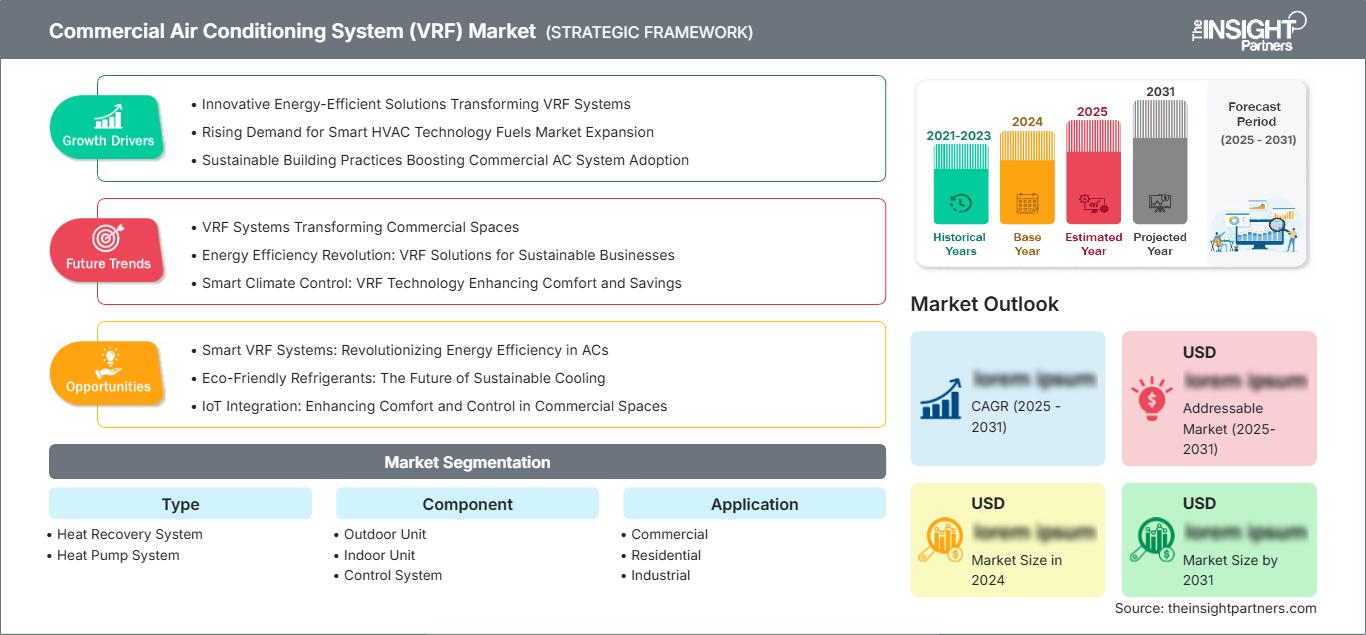
Commercial Air Conditioning System (VRF) Market: Strategic Insights
Regional Insights
North America Commercial Air Conditioning System Market
North America accounted for 29–33% of Commercial Air Conditioning System market share in 2025 and is projected to expand at a CAGR of 7.9–8.7% during 2026–2034. Demand drivers include retrofits in the commercial space, warehouse expansion, building automation with robust data management, heat pump rebates, and higher cooling needs in the health care, retail, hospitality, educational, and office sectors.
The importance of replacement comes from the fact that there are many buildings that have older generation roof top, split, and packaged units with poor diagnostics and low efficiencies at part load conditions. End users look for integrated control systems, refrigerant ready units, and low total cost of ownership.
U.S. Commercial Air Conditioning System Market
The U.S. represented 78–82% of North American revenue in 2025 and is expected to grow at a CAGR of 8.0–8.8% during 2026–2034. Application needs are focused on office spaces, hotels, healthcare complexes, retail networks, logistics centers, educational institutions, multi-family housing, and light industrial properties with the need for durable cooling and improved management of energy costs.
Companies such as Daikin Industries, Ltd., Johnson Controls International plc, Lennox International Inc., Mitsubishi Electric Corporation, LG Electronics Inc., and Samsung Electronics Co., Ltd. have strong distribution channels in the United States through their commercial products and services. More and more buyers ask for heat-pump features, variable-speed performance, dashboards, and refrigerant compliance due to sustainability reporting and tenants' retention.
Europe Commercial Air Conditioning System Market
Europe held 22–26% share in 2025 and is projected to grow at a CAGR of 7.2–8.0% during 2026–2034. The Germany market is driven by cooling requirements in industrial buildings, office buildings, hotel buildings, and public assets. Retrofit in the UK benefits from improvements made to commercial properties along with energy-performance analysis.
France, Italy, and Spain benefit from milder summers, HVAC needs of tourism-related projects, and de-carbonization initiatives that reward energy-efficient heat pumps. In Europe, buyers look for seasonal efficiency, refrigerant compatibility, quiet operation, and system compatibility with building management systems. There is strong replacement demand due to the savings on operational expenses, which may justify higher equipment costs.
APAC Commercial Air Conditioning System Market
Asia Pacific accounted for 35–39% share in 2025 and is forecast to grow at a CAGR of 9.1–10.0% during 2026–2034. China’s lead comes from construction size, local production, and demand from retail, office, health care, data center, and industrial facilities.
Japan and South Korea provide leadership in terms of efficiency and systems integration, whereas India and Australia gain strength from urban development and growth in commercial floor space, focusing on energy-efficient cooling solutions. Suppliers have an advantage in terms of production concentration, yet fierce competition persists due to buyer preferences for life-cycle cost, service, and intelligence.
Middle East & Africa Commercial Air Conditioning System Market
The Middle East & Africa market is projected to grow at a CAGR of 7.0–7.8% during 2026–2034. Saudi Arabia dominates the category as the cooling requirement is constant at all the commercial zones, hospitality centers, healthcare, and industrial areas due to the extreme temperatures prevailing.
In the case of the UAE, there is a need for higher efficiency for premium customers such as hotels, airports, malls, and commercial centers, while in South Africa and RoMEA, the need is more on the modernization of retail centers, mining-based facilities, and urban services.
Segmentation Analysis
Type
Type is projected to grow at a CAGR of 8.5–9.3% during 2026–2034. The Commercial Air Conditioning System Market scope covers heat recovery and heat pump architectures that serve cooling, heating, ventilation coordination, and energy reuse needs. Heat recovery systems are favored in dense commercial buildings with simultaneous heating and cooling loads, while heat pump systems gain momentum where electrification and fossil-fuel reduction are strategic priorities.
- Heat Recovery System supports buildings with diversified zones, allowing recovered thermal energy to serve areas needing heating while other zones require cooling, improving operating efficiency and tenant comfort.
- Heat Pump System is strategically important for electrification programs because it provides reversible heating and cooling, reduces dependence on combustion equipment, and aligns with commercial decarbonization plans.
Component
Component is forecast to grow at a CAGR of 8.3–9.1% during 2026–2034. Outdoor units command the largest equipment value because compressors, coils, fans, inverters, and refrigerant circuits determine system capacity and efficiency. Indoor units influence comfort and zone control, while control systems are becoming more valuable as remote diagnostics, occupancy analytics, and predictive maintenance become standard in commercial operations.
- Outdoor Unit leads demand because capacity, compressor technology, refrigerant management, and weather resilience are concentrated in this equipment layer, making it central to replacement decisions.
- Indoor Unit supports occupant comfort and zone flexibility across offices, hotels, healthcare rooms, retail units, and apartments where noise, airflow, and aesthetics influence selection.
- Control System is gaining strategic importance as owners connect equipment to building management platforms, monitor energy use, schedule maintenance, and optimize performance across multiple sites.
Application
Application is expected to grow at a CAGR of 8.6–9.4% during 2026–2034. Commercial buildings remain the primary demand base because cooling reliability affects customer experience, worker productivity, asset value, and operating expenditure. Residential complexes are adopting larger coordinated systems for shared amenities and high-rise projects, while industrial facilities use air conditioning for process stability, worker safety, and equipment protection.
- Commercial dominates demand through offices, hotels, hospitals, malls, schools, and logistics properties where uptime, comfort, energy management, and service contracts shape purchasing decisions.
- Residential reflects high-rise apartments, premium housing, and shared amenities using coordinated systems that offer better zoning, quieter operation, and improved maintenance oversight.
- Industrial represents factories, clean areas, warehouses, laboratories, and process facilities where temperature control protects workers, machinery, materials, and production quality.
Opportunity Snapshot
| Application | Revenue Contribution | Trend Tag | Adoption Stage |
| Commercial | High | Smart Retrofit | Mature |
| Residential | Medium | High-Rise | Scaling |
| Industrial | Medium | Process Cooling | Scaling |
Commercial Air Conditioning System (VRF) Market Growth Drivers and Impact Analysis
Efficiency regulations accelerate replacement cycles
Commercial property owners face rising pressure to lower energy intensity, document performance, and replace aging cooling equipment before operating costs become unmanageable. The International Energy Agency reported that commercial and public buildings account for roughly 30% of building energy demand, making HVAC upgrades a major efficiency lever. This driver increases demand for inverter compressors, efficient heat exchangers, smart controls, and refrigerant-ready platforms. Market impact is visible in larger retrofit pipelines, multi-site procurement programs, and preference for systems that can prove lifecycle savings through metering and diagnostics.
Electrification increases heat pump adoption
Building decarbonization plans are encouraging commercial owners to reduce reliance on combustion-based heating and adopt reversible heat pump systems that provide cooling and heating from one platform. This shift expands the addressable market beyond seasonal cooling because equipment can support year-round comfort and emissions reduction goals. The impact is strongest in offices, hotels, schools, healthcare buildings, and multifamily assets where owners want fewer mechanical systems, lower maintenance complexity, and better control. Suppliers with scalable heat pump portfolios can capture larger projects as electrification becomes part of capital planning.
Connected controls improve service economics
Digital controls are changing how commercial air conditioning is specified, operated, and serviced. Sensors, cloud dashboards, fault detection, and automated scheduling help facility teams reduce energy waste, prevent downtime, and manage equipment across multiple sites. This driver is important because service labor is constrained and building owners need clearer evidence of performance after installation. OEMs and contractors can create recurring revenue through monitoring, maintenance contracts, and optimization services. The market impact is a shift from equipment-only competition toward integrated hardware, software, and service relationships.
Commercial Air Conditioning System (VRF) Market Future Trends
AI-enabled HVAC optimization becomes standard
Commercial Air Conditioning System Market trends point toward wider use of AI-enabled controls that adjust cooling output based on occupancy, weather forecasts, tariffs, and equipment condition. Future platforms will move beyond scheduled operation toward predictive optimization across zones and sites. This trend will reduce unnecessary runtime, improve fault detection, and help owners validate sustainability targets. Suppliers that combine equipment data, control logic, and service analytics will be better positioned than vendors selling isolated units. Adoption should accelerate as property portfolios demand measurable energy savings and standardized reporting across buildings.
Low-GWP refrigerant platforms reshape product design
Product development will increasingly revolve around refrigerants with lower global warming potential, requiring redesign of compressors, heat exchangers, safety systems, and service practices. This trend affects equipment certification, installer training, spare parts, and lifecycle risk management. Commercial buyers will ask suppliers to clarify refrigerant availability, maintenance procedures, and long-term compliance before committing capital. Manufacturers that complete platform transitions early can reduce channel uncertainty and protect margins. The shift also creates an opportunity for controls that monitor leakage, pressure, and operating conditions more precisely.
Commercial Air Conditioning System (VRF) Market Opportunities
Retrofit programs for multi-site commercial portfolios
Commercial Air Conditioning System Market Forecasts support investment in packaged retrofit programs for retail chains, hotels, healthcare groups, schools, and office portfolios with aging equipment. Vendors can combine audits, financing support, standardized equipment bundles, controls, installation planning, and service agreements to reduce complexity for owners. This opportunity is attractive because multi-site buyers value predictable savings, consistent maintenance, and limited disruption. Contractors and OEMs that quantify energy reductions and offer staged deployment can capture repeat business. Retrofit programs also create data streams that support ongoing optimization and future equipment replacement planning.
High-efficiency cooling for mixed-use urban projects
Mixed-use developments create opportunities for systems that manage diverse cooling and heating loads across retail, residential, office, hospitality, and amenity spaces. Heat recovery and advanced zoning can improve energy efficiency when different areas operate at different schedules and load profiles. Developers need compact outdoor units, quiet indoor units, flexible controls, and reliable service partners. Suppliers can differentiate by supporting early design, commissioning, and long-term monitoring. This opportunity is strongest in dense cities where floor area is expensive, energy rules are stricter, and tenants expect stable comfort.
Recent Developments
- July 2026: Mitsubishi Electric Corporation (TOKYO: 6503) announced that its wholly owned subsidiary Mitsubishi Electric Hydronics & IT Cooling Systems S.p.A. acquired all shares of the APAC group and the COMPAC group including their operating companies involved in HVAC sales, installation and maintenance on July 13. Both groups were headquartered in Utrecht Province in the Netherlands.
- March 2026: LG Electronics (LG) will debut compressor solutions tailored for the Indian market at ACREX 2026 – a leading heating, ventilation and air conditioning (HVAC) and building automation exhibition in South Asia – taking place from March 12-14 at the Bombay Exhibition Centre in Mumbai. Developed in response to India’s growing air-conditioning demand and rising energy-efficiency standards, the new lineup is designed for residential and commercial applications and reflects LG’s continued focus on localized product development and manufacturing.
- February 2026: Daikin Industries, Ltd. has announced the launch of two new air conditioning products in Japan to address growing demands for energy efficiency and operational reliability in large commercial spaces and high-humidity environments. The “Multi Jet” air conditioning unit for large spaces will be released in mid-April 2026, while the “FIVE STAR ZEAS” model for offices and retail stores will be available from April 1, 2026.
Frequently Asked Questions

- Comprehensive Market Sizing and Forecast Analysis
- Detailed Segmentation Analysis
- In-Depth Market Dynamics Assessment
- Regional and Country-Level Insights
- Competitive Landscape and Company Benchmarking
- Strategic Business Intelligence
Recent Reports
Testimonials

The Insight Partners' SCADA System Market report is comprehensive, with valuable insights on current trends and future forecasts. The team was highly professional, responsive, and supportive throughout. We are very satisfied and highly recommend their services.
RAN KEDEM Partner, Reali Technologies LTDs
I requested a report on a very specific software market and the team produced the report in a few days. The information was very relevant and well presented. I then requested some changes and additions to the report. The team was again very responsive and I got the final report in less than a week.
JEAN-HERVE JENN Chairman, Future Analytica
We worked with The Insight Partners for an important market study and forecast. They gave us clear insights into opportunities and risks, which helped shape our plans. Their research was easy to use and based on solid data. It helped us make smart, confident decisions. We highly recommend them.
PIYUSH NAGPAL Sr. Vice President, High Beam Global
The Insight Partners delivered insightful, well-structured market research with strong domain expertise. Their team was professional and responsive throughout. The user-friendly website made accessing industry reports seamless. We highly recommend them for reliable, high-quality research services
YUKIHIKO ADACHI CEO, Deep Blue, LLC.
This is the first time I have purchased a market report from The Insight Partners.While I was unsure at first, I visited their web site and felt more comfortable to take the risk and purchase a market report.I am completely satisfied with the quality of the report and customer service. I had several questions and comments with the initial report, but after a couple of dialogs over email with their analyst I believe I have a report that I can use as input to our strategic planning process.Thank you so much for taking the extra time and making this a positive experience.I will definitely recommend your service to others and you will be my first call when we need further market data.
JOHN SUZUKI President and Chief Executive Officer, Board Director, BK Technologies
I wish to appreciate your support and the professionalism you displayed in the course of attending to my request for information regarding to infectious disease IVD market in Nigeria. I appreciate your patience, your guidance, and the fact that you were willing to offer a discount, which eventually made it possible for us to close a deal. I look forward to engaging The Insight Partners in the future, all thanks to the impression you have created in me as a result of this first encounter.
DR CHIJIOKE ONYIA MANAGING DIRECTOR, PineCrest Healthcare Ltd.Reason to Buy
- Informed Decision-Making
- Understanding Market Dynamics
- Competitive Analysis
- Identifying Emerging Markets
- Customer Insights
- Market Forecasts
- Risk Mitigation
- Boosting Operational Efficiency
- Strategic Planning
- Investment Justification
- Tracking Industry Innovations
- Aligning with Regulatory Trends





 Get Free Sample for