
Common Mode Filters Market Demand, Size & Forecast by 2034
Coverage: By Type (Split Winding, Bifilar Winding); Application (Tablet, Desktop, Notebooks, Printer, Others) , and Geography (North America, Europe, Asia Pacific, and South and Central America)
- Status : Data Released
- Report Code : TIPRE00017126
- Category : Electronics and Semiconductor
- No. of Pages : 150
- Available Report Formats :


- Last update date : August 05, 2026


2025 Market Size
US$ 1.27 Bn
Base year value
2034 Forecast
US$ 2.56 Bn
Projected by 2034
CAGR 2026-2034
8.09 %
Growth rate
Addressable Market
US$ 17.21 Bn
(2026-2034)
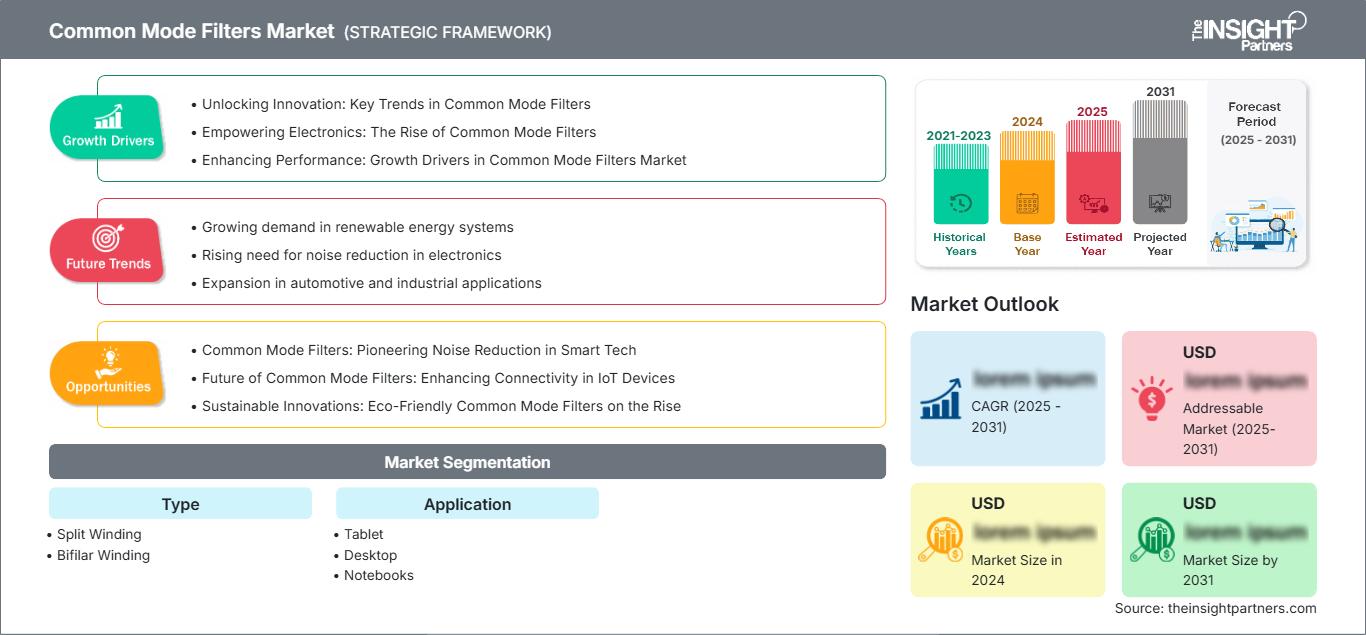
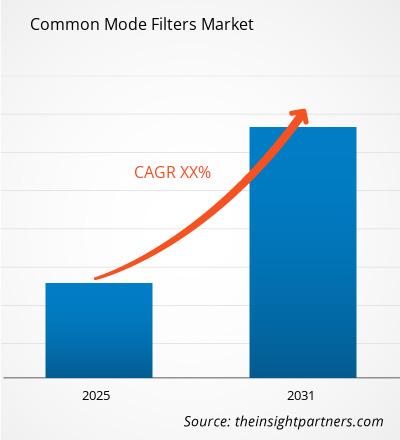
The Common Mode Filters Market size was estimated at US$ 1.27 Billion in 2025, with a forecast of reaching US$ 2.56 Billion by 2034, exhibiting a CAGR of 8.09% from 2026–2034. The Common mode filters eliminate electromagnetic interference along the signal and power lines of tablets, computers, laptops, and printers, thus helping maintain connectivity performance, compliance, and the compactness of the circuit boards as switch frequencies increase in electronic devices.
North America’s demand is estimated to grow at a CAGR of 7.2-7.8%, supported by device replacement cycles, enterprise computing system upgrades, and increasing emphasis on EMC testing. The Common Mode Filters Market in the region will be driven by high notebook market penetration, fleets of printers in managed work environments, and engineers specifying low profile components for USB, display, power adapter, and motherboard interference control.
Common Mode Filters Market Assessment and Insights
- North America: The region holds 26–29% Common Mode Filters Market share in 2025 and grows at a CAGR range of 7.2–7.8% during 2026–2034, supported by notebook upgrades, EMC compliance, and enterprise peripherals.
- US: The country represents 78–82% of North America in 2025 and grows at a CAGR range of 7.1–7.7% during 2026–2034, led by computing OEMs and device validation labs.
- Europe: The region accounts for 20–23% share in 2025 and grows at a CAGR range of 6.6–7.2% during 2026–2034, with Germany, the UK, France, Italy, and Spain leading adoption.
- Asia Pacific: The region holds 43–46% share in 2025 and grows at a CAGR range of 8.9–9.6% during 2026–2034, led by China, Japan, South Korea, Taiwan, and India.
- Largest Segment: Bifilar Winding holds 56–60% market share in 2025 and grows at a CAGR range of 7.7–8.3% during 2026–2034 through compact high-speed line filtering.
- High Growth Segment: Split Winding holds 40–44% market share in 2025 and grows at a CAGR range of 8.6–9.2% during 2026–2034 as power integrity requirements rise.
- Key companies analyzed in detail: Frontier Electronics Corporation; NXP Semiconductors N.V.; onsemi; Panasonic Holdings Corporation; Samsung Electro-Mechanics Co., Ltd.; STMicroelectronics N.V.; Texas Instruments Incorporated; TDK Corporation; Murata Manufacturing Co., Ltd.; Coilcraft, Inc.; Würth Elektronik eiSos GmbH & Co. KG; Vishay Intertechnology, Inc.
Source: The Insight Partners' analysis based on proprietary research, government publications, company annual reports, investor presentations, industry databases, and expert interviews.
The trend in product development is leading the role of common mode filters from generalized EMI suppression to application-oriented signal integrity. In high speed interfaces, thinner printed circuit boards and denser power blocks call for impedance management, reduced loss characteristics and better heat transfer properties. Meanwhile, component makers are working on optimizing ferrite cores, winding patterns and packaging footprints, while electronic assembly facilities qualify parts early in board design to preclude costly redesign later.
Future requirements will be driven by mass production in Asia of electronic assemblies, corporate computing in North America and EMC practice in Europe. Capital is being spent on surface mount miniaturization, integrated ESD protection and automotive-grade techniques, which will find their way into computing products. Conducted and radiated emissions regulation will make filter selection integral to new tablets, personal computers, notebooks and printers.
Common Mode Filters Market Report Scope
| Report Attribute | Details |
|---|---|
| Market size in 2025 | US$ 1.27 Billion |
| Market Size by 2034 | US$ 2.56 Billion |
| Global CAGR (2026 - 2034) | 8.09% |
| Historical Data | 2021-2024 |
| Forecast period | 2026-2034 |
Common Mode Filters Market Analysis
Common Mode Filter Market The market is growing due to increased EMI pollution caused by faster processors, smaller power supplies, wireless parts, and fast connectors. Manufacturers require parts that can protect their devices from common mode interference while preserving differential signals. The chain includes ferrite powder suppliers, suppliers of windings and multi-layer components, semiconductor interfaces suppliers, distributors, EMS services, notebook OEMs, printer OEMs, and certification laboratories.
The supply chain structure favors the companies that produce products with wide impedance range, stable supply and qualification capabilities in multiple board types. Mouser sells thousands of different types of common mode filters and chokes by manufacturers such as Panasonic, STMicroelectronics, TDK, Murata, Coilcraft, Vishay, and Würth Elektronik, which suggests fragmented but well-qualified supplier base for electronics OEMs.
Positioning in the Common Mode Filters Market is based on packaging size reduction, application expertise, EMC knowledge and design-in relationships. Frontier Electronics Corporation, NXP Semiconductors N.V., onsemi, Panasonic Holdings Corporation, Samsung Electro-Mechanics Co., Ltd., STMicroelectronics N.V., and Texas Instruments Incorporated are important in the field of discrete filters, protection devices, and interface ecosystem solutions.
Capital flow is focused on smaller package sizes, improved attenuation at selected frequencies, and parts suitable for automated manufacturing processes. The players TDK Corporation, Murata Manufacturing Co., Ltd., Coilcraft, Inc., Würth Elektronik eiSos GmbH & Co. KG, and Vishay Intertechnology, Inc. are significant in relation to OEMs adopting filter families for tablet, notebook, desktop, and printer products.
● REPORT CUSTOMIZATION
Tailor This Report To Align With Your Specific Business Requirements
This report can be customized to align precisely with your business objectives, scope, and target markets. Customization options include tailored segmentation, geography, competitive analysis, and strategic insights to support informed decision-making.
Customize This Report →WHAT YOU CAN ADJUST
- ● Segmentations
- ● Geography
- ● Competitive Analysis
- ● Language Preferences
Common Mode Filters Market: Strategic Insights
Regional Insights
North America Common Mode Filters Market
North America has a market share of 26-29% in 2025 and is expected to experience a CAGR of 7.2-7.8% from 2026 to 2034. North America market share is driven by notebooks, desktop computers, printers, and tablets being used for enterprises, educational institutions, hospitals, and government departments. Challenges include EMC certification, use of USB-C ports, and Wi-Fi coexistence.
North America regional demand also receives a boost through device recycling schemes and engineering teams using filters in reference designs. The U.S. Consumer Technology Association stated that over US$ 500 billion was earned as consumer technology retail revenues in the United States in recent times. Distributors and suppliers with compliance knowledge are preferred in the region.
U.S. Common Mode Filters Market
The U.S. constitutes 78%-82% of North America in 2025 and experiences CAGR of 7.1%-7.7% during 2026-2034. The application is centered around enterprise notebooks, desktops, tablets, and printer systems that need FCC-compliant emissions testing. NXP Semiconductors N.V., onsemi, Texas Instruments Incorporated, and STMicroelectronics N.V. foster interface and protection design ecosystems.
Applications will be seen along the lines of USB 3.x ports, display interfaces, power delivery pathways, and motherboard connector filtering. U.S. customers will favor design availability from authorized distributors, AEC-Q compliant reliability certification wherever necessary, and simulation capabilities. Printer system upgrades and hybrid work notebook upgrades will drive the applications despite discretionary consumer electronics buying being erratic.
Europe Common Mode Filters Market
Europe has a market share ranging from 20% to 23%, growing with a compound annual growth rate of 6.6% to 7.2%. Germany is leading because of electronics engineering, industrial computing, and EMC requirements. The UK drives demand through enterprise IT, managed print services, and educational device purchases that require reliable notebook and desktop connectivity.
France, Italy, and Spain drive demand through digitization efforts in the public sector, hardware replacement in offices, and electronics manufacturing. European buyers value CE certification, component traceability, and reduced power noise in small units. Suppliers in Europe include Würth Elektronik eiSos GmbH & Co. KG, STMicroelectronics N.V., TDK Corporation, Murata Manufacturing Co., Ltd., and Vishay Intertechnology, Inc.
APAC Common Mode Filters Market
The APAC region commands a market share of 43–46% in 2025 and is forecasted to witness growth at a CAGR between 8.9–9.6% between 2026 and 2034. China leads in this market, followed by Japan, South Korea, Taiwan, India, and Australia. The electronics manufacturing scale, notebook assembly, and component localization create demand.
Semiconductor chain policy support and device exports support filter sales. Samsung Electro-Mechanics Co., Ltd., Panasonic Holdings Corporation, TDK Corporation, and Murata Manufacturing Co., Ltd. capitalize on their proximity to consumer electronics design centers. India creates demand due to increased assembly of tablets, desktops, and printers in incentive-based manufacturing programs.
Middle East & Africa Common Mode Filters Market
Middle East & Africa is projected to grow at a CAGR range of 5.8–6.4% during 2026–2034. Saudi Arabia is a leading country, supported by education technology, government digitization, and enterprise hardware imports. The UAE adds regional distribution and commercial IT demand, while South Africa supports office computing and printing.
Rest of MEA adoption remains import-led and tied to infrastructure projects, schools, and commercial device fleets. Buyers usually procure finished electronics rather than discrete components, but regional service centers and repair ecosystems influence replacement filter demand. Energy stability and reliable IT networks remain important context for electronics performance.
Segmentation Analysis
Type
Type is projected to grow at a CAGR range of 8.0–8.6% during 2026–2034. Common Mode Filters Market scope is defined by winding architecture, coupling efficiency, leakage inductance, and suitability for high-speed signal or power filtering. Selection depends on board space, target noise frequency, impedance curve, current rating, and tolerance requirements across tablets, desktops, notebooks, and printers.
- Split Winding: Split winding filters are strategically important where power paths, higher isolation, and broader attenuation profiles are required, especially in desktops, printers, and adapters with noisier switching environments.
- Bifilar Winding: Bifilar winding filters lead compact data-line designs because close coupling supports low leakage inductance, balanced impedance, and minimal differential signal distortion in tablets and notebooks.
Application
Application is expected to grow at a CAGR range of 7.9–8.5% during 2026–2034. Demand reflects different noise-control priorities across mobile and office electronics. Tablets need ultra-small filters near connectors, notebooks require high-speed interface protection, desktops need motherboard and power-path filtering, and printers depend on stable motor, data, and power communication under compact enclosure constraints.
- Tablet: Tablet demand centers on low-profile filters for USB-C, display, camera, and wireless coexistence paths, where thin form factors require compact attenuation without degrading battery or data performance.
- Desktop: Desktop systems use filters across motherboards, power supplies, and peripheral interfaces, with demand tied to gaming PCs, workstations, and office refresh cycles requiring emissions compliance.
- Notebooks: Notebooks remain strategically important because dense boards, USB-C docking, high-resolution displays, and wireless modules create multiple noise paths within constrained thermal and mechanical designs.
- Printer: Printers require filters for motors, data interfaces, power adapters, and scanner modules, especially in enterprise fleets where reliability and electromagnetic compatibility affect uptime and service cost.
Opportunity Snapshot
| Application | Revenue Contribution | Trend Tag | Adoption Stage |
| Tablet | Medium | USB-C | Scaling |
| Desktop | Medium | Power Filtering | Mature |
| Notebooks | High | Docking Ports | Mature |
| Printer | Medium | Motor Noise | Scaling |
Common Mode Filters Market Growth Drivers and Impact Analysis
Rising EMI Complexity in Compact Computing Devices
Tablets, notebooks, desktops, and printers now combine faster processors, wireless radios, high-speed serial interfaces, switching regulators, and compact connectors in smaller board areas. This creates more common-mode noise paths and raises the risk of failed emissions tests or degraded signal quality. Common mode filters address this by presenting high impedance to unwanted common-mode currents while allowing intended signals to pass. The market impact is earlier component selection during schematic and layout stages, stronger demand for impedance-characterized product families, and higher value for suppliers that provide simulation models, layout guidance, and application-specific recommendations.
EMC Compliance Becoming a Design Gate for Device Launches
Regulatory and customer requirements make electromagnetic compatibility a practical launch gate for electronics manufacturers. Devices that fail conducted or radiated emissions testing can face redesign, delayed shipments, and additional validation cost. The impact on the Common Mode Filters Market is visible in procurement behavior, as OEMs increasingly qualify filters alongside connectors, cables, and interface ICs instead of treating them as late-stage fixes. This strengthens demand for components with stable impedance curves, low insertion loss, temperature consistency, and package options suited to automated assembly in high-volume computing and printing hardware.
Expansion of USB-C, High-Speed Displays, and Printer Electronics
USB-C ports, high-resolution displays, camera modules, docking interfaces, and printer motor controls create recurring use cases for common mode filtering. High-speed links are sensitive because skew, cable radiation, and connector discontinuities can convert differential signals into common-mode noise. Printer electronics add motor switching and power supply noise that must be isolated from data paths. The commercial impact is broader filter content per device, particularly in premium notebooks and multifunction printers. Suppliers that align part recommendations with interface standards and board placement constraints can capture repeat design wins across platform generations.
Common Mode Filters Market Future Trends
Integrated Protection and Filtering for High-Speed Ports
Common Mode Filters Market trends will increasingly favor integrated devices that combine common-mode attenuation with ESD protection for compact ports. Tablets and notebooks have limited board area around USB-C, display, and camera connectors, so reducing component count improves routing and assembly efficiency. Future devices will need lower parasitic capacitance, wider bandwidth, and repeatable protection behavior. This trend benefits suppliers with semiconductor and passive component expertise, because design teams want validated performance across both signal integrity and surge protection. Adoption will be strongest in premium mobile computing, convertible notebooks, and thin enterprise tablets.
Simulation-Led Filter Selection Before Prototype Builds
Filter selection will become more simulation-led as device makers try to reduce prototype spins and lab retesting. Engineers will compare impedance curves, insertion loss, saturation behavior, and placement sensitivity before committing to board layouts. Component vendors that provide equivalent circuits, S-parameters, application notes, and distributor-linked availability can influence specifications earlier. This changes competition from catalog breadth alone toward design enablement. The trend is especially relevant for notebooks and tablets, where connector density and battery packaging leave limited room for corrective filtering after the first hardware build.
Common Mode Filters Market Opportunities
Notebook Platform Refresh and USB-C Docking Expansion
Common Mode Filters Market Forecasts point to a strong opportunity in notebook platform refreshes as enterprises standardize USB-C docking, external displays, and higher-speed peripherals. Each interface can create additional common-mode noise risks, especially when cable length and connector quality vary across workplace setups. Component suppliers should target reference designs, docking ecosystems, and motherboard qualification cycles with compact bifilar products, integrated protection options, and clear placement guidance. Winning early design-in slots can generate recurring revenue across multiple notebook models because OEMs often reuse validated filter families to control compliance risk and purchasing complexity.
Printer and Desktop Power Noise Mitigation Upgrades
Printers and desktops present an opportunity for split winding filters and higher-current components because motors, switching power supplies, fans, and peripheral cables can introduce persistent noise. Office hardware vendors need cost-effective components that reduce emissions without increasing board area or thermal load. Suppliers can pursue this opportunity by bundling filter recommendations with power supply, motor control, and data interface use cases. Repair and aftermarket channels also matter because enterprise printers and desktops often remain deployed for several years, sustaining demand for qualified replacement assemblies and compatible component families.
Recent Developments
- March 2026: Vishay Intertechnology introduced the SGCM05339 Space-Grade Surface-Mount Common Mode Choke, designed to provide EMI filtering and noise suppression for GaN and SiC switching applications in space, aerospace, and defense systems. The new device features a robust nanocrystalline core, rugged overmolded construction, operating temperatures from −55°C to +130°C, current ratings up to 14.43 A, and compliance with ASTM-E595 and multiple military screening standards for high-reliability power electronics.
- June 2025: Bourns introduced the CCF1206 Series Multilayer Common Mode Filters, featuring a monolithic construction with composite co-fired materials for enhanced reliability and compact PCB designs. Designed for high-speed differential signal transmission applications such as USB, LVDS, and MIPI interfaces, the new filters improve signal integrity, offer an impedance range of 67–120 Ω, operate from −40°C to +85°C, and support space-constrained electronic devices.
- July 2024: TDK Corporation expanded its YFF series 3-terminal feedthrough filters with new YFF21AC1H222MT0Y0N and YFF21AC1E102MT0Y0N models, designed for automotive applications requiring enhanced EMI suppression. The new AEC-Q200-qualified filters support operating temperatures up to +125°C, feature compact 0805-size packaging, and provide high-capacitance characteristics to improve noise filtering and signal integrity in automotive electronic control units (ECUs) and advanced driver-assistance systems (ADAS).
Frequently Asked Questions

- Comprehensive Market Sizing and Forecast Analysis
- Detailed Segmentation Analysis
- In-Depth Market Dynamics Assessment
- Regional and Country-Level Insights
- Competitive Landscape and Company Benchmarking
- Strategic Business Intelligence
Recent Reports
Testimonials

The Insight Partners provided valuable market intelligence that supported our global go-to-market strategy. Their team was professional, responsive, and attentive to our feedback, providing thoughtful analysis and helpful methodological clarifications throughout the project.
Junmo Kim Chief Financial Officer (CFO), Enertech Co., Ltd.
The Insight Partners' SCADA System Market report is comprehensive, with valuable insights on current trends and future forecasts. The team was highly professional, responsive, and supportive throughout. We are very satisfied and highly recommend their services.
RAN KEDEM Partner, Reali Technologies LTDs
I requested a report on a very specific software market and the team produced the report in a few days. The information was very relevant and well presented. I then requested some changes and additions to the report. The team was again very responsive and I got the final report in less than a week.
JEAN-HERVE JENN Chairman, Future Analytica
We worked with The Insight Partners for an important market study and forecast. They gave us clear insights into opportunities and risks, which helped shape our plans. Their research was easy to use and based on solid data. It helped us make smart, confident decisions. We highly recommend them.
PIYUSH NAGPAL Sr. Vice President, High Beam Global
The Insight Partners delivered insightful, well-structured market research with strong domain expertise. Their team was professional and responsive throughout. The user-friendly website made accessing industry reports seamless. We highly recommend them for reliable, high-quality research services
YUKIHIKO ADACHI CEO, Deep Blue, LLC.
This is the first time I have purchased a market report from The Insight Partners.While I was unsure at first, I visited their web site and felt more comfortable to take the risk and purchase a market report.I am completely satisfied with the quality of the report and customer service. I had several questions and comments with the initial report, but after a couple of dialogs over email with their analyst I believe I have a report that I can use as input to our strategic planning process.Thank you so much for taking the extra time and making this a positive experience.I will definitely recommend your service to others and you will be my first call when we need further market data.
JOHN SUZUKI President and Chief Executive Officer, Board Director, BK Technologies
I wish to appreciate your support and the professionalism you displayed in the course of attending to my request for information regarding to infectious disease IVD market in Nigeria. I appreciate your patience, your guidance, and the fact that you were willing to offer a discount, which eventually made it possible for us to close a deal. I look forward to engaging The Insight Partners in the future, all thanks to the impression you have created in me as a result of this first encounter.
DR CHIJIOKE ONYIA MANAGING DIRECTOR, PineCrest Healthcare Ltd.Reason to Buy
- Informed Decision-Making
- Understanding Market Dynamics
- Competitive Analysis
- Identifying Emerging Markets
- Customer Insights
- Market Forecasts
- Risk Mitigation
- Boosting Operational Efficiency
- Strategic Planning
- Investment Justification
- Tracking Industry Innovations
- Aligning with Regulatory Trends





 Get Free Sample for