
Compact Flash Market Trends, Demand & Growth by 2034
Coverage: By Type (Compact Flash I, Compact Flash II); Application (Digital Cameras, Music Players, Smartphones, Tablets and Laptops, Other), and Geography (North America, Europe, Asia Pacific, and South and Central America)
- Status : Data Released
- Report Code : TIPRE00015008
- Category : Electronics and Semiconductor
- No. of Pages : 150
- Available Report Formats :


- Last update date : July 28, 2026


2025 Market Size
US$ 1.65 Bn
Base year value
2034 Forecast
US$ 3.04 Bn
Projected by 2034
CAGR 2026-2034
7.03 %
Growth rate
Addressable Market
US$ 21.18 Bn
(2026-2034)
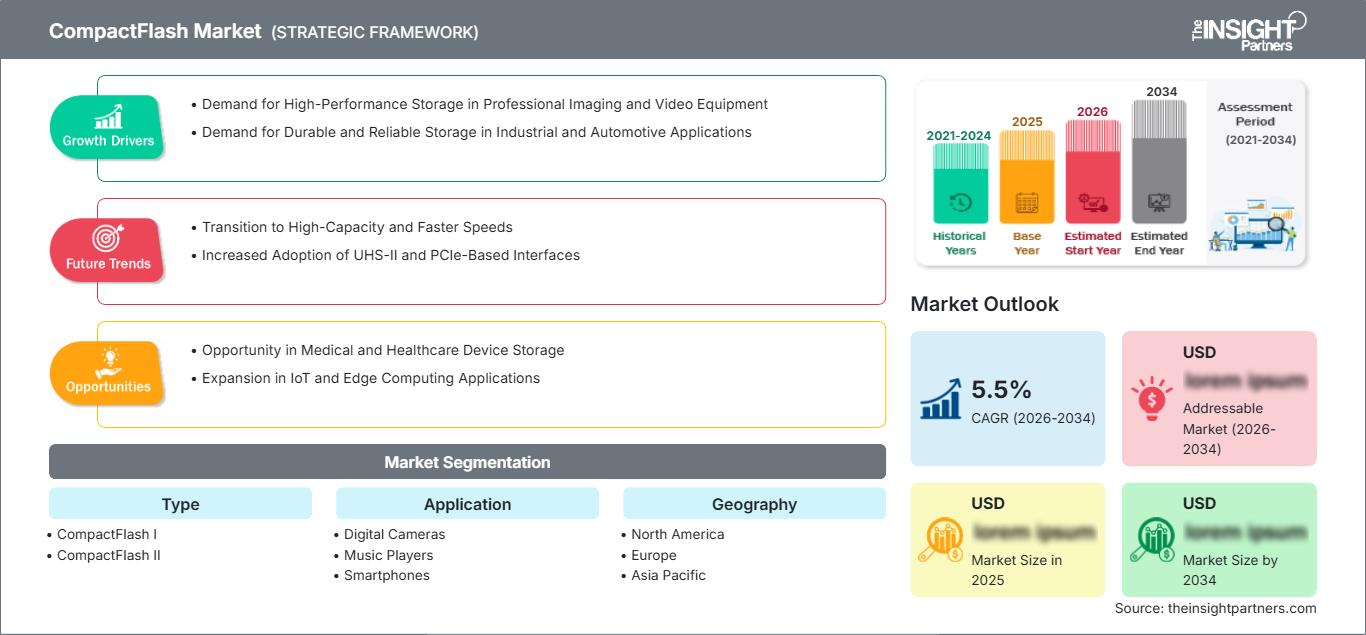
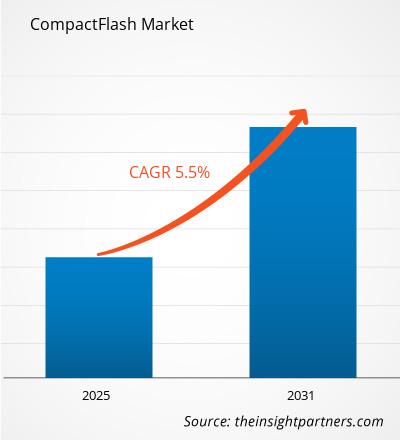
The Compact Flash Market had a value of US$ 1.65 Billion in 2025, and it is forecasted to achieve a market valuation of US$ 3.04 Billion by 2034, growing at a CAGR of 7.03% in 2026-2034. The market keeps meeting demands from professional imaging, industrial automation, embedded computing, and long-lifecycle electronics where the reliability, longevity, and stability of removable storage become key purchase considerations.
The North American region continues to be a valuable demand hub with the Compact Flash Market size being driven by industrial control upgrades, aircraft maintenance programs, and professional imaging replacement requirements. The region is forecasted to grow at a CAGR of 6.6-7.2% in 2026-2034, driven by ruggedized storage requirements, qualification cycle lengths, and the need to procure components not able to move quickly to new removable storage formats.
Compact Flash Market Assessment and Insights
- North America accounted for 31–34% share in 2025 and is projected to grow at a 6.6–7.2% CAGR between 2026–2034, supported by industrial automation, defense electronics, and professional imaging replacement cycles.
- US represented 78–82% of North America in 2025 and is expected to grow at a 6.7–7.3% CAGR between 2026–2034 through aerospace, factory control, and medical device demand.
- Europe held 24–27% share in 2025 and is forecast to expand at a 6.2–6.8% CAGR between 2026–2034, with Germany, the UK, France, Italy, and Spain leading procurement.
- Asia Pacific captured 29–32% share in 2025 and is likely to grow at a 7.4–8.1% CAGR between 2026–2034, led by China, Japan, South Korea, India, and Australia.
- Largest Segment Compact Flash I held 61–65% market share in 2025 and is expected to grow at a 6.5–7.1% CAGR between 2026–2034 due to broad legacy compatibility.
- High Growth Segment Digital Cameras recorded 33–37% market share in 2025 and is projected to grow at a 7.6–8.2% CAGR between 2026–2034 as professional workflows retain high-reliability cards.
- Key companies analyzed in detail: Greenliant Systems, Ltd.; Hyperstone GmbH; Innodisk Corporation; Kingston Technology Company, Inc.; KIOXIA Corporation; Micron Technology, Inc.; Netlist, Inc.; Samsung Electronics Co., Ltd.; Transcend Information, Inc.; Western Digital Corporation.
Source: The Insight Partners' analysis based on proprietary research, government publications, company annual reports, investor presentations, industry databases, and expert interviews.
Product development in the market is determined by the steady movement from mainstream consumer applications to industrial, embedded, and professional devices where long-term supply is an important aspect. Compact Flash I prevails due to the compatibility of this product type with currently existing host slots and firmware ecosystems, whereas Compact Flash II is used in special applications requiring thicker mechanical packages. Supply characteristics are favorable for those companies that have experience in controller manufacturing, temperature range expansion, and product lifecycle management.
The future demand will be driven not by popular consumer electronics, but rather by reliable supply of products to the aerospace industry, industrial automation, transportation, and imaging fleets. The new geographies will generate value through factory upgrades and medical device localization. Moreover, the regulatory requirements on traceability, security, and data protection support qualified memory media. In such a way, the market will remain specialized and commercially viable.
Compact Flash Market Report Scope
| Report Attribute | Details |
|---|---|
| Market size in 2025 | US$ 1.65 Billion |
| Market Size by 2034 | US$ 3.04 Billion |
| Global CAGR (2026 - 2034) | 7.03% |
| Historical Data | 2021-2024 |
| Forecast period | 2026-2034 |
Compact Flash Market Analysis
Compact Flash Market Growth will be facilitated by applications where media will have to withstand vibrations, temperature changes, power interruptions, and write cycles. Industrial automation equipment, transport terminal infrastructure, diagnostic tools, and professional cameras still use Compact Flash owing to the fact that the cost of qualifying the equipment can be higher than redesigning it to use new media types.
The value chain comprises suppliers of NAND, controller developers, card manufacturers, providers of the firmware, distributors, and OEMs. Hyperstone GmbH emphasizes continuing support of CF and PATA controllers in industrial embedded storage systems, emphasizing the importance of controllers' stability for the sustainability of market demand. Specifications of the Compact Flash Association will additionally contribute to the professional imaging, automotive, and industrial sectors.
Competitive positioning in Compact Flash Market report is based on two classes of suppliers – diversified memory companies and industrial specialists. Availability of NAND chips will be driven by Samsung Electronics Co., Ltd., KIOXIA Corporation, Micron Technology, Inc., and Western Digital Corporation. The following companies cater to lifecycle considerations: Greenliant Systems, Ltd., Innodisk Corporation, Transcend Information, Inc., Kingston Technology Company, Inc., Hyperstone GmbH, and Netlist, Inc.
Capital expenditures are centered on endurance optimization, firmware robustness, security functionality, and availability, not on capacity-driven competition among consumers. Manufacturers that can offer controlled bill-of-materials, industrial temperature rating, and lengthy manufacturing commitments are better placed to defend margins as volumes ramp up and procurement becomes application-specific.
● REPORT CUSTOMIZATION
Tailor This Report To Align With Your Specific Business Requirements
This report can be customized to align precisely with your business objectives, scope, and target markets. Customization options include tailored segmentation, geography, competitive analysis, and strategic insights to support informed decision-making.
Customize This Report →WHAT YOU CAN ADJUST
- ● Segmentations
- ● Geography
- ● Competitive Analysis
- ● Language Preferences
Compact Flash Market: Strategic Insights
Regional Insights
North America Compact Flash Market
North America generated 31%-34% of total revenues in 2025 and is forecast to expand at a CAGR of 6.6%-7.2% in the period 2026-2034. The region has already invested in industrial controllers, defense systems, avionics systems, and imaging equipment in which media replacement is easier compared to changing the hardware.
The Compact Flash market share in North America is also facilitated by systems integration within the country, high standards of reliability, and lengthy lifetimes of systems in regulated industries. The largest demand will be seen for Compact Flash I type industrial cards with firmware control and extended temperature range operation.
U.S. Compact Flash Market
The U.S. accounted for 78-82% of North America revenues in 2025 and is expected to register a growth of 6.7-7.3% CAGR over the forecast period of 2026-2034. The demand arises from the use of factory automation systems, medical imaging peripherals, aircraft maintenance, and professional content creation applications where the host system has legacy support.
The presence of key companies includes Western Digital Corporation, Micron Technology, Inc., Kingston Technology Company, Inc., and Greenliant Systems, Ltd. The application trends are towards the use of rugged removable drives, secure data transfers, and replacement media for devices likely to last several years under maintenance.
Europe Compact Flash Market
Share of Europe stands at 24-27% in 2025 and is estimated to grow at a 6.2-6.8% CAGR up to 2034, with Germany being the leading country. The United Kingdom adds through aerospace maintenance and broadcasting applications, whereas Germany drives the demand because of its applications for industrial machinery, controls, and transportation electronics needing stability in memory interfaces.
France, Italy, and Spain contribute replacement demand through applications in medical devices, energy infrastructure, and industrial inspection devices. The customers in Europe are concerned about documentation, continuity of supplies, and lifecycle, making industrial grade Compact Flash cards an important solution, although newer formats are adopted by consumer electronics.
APAC Compact Flash Market
APAC captured 29–32% market share in 2025 and is expected to have a CAGR of 7.4-8.1% from 2026 to 2034, driven by the high value generated by China in the region. Japan and South Korea facilitate demand by means of electronic production, imaging technologies, and industrial automation.
Demand for India and Australia is driven by the need for updating plants, railways, mining equipment, and use of medical devices. Policy-induced localization and digitalization of the industry stimulates purchase of durable storage components, particularly when long qualifying periods prevent replacing existing Compact Flash devices.
Middle East & Africa Compact Flash Market
The MEA is anticipated to experience a CAGR of 5.8% to 6.4% for 2026–2034. The growth would be due to the adoption in the UAE through logistics, aviation, and security infrastructure. The country of Saudi Arabia would spur demand through energy plants and industrialization projects.
South Africa and other countries of MEA would drive demand through mining, utilities, and transportation infrastructure, which have rugged storage needs in severe environments. Purchase is selective; however, there is continued demand for replacements since Compact Flash cards are embedded in durable industrial and infrastructure equipment.
Segmentation Analysis
Type
The type segment is expected to grow at a 6.7–7.3% CAGR during 2026–2034. Compact Flash Market scope remains defined by physical compatibility, host interface continuity, and endurance expectations. Buyers prioritize form factors that preserve installed equipment designs, reduce requalification cost, and maintain field-service availability for industrial, imaging, and embedded computing applications.
- Compact Flash I remains the largest type because its slimmer profile fits a wide installed base of cameras, controllers, and terminals, making it the preferred replacement medium for validated systems.
- Compact Flash II serves thicker-slot applications where mechanical depth supports specialized storage designs, legacy adapters, or equipment requiring durable removable media in constrained industrial operating environments.
Application
The application segment is projected to expand at a 7.1–7.7% CAGR during 2026–2034. Demand is strongest where removable media must combine write endurance, stable read performance, and backward compatibility. Professional imaging leads value contribution, while industrialized consumer electronics and mobile computing niches sustain replacement sales in selected geographies.
- Digital Cameras retain strategic importance in professional photography and videography workflows where rugged removable storage, fast capture, and proven card-reader compatibility reduce operational risk during field assignments.
- Music Players represent a mature replacement niche, mainly linked to legacy high-capacity portable devices, specialist audio equipment, and aftermarket buyers seeking compatible removable storage media.
- Smartphones contribute limited demand because integrated and microSD storage dominate, although selected rugged or legacy devices may still require Compact Flash-linked adapters or service parts.
- Tablets show selective usage in industrial and field-service environments, especially where peripherals, diagnostics, or rugged docks maintain compatibility with older removable storage ecosystems.
- Laptops support replacement and data-transfer demand through card readers, industrial notebooks, and legacy computing systems used in manufacturing, diagnostics, defense, and field maintenance.
Opportunity Snapshot
| Application | Revenue Contribution | Trend Tag | Adoption Stage |
| Digital Cameras | High | Pro Imaging | Mature |
| Music Players | Low | Legacy Audio | Mature |
| Smartphones | Low | Adapter Use | Emerging |
| Tablets | Medium | Rugged Field | Scaling |
| Laptops | Medium | Reader Support | Scaling |
Compact Flash Market Growth Drivers and Impact Analysis
Long-Lifecycle Industrial Equipment Retains Legacy Interfaces
Industrial systems tend to run for a period of ten to fifteen years, and therefore continuity of the interface is not an option but rather a necessity. The Compact Flash card is still installed in PLC, transport hubs, diagnostic systems, and legacy machine vision systems, where any form of requalification will have to be done through software re-validation, mechanical engineering, and field testing. As such, there is always going to be a consistent demand for Compact Flash card replacements, and companies that can offer assured control on firmware and hardware components will win.
Professional Imaging Workflows Preserve Removable Media Demand
The professional photography, broadcasting, and field production communities keep relying on camera and reader models that rely on Compact Flash slots for second bodies, archival purposes, and dedicated capture systems. While there are faster storage mediums, some companies place more emphasis on the reliability of storage medium behavior, compatibility with current setups, and the availability of readers. The necessity for a durable card that will allow for frequent formatting and transport strengthens the requirement for replacements. It drives demand for premium-level cards and sustains the channel’s relevance to established memory brands.
Rugged Storage Requirements Increase Value per Unit
There is increasing emphasis on assessing demand by means of reliability rather than the size of the shipment. The application of such technology includes requirements for storage that is capable of handling temperature extremes, vibration, power interruptions, and many writes. Suppliers of Compact Flash cards who have experience in industrial testing and sophisticated technologies including error correction, wear leveling, and power failure protection can charge a higher price than commodity card suppliers.
Compact Flash Market Future Trends
Controlled-BOM Industrial Memory Becomes a Differentiator
Compact Flash Market trends will increasingly favor controlled bill-of-materials programs that give original equipment manufacturers confidence in long-term compatibility. As NAND generations change, uncontrolled substitutions can affect timing behavior, endurance, and firmware interaction in older hosts. Suppliers that lock controllers, firmware versions, and flash configurations for qualified customers will gain strategic preference. This trend is expected to support service contracts, lifecycle notifications, and premium pricing, especially in aerospace, medical, energy, and factory automation applications where a storage component change can trigger costly system validation.
Hybrid Storage Migration Extends Replacement Cycles
Many organizations will adopt hybrid strategies that combine newer storage formats in fresh designs while maintaining Compact Flash media for installed equipment. This creates a measured transition rather than an abrupt exit. Service teams are expected to stock qualified cards, readers, and adapters to support legacy devices until equipment refreshes are economically justified. The trend benefits suppliers that can bridge old and new portfolios, offering Compact Flash alongside industrial SSDs, SD cards, and embedded storage for staged modernization programs.
Compact Flash Market Opportunities
Aftermarket Programs for Qualified Industrial Fleets
Compact Flash Market Forecasts indicate strong opportunity in structured aftermarket programs for industrial fleets that cannot migrate quickly. Suppliers can create value by offering cross-reference services, failure analysis, compatibility testing, and guaranteed replacement SKUs for controllers, terminals, and measurement systems. Distributors can bundle cards with lifecycle documentation and inventory planning to reduce unplanned downtime for end users. The opportunity is especially relevant in North America and Europe, where maintenance budgets often support validated replacement parts that extend equipment life while avoiding capital-intensive redesign projects.
Secure Rugged Media for Critical Infrastructure
Critical infrastructure operators need removable media that supports dependable logging, configuration transfer, and field diagnostics in harsh environments. Vendors can differentiate through encryption support, power-loss protection, firmware integrity controls, and extended-temperature validation. Energy, rail, aviation, and public safety applications offer attractive opportunities because procurement decisions emphasize risk reduction and system availability. Partnerships with systems integrators and maintenance providers can help memory suppliers position Compact Flash products as certified service components rather than generic storage accessories, improving margins and customer retention.
Recent Developments
- January 2026: Novachips, a global provider of professional flash storage solutions, today announced the launch of its latest CFexpress 4.0 memory cards in February 2026, which are officially VPG 800 certified by the Compact Flash Association (CFA). The new lineup is built to meet the growing needs of professional photographers and video creators who require reliable, sustained write performance for high-bitrate recording and long-duration workflows.
- July 2026: Compact Flash Association (CFA) welcomes RIEGL Laser Measurement System GmbH (Austria) and VersaLogic Corporation (USA) as new Affiliate Members. We are excited to continue innovating the newest removable storage solutions with both companies and grow CFexpress’s presence in the embedded and industrial markets.
- May 2026: Compact Flash Association (CFA) welcomes HONCHITEC, previously an Affiliate Member, as a new Executive Member. We look forward to collaborating with HONCHITEC in further strengthening CFexpress’ presence in the removable media market.
Frequently Asked Questions

- Comprehensive Market Sizing and Forecast Analysis
- Detailed Segmentation Analysis
- In-Depth Market Dynamics Assessment
- Regional and Country-Level Insights
- Competitive Landscape and Company Benchmarking
- Strategic Business Intelligence
Recent Reports
Testimonials

The Insight Partners provided valuable market intelligence that supported our global go-to-market strategy. Their team was professional, responsive, and attentive to our feedback, providing thoughtful analysis and helpful methodological clarifications throughout the project.
Junmo Kim Chief Financial Officer (CFO), Enertech Co., Ltd.
The Insight Partners' SCADA System Market report is comprehensive, with valuable insights on current trends and future forecasts. The team was highly professional, responsive, and supportive throughout. We are very satisfied and highly recommend their services.
RAN KEDEM Partner, Reali Technologies LTDs
I requested a report on a very specific software market and the team produced the report in a few days. The information was very relevant and well presented. I then requested some changes and additions to the report. The team was again very responsive and I got the final report in less than a week.
JEAN-HERVE JENN Chairman, Future Analytica
We worked with The Insight Partners for an important market study and forecast. They gave us clear insights into opportunities and risks, which helped shape our plans. Their research was easy to use and based on solid data. It helped us make smart, confident decisions. We highly recommend them.
PIYUSH NAGPAL Sr. Vice President, High Beam Global
The Insight Partners delivered insightful, well-structured market research with strong domain expertise. Their team was professional and responsive throughout. The user-friendly website made accessing industry reports seamless. We highly recommend them for reliable, high-quality research services
YUKIHIKO ADACHI CEO, Deep Blue, LLC.
This is the first time I have purchased a market report from The Insight Partners.While I was unsure at first, I visited their web site and felt more comfortable to take the risk and purchase a market report.I am completely satisfied with the quality of the report and customer service. I had several questions and comments with the initial report, but after a couple of dialogs over email with their analyst I believe I have a report that I can use as input to our strategic planning process.Thank you so much for taking the extra time and making this a positive experience.I will definitely recommend your service to others and you will be my first call when we need further market data.
JOHN SUZUKI President and Chief Executive Officer, Board Director, BK Technologies
I wish to appreciate your support and the professionalism you displayed in the course of attending to my request for information regarding to infectious disease IVD market in Nigeria. I appreciate your patience, your guidance, and the fact that you were willing to offer a discount, which eventually made it possible for us to close a deal. I look forward to engaging The Insight Partners in the future, all thanks to the impression you have created in me as a result of this first encounter.
DR CHIJIOKE ONYIA MANAGING DIRECTOR, PineCrest Healthcare Ltd.Reason to Buy
- Informed Decision-Making
- Understanding Market Dynamics
- Competitive Analysis
- Identifying Emerging Markets
- Customer Insights
- Market Forecasts
- Risk Mitigation
- Boosting Operational Efficiency
- Strategic Planning
- Investment Justification
- Tracking Industry Innovations
- Aligning with Regulatory Trends





 Get Free Sample for