
Compressed Air Treatment Equipment Market Size, Share & Growth by 2034
Coverage: by Product (Filters, Dryers, Aftercoolers, Others); End-Use (Chemical, Paper, Food and Beverage, Pharmaceutical and Healthcare, Automotive, Others) , and Geography (North America, Europe, Asia Pacific, and South and Central America)
- Status : Data Released
- Report Code : TIPRE00006751
- Category : Electronics and Semiconductor
- No. of Pages : 150
- Available Report Formats :


- Last update date : July 21, 2026


2025 Market Size
US$ 7.13 Bn
Base year value
2034 Forecast
US$ 10.56 Bn
Projected by 2034
CAGR 2026-2034
4.46 %
Growth rate
Addressable Market
US$ 80.32 Bn
(2026-2034)
Compressed Air Treatment Equipment market size was valued at US$ 7.13 Billion in 2025 and is projected to reach US$ 10.56 Billion by 2034, registering a CAGR of 4.46% during 2026–2034. The market includes filters, dryers, and after-coolers which help eliminate moisture, oil, contaminants, and any other substances from compressed air utilized in various applications such as manufacturing, regulated processes, and mission critical pneumatic systems.
North America is forecast to experience an increase in demand at a rate of 3.8%-4.4% during 2026-2034 due to upgrades and improvements in the compressed air systems by the manufacturers. The Compressed Air Treatment Equipment Market in the region has been driven by regulations related to food safety, pharmaceuticals, automotive industry automation, and energy conservation efforts.
Compressed Air Treatment Equipment Market Assessment and Insights
- North America held 24–28% of the Compressed Air Treatment Equipment market share in 2025 and is growing at a CAGR of 3.8–4.4% during 2026–2034, led by food, pharmaceutical, automotive, and chemical plant upgrades.
- US represented 76–80% of North American revenue in 2025 and is growing at a CAGR of 3.9–4.5% during 2026–2034.
- Europe accounted for 22–26% share in 2025 and is growing at a CAGR of 3.6–4.2% during 2026–2034, with Germany, France, Italy, Spain, and the UK leading adoption.
- Asia Pacific held 34–38% share in 2025 and is growing at a CAGR of 5.0–5.8% during 2026–2034, supported by China, India, Japan, South Korea, and Southeast Asia.
- Largest Segment Filters held 42–46% market share in 2025 and is growing at a CAGR of 4.1–4.7% during 2026–2034 as plants prioritize particulate and oil removal.
- High Growth Segment Pharmaceutical and Healthcare held 14–17% market share in 2025 and is growing at a CAGR of 5.2–6.0% during 2026–2034.
- Key companies analyzed in detail: C. H. Reed, Inc.; Chicago Pneumatic; Compressed Air Parts Company; Donaldson Company, Inc.; Gardner Denver, Inc.; Gem Equipments Pvt. Ltd.; Ingersoll Rand Inc.; MANN+HUMMEL International GmbH & Co. KG; Parker-Hannifin Corporation; Sanmina Corporation.
Source: The Insight Partners' analysis based on proprietary research, government publications, company annual reports, investor presentations, industry databases, and expert interviews.
The air-treatment process has transformed from being a protective measure to becoming a quality control process for industrial utilities. Formerly, concerns about protection were paramount, whereas currently considerations such as ISO 8573 air classifications, dew point stability, oil carryover, condensate control, and the cost of pressure drop are incorporated. The production process has changed as plants incorporate filters, dryers, drains, and sensors to the maintenance process and thus reducing unplanned downtime and validating the air used in regulated production processes.
Future demand will be driven by automation in industries, high hygiene standards, and energy efficiency needs in the emerging industrial belt. Demand is likely to increase in Asia Pacific and certain plants in the Middle East that have new plants producing food products, pharmaceuticals, and specialty chemicals that will require valid utility processes. Favorable regulatory environment driven by health and safety at work, product contamination and low greenhouse gas refrigerants will drive the need for replacement of dryers and filtration packages.
Compressed Air Treatment Equipment Market Report Scope
| Report Attribute | Details |
|---|---|
| Market size in 2025 | US$ 7.13 Billion |
| Market Size by 2034 | US$ 10.56 Billion |
| Global CAGR (2026 - 2034) | 4.46% |
| Historical Data | 2021-2024 |
| Forecast period | 2026-2034 |
Compressed Air Treatment Equipment Market Analysis
CADE growth is propelled by expanding pneumatics automation, increasing purity standards for air, and growing recognition of lifetime costs of energy. Unfiltered air may cause valve damage, corrosion of piping, product contamination on the packaging line, and loss of instrument precision; hence consumers consider drying and filtering equipment as productivity enhancers.
Value chain includes compressor OEMs, filtration media producers, refrigeration and desiccant technologies suppliers, distributors, after-sales technicians, and consumers. Market supply relies on media availability, refrigerant compatibility, pressure vessel certification, and after-sales services availability. Consumers tend to favor bundled systems minimizing leakage and maintaining pressure.
Compressed Air Treatment Equipment market report reveals a competitive landscape among global compressor groups, filtration specialists, and regional service companies in terms of their reliability, installed base, and application experience. Ingersoll Rand Inc., Donaldson Company, Inc., Parker-Hannifin Corporation, and MANN+HUMMEL International GmbH & Co. KG represent global technological depth, while C. H. Reed, Inc., Chicago Pneumatic, Compressed Air Parts Company, Gem Equipments Pvt. Ltd., Gardner Denver, Inc., and Sanmina Corporation offer distribution, systems integration, and manufacturing depth.
Low pressure drop filters, cycling refrigerated dryers, heatless/heat regeneration desiccant systems, condensate separators, and digital monitoring systems attract investments. The key to success becomes service responsiveness since treatment equipment should be properly sized, drained, and maintained to provide the required air quality.
● REPORT CUSTOMIZATION
Tailor This Report To Align With Your Specific Business Requirements
This report can be customized to align precisely with your business objectives, scope, and target markets. Customization options include tailored segmentation, geography, competitive analysis, and strategic insights to support informed decision-making.
Customize This Report →WHAT YOU CAN ADJUST
- ● Segmentations
- ● Geography
- ● Competitive Analysis
- ● Language Preferences
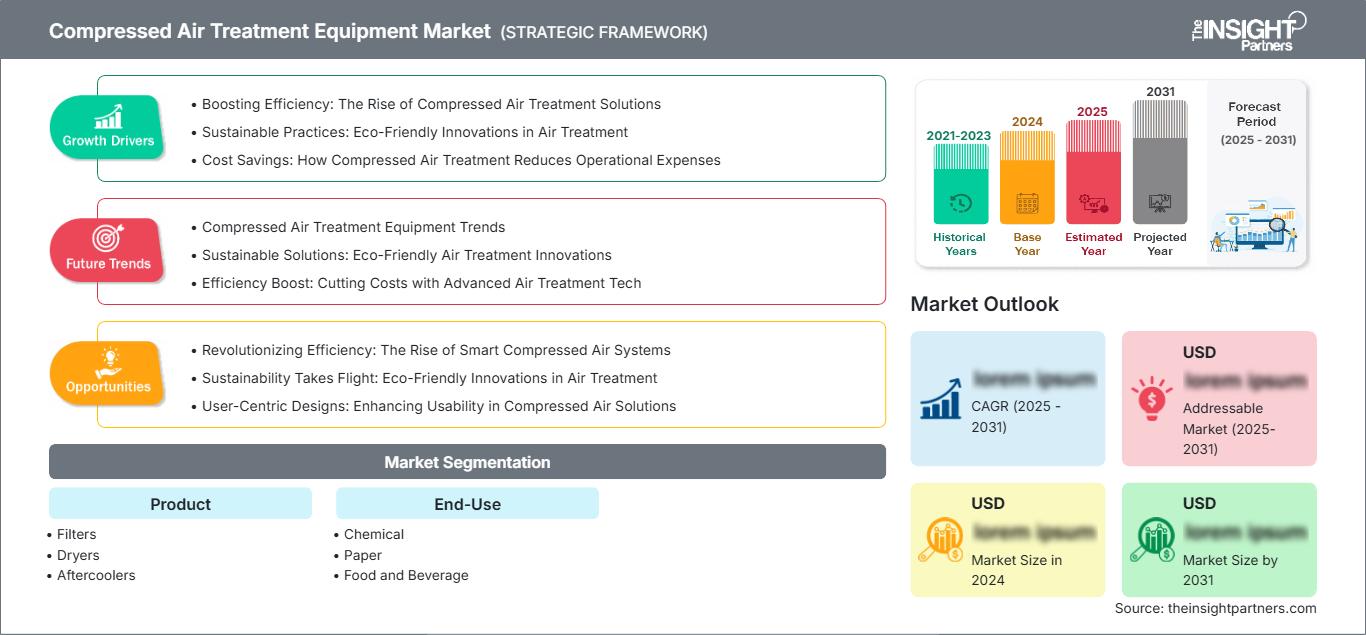
Compressed Air Treatment Equipment Market: Strategic Insights
Regional Insights
North America Compressed Air Treatment Equipment Market
North America accounted for 24–28% of Compressed Air Treatment Equipment Market share in 2025 and is projected to expand at a CAGR of 3.8–4.4% during 2026–2034. Demand is associated with preventive maintenance, energy auditing, and contamination control in food, chemical, paper, automotive, and health care plants.
Local consumers upgrade their old dryers and put in more efficient filters to safeguard their pneumatic tools, packaging machinery, and instrumentation. This market is also gaining from programs for leakage elimination in the air compression systems, which help in ensuring the pressure stability in the system.
U.S. Compressed Air Treatment Equipment Market
The U.S. represented 76–80% of the Compressed Air Treatment Equipment in North America in 2025 and is expected to grow at a CAGR of 3.9–4.5% during 2026–2034. Application trends concentrate in automotive assembly, packaged foods, pharmaceutical utilities, electronics, and general manufacturing plants requiring dry instrument air.
Company presence is broad through national distributors, compressor service networks, and filtration specialists. Buyers seek validated performance, fast replacement elements, and service documentation because downtime in compressed-air systems can interrupt multiple production lines simultaneously.
Europe Compressed Air Treatment Equipment Market
Europe held 22–26% share in 2025 and is projected to grow at a CAGR of 3.6–4.2% during 2026–2034. Germany drives demand in the areas of machinery, automobiles, chemicals, and industrial automation, while France and Italy help drive adoption of air compressors in the fields of food production, pharmaceuticals, and packaging.
The UK and Spain provide additional demand in terms of replacements for healthcare, paper, and manufacturing utilities. Customers in Europe place a lot of importance on energy efficient dryers, compliance with condensate treatment, and reduced leakage due to electricity costs and environmental monitoring.
APAC Compressed Air Treatment Equipment Market
Asia Pacific accounted for 34–38% share in 2025 and is forecast to grow at a CAGR of 5.0–5.8% during 2026–2034. China is the leading country, followed by Japan, South Korea, India, and Australia.
Expansion in industrial growth, production of packaged food items, manufacturing of drugs, assembling of electronic products, and localized manufacturing backed by policy make the adoption possible. Production units are shifting from moisture removal to filtration systems that also have dryers and condensates.
Middle East & Africa Compressed Air Treatment Equipment Market
The Middle East & Africa market is projected to grow at a CAGR of 4.0–4.8% during 2026–2034. Saudi Arabia and the UAE lead demand through petrochemicals, food processing, healthcare infrastructure, and industrial diversification programs.
South Africa and Rest of MEA contribute through paper, mining services, packaging, and general manufacturing. Hot climates increase dryer load, making aftercoolers, refrigerated dryers, and condensate management important for stable air quality in energy-intensive industrial sites.
Segmentation Analysis
Product
Product is projected to grow at a CAGR of 4.2–4.8% during 2026–2034. The Compressed Air Treatment Equipment Market scope covers filtration, moisture removal, and cooling technologies that are selected by air quality class, ambient conditions, compressor type, and process sensitivity. Product decisions balance upfront cost against pressure loss, element life, refrigerant compliance, and maintenance access.
- Filters hold the largest position because they remove particulates, oil aerosols, vapors, and microorganisms before air reaches tools, instruments, or product-contact points in sensitive plants.
- Dryers show steady replacement demand as operators control dew point, prevent corrosion, and protect pneumatic systems in humid climates, cold rooms, and validated manufacturing environments.
- Aftercoolers remain strategically important because they reduce air temperature after compression, lower moisture load on dryers, and improve downstream treatment efficiency in high-duty operations.
End-Use
End-Use is forecast to grow at a CAGR of 4.4–5.0% during 2026–2034. Adoption varies by contamination risk and production continuity. Food and beverage and pharmaceutical plants require validated clean air, while chemical, paper, and automotive facilities emphasize equipment protection, instrument reliability, and lower maintenance cost across large compressed-air networks.
- Chemical users require dry, clean instrument air for valves, actuators, and control systems. Treatment reliability reduces corrosion risk, contamination incidents, and unscheduled shutdowns.
- Paper facilities use compressed air in web handling, controls, drying assistance, and packaging. Moisture removal protects pneumatic components and improves uptime in high-humidity environments.
- Food and Beverage demand is driven by product-contact air, packaging, conveying, and hygiene audits. Filters and dryers support safety programs and reduce contamination exposure.
- Pharmaceutical and Healthcare users require validated air quality, documentation, and stable dew points. Demand is strategically important because contamination can affect compliance and batch release.
- Automotive plants use treated air for assembly tools, paint shops, robotics, and testing. System reliability supports production takt time and protects precision pneumatic equipment.
Opportunity Snapshot
| End-Use | Revenue Contribution | Trend Tag | Adoption Stage |
| Chemical | High | Instrument Air | Mature |
| Paper | Medium | Moisture Control | Mature |
| Food and Beverage | High | Hygiene Air | Scaling |
| Pharmaceutical and Healthcare | Medium | Validated Utilities | Scaling |
| Automotive | High | Robotic Tools | Mature |
Compressed Air Treatment Equipment Market Growth Drivers and Impact Analysis
Industrial automation raises air-quality expectations
Factories are adding pneumatic actuators, sensors, robotic end-effectors, and automated packaging systems that require stable, dry, and particle-controlled air. Poor treatment increases valve sticking, tool wear, and sensor failure, which can stop lines that operate with tight takt times. The impact is strongest in automotive, electronics, food packaging, and chemical processing because one air-quality issue can affect multiple assets connected to the same header. This driver supports replacement of basic filters with staged filtration, refrigerated or desiccant drying, and automated drains. It also increases demand for service contracts that verify differential pressure, dew point, and condensate removal before failures occur.
Regulated production needs validated clean air
Food, beverage, pharmaceutical, and healthcare facilities increasingly treat compressed air as a controlled utility because air can contact packaging, ingredients, instruments, or sterile environments. Standards for particulate, moisture, and oil control require defined air-quality classes, documented maintenance, and repeatable equipment performance. The market impact is a shift toward higher-grade coalescing filters, sterile filters, adsorption dryers, and monitoring accessories that support audits. Buyers also value suppliers that can provide validation support and replacement-element traceability. As more production moves to automated filling, conveying, and cleanroom-adjacent processes, compliant treatment systems become essential for protecting product quality and avoiding costly batch rejection.
Energy management shifts attention to pressure drop
Compressed air is an expensive utility because compressor power rises when systems compensate for leaks, wet air, blocked filters, or undersized dryers. Treatment equipment with lower pressure drop helps plants reduce compressor load while maintaining quality. This driver is influencing purchasing decisions as companies quantify total cost of ownership rather than focusing only on equipment price. High-efficiency filters, cycling dryers, optimized aftercoolers, and condensate management systems can reduce wasted energy and protect downstream equipment. The impact is particularly visible in continuous-process plants where even small pressure improvements can translate into meaningful operating savings across thousands of production hours.
Compressed Air Treatment Equipment Market Future Trends
Connected monitoring becomes a standard treatment layer
Compressed Air Treatment Equipment Market trends point toward wider use of connected dew point sensors, differential-pressure indicators, drain alarms, and remote service dashboards. Future systems will help maintenance teams identify saturated elements, dryer faults, and condensate problems before air quality falls outside specification. This shift will be valuable for plants running lean maintenance crews because treatment assets are often distributed across multiple compressor rooms and production zones. Data visibility can also support compliance records in food and pharmaceutical operations. Suppliers able to combine hardware, analytics, and field service will strengthen customer retention and create recurring revenue beyond equipment sales.
Low-GWP refrigeration reshapes dryer design
Refrigerated dryers will increasingly be redesigned around lower-GWP refrigerants, improved heat exchangers, and smarter cycling controls. The change is not only environmental; it also affects energy use, service practices, and component selection. Manufacturers that introduce compliant platforms without sacrificing pressure dew point stability can benefit from replacement demand in regulated markets. Customers will evaluate whether new dryers reduce refrigerant charge, maintain uptime, and integrate pre-filtration in compact footprints. Over the forecast period, lifecycle performance and refrigerant compliance are expected to become standard bid criteria for medium and large industrial dryer installations.
Compressed Air Treatment Equipment Market Opportunities
Validated utility packages for regulated plants
Compressed Air Treatment Equipment Market Forecasts indicate a strong opportunity for packaged solutions designed for food, beverage, pharmaceutical, and healthcare facilities. Vendors can combine prefilters, coalescing filters, sterile final filtration, dryers, drains, and monitoring into documented systems that simplify validation. The opportunity is action-oriented because customers need supplier support for sizing, installation checks, replacement schedules, and audit records. Firms that provide application-specific packages can reduce engineering burden for plant teams and improve customer confidence. This approach also supports aftermarket revenue because validated systems require periodic element replacement, calibration, and performance verification.
Service-led upgrades for installed compressor rooms
Large installed bases of aging filters, manual drains, heatless dryers, and poorly sized aftercoolers create a practical retrofit opportunity. Service providers can audit pressure drop, dew point stability, drain performance, and condensate handling to identify low-risk upgrades with fast operational payback. This opportunity is strongest where plants are not ready for full compressor replacement but need better air quality and lower energy cost. Bundling equipment upgrades with maintenance contracts can deepen customer relationships and improve recurring revenue. Distributors and specialists with local technicians are well positioned because site knowledge is critical to system-level improvement.
Recent Developments
- May 2025: Atlas Copco has launched a new range of portable desiccant air dryers, setting a new benchmark in on-site air treatment for industries working in the toughest conditions. The line-up includes six models – three twin tower models (CDR 850, CDR 1200, CDR 1700) and three units with Cerades™ technology (CDR+ 980, CDR+ 1350, CDR+ 1700) – each designed to provide a consistent flow of high-quality, moisture-free compressed air in a wide range of mobile applications.
- April 2025: Atlas Copco has launched a new range of portable desiccant air dryers, setting a new benchmark in on-site air treatment for industries working in the toughest conditions. The line-up includes six models – three twin tower models (CDR 850, CDR 1200, CDR 1700) and three units with Cerades technology (CDR+ 980, CDR+ 1350, CDR+ 1700) – each designed to provide a consistent flow of high-quality, moisture-free compressed air in a wide range of mobile applications.
- October 2025: Hitachi Industrial Equipment Systems Co., Ltd. (HIES) will begin selling its new oil-free scroll air compressor "G Series" (oil-free 1.5kW/2.2kW/3.7kW models) capable of operation even in high ambient temperature environments (45°C). By improving both the core components and the overall package of the oil-free scroll air compressor, we will meet a wider range of customer needs, further enhancing efficiency in industry, and reducing environmental impact.
Frequently Asked Questions

- Comprehensive Market Sizing and Forecast Analysis
- Detailed Segmentation Analysis
- In-Depth Market Dynamics Assessment
- Regional and Country-Level Insights
- Competitive Landscape and Company Benchmarking
- Strategic Business Intelligence
Recent Reports
Testimonials

The Insight Partners' SCADA System Market report is comprehensive, with valuable insights on current trends and future forecasts. The team was highly professional, responsive, and supportive throughout. We are very satisfied and highly recommend their services.
RAN KEDEM Partner, Reali Technologies LTDs
I requested a report on a very specific software market and the team produced the report in a few days. The information was very relevant and well presented. I then requested some changes and additions to the report. The team was again very responsive and I got the final report in less than a week.
JEAN-HERVE JENN Chairman, Future Analytica
We worked with The Insight Partners for an important market study and forecast. They gave us clear insights into opportunities and risks, which helped shape our plans. Their research was easy to use and based on solid data. It helped us make smart, confident decisions. We highly recommend them.
PIYUSH NAGPAL Sr. Vice President, High Beam Global
The Insight Partners delivered insightful, well-structured market research with strong domain expertise. Their team was professional and responsive throughout. The user-friendly website made accessing industry reports seamless. We highly recommend them for reliable, high-quality research services
YUKIHIKO ADACHI CEO, Deep Blue, LLC.
This is the first time I have purchased a market report from The Insight Partners.While I was unsure at first, I visited their web site and felt more comfortable to take the risk and purchase a market report.I am completely satisfied with the quality of the report and customer service. I had several questions and comments with the initial report, but after a couple of dialogs over email with their analyst I believe I have a report that I can use as input to our strategic planning process.Thank you so much for taking the extra time and making this a positive experience.I will definitely recommend your service to others and you will be my first call when we need further market data.
JOHN SUZUKI President and Chief Executive Officer, Board Director, BK Technologies
I wish to appreciate your support and the professionalism you displayed in the course of attending to my request for information regarding to infectious disease IVD market in Nigeria. I appreciate your patience, your guidance, and the fact that you were willing to offer a discount, which eventually made it possible for us to close a deal. I look forward to engaging The Insight Partners in the future, all thanks to the impression you have created in me as a result of this first encounter.
DR CHIJIOKE ONYIA MANAGING DIRECTOR, PineCrest Healthcare Ltd.Reason to Buy
- Informed Decision-Making
- Understanding Market Dynamics
- Competitive Analysis
- Identifying Emerging Markets
- Customer Insights
- Market Forecasts
- Risk Mitigation
- Boosting Operational Efficiency
- Strategic Planning
- Investment Justification
- Tracking Industry Innovations
- Aligning with Regulatory Trends





 Get Free Sample for