
Computer Numerical Control Market Share, Demand & Growth by 2034
Coverage: by Type (Lathe Machine, Miller Machine, Router, Grinders, and others ) and Application (Aerospace and Defense, Automobile, Electronics, Healthcare, and Industrial Machinery), and Geography (North America, Europe, Asia Pacific, and South and Central America)
- Status : Data Released
- Report Code : TIPRE00003117
- Category : Electronics and Semiconductor
- No. of Pages : 150
- Available Report Formats :


- Last update date : August 12, 2026


2025 Market Size
US$ 93.18 Bn
Base year value
2034 Forecast
US$ 154.74 Bn
Projected by 2034
CAGR 2026-2034
5.80 %
Growth rate
Addressable Market
US$ 1,123.53 Bn
(2026-2034)
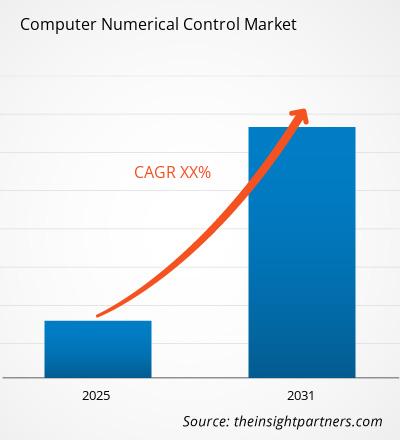
The Computer Numerical Control Market is estimated to be worth US$ 93.18 Billion in 2025 and will grow to become US$ 154.74 Billion by 2034, registering a CAGR of 5.80% between 2026 and 2034. The market consists of machine tool systems where the machining process such as milling, turning, grinding, and routing is done with the help of programmed instruction control. Such systems comprise controllers, servomotors, feedback devices, and machine interfaces to perform precise manufacturing of various components for aerospace, automotive, electronics, and industrial machinery industries.
The Computer Numerical Control Market size in North America is predicted to witness a CAGR of 5.2–5.9% between 2026 and 2034. This growth would be driven by aerospace manufacturing, automotive manufacturing, and the industrial machinery industry. Reshoring, manufacturing in defense, and the preference for highly accurate CNC machine tools in job shops are other factors fueling demand in the region.
Computer Numerical Control Market Assessment and Insights
- North America held 22–25% share in 2025 and is growing at a CAGR of 5.2–5.9% during 2026–2034, led by aerospace manufacturing, defense production, and automotive applications across the US and Canada.
- US represented 82–85% of North American revenue in 2025 and is growing at a CAGR of 5.4–6.1% during 2026–2034.
- Europe accounted for 24–27% share in 2025 and is growing at a CAGR of 5.0–5.7% during 2026–2034, led by Germany, the UK, France, Italy, and Spain.
- Asia Pacific held 40–43% share in 2025 and is growing at a CAGR of 6.5–7.2% during 2026–2034, led by China, India, Japan, South Korea, and Australia.
- Largest Segment Lathe Machine held 32–35% market share in 2025 and is growing at a CAGR of 5.5–6.2% during 2026–2034.
- High Growth Segment Miller Machine represented 28–31% market share in 2025 and is growing at a CAGR of 6.0–6.7% during 2026–2034.
- Key companies analyzed in detail: Bosch Rexroth AG; Dr. Johannes Heidenhain GmbH; Fanuc Corporation; Haas Automation; Mazak Corporation; Mondragon Corporation (Fagor Automation); Mitsubishi Electric Corporation; OKUMA AMERICA CORPORATION; Siemens AG; Takisawa Machine Tool Co., Ltd.; DMG MORI; TRUMPF Group.
Source: The Insight Partners' analysis based on proprietary research, government publications, company annual reports, investor presentations, industry databases, and expert interviews.
CNC technology has progressed from numerical control to sophisticated technology characterized by multi-axis machining, high-speed machining, and intelligent control with predictive maintenance capabilities. Production dynamics focus on machine rigidity, thermal stability, precision control and calibration of machines under different working conditions. The demand for CNC Machine Market is further influenced by machine tool manufacturers who match CNC machines to suit application needs, nature of the workpiece and production environment in manufacturing.
The Computer Numerical Control Market report indicates that future investments will be towards manufacturing plants in Asia Pacific, North America and Europe where advanced CNC machines will be required due to automation in manufacturing and precision manufacturing in addition to production efficiency. Regulation in line with the industry safety standards and quality will qualify the machinery. Buyers will be attracted to systems which integrate control capacity, machine integration and services with prompt technical support and lifetime support without interfering with manufacturing process.
Computer Numerical Control Market Report Scope
| Report Attribute | Details |
|---|---|
| Market size in 2025 | US$ 93.18 Billion |
| Market Size by 2034 | US$ 154.74 Billion |
| Global CAGR (2026 - 2034) | 5.80% |
| Historical Data | 2021-2024 |
| Forecast period | 2026-2034 |
Computer Numerical Control Market Analysis
Computer Numerical Control Market growth is driven by manufacturing automation, precision requirements, aerospace production, and automotive manufacturing demand. The value chain includes control system suppliers, machine tool builders, cutting tool manufacturers, and manufacturing end-users. Supply dynamics are shaped by control technology, machine tool capacity, and manufacturing investment cycles. Computer Numerical Control Market analysis indicates that lathe machines remain the dominant type while miller machines gain share through versatility and application flexibility. Service capability is decisive because machine reliability, technical support, and application engineering affect production efficiency and part quality.
Competition is led by CNC system suppliers and machine tool manufacturers. Fanuc Corporation, Siemens AG, Mitsubishi Electric Corporation, Haas Automation, Mazak Corporation, DMG MORI, Bosch Rexroth AG, Dr. Johannes Heidenhain GmbH, OKUMA AMERICA CORPORATION, Mondragon Corporation (Fagor Automation), Takisawa Machine Tool Co., Ltd., and TRUMPF Group compete on control capability, machine precision, application expertise, and installed-base relationships. Investment trends favor multi-axis machining, high-speed processing, and Industry 4.0 connectivity. Fanuc Corporation and Siemens AG maintain leadership through comprehensive control portfolios and global support networks, while Haas and Mazak benefit from machine tool expertise. Strategic positioning depends on certified performance, control reliability, and manufacturing support.
The market is also witnessing accelerated adoption of advanced digital manufacturing technologies that significantly enhance the capabilities of modern CNC systems. Digital twins, artificial intelligence (AI), machine learning algorithms, predictive maintenance platforms, and Industrial Internet of Things (IIoT) connectivity are being integrated into CNC machines to improve machining precision, reduce unplanned downtime, and optimize production efficiency. These technologies enable manufacturers to monitor machine health in real time, identify potential failures before they occur, and schedule maintenance activities proactively, thereby extending equipment life and minimizing production interruptions. In addition, cloud-based monitoring solutions and remote diagnostics allow production managers to oversee multiple manufacturing facilities from centralized locations, improving operational visibility and decision-making. The growing adoption of Industry 4.0 practices is further encouraging manufacturers to invest in connected CNC equipment capable of seamless data exchange with enterprise resource planning (ERP) systems, manufacturing execution systems (MES), and automated production lines. These advancements support higher productivity, consistent product quality, reduced material waste, and improved energy efficiency, making intelligent CNC systems increasingly attractive across aerospace, automotive, medical device, electronics, and precision engineering industries.
From a regional perspective, Asia-Pacific continues to account for the largest share of the Computer Numerical Control Market, supported by its extensive manufacturing ecosystem, favorable government initiatives promoting industrial modernization, and substantial investments in automotive, electronics, heavy machinery, and semiconductor production. Countries such as China, Japan, South Korea, and India are expanding advanced manufacturing capabilities through factory automation and high-precision machining, driving sustained demand for CNC equipment and control systems. North America remains a major market due to its strong aerospace, defense, medical equipment, and industrial machinery sectors, where manufacturers prioritize advanced multi-axis machining, high-speed processing, and digitally connected production environments. Europe also maintains a significant market position, supported by its established automotive industry, high-value engineering expertise, and emphasis on energy-efficient and sustainable manufacturing technologies. Meanwhile, emerging economies in Latin America, the Middle East, and Africa are gradually increasing investments in industrial infrastructure, metal fabrication, and manufacturing automation to improve productivity and competitiveness. Rising foreign direct investment, expansion of industrial parks, and government programs supporting advanced manufacturing are expected to create new opportunities for CNC machine manufacturers, software providers, and control system suppliers, contributing to sustained global market growth over the forecast period.
● REPORT CUSTOMIZATION
Tailor This Report To Align With Your Specific Business Requirements
This report can be customized to align precisely with your business objectives, scope, and target markets. Customization options include tailored segmentation, geography, competitive analysis, and strategic insights to support informed decision-making.
Customize This Report →WHAT YOU CAN ADJUST
- ● Segmentations
- ● Geography
- ● Competitive Analysis
- ● Language Preferences
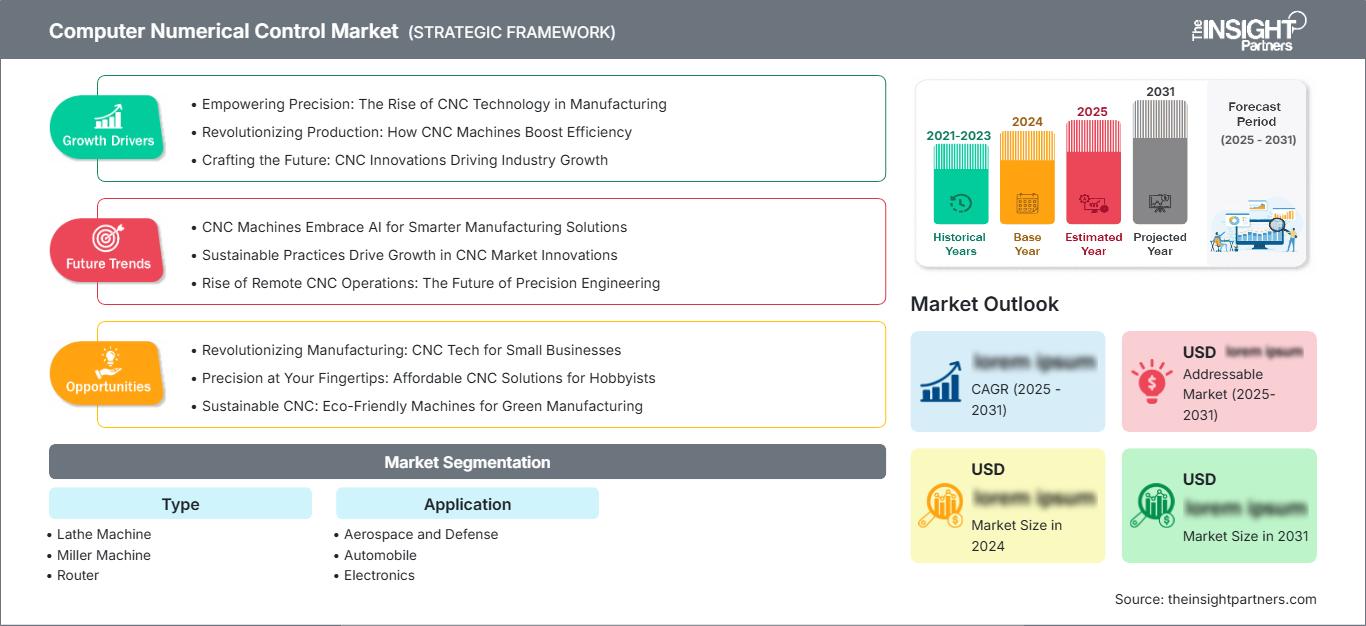
Computer Numerical Control Market: Strategic Insights
Regional Insights
North America Computer Numerical Control Market
North America accounted for 22–25% of Computer Numerical Control Market share in 2025 and is projected to grow at a CAGR of 5.2–5.9% during 2026–2034. Demand is supported by aerospace manufacturing, defense production, automotive manufacturing, and industrial machinery modernization. The region's advanced manufacturing base and technology adoption drive consistent demand for CNC equipment. Fanuc Corporation, Siemens AG, Haas Automation, Mazak Corporation, and DMG MORI support installed bases across aerospace suppliers, automotive manufacturers, and job shops in the US and Canada.
U.S. Computer Numerical Control Market
The U.S. represented 82–85% of North American revenue in 2025 and is forecast to grow at a CAGR of 5.4–6.1% during 2026–2034. Application demand is concentrated in aerospace manufacturing, defense production, automotive parts manufacturing, and industrial equipment production. Company presence is reinforced by Fanuc Corporation, Siemens AG, Haas Automation, Mazak Corporation, and OKUMA AMERICA CORPORATION. Buyers prioritize precision, reliability, production speed, and support capability, plus integration that reduces setup time and improves confidence in manufacturing quality.
Europe Computer Numerical Control Market
Europe held 24–27% share in 2025 and is expected to grow at a CAGR of 5.0–5.7% during 2026–2034. Germany leads through precision manufacturing and machine tool production, while the UK supports demand from aerospace and automotive manufacturing. France, Italy, and Spain add demand through industrial production and manufacturing applications. Manufacturing quality and technology standards favor suppliers with documented performance and support. Siemens AG, Fanuc Corporation, Bosch Rexroth AG, DMG MORI, and Dr. Johannes Heidenhain GmbH remain visible across manufacturing projects.
APAC Computer Numerical Control Market
Asia Pacific accounted for 40–43% share in 2025 and is projected to grow at a CAGR of 6.5–7.2% during 2026–2034. China leads through manufacturing scale and industrial expansion, while India expands through manufacturing development and capacity investment. Japan and South Korea prioritize advanced CNC systems for precision manufacturing and automotive production, while Australia adds industrial manufacturing and mining equipment applications. Policy support for manufacturing modernization and industrial growth strengthen Computer Numerical Control Market adoption where production capability and quality carry significant value.
Middle East & Africa Computer Numerical Control Market
The Middle East & Africa market is projected to grow at a CAGR of 4.5–5.2% during 2026–2034. Saudi Arabia leads through industrial development and manufacturing investment, while the UAE adds manufacturing and production capabilities. South Africa and Rest of MEA rely on industrial development and manufacturing applications. Industrial investment and capacity expansion create demand for CNC solutions. Suppliers succeed when they combine product quality, technical support, and manufacturing expertise for production requirements.
Segmentation Analysis
Type
Type is projected to grow at a CAGR of 5.5–6.2% during 2026–2034. Computer Numerical Control Market scope covers Lathe Machine, Miller Machine, Router, and Grinders. Selection depends on workpiece geometry, material characteristics, and production requirements. Lathe Machine leads through established applications and widespread adoption.
- Lathe Machine systems perform turning operations for cylindrical workpieces with established applications across automotive, aerospace, and industrial manufacturing.
- Miller Machine systems support versatility and multi-axis machining for diverse workpiece geometries and application requirements.
- Router systems serve woodworking, composites, and non-metal applications requiring high-speed material removal.
- Grinders provide precision finishing for hardened materials and components with surface finish and dimensional accuracy requirements.
Application
Application is forecast to grow at a CAGR of 5.8–6.5% during 2026–2034. Aerospace and Defense, Automobile, Electronics, Healthcare, and Industrial Machinery represent distinct manufacturing environments with varying equipment requirements. Application adoption grows when production complexity and precision requirements drive equipment investment.
- Aerospace and Defense applications require high-precision CNC systems for complex components with stringent quality and traceability requirements.
- Automobile applications support high-volume production of precision components with efficiency and reliability priorities.
- Electronics applications require precision machining for components and enclosures with fine feature capabilities.
- Healthcare applications demand precision manufacturing for medical devices and instruments with quality and cleanliness requirements.
- Industrial Machinery applications support production of equipment components with reliability and durability requirements.
Opportunity Snapshot
| Application | Revenue Contribution | Trend Tag | Adoption Stage |
|---|---|---|---|
| Aerospace and Defense | High | Precision Parts | Mature |
| Automobile | High | High Volume | Mature |
| Electronics | Medium | Fine Features | Scaling |
| Healthcare | Medium | Medical Devices | Scaling |
| Industrial Machinery | High | Equipment Production | Mature |
Computer Numerical Control Market Growth Drivers and Impact Analysis
Aerospace Manufacturing Expansion Drives Precision CNC Demand
Global aerospace production and defense spending continue driving demand for precision manufacturing capabilities across airframe, engine, and component manufacturing. Aerospace components require high-precision machining with complex geometries, driving investment in advanced CNC systems. The expansion of commercial aerospace production and defense modernization programs creates consistent demand for precision manufacturing equipment. The practical impact is demand for high-precision, reliable CNC systems supporting aerospace manufacturing requirements.
Automotive Production Modernization Creates Equipment Demand
Automotive manufacturing modernization and capacity expansion across global markets create demand for CNC systems supporting powertrain, chassis, and component production. Automakers and suppliers invest in precision manufacturing capabilities for evolving vehicle content. The transition toward electric vehicles creates new machining requirements for battery housings and powertrain components. This driver benefits suppliers that can deliver production-capable CNC systems supporting automotive manufacturing with quality and throughput requirements.
Manufacturing Reshoring Accelerates Investment in CNC Technology
Reshoring initiatives across North America and Europe are accelerating investment in domestic manufacturing capacity, creating demand for CNC equipment. Companies seek to localize production and reduce supply chain dependence through investment in manufacturing facilities. The reshoring trend drives demand for new CNC machines and system upgrades. The market impact is demand for production-capable, cost-effective CNC systems supporting manufacturing expansion and local production requirements.
Computer Numerical Control Market Future Trends
Industrial Internet of Things Integration Enhances Machine Intelligence
Computer Numerical Control Market trends point toward Industrial Internet of Things integration with enhanced connectivity, monitoring, and analytics for manufacturing intelligence and optimization. The next product cycle will combine machine connectivity, real-time monitoring, and predictive analytics for improved manufacturing efficiency. This shift matters because manufacturers increasingly value production intelligence and process optimization. Vendors with connectivity and analytics capabilities will be better positioned as smart manufacturing requirements evolve.
Additive Subtractive Hybrid Systems Enable Complex Manufacturing
Hybrid machine tools combining additive and subtractive manufacturing capabilities are emerging as solutions for complex component production requiring both capabilities. Next-generation systems will integrate additive deposition with CNC machining in single setups. This evolution supports complex geometries and reduced production steps. Suppliers that can deliver hybrid capabilities with established precision will gain credibility with manufacturers seeking production advantages.
Computer Numerical Control Market Opportunities
Five-Axis Machining Solutions for Complex Component Production
Computer Numerical Control Market Forecasts support investment in five-axis machining solutions enabling complex component production for aerospace and automotive applications requiring multi-axis capability. Manufacturers need systems delivering precision and efficiency for complex geometries. Providers can create opportunities by developing five-axis solutions for demanding applications. The opportunity is strongest where component complexity drives demand for advanced machining capability.
Automation-Ready CNC Systems for Lights-Out Manufacturing
Automation-ready CNC systems supporting unattended manufacturing and lights-out production create demand for systems with robotic integration and autonomous operation capability. Manufacturers need systems enabling reduced labor dependence and extended production hours. Suppliers with automation-ready solutions can capture opportunities in advanced manufacturing environments. This opportunity rewards companies that can deliver reliability, automation compatibility, and production capability.
Recent Developments
- July 2026: Siemens is introducing a new hardware generation for its Sinumerik One CNC control system. With significantly enhanced computing performance, modern graphics architecture, and a platform designed for long-term cybersecurity, the company addresses key technological and regulatory requirements across the manufacturing industry. At the same time, the new architecture lays the foundation for the use of artificial intelligence in machine tools. Customers benefit from increased productivity through data-driven optimization of machining processes and improved use of machine data.
- March 2026: Strategic collaboration combines FANUC’s global robotics leadership with NVIDIA AI computing and simulation platforms to deliver intelligent, adaptable automation for the factory of the future. FANUC, the world’s leading supplier of industrial robots and factory automation systems, is collaborating with NVIDIA to advance physical AI—a new paradigm that merges artificial intelligence with physical robotics to enable machines that see, reason, and act in dynamic environments. Under this collaboration, FANUC will leverage NVIDIA AI infrastructure, including NVIDIA Jetson edge modules, cloud/edge AI infrastructure, NVIDIA Isaac Sim open robotic simulation framework and NVIDIA Omniverse libraries, within its extensive robot portfolio and ROBOGUIDE simulation software. This approach empowers manufacturers to create photorealistic digital twins of their factories, train robots virtually, and deploy them with unprecedented speed and flexibility.
- August 2023: The leadership team at Okuma America Corporation is pleased to announce the launch of the company’s next-generation machine control for its expansive line of CNC (computer numeric control) machine tools. The new control – the Okuma OSP-P500 – is the company’s latest innovation within its OSP control line which dates back to 1963. Leveraging the OSP line’s 60-year history, coupled with today’s digital transformation technologies, the OSP-P500 is designed to enhance user experiences and fully optimize modern manufacturing operations.
Frequently Asked Questions

- Comprehensive Market Sizing and Forecast Analysis
- Detailed Segmentation Analysis
- In-Depth Market Dynamics Assessment
- Regional and Country-Level Insights
- Competitive Landscape and Company Benchmarking
- Strategic Business Intelligence
Recent Reports
Testimonials

The Insight Partners provided valuable market intelligence that supported our global go-to-market strategy. Their team was professional, responsive, and attentive to our feedback, providing thoughtful analysis and helpful methodological clarifications throughout the project.
Junmo Kim Chief Financial Officer (CFO), Enertech Co., Ltd.
The Insight Partners' SCADA System Market report is comprehensive, with valuable insights on current trends and future forecasts. The team was highly professional, responsive, and supportive throughout. We are very satisfied and highly recommend their services.
RAN KEDEM Partner, Reali Technologies LTDs
I requested a report on a very specific software market and the team produced the report in a few days. The information was very relevant and well presented. I then requested some changes and additions to the report. The team was again very responsive and I got the final report in less than a week.
JEAN-HERVE JENN Chairman, Future Analytica
We worked with The Insight Partners for an important market study and forecast. They gave us clear insights into opportunities and risks, which helped shape our plans. Their research was easy to use and based on solid data. It helped us make smart, confident decisions. We highly recommend them.
PIYUSH NAGPAL Sr. Vice President, High Beam Global
The Insight Partners delivered insightful, well-structured market research with strong domain expertise. Their team was professional and responsive throughout. The user-friendly website made accessing industry reports seamless. We highly recommend them for reliable, high-quality research services
YUKIHIKO ADACHI CEO, Deep Blue, LLC.
This is the first time I have purchased a market report from The Insight Partners.While I was unsure at first, I visited their web site and felt more comfortable to take the risk and purchase a market report.I am completely satisfied with the quality of the report and customer service. I had several questions and comments with the initial report, but after a couple of dialogs over email with their analyst I believe I have a report that I can use as input to our strategic planning process.Thank you so much for taking the extra time and making this a positive experience.I will definitely recommend your service to others and you will be my first call when we need further market data.
JOHN SUZUKI President and Chief Executive Officer, Board Director, BK Technologies
I wish to appreciate your support and the professionalism you displayed in the course of attending to my request for information regarding to infectious disease IVD market in Nigeria. I appreciate your patience, your guidance, and the fact that you were willing to offer a discount, which eventually made it possible for us to close a deal. I look forward to engaging The Insight Partners in the future, all thanks to the impression you have created in me as a result of this first encounter.
DR CHIJIOKE ONYIA MANAGING DIRECTOR, PineCrest Healthcare Ltd.Reason to Buy
- Informed Decision-Making
- Understanding Market Dynamics
- Competitive Analysis
- Identifying Emerging Markets
- Customer Insights
- Market Forecasts
- Risk Mitigation
- Boosting Operational Efficiency
- Strategic Planning
- Investment Justification
- Tracking Industry Innovations
- Aligning with Regulatory Trends





 Get Free Sample for