
Conductive Plastic Compounds Market Growth, Trends & Demand by 2034
Coverage: By Resin (Polyethylene, Polypropylene, Polyvinyl Chloride, Polystyrene, Engineering Plastics, Thermoplastic Elastomers, Bio-plastics, Others); Filler (Carbon Black, Carbon Fibers, Carbon Nanotubes, Metals, Others); End-Use Industry (Automotive, Electrical and Electronics, Building and Construction, Packaging, Industrial Machinery, Medical Devices, Others) , and Geography (North America, Europe, Asia Pacific, and South and Central America)
- Status : Data Released
- Report Code : TIPRE00021115
- Category : Chemicals and Materials
- No. of Pages : 150
- Available Report Formats :


- Last update date : August 27, 2026


2025 Market Size
US$ 17.08 Bn
Base year value
2034 Forecast
US$ 41.81 Bn
Projected by 2034
CAGR 2026-2034
10.46 %
Growth rate
Addressable Market
US$ 261.21 Bn
(2026-2034)
The Conductive Plastic Compounds Market was valued at US$ 17.08 Billion in 2025 and is projected to reach US$ 41.81 Billion by 2034, expanding at a CAGR of 10.46% from 2026 to 2034. The market encompasses engineered polymer systems incorporating conductive fillers to deliver controlled electrical, electrostatic, electromagnetic, or thermal performance while retaining plastic processing advantages. Demand is increasingly linked to vehicle electrification, electronics miniaturization, industrial automation, and lightweight component design.
North America represents a technically mature demand center, with the Conductive Plastic Compounds Market size supported by automotive electrification, semiconductor manufacturing, medical equipment, and industrial electronics. The region is estimated to expand at a CAGR of 8.7–9.4% during 2026–2034. Adoption is reinforced by stringent ESD-control requirements, increasing use of lightweight polymeric components, and continued investment in domestic electronics and advanced manufacturing capacity.
Conductive Plastic Compounds Market Assessment and Insights
- North America: The region is estimated to account for a 25–29% share in 2025 and expand at a CAGR of 8.7–9.4% between 2026–2034, supported by electronics, automotive, medical, and industrial applications requiring controlled conductivity.
- US: The US represents 78–82% of North American demand in 2025 and is projected to grow at a CAGR of 8.5–9.2% between 2026–2034, led by electronics, automotive, and defense applications.
- Europe: Europe is estimated to hold a 22–26% share in 2025 and grow at a CAGR of 8.9–9.7%, with Germany, France, Italy, and the UK benefiting from automotive electrification and advanced manufacturing.
- Asia Pacific: Asia Pacific is estimated to command a 34–38% share in 2025 and register a CAGR of 11.2–12.1%, with China, Japan, South Korea, and India driving electronics and vehicle production.
- Largest Segment: Electrical and electronics is estimated to represent a 28–32% market share in 2025, with a CAGR of 11.0–11.8% through 2034.
- High Growth Segment: Carbon nanotubes are estimated to represent a 9–12% market share in 2025 and grow at a CAGR of 13.2–14.1%, driven by low-loading conductivity requirements.
- Key companies analyzed in detail: BASF SE, RTP Company, LyondellBasell Industries N.V., Mexichem Specialty Compounds Inc., SABIC, Dow Inc., Coperion K-Tron, Adell Plastics, Inc., Sojitz Corporation, and Ravago.
Source: The Insight Partners' analysis based on proprietary research, government publications, company annual reports, investor presentations, industry databases, and expert interviews.
Material technology has moved from standard carbon black-filled polymers to advanced materials involving carbon fibers, carbon nanotubes, metallic fillers, and permanently dissipative polymers. Material producers are finding ways to optimize conductivity with impact strength, ease of processing, surface quality, flame resistance, and dimensional stability. Such advancements will make it possible for conductive products to take over where metals and coated plastic were used in some applications, all at lower costs for injection molding and extrusion.
The future looks promising for Asia Pacific owing to the development of electronics, batteries, semiconductors, and electric vehicles. Investors are also focusing on developing high-end materials that can work within the conductivity windows of applications. Regulatory attention to electrical safety, hazardous-area equipment, electromagnetic compatibility, and material sustainability should encourage suppliers to develop cleaner, recyclable, and lower-loading conductive systems for demanding applications in the Conductive Plastic Compounds Market.
Conductive Plastic Compounds Market Report Scope
| Report Attribute | Details |
|---|---|
| Market size in 2025 | US$ 17.08 Billion |
| Market Size by 2034 | US$ 41.81 Billion |
| Global CAGR (2026 - 2034) | 10.46% |
| Historical Data | 2021-2024 |
| Forecast period | 2026-2034 |
Conductive Plastic Compounds Market Analysis
The Conductive Plastic Compounds Market growth is closely connected with demand for polymer components that combine electrical functionality with low weight, corrosion resistance, and design flexibility. Resin producers supply PE, PP, PVC, PS, engineering plastics, TPEs, and specialty polymers, while compounders integrate conductive fillers and additives. OEMs and molders then convert these formulations into housings, trays, tubing, cable components, automotive parts, and electronic assemblies.
The economics of supply will have to factor in the cost of polymer, the cost of carbon-based fillers, the efficiency of filler dispersion, energy consumption, and the complexity of the compound formulation. Carbon black is more appealing for low-cost uses, while carbon fibers and nanotubes require more value when conductivity has to be provided without a high amount of fillers.
The Conductive Plastic Compounds Market analysis indicates competition is differentiated by formulation breadth, application engineering, global manufacturing, and the ability to tailor resistivity. BASF SE, RTP Company, SABIC, LyondellBasell Industries N.V., and Ravago have broad polymer or compounding capabilities, while specialists such as Adell Plastics, Inc. compete through formulation flexibility. Coperion K-Tron participates through compounding and feeding technologies supporting conductive-material production.
Positioning is becoming more about high-value applications than commodity grades of conductive materials. RTP Company provides conductive, antistatic, EMI / RFI shielding, and thermally-conductive materials based on various types of resins. SABIC has a wide range of LNP STAT-KON compounds that utilize carbon powder, carbon fibers, and carbon nanotubes. Ravago produces electrically conductive Scolefin compounds.
● REPORT CUSTOMIZATION
Tailor This Report To Align With Your Specific Business Requirements
This report can be customized to align precisely with your business objectives, scope, and target markets. Customization options include tailored segmentation, geography, competitive analysis, and strategic insights to support informed decision-making.
Customize This Report →WHAT YOU CAN ADJUST
- ● Segmentations
- ● Geography
- ● Competitive Analysis
- ● Language Preferences
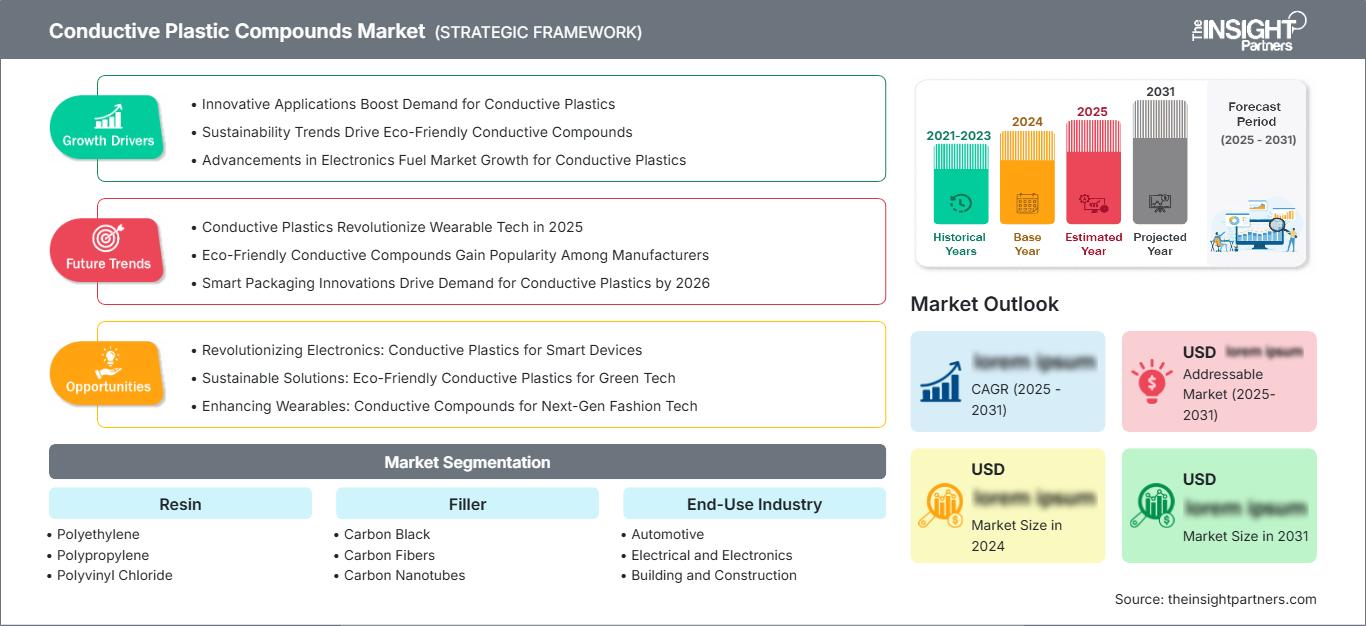
Conductive Plastic Compounds Market: Strategic Insights
Regional Insights
North America Conductive Plastic Compounds Market
North America is estimated to represent 25–29% of global Conductive Plastic Compounds Market demand in 2025 and expand at a CAGR of 8.7–9.4% through 2034. The US leads in regional consumption as a result of its strong electronics, automotive, medical devices, aerospace, and industrial equipment industry presence. The demand for the material will be driven by the increased need for ESD protection, EMI shielding, light weighting, and conductive packaging in demanding manufacturing applications.
Mexico and Canada provide support to the regional supply chain through automotive, electronics, industrial, and packaging production. Mexico in particular represents a key region for polymer processing associated with North American automotive and electronics manufacturing. The compounder will gain from their proximity to both OEMs and molders as conductivity needs often demand special formulations tailored to specific applications.
U.S. Conductive Plastic Compounds Market
The U.S. accounts for 78–82% of North American Conductive Plastic Compounds Market demand in 2025 and is expected to grow at a CAGR of 8.5–9.2% through 2034. A wide variety of applications such as semiconductor equipment, electric cars, healthcare products, defense electronics, industrial automation, and ESD-sensitive packaging, are found for the products being researched. Domestic suppliers also need to cater to customers who look for materials that are both conductive and resistant to flames, as well as dimensionally stable.
The RTP Company, BASF SE, SABIC, Dow Inc., and Adell Plastics, Inc. could be considered to have relevant technical competencies in conducting business in the market. The trend among customers is changing toward molded products which serve as a replacement for metallic products with electrical properties maintained.
Europe Conductive Plastic Compounds Market
Europe is estimated to hold 22–26% of global Conductive Plastic Compounds Market demand in 2025 and expand at a CAGR of 8.9–9.7%. Germany is the leading country, supported by automotive engineering, industrial machinery, electrical equipment, and chemical manufacturing. The UK, France, Italy, and Spain provide additional demand through electronics, automotive, packaging, medical, and industrial applications.
Germany's large automotive and industrial manufacturing base supports conductive compounds for sensor housings, cable systems, battery components, and ESD-sensitive equipment. France combines aerospace, automotive, electronics, and industrial demand, while Italy and Spain benefit from machinery, automotive components, electrical equipment, and packaging production. European buyers increasingly emphasize recyclability, material efficiency, and regulatory compliance alongside conductivity, encouraging compounders to develop lower-loading and more application-specific formulations.
APAC Conductive Plastic Compounds Market
APAC is estimated to account for 34–38% of the global Conductive Plastic Compounds Market demand in 2025 and grow at a CAGR of 11.2–12.1%. China is the leading market, followed by Japan, South Korea, India, and Australia. Electronics manufacturing, electric vehicles, batteries, semiconductors, and industrial automation provide the strongest demand foundation.
The large-scale manufacturing capabilities of China cover commodity grades and sophisticated conductive grades, whereas the focus of Japan and South Korea is on high-end electronics and automotive uses. India is growing in electronics manufacturing and automobile localization, while Australia offers smaller industrial and mining applications. The regional government policies on electronics, electric vehicles, semiconductor fabrication, and domestic manufacturing capability will ensure investments in specialized polymer compounding and filler technologies.
Middle East & Africa Conductive Plastic Compounds Market
The Middle East and Africa represent a smaller Conductive Plastic Compounds Market demand base but provide selective opportunities in industrial equipment, electrical infrastructure, automotive components, packaging, and construction-related applications. Saudi Arabia and the UAE lead regional demand, supported by industrial diversification, while South Africa remains important for automotive and industrial manufacturing. These factors contribute to the Conductive Plastic Compounds Market share across the region.
Downstream manufacturing investments in Saudi Arabia and logistics & industrial infrastructure in the UAE would help to boost demand for specialty polymers. South Africa has an input in terms of automobile production, mining machinery, and electricity usage. The remainder of MEA lacks integration; however, there is high demand in the industrial regions. Growth rates in MEA region are expected at CAGR of 7.4% to 8.3%.
Segmentation Analysis
Resin
The resin segment is expected to expand at a CAGR of 10.1–10.9% from 2026–2034. Selection depends on conductivity targets, temperature resistance, mechanical requirements, chemical exposure, processing method, and final-part economics. Commodity polyolefins remain important for high-volume applications, while engineering plastics and TPEs serve demanding automotive, electronics, medical, and industrial applications. The Conductive Plastic Compounds Market scope therefore increasingly includes tailored resin-filler combinations rather than standardized grades.
- Polyethylene: Used in films, tubing, packaging, and industrial components where chemical resistance, flexibility, and economical conductive performance are required.
- Polypropylene: Supports lightweight automotive, packaging, industrial, and electrical components, with compounding flexibility enabling conductive and ESD-oriented formulations.
- Polyvinyl Chloride: Serves cable, tubing, flooring, and industrial applications requiring controlled conductivity alongside durability and established processing infrastructure.
- Polystyrene: Used in ESD packaging, housings, and protective components where dimensional stability and electrical conductivity are important.
- Engineering Plastics: Enable demanding automotive, electronics, and industrial parts requiring conductivity alongside heat resistance, strength, flame performance, and dimensional stability.
- Thermoplastic Elastomers: Provide flexible conductive solutions for seals, tubing, grips, and specialized components requiring elasticity with controlled electrical properties.
- Bio-plastics: Offer an emerging route for conductive formulations where renewable feedstocks and sustainability objectives are increasingly considered during material selection.
Filler
The filler segment is projected to grow at a CAGR of 11.3–12.1% between 2026–2034. Filler selection determines conductivity, loading requirements, surface finish, mechanical properties, cost, and processing behavior. Carbon black remains widely adopted, whereas carbon fibers and nanotubes gain importance in applications demanding higher conductivity, lower loading, lightweight construction, or improved multifunctional performance.
- Carbon Black: Remains a cost-effective conductive filler for packaging, automotive, cable, industrial, and ESD applications where high-volume production is important.
- Carbon Fibers: Provide conductivity while contributing stiffness and reinforcement, making them suitable for automotive, electronics, industrial, and lightweight structural components.
- Carbon Nanotubes: Enable conductive networks at comparatively low loading and support advanced applications requiring uniform electrical performance, surface quality, and lightweight construction.
- Metals: Deliver strong conductivity and EMI-shielding potential, particularly where applications justify higher material costs and require robust electrical performance.
End-Use Industry
End-use industries are expected to grow at a CAGR of 10.6–11.5% through 2034. Electrical and electronics represent the largest demand center, while automotive is among the fastest-expanding applications because vehicle electrification increases requirements for lightweight, conductive, thermally functional, and EMI-compatible polymer components. Industrial machinery and medical applications add specialized demand.
- Automotive: Conductive polymers support lightweighting, ESD control, EMI management, sensor integration, battery-related components, and electrostatically paintable parts.
- Electrical and Electronics: Demand centers on ESD protection, EMI shielding, housings, connectors, semiconductor-related equipment, and thermally managed components.
- Building and Construction: Applications include conductive flooring, cable systems, piping, and specialized infrastructure components requiring controlled electrical properties.
- Packaging: ESD-safe trays, films, containers, and protective packaging help safeguard sensitive electronic and industrial products during handling and transportation.
- Industrial Machinery: Conductive compounds support hoses, pipes, housings, rollers, and components exposed to static accumulation or requiring electromagnetic management.
- Medical Devices: Cleanroom-compatible antistatic and conductive materials serve equipment and components where static control, cleanliness, and material consistency are critical.
Opportunity Snapshot
| End-Use Industry | Revenue Contribution | Trend Tag | Adoption Stage |
| Automotive | High | EV Lightweighting | Scaling |
| Electrical and Electronics | High | ESD Shielding | Mature |
| Building and Construction | Medium | Conductive Infrastructure | Scaling |
| Packaging | Medium | ESD Packaging | Mature |
| Industrial Machinery | Medium | Static Control | Scaling |
| Medical Devices | Low | Cleanroom ESD | Emerging |
Conductive Plastic Compounds Market Growth Drivers and Impact Analysis
Electrification and lightweight component substitution
The electrification of cars is increasing the range of functions that are expected of polymer parts. Increasingly, batteries, power electronics, sensors, connectors, thermal management assemblies, and chargers will need conductive materials that have the combination of electrical functions, low weight, and freedom of design. Conductive materials could enable the reduction in reliance on metals and allow for complex part designs. Hence, their use could also affect material choice and part design. Compounders for the automotive industry would probably favor materials that incorporate all of these attributes in one compound. The implications would extend beyond personal vehicles into commercial vehicles, chargers, and energy storage devices. With the expansion of OEM qualification processes, material suppliers who can consistently perform electrically would benefit in the material supply chain for the automotive industry.
Expansion of electronics and ESD-sensitive manufacturing
Increased use of electronic devices, semiconductor equipment, sensors, industrial controls, and automated manufacturing systems requires increased control of the electrostatic environment. Conductive compounds offer integrated ESD protection without being dependent only on coatings and secondary processing. This might help in making products more durable since conductive property is built into the compound itself, not just applied to the outer surface. The significance of such development is especially great in the context of cleanrooms, electronics manufacturing, medical devices manufacturing, and packaging machinery, where uncontrolled static discharge may lead to component damage or contamination. Compound producers are therefore working on developing new compounds with the required electrical resistivity characteristics, low outgassing, cleanliness, and better mechanical properties.
Demand for multifunctional polymer performance
Manufacturers often look for materials that meet multiple engineering needs at once. Conductive materials can be combined with electrical properties, reinforcement, flame retardance, chemical resistance, thermal management, impact resistance, or light weight. Such multifunctional properties mean that fewer materials or processes would be needed to produce specific parts. As an example, RTP Company supplies conductive materials for such applications as electrostatic dissipation, electromagnetic interference/radio frequency interference shielding, thermal management, and permanently antistatic protection. It is easy to see how compound design evolves from simply conductive to multi-functional. Its implications in terms of market opportunities are an expanded application range, especially in such industries as electronics, automotive, industrial machinery, and medical equipment, which use material properties assessment based on several criteria at once.
Conductive Plastic Compounds Market Future Trends
Lower-loading conductive networks
Conductive Plastic Compounds Market trends increasingly point toward conductive systems that achieve target electrical performance using lower filler concentrations. Carbon nanotubes, optimized carbon structures, hybrid fillers, and improved dispersion technologies can reduce the mechanical and processing penalties associated with high additive loading. Future formulations are likely to focus on maintaining surface finish, impact strength, flow behavior, and dimensional stability while establishing reliable conductive pathways. This approach can broaden adoption in thin-wall molded components and visually sensitive applications where conventional carbon-black loading may compromise appearance or processing. Suppliers with strong dispersion capabilities should increasingly differentiate products through conductivity consistency rather than simply filler concentration. Lower-loading technologies may also improve material efficiency and support lightweight component design in automotive and electronics applications.
Digitally optimized formulation and process control
Future developments will probably integrate formulation engineering with process monitoring and optimization based on data. The conductivity performance depends on filler dispersion, shear history, moisture content, resin grade, and processing conditions, and thus, the manufacturing process must be consistent in order to produce qualified products. The compounder companies will increasingly rely on automated feeding, process monitoring, lab analysis, and quality management via computers to achieve lower variability between lots. Process simulation will also become more common for predicting the performance of conductive networks and the mechanical properties of the material prior to commercial production. These options would allow a shorter time in the formulation process and better economics of customization for customers needing a narrower performance range of electrical properties.
Conductive Plastic Compounds Market Opportunities
Localized specialty compounding in emerging manufacturing hubs
Conductive Plastic Compounds Market Forecasts indicate attractive opportunities for localized production in countries expanding electronics, automotive, battery, and industrial manufacturing capacity. India, Southeast Asia, and selected Eastern European economies can become increasingly relevant as companies diversify manufacturing footprints and seek shorter material supply chains. Local compounding facilities can reduce logistics exposure, provide faster technical support, and allow formulations to be adjusted for regional molding processes and customer specifications. Investors can prioritize facilities positioned near electronics clusters, automotive manufacturing corridors, and industrial parks. Partnerships with resin producers, filler suppliers, molders, and OEM engineering teams can further accelerate qualification. The strongest opportunities are likely to involve specialty grades where technical support and application development create greater differentiation than commodity polymer distribution.
Advanced conductive compounds for energy infrastructure
Energy transition infrastructure creates opportunities beyond conventional electronics and automotive applications. Charging systems, battery manufacturing equipment, energy-storage components, power electronics, cable systems, and renewable-energy equipment require materials capable of managing electrical, thermal, and mechanical requirements simultaneously. Suppliers can target conductive formulations that combine lightweight construction with EMI management, static control, flame resistance, or thermal dissipation. Investment should focus on grades designed for high-voltage environments and demanding temperature cycles, where material qualification creates stronger barriers to substitution. Strategic collaborations with cable manufacturers, battery-system suppliers, and power-electronics companies can help compounders develop application-specific products. The opportunity is particularly relevant where polymer components can replace heavier metallic parts while maintaining the required electrical functionality and manufacturing efficiency.
Recent Developments
- August 2026: Principal Mineral, a leader in rebuilding the industrial "missing midstream" of the global strategic materials supply chain, announced the acquisition of Conductive Group, an advanced materials manufacturer specializing in electrically conductive composite technologies and electromagnetic interference (EMI) shielding solutions. The acquisition expands Principal Mineral's portfolio across the advanced materials stack that underpins America's electronics industrial base, from electrodeposited copper foil and copper-clad laminates to the structural composites and shielding systems that protect mission-critical platforms.
- June 2026: Coperion K-Tron — Coperion supported Premix in establishing a new automated compounding plant in Dallas, Texas, for conductive polyolefin compounds used in pipettes and other demanding applications. The facility incorporates two Coperion ZSK twin-screw extruders, automated feeding, blending, conveying, and material-handling systems, with real-time process monitoring designed to improve production consistency, traceability, and quality for healthcare and electronics applications.
Frequently Asked Questions

- Comprehensive Market Sizing and Forecast Analysis
- Detailed Segmentation Analysis
- In-Depth Market Dynamics Assessment
- Regional and Country-Level Insights
- Competitive Landscape and Company Benchmarking
- Strategic Business Intelligence
Recent Reports
Testimonials

The Insight Partners' SCADA System Market report is comprehensive, with valuable insights on current trends and future forecasts. The team was highly professional, responsive, and supportive throughout. We are very satisfied and highly recommend their services.
RAN KEDEM Partner, Reali Technologies LTDs
I requested a report on a very specific software market and the team produced the report in a few days. The information was very relevant and well presented. I then requested some changes and additions to the report. The team was again very responsive and I got the final report in less than a week.
JEAN-HERVE JENN Chairman, Future Analytica
We worked with The Insight Partners for an important market study and forecast. They gave us clear insights into opportunities and risks, which helped shape our plans. Their research was easy to use and based on solid data. It helped us make smart, confident decisions. We highly recommend them.
PIYUSH NAGPAL Sr. Vice President, High Beam Global
The Insight Partners delivered insightful, well-structured market research with strong domain expertise. Their team was professional and responsive throughout. The user-friendly website made accessing industry reports seamless. We highly recommend them for reliable, high-quality research services
YUKIHIKO ADACHI CEO, Deep Blue, LLC.
This is the first time I have purchased a market report from The Insight Partners.While I was unsure at first, I visited their web site and felt more comfortable to take the risk and purchase a market report.I am completely satisfied with the quality of the report and customer service. I had several questions and comments with the initial report, but after a couple of dialogs over email with their analyst I believe I have a report that I can use as input to our strategic planning process.Thank you so much for taking the extra time and making this a positive experience.I will definitely recommend your service to others and you will be my first call when we need further market data.
JOHN SUZUKI President and Chief Executive Officer, Board Director, BK Technologies
I wish to appreciate your support and the professionalism you displayed in the course of attending to my request for information regarding to infectious disease IVD market in Nigeria. I appreciate your patience, your guidance, and the fact that you were willing to offer a discount, which eventually made it possible for us to close a deal. I look forward to engaging The Insight Partners in the future, all thanks to the impression you have created in me as a result of this first encounter.
DR CHIJIOKE ONYIA MANAGING DIRECTOR, PineCrest Healthcare Ltd.Reason to Buy
- Informed Decision-Making
- Understanding Market Dynamics
- Competitive Analysis
- Identifying Emerging Markets
- Customer Insights
- Market Forecasts
- Risk Mitigation
- Boosting Operational Efficiency
- Strategic Planning
- Investment Justification
- Tracking Industry Innovations
- Aligning with Regulatory Trends





 Get Free Sample for