
Connected Device Market Growth, Trends & Demand by 2034
Coverage: By Device Type (Smart Phones, Tablets, Laptops, and Personal Computers); Application (Hospitality, Retail, Healthcare, Education, and Others ), and Geography (North America, Europe, Asia Pacific, and South and Central America)
- Status : Data Released
- Report Code : TIPRE00003226
- Category : Electronics and Semiconductor
- No. of Pages : 150
- Available Report Formats :


- Last update date : July 28, 2026


2025 Market Size
US$ 41.25 Bn
Base year value
2034 Forecast
US$ 255.48 Bn
Projected by 2034
CAGR 2026-2034
22.46 %
Growth rate
Addressable Market
US$ 1,168.11 Bn
(2026-2034)
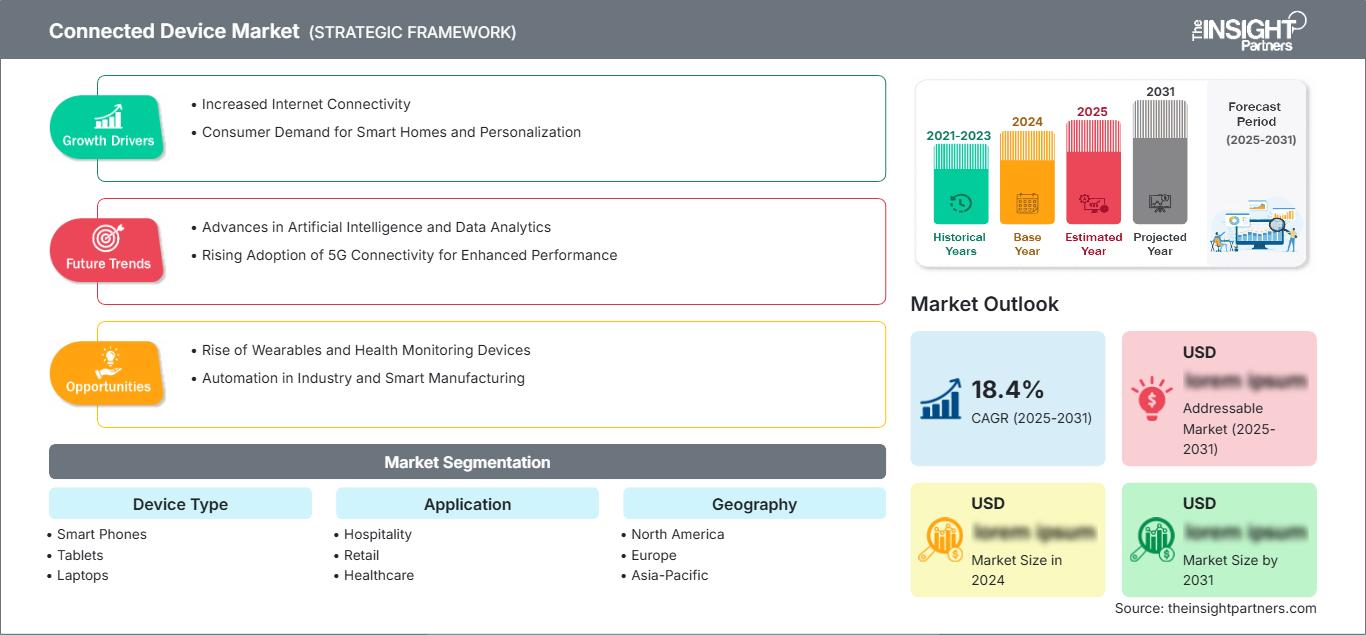
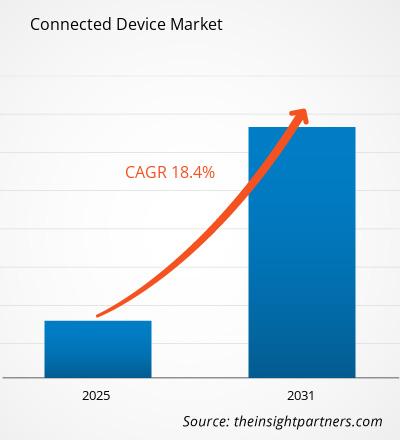
The Connected Device market was valued at US$ 41.25 Billion in 2025, and it is expected to reach US$ 255.48 Billion by 2034, growing at a CAGR of 22.46% from 2026 to 2034. The growth of the market can be attributed to smartphones, tablets, laptops, and personal computers becoming essential for business operations, education, healthcare, retail, hospitality, and consumers' interaction.
The Connected Device market size is expected to grow in North America at a CAGR ranging between 20.5–21.8%, due to factors like enterprise mobility, 5G network expansion, cloud managed end-points, and public digital infrastructure. Growth drivers for the market in the region include high smartphone penetration, PC replacement cycle, security management requirements, and replacement needs of healthcare organizations, retail chains, universities, and hotels.
Connected Device Market Assessment and Insights
- North America held 27–31% share in 2025 and is growing at a CAGR of 20.5–21.8% during 2026–2034, supported by 5G, enterprise mobility, and connected healthcare investment.
- US represented 79–83% of North America in 2025 and is growing at a CAGR of 20.8–22.0%, led by commercial deployments and premium devices.
- Europe accounted for 21–25% share in 2025 and is advancing at a CAGR of 19.2–20.6%, with Germany, the UK, France, Italy, and Spain leading deployments.
- Asia Pacific captured 36–40% of the Connected Device market share in 2025 and is expanding at a CAGR of 24.0–25.5%, led by China, India, Japan, South Korea, and Australia.
- Largest Segment Smart Phones held 49–53% market share in 2025 and are growing at a CAGR of 21.5–22.8%, supported by mobile-first consumer and enterprise workflows.
- High Growth Segment Healthcare applications held 13–16% share in 2025 and are growing at a CAGR of 25.5–27.2%, driven by remote care and mobile clinical access.
- Key companies analyzed in detail: Acer Incorporated, Apple Inc., BlackBerry Limited, Dell Technologies Inc., Gionee Communication Equipment Co., Ltd., HP Inc., HTC Corporation, LG Electronics Inc., Micromax Informatics Limited, Motorola Mobility LLC, Samsung Electronics Co., Ltd., and Lenovo Group Limited.
Source: The Insight Partners' analysis based on proprietary research, government publications, company annual reports, investor presentations, industry databases, and expert interviews.
Devices have moved away from single computing devices to cloud-enabled, AI-infused, and secured endpoints. This is depicted in the market through increased levels of integration of processors, displays, batteries, connectivity chips, OSs, and application software. Manufacturing of such devices continues to revolve around the Asian electronics hubs but the creation of value is increasingly dependent on ecosystem management, service bundling, enterprise security, post-sale services, and hardware refreshing capabilities.
Future demands for connected devices will be influenced by new geography, rollout of 5G technology, digital public services, mobile healthcare, and education transformation. Manufacturers will be required to focus on development of energy-saving chipsets, device lifecycle services, toughened forms, and secure endpoint management. Issues such as cybersecurity, environmental pollution due to e-waste, data protection laws, and right to repair issues will be a concern for regulation makers.
Connected Device Market Report Scope
| Report Attribute | Details |
|---|---|
| Market size in 2025 | US$ 41.25 Billion |
| Market Size by 2034 | US$ 255.48 Billion |
| Global CAGR (2026 - 2034) | 22.46% |
| Historical Data | 2021-2024 |
| Forecast period | 2026-2034 |
Connected Device Market Analysis
Connected Device Market growth is attributed to the increasing requirements for mobile productivity, e-commerce, education, and information sharing. Smartphones serve as the focal access point, and tablets, laptops, and PCs are used for applications which require bigger screen sizes, keyboard, computing power, and managed environments. The companies purchase devices as an integral component of their endpoint solution plans for security, identification, cloud collaboration, and management.
The supply factors are semiconductors, display, memory, battery, camera, connectivity chipsets, operating system, and assembly capabilities. IDC projects the 2025 global PC shipment to reach 274 million units, driven by the upgrade requirements of businesses and the Windows migration strategy. GSMA valued the economic impact of mobile technology solutions in 2024 at US$ 6.5 trillion.
The Connected Device Market report suggests a competitive environment that is influenced by premium ecosystems, enterprise connections, and geographic presence. Apple Inc. operates in a highly competitive market relying on its hardware, software, and services. The competition in Samsung Electronics Co., Ltd. and Lenovo Group Limited combines consumer-scale capabilities and enterprise solutions. Dell Technologies Inc., HP Inc., and Acer Incorporated focus on the refresh cycles of commercial PCs, whereas BlackBerry Limited specializes in endpoint software and communication solutions.
Competitive positioning evolves from hardware sales to lifecycle services, device financing, AI-driven user experience, and cybersecurity. The Motorola Mobility LLC, LG Electronics Inc., HTC Corporation, Micromax Informatics Limited, and Gionee Communication Equipment Co., Ltd. concentrate on specific regions or categories. Investments will be made when vendors can leverage the combination of supply capability, channel presence, application compatibility, and secure management tools for multi-device environments.
● REPORT CUSTOMIZATION
Tailor This Report To Align With Your Specific Business Requirements
This report can be customized to align precisely with your business objectives, scope, and target markets. Customization options include tailored segmentation, geography, competitive analysis, and strategic insights to support informed decision-making.
Customize This Report →WHAT YOU CAN ADJUST
- ● Segmentations
- ● Geography
- ● Competitive Analysis
- ● Language Preferences
Connected Device Market: Strategic Insights
Regional Insights
North America Connected Device Market
North America held 27–31% share in 2025 and is projected to grow at a CAGR of 20.5–21.8% through 2034. The market share in the region is supported by advanced 5G availability, high enterprise cloud adoption, strong replacement cycles, and rising use of managed smartphones, tablets, laptops, and PCs across regulated industries.
Healthcare systems use connected endpoints for mobile clinical records, telehealth, and patient engagement, while retail chains deploy tablets and handheld devices for inventory, checkout, and customer service. Hospitality operators are upgrading guest-facing and staff devices. Enterprise buyers prioritize cybersecurity, device management, warranty coverage, and interoperability with collaboration platforms, creating recurring demand across premium and mid-tier categories.
U.S. Connected Device Market
The US accounted for 79–83% of North America in 2025 and will continue to expand at a compound annual growth rate (CAGR) of 20.8–22.0%. Drivers of demand include enterprise IT spending, government modernization, digital health care systems, device schemes of universities, and replacement cycles of consumers. The companies that have strong commercial and consumer base are Apple Inc., Dell Technologies Inc., HP Inc., Samsung Electronics Co., Ltd., Lenovo Group Limited, and Motorola Mobility LLC.
Current trends in the application market involve using secure smartphones for field personnel, tablets for patients and guests' engagement, laptops for working from home, and PCs for educational labs and professionals. There is an increased demand among retailers and hospitals for the devices that enable mobile payments, user authentication, scheduling, analytics dashboard, and communication.
Europe Connected Device Market
Share of Europe was 21–25% in 2025 and it is expected to register a CAGR of 19.2–20.6%. Germany is dominating regional adoption through digitization of industry, PCs for enterprises, and healthcare information technology. UK is driving procurement in the public sector, retail, and education sector. France contributes procurement driven by healthcare networks, hospitality, and digital government services.
Italy and Spain are becoming increasingly important regions driven by small businesses, tour operators, and schools’ investments in computing and mobile devices. European customers value security of data, energy efficiency, reparability, and lifecycle management. Adoption is disciplined, but device replacement cycles are robust due to the need to have access to cloud applications and digital services.
APAC Connected Device Market
The Asia Pacific region had a market share of 36%–40% in 2025, while the forecast suggests that its growth will come in terms of 24.0%–25.5% CAGR. China dominates the market due to mass production, high number of smartphones, and enterprise digitalization. Fast adoption of technology in India is driven by mobile-first users, education initiatives, modernized retail segment, and healthcare.
Positive policies regarding electronics production, digital identity, 5G deployment, and smart infrastructure drive the growth in the region. APAC plays an important role in components and final assembly, which provides suppliers with cost benefits, shortened production cycle, and export abilities. APAC is the most dynamic volume opportunity in the Connected Devices Market.
Middle East & Africa Connected Device Market
Middle East & Africa is projected to grow at a CAGR of 21.0–22.5% as Saudi Arabia, the UAE, South Africa, and the rest of MEA invest in digital government, healthcare modernization, education access, and smart-city infrastructure. The UAE leads regional adoption through enterprise technology spending, retail penetration, and hospitality digitization.
Energy diversification programs create demand for connected endpoints in offices, field operations, control rooms, and training centers. South Africa contributes through banking, education, and retail channels, while broader MEA remains price sensitive. Distribution partnerships, financing options, warranty support, and localized service networks are essential for scalable adoption.
Segmentation Analysis
Device Type
Device Type is expected to grow at a CAGR of 22.0–23.5% from 2026 to 2034 as the Connected Device Market scope spans mobile-first devices, portable productivity tools, and fixed computing endpoints. Buyers choose based on screen size, application workload, mobility, security requirements, price, replacement cycles, and compatibility with enterprise platforms.
- Smart Phones remain the largest category because they serve as the primary access point for communication, digital payments, identity, retail engagement, remote work, and healthcare interactions across consumer and enterprise environments.
- Tablets gain demand in hospitality, retail, healthcare, and education where touch interfaces, portability, long battery life, and shared-device workflows support service delivery and customer-facing applications.
- Laptops are strategically important for hybrid work, professional learning, and enterprise productivity because they combine mobility, computing power, security features, and compatibility with collaboration and business software.
- Personal Computers remain relevant for education labs, administrative offices, retail back offices, healthcare workstations, and professional users who require larger displays, peripherals, durability, and centralized management.
Application
Application demand is forecast to grow at a CAGR of 22.3–24.0% during 2026–2034 as connected endpoints become embedded in service operations, learning delivery, clinical workflows, and commerce. Organizations increasingly evaluate devices by workflow value rather than hardware specifications alone, creating differentiated demand across verticals.
- Hospitality uses tablets, smartphones, laptops, and PCs for booking, guest check-in, staff coordination, room service, loyalty engagement, and back-office operations across hotels, restaurants, and travel venues.
- Retail demand is shaped by mobile point-of-sale, inventory visibility, customer assistance, self-service kiosks, and omnichannel fulfillment, making device reliability and application uptime commercially important.
- Healthcare adoption accelerates through telehealth, mobile clinical records, patient monitoring interfaces, scheduling, pharmacy workflows, and secure staff communication across hospitals, clinics, and home-care networks.
- Education requires laptops, tablets, and PCs for digital classrooms, remote learning, testing, administration, and content access, with affordability, durability, management, and connectivity influencing procurement.
Opportunity Snapshot
| Application | Revenue Contribution | Trend Tag | Adoption Stage |
| Hospitality | Medium | Guest Mobility | Scaling |
| Retail | High | Mobile POS | Mature |
| Healthcare | High | Remote Care | Scaling |
| Education | Medium | Digital Class | Scaling |
| Others | Low | Field Access | Emerging |
Connected Device Market Growth Drivers and Impact Analysis
5G and Cloud Services Raise Endpoint Utility
The spread of 5G coverage, coupled with cloud application usage, is adding value to smartphones, tablets, laptops, and desktops through quicker access to collaborative tools, analytics, payments, and services. It is most beneficial to organizations that require instant updates in the field, safe customer interaction, and always available information about operations. GSMA estimates that mobility adds as much as 5.8% to the GDP of the world through increased productivity due to connectivity. Improved capacity of the networks makes it easier for consumers to upgrade their existing products with better bandwidth, security, and advanced applications.
Digital Healthcare and Education Expand Institutional Demand
The need for institutional demand has been brought about by healthcare and education. These industries depend on continuous access to records, information, communications, and remotely accessible services. Hospitals rely on connectivity in order to document, consult, perform pharmaceutical procedures, and coordinate activities, whereas institutions rely on connectivity through the use of tablets, laptops, and personal computers for mixed learning and assessment. The implication of all this is increased demand for management of fleets, durability of equipment, device financing, and centralization of support systems. Providers who can give secure configuration, warranties, and deployment tools stand a chance.
Retail and Hospitality Digitization Strengthens Frontline Adoption
For retailers and the hospitality industry, increasing reliance on connected devices can help enhance speed of service, stock accuracy, flexible payment options, and customer interactions. These devices include tablets and phones for mobile checkouts, queuing, loyalty programs, communication, and booking, and laptops and desktops for administrative and analytical tasks. This driver directly impacts the bottom line since poor performance and downtime can have an effect on customer experience and process execution. As omnichannel retailing and digitally transformed hospitality grow, there may be more standardization of device inventories, incorporation of security features, and endpoint replacements to facilitate customer apps.
Connected Device Market Future Trends
On-Device AI Becomes a Differentiator
Connected Device Market trends will increasingly reflect on-device AI as processors, operating systems, and applications shift more tasks from cloud-only processing to local inference. This will support faster translation, image enhancement, personal assistants, clinical documentation support, fraud detection, and productivity automation while reducing latency and improving privacy. The trend will reshape purchasing criteria because buyers will compare neural processing capability, battery efficiency, software support, and security architecture. Vendors with integrated hardware and software roadmaps will gain advantage, while fragmented portfolios may face pressure to prove long-term upgrade value.
Lifecycle Services Become Central to Enterprise Procurement
Enterprise buyers are expected to place greater weight on lifecycle services, including deployment, configuration, repair, recycling, security updates, and device return programs. This trend will move purchasing decisions away from unit price alone toward predictable total cost of ownership. Suppliers offering financing, managed endpoint platforms, certified repair networks, and transparent sustainability reporting can strengthen retention. Over the forecast period, service-led procurement will be especially important in healthcare, education, retail, and public administration, where organizations need large device fleets but must control data security, downtime, and compliance obligations.
Connected Device Market Opportunities
Managed Device Programs for Regulated Industries
Regulated industries offer a strong investment opportunity because healthcare, banking, education, and public agencies need secure devices that can be deployed, monitored, updated, and retired under strict compliance controls. Connected Device Market Forecasts point to rising demand for bundled hardware, identity management, endpoint protection, and service contracts. Vendors should target decision-makers with device-as-a-service models that reduce upfront spending and improve lifecycle accountability. The opportunity is strongest where organizations manage thousands of endpoints across multiple sites and require consistent security, warranty support, application compatibility, and audit-ready asset records.
Affordable Connected Devices for Emerging Digital Services
Emerging markets create an opportunity for affordable smartphones, tablets, laptops, and PCs aligned with digital identity, mobile payments, remote learning, and public healthcare access. Success will depend on balancing price, durability, battery life, local language support, and financing options. Manufacturers can expand through education tenders, telecom partnerships, local assembly, and after-sales networks. This opportunity is distinct from premium device demand because value engineering and distribution reliability are more important than flagship specifications. Suppliers that build trust through service availability and ecosystem partnerships can convert first-time users into repeat customers.
Recent Developments
- June 2026: Apple Inc. introduced new operating system capabilities across iPhone, iPad, and Mac ecosystems, emphasizing Apple Intelligence, continuity features, and developer tools that strengthen cross-device user experience and productivity workflows.
- March 2026: Dell Technologies Inc. expanded its commercial PC and AI PC portfolio at CES, highlighting refreshed Dell Pro devices, security features, and lifecycle services designed for enterprise deployment across hybrid work and managed endpoint environments.
- September 2025: Acer Incorporated announced new AI-ready laptops and commercial devices at IFA, expanding its Swift, TravelMate, and Chromebook portfolios to address productivity, education, and enterprise mobility demand.
Frequently Asked Questions

- Comprehensive Market Sizing and Forecast Analysis
- Detailed Segmentation Analysis
- In-Depth Market Dynamics Assessment
- Regional and Country-Level Insights
- Competitive Landscape and Company Benchmarking
- Strategic Business Intelligence
Recent Reports
Testimonials

The Insight Partners' SCADA System Market report is comprehensive, with valuable insights on current trends and future forecasts. The team was highly professional, responsive, and supportive throughout. We are very satisfied and highly recommend their services.
RAN KEDEM Partner, Reali Technologies LTDs
I requested a report on a very specific software market and the team produced the report in a few days. The information was very relevant and well presented. I then requested some changes and additions to the report. The team was again very responsive and I got the final report in less than a week.
JEAN-HERVE JENN Chairman, Future Analytica
We worked with The Insight Partners for an important market study and forecast. They gave us clear insights into opportunities and risks, which helped shape our plans. Their research was easy to use and based on solid data. It helped us make smart, confident decisions. We highly recommend them.
PIYUSH NAGPAL Sr. Vice President, High Beam Global
The Insight Partners delivered insightful, well-structured market research with strong domain expertise. Their team was professional and responsive throughout. The user-friendly website made accessing industry reports seamless. We highly recommend them for reliable, high-quality research services
YUKIHIKO ADACHI CEO, Deep Blue, LLC.
This is the first time I have purchased a market report from The Insight Partners.While I was unsure at first, I visited their web site and felt more comfortable to take the risk and purchase a market report.I am completely satisfied with the quality of the report and customer service. I had several questions and comments with the initial report, but after a couple of dialogs over email with their analyst I believe I have a report that I can use as input to our strategic planning process.Thank you so much for taking the extra time and making this a positive experience.I will definitely recommend your service to others and you will be my first call when we need further market data.
JOHN SUZUKI President and Chief Executive Officer, Board Director, BK Technologies
I wish to appreciate your support and the professionalism you displayed in the course of attending to my request for information regarding to infectious disease IVD market in Nigeria. I appreciate your patience, your guidance, and the fact that you were willing to offer a discount, which eventually made it possible for us to close a deal. I look forward to engaging The Insight Partners in the future, all thanks to the impression you have created in me as a result of this first encounter.
DR CHIJIOKE ONYIA MANAGING DIRECTOR, PineCrest Healthcare Ltd.Reason to Buy
- Informed Decision-Making
- Understanding Market Dynamics
- Competitive Analysis
- Identifying Emerging Markets
- Customer Insights
- Market Forecasts
- Risk Mitigation
- Boosting Operational Efficiency
- Strategic Planning
- Investment Justification
- Tracking Industry Innovations
- Aligning with Regulatory Trends





 Get Free Sample for