
Contactless Connector Market Size, Growth & Demand by 2034
Contactless Connector Market Size and Forecasts (2021–2034), Global and Regional Share, Trends, and Growth Opportunity Analysis Report Coverage : By Product Type (Wireless Charging Connectors and Wireless Data Transfer Connectors (NFC Connectors, RFID Connectors, Others)), Technology (Inductive Coupling, Radio Frequency, and Magnetic Field), Data Rate (1 Gbps, 3 Gbps, and Up to 6 Gbps), Mode of Operation (Simplex Connectivity, Half-Duplex Connectivity, and Full-Duplex Connectivity), Vertical (Consumer Electronics, Automotive, Healthcare, and Industrial)
- Status : Data Released
- Report Code : TIPRE00039797
- Category : Electronics and Semiconductor
- No. of Pages : 150
- Available Report Formats :


- Last update date : July 27, 2026


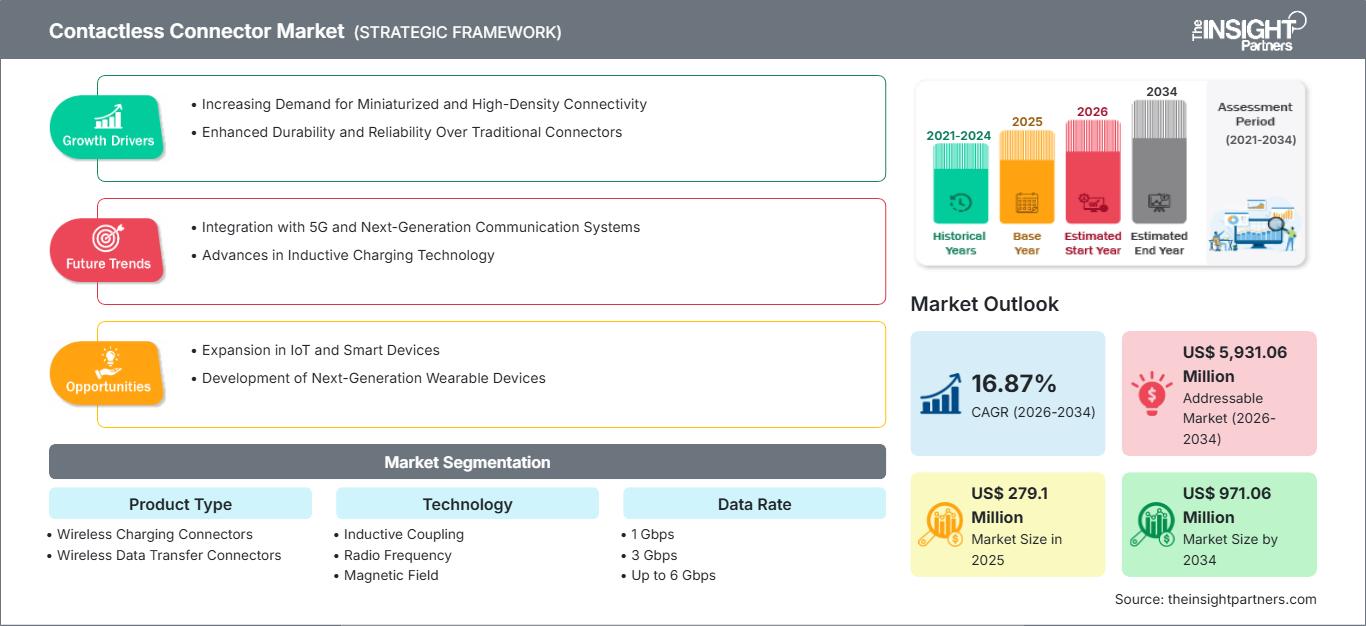
2025 Market Size
US$ 279.1 Mn
Base year value
2034 Forecast
US$ 971.06 Mn
Projected by 2034
CAGR 2026-2034
16.87 %
Growth rate
Addressable Market
US$ 5,931.06 Mn
(2026-2034)
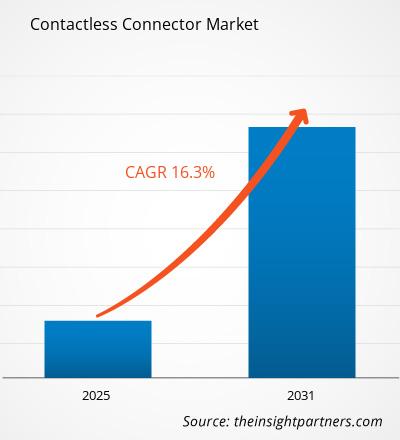
The Contactless Connector Market was valued at US$ 279.1 Million in 2025 and is forecasted to reach US$ 971.06 Million by 2034, growing at a CAGR of 16.87% between 2026 and 2034. This includes wireless charging connectors and wireless data transfer connectors that facilitate power transfer/data transfer through a connection that has no exposed electrical contacts.
The North American Contactless Connector Market size is expected to grow at a CAGR of 15.8–16.6% between 2026 and 2034, aided by automated manufacturing, development of medical devices, EV platforms, and reliable electronics design. North America is advantaged by robust design in the U.S., where sealed connections, lower maintenance costs, and safe short-range connection have become increasingly relevant.
Contactless Connector Market Assessment and Insights
- North America held 29–33% share in 2025 and is growing at a CAGR of 15.8–16.6% during 2026–2034, led by industrial robotics, medical electronics, aerospace systems, and automotive electrification programs.
- US represented 76–80% of North American revenue in 2025 and is growing at a CAGR of 16.0–16.8% during 2026–2034, supported by advanced manufacturing and defense electronics.
- Europe accounted for 25–29% share in 2025 and is growing at a CAGR of 15.1–15.9% during 2026–2034, with Germany, the UK, France, Italy, and Spain leading adoption.
- Asia Pacific held 34–38% share in 2025 and is growing at a CAGR of 17.6–18.4% during 2026–2034, led by China, Japan, South Korea, India, and Australia.
- Largest Segment Wireless Charging Connectors held 55–59% market share in 2025 and is growing at a CAGR of 16.2–17.0% during 2026–2034 due to rising cable-free power requirements.
- High Growth Segment Wireless Data Transfer Connectors represented 41–45% market share in 2025 and is growing at a CAGR of 17.5–18.3% during 2026–2034, supported by automation and sealed devices.
- Key companies analyzed in detail: TE Connectivity plc; Molex LLC; Rosenberger Hochfrequenztechnik GmbH & Co. KG; Amphenol Corporation; Hirose Electric Co., Ltd.; Luxshare Precision Industry Co., Ltd.; Yamaichi Electronics Co., Ltd.; Smiths Interconnect; Kyocera AVX Components Corporation; Japan Aviation Electronics Industry, Limited.
Source: The Insight Partners' analysis based on proprietary research, government publications, company annual reports, investor presentations, industry databases, and expert interviews.
Contactless interfaces are emerging from specialized connector solutions into engineered modules integrating antennas, power electronics, transceivers, housings, firmware, and thermal management. Manufacturing processes are becoming increasingly concerned with form factor, ingress protection, electromagnetic compatibility, and performance repeatability through air gaps. Manufacturers are matching their connector mechanical experience with knowledge of RF, inductive, and magnetic fields as users seek the benefit of reliable contactless transmission while avoiding any loss of validation rigor, manufacturability, and engineering services.
Future growth opportunities will expand as smart manufacturing, medical instrumentation, EV sub-systems, and autonomous machines demand sealed and friction-free interfaces. Research and development efforts are expected to center in Asia Pacific manufacturing centers, North America design facilities, and Europe's industrial automation clusters. Government concerns for medical hygiene, EV safety, and industrial up-time facilitate the migration to contactless interfaces where contamination, vibration, cleaning cycles, or repetitive mating lower long-term performance.
Contactless Connector Market Report Scope
| Report Attribute | Details |
|---|---|
| Market size in 2025 | US$ 279.1 Million |
| Market Size by 2034 | US$ 971.06 Million |
| Global CAGR (2026 - 2034) | 16.87% |
| Historical Data | 2021-2024 |
| Forecast period | 2026-2034 |
Contactless Connector Market Analysis
The Contactless Connector market grows due to the necessity to prevent mechanical wear and tear, contamination, and maintenance from affecting high duty electronics. Its value chain involves semiconductor suppliers, antenna suppliers, magnetic component manufacturers, connector producers, module assemblers, OEM engineers, distributors, and certifying parties. The largest demand is observed where seal-tightness, rotation capability, compactness, or reconnection enhance the reliability of the system.
The market supply is influenced by the availability of RF components, material used for coils, conversion efficiency, precision molding, and the capacity to validate the solution. In addition, the ecosystem includes wireless power standards, industrial communication standards, automobile safety standards, and medical device reliability standards. Consumers now prefer to consider the range of the transfer, misalignment tolerance, energy efficiency, latency, ingress protection, and the total lifetime cost of the device.
Contactless Connector Market analysis reveals competition among diversified connector manufacturers and specialized technology developers. The competitors include TE Connectivity plc, Amphenol Corporation, Molex LLC, Hirose Electric Co., Ltd., and Japan Aviation Electronics Industry, Limited, which compete by having access to extensive engineering capabilities, vehicle approvals, and large-scale customer programs. Rosenberger Hochfrequenztechnik GmbH & Co. KG competes through its specialized RF based contactless data and power modules for extreme conditions.
Competitors such as Luxshare Precision Industry Co., Ltd., Yamaichi Electronics Co., Ltd., Smiths Interconnect, and Kyocera AVX Components Corporation have enhanced the competitive environment via manufacturing scale, miniaturization capability, and high reliability interconnect product lines. Investment trends are towards 60 GHz connection modules, inductive charging systems, medical grade sealed connectors, and factory automation modules. Competitive strategy requires validation data, integration capability, application engineering, and reliable regional supply.
● REPORT CUSTOMIZATION
Tailor This Report To Align With Your Specific Business Requirements
This report can be customized to align precisely with your business objectives, scope, and target markets. Customization options include tailored segmentation, geography, competitive analysis, and strategic insights to support informed decision-making.
Customize This Report →WHAT YOU CAN ADJUST
- ● Segmentations
- ● Geography
- ● Competitive Analysis
- ● Language Preferences
Contactless Connector Market: Strategic Insights
Regional Insights
North America Contactless Connector Market
North America constituted 29–33% of the Contactless Connector Market share in 2025 and is forecasted to grow at a CAGR of 15.8–16.6% in 2026–2034. Applications include automated systems, medical device electronics, EV charging systems, aerospace platforms, and high data rates that need robust and low maintenance solutions.
The regional market is bolstered by the digitalization of industries, the capability of electronic design, and consumer preferences for reliability in critical applications. The United States holds a lead in system integrations, whereas Canada and Mexico bring manufacturing expertise and automotive electronics to the table. Companies that have application laboratories, certification, and distributors can capture the early adopters.
U.S. Contactless Connector Market
The U.S. accounted for 76%-80% of the North American market in 2025 and is projected to post a CAGR of 16.0-16.8% between 2026 and 2034. Demand is driven by robotics, defense electronics, medical devices, EV platforms, semiconductor manufacturing equipment, and heavy-industry applications requiring contamination-free connection technologies.
TE Connectivity plc, Molex LLC, Amphenol Corporation, Smiths Interconnect, and Rosenberger Hochfrequenztechnik GmbH & Co. KG retain their visibility via engineering expertise, distribution networks, and high-reliability product ranges. The key requirements of U.S. customers include superior electromagnetic characteristics, small form factor, cyber-secure data connectivity solutions, and demonstration of reduced serviceability due to contactless interface.
Europe Contactless Connector Market
Europe's market shares were 25-29% in 2025 and will grow by a compound annual growth rate (CAGR) of 15.1-15.9% during 2026-2034. Europe's Germany dominates the regional market due to automation, automotive electronics, robotics, and machinery industries. Europe's UK makes contributions through their aerospace, medical technology, and defense electronics systems programs that require robust and hermetic contact interfaces.
France, Italy, and Spain contribute to demand in rail, industrial equipment, energy, and electronics assembly applications. European customers demand functional safety, electromagnetic compatibility, energy efficiency, and longevity validation of products. The Contactless Connector Market will see its growth encouraged by advances in automation and sustainability goals.
APAC Contactless Connector Market
The Asia Pacific region held 34–38% market share in 2025 and will register a compound annual growth rate of 17.6–18.4% during 2026–2034. China dominates in the production of electronic devices and in supply chain operations for electric vehicles, robotics, and smart factories, while Japan and South Korea contribute through precision automation and reliable miniaturized electronics.
India and Australia offer contributions in terms of industrialization, manufacturing of medical devices, automation in mining, and monitoring of renewable energy infrastructure. The policy support provided for advanced manufacturing, semiconductors, and electric vehicle ecosystem development facilitates the adoption process despite sensitivity toward pricing and qualifications.
Middle East & Africa Contactless Connector Market
Market growth in the Middle East & Africa region is estimated to have a CAGR between 13.8-14.6%. The leading countries include Saudi Arabia due to the need for smart infrastructure, energy establishments, logistics systems, and industrial development in areas where there is a need for electronic components which are subject to dust, heat, and vibrations.
In the UAE, there is demand owing to airport, data center, port and building systems development while in South Africa and the rest of MEA, it arises from the need for mining automation, utility services, medical equipment and telecommunications infrastructure. The demanding environment presents a use case for sealed contactless power transfer.
Segmentation Analysis
Product Type
Product Type is projected to grow at a CAGR of 16.7–17.5% during 2026–2034. The Contactless Connector Market scope covers wireless charging connectors and wireless data transfer connectors selected according to power level, data integrity, gap tolerance, enclosure design, and operating environment. Wireless charging connectors dominate present revenue, while wireless data transfer connectors are gaining importance in automation, medical, and sealed device architectures.
- Wireless Charging Connectors lead adoption where cable-free power improves docking convenience, reduces exposed contacts, and supports sealed electronics in automotive, medical, consumer, and industrial equipment.
- Wireless Data Transfer Connectors gain strategic importance where short-range, high-reliability communication is needed across rotating joints, removable modules, cleanable surfaces, and harsh manufacturing environments.
Technology
Technology is forecast to grow at a CAGR of 16.5–17.3% during 2026–2034. Inductive coupling supports power transfer and compact charging designs, radio frequency enables high-speed data across short air gaps, and magnetic field approaches serve applications needing tolerant alignment and robust performance. Technology choice depends on efficiency, data rate, shielding, interference control, safety certification, and integration complexity.
- Inductive Coupling remains central to wireless charging applications because it offers mature power-transfer principles, scalable module designs, and familiar engineering pathways for compact equipment.
- Radio Frequency supports high-speed data transfer in robotics, medical systems, and automation equipment where sealed, rotational, or contamination-resistant links create operational value.
- Magnetic Field solutions address applications needing alignment tolerance, durability, and contact-free transfer across challenging environments where repeated mechanical mating is undesirable.
Data Rate
Data Rate is expected to grow at a CAGR of 16.6–17.4% during 2026–2034. Data-rate selection reflects the trade-off between bandwidth, power consumption, latency, air-gap stability, and certification. Lower-rate links suit sensing and control, 3 Gbps supports industrial equipment and machine interfaces, and up to 6 Gbps enables high-bandwidth use cases in imaging, robotics, and advanced medical devices.
- 1 Gbps addresses control, sensing, and moderate-bandwidth equipment where reliability, compactness, and low implementation complexity are more important than peak throughput.
- 3 Gbps serves machine vision, industrial modules, and medical equipment that need faster transfer without the integration burden of the highest-speed architectures.
- Up to 6 Gbps supports advanced imaging, robotics, and high-throughput systems where contactless links must preserve data integrity while eliminating wear-prone connectors.
Mode of Operation
Mode of Operation is projected to grow at a CAGR of 16.4–17.2% during 2026–2034. Simplex connectivity supports one-way sensing or command links, half-duplex connectivity balances cost and two-way communication, and full-duplex connectivity enables simultaneous bidirectional exchange in advanced automation and medical systems. Selection depends on latency, protocol design, reliability requirements, and the value of real-time feedback.
- Simplex Connectivity fits one-direction transfer needs such as sensor output, identification signals, or status communication where low complexity and reliability matter most.
- Half-Duplex Connectivity supports controlled two-way communication in industrial and consumer devices where alternating transmit and receive cycles reduce system cost and complexity.
- Full-Duplex Connectivity becomes strategically important in robotics, medical systems, and high-speed automation where simultaneous command and feedback improve precision and uptime.
Opportunity Snapshot
| Product Type | Revenue Contribution | Trend Tag | Adoption Stage |
| Wireless Charging Connectors | High | Sealed Power | Scaling |
| Wireless Data Transfer Connectors | Medium | RF Links | Emerging |
Contactless Connector Market Growth Drivers and Impact Analysis
Wear-free interfaces reduce lifecycle downtime
Industrial robots, automated guided vehicles, medical devices, and modular electronics often experience repeated docking, vibration, cleaning, or contamination exposure. Physical contacts can corrode, bend, collect debris, or require maintenance after many mating cycles. Contactless Connector Market adoption directly addresses this reliability gap by moving power and data transfer across short air gaps. The market impact is strongest where downtime is expensive, access is difficult, or equipment must remain sealed. Manufacturers can justify premium modules by quantifying lower service calls, longer device life, fewer consumables, and more predictable uptime across distributed equipment fleets.
Wireless power adoption expands sealed device design
Wireless charging connectors are gaining relevance as OEMs design products with fewer ports, tighter ingress protection, and cleaner external surfaces. Medical instruments, wearable electronics, industrial sensors, EV subsystems, and mobile robots benefit from sealed housings that reduce moisture and dust entry. This driver expands the addressable market beyond convenience charging into equipment reliability and certification strategy. Suppliers that provide coils, shielding guidance, thermal analysis, and integration support can influence early design decisions. The commercial impact is rising demand for standardized modules that reduce engineering risk while improving user experience and field durability.
High-speed automation needs reliable short-range data links
Factories are using more machine vision, rotating tooling, collaborative robots, and modular production cells that require dependable data exchange without cable strain or exposed contacts. Radio frequency and magnetic approaches allow short-range communication through sealed or moving interfaces, reducing mechanical complexity. Contactless links are especially valuable where hygiene, dust, vibration, or frequent tool changes make conventional connectors vulnerable. The market impact includes higher demand for validated data integrity, electromagnetic compatibility, and latency performance. Vendors able to demonstrate stable operation under industrial conditions can win positions in automation platforms and replacement programs.
Contactless Connector Market Future Trends
RF-based sealed data modules become standardized
Contactless Connector Market trends point toward broader standardization of compact RF-based modules that deliver validated data transfer across predictable air gaps. Future products will combine transceivers, antennas, shielding, diagnostics, and firmware in pre-qualified packages, reducing the burden on OEM design teams. This shift will be important in robotics, medical imaging, semiconductor tools, and cleanable industrial systems. As module libraries mature, adoption will move from custom engineering projects to repeatable platform specifications. Suppliers with test data, application notes, and multi-region support will gain an advantage as customers seek faster qualification and lower design risk.
Integrated power-and-data architectures gain traction
Future systems will increasingly combine wireless charging and short-range data transfer in one sealed interface, allowing devices to dock, authenticate, update, and recharge without exposed pins. This trend will support autonomous mobile robots, medical carts, smart tools, and modular factory equipment. Integrated architectures will require tighter coordination across thermal design, electromagnetic shielding, protocol security, and mechanical alignment. The opportunity for suppliers is to move from component sales toward engineered subsystems. Customers will favor validated assemblies that reduce integration effort and provide measurable reliability advantages over separate power and data connector designs.
Contactless Connector Market Opportunities
Automation retrofit kits for harsh industrial assets
Contactless Connector Market Forecasts support investment in retrofit kits for rotating equipment, robotic end effectors, automated guided vehicles, and production machinery exposed to dust, fluids, or vibration. Vendors can package contactless modules with mounting hardware, evaluation boards, firmware, shielding guidance, and service documentation. This opportunity is attractive because industrial users prefer upgrades that reduce downtime without redesigning entire machines. Channel partners can target maintenance-heavy assets and demonstrate payback through fewer connector failures, faster tool changes, and improved uptime. Local engineering support will be essential for converting pilot projects into plantwide programs.
Medical and hygienic electronics platforms
Medical device manufacturers can use contactless interfaces to simplify cleaning, reduce crevices, and improve reliability in diagnostic tools, patient monitoring systems, surgical instruments, and mobile healthcare equipment. Investment should focus on biocompatible housings, low-heat charging, secure data pairing, and documentation that supports regulatory submissions. This opportunity is distinct because buyers evaluate both clinical workflow and engineering reliability. Suppliers able to provide test evidence for cleaning cycles, electromagnetic safety, and long service life can become preferred partners. Growth will depend on early engagement with device designers and contract manufacturers.
Recent Developments
- November 2025: FC Lane Electronics Ltd announced the availability of CINCH Fibreco generic D38999 (MIL-DTL-38999 Series III derived) Fibre-Optic Connectors. Designed for performance-critical applications, these rugged connectors combine proven expanded beam technology with the familiar D38999 housing, offering reliability, flexibility, and cost-effective deployment in harsh environments.
- May 2025: Phoenix Contact added new IO-Link couplers to its portfolio for contactless power and data transmission. The innovative product enables contactless data exchange between IO-Link devices in existing automation systems and offers numerous advantages for users. The new IO-Link couplers are characterized by their high degree of flexibility and easy handling. The couplers communicate power (≤18 W) and IO-Link data (≤230.4 kbps) across an air gap of up to 7 mm without the need for contact. Power transmission is inductive. Near-field communication via air gap does not require frequency planning or wireless technology expertise.
- September 2023: Molex, a global electronics leader and connectivity innovator, has diversified its robust product portfolio with the introduction of the MX60 series of contactless connectivity solutions. These low-power, high-speed, solid-state devices feature miniaturized mmWave RF transceivers and built-in antennas in one complete package for faster, simpler, device-to-device communications without the use of physical cables or connectors. As a result, MX60 solutions offer greater product design freedom, seamless device pairing and increased communications reliability for video displays, sleek and light consumer electronics, industrial robotics and devices operating in harsh environments.
Frequently Asked Questions

- Comprehensive Market Sizing and Forecast Analysis
- Detailed Segmentation Analysis
- In-Depth Market Dynamics Assessment
- Regional and Country-Level Insights
- Competitive Landscape and Company Benchmarking
- Strategic Business Intelligence
Recent Reports
Testimonials

The Insight Partners' SCADA System Market report is comprehensive, with valuable insights on current trends and future forecasts. The team was highly professional, responsive, and supportive throughout. We are very satisfied and highly recommend their services.
RAN KEDEM Partner, Reali Technologies LTDs
I requested a report on a very specific software market and the team produced the report in a few days. The information was very relevant and well presented. I then requested some changes and additions to the report. The team was again very responsive and I got the final report in less than a week.
JEAN-HERVE JENN Chairman, Future Analytica
We worked with The Insight Partners for an important market study and forecast. They gave us clear insights into opportunities and risks, which helped shape our plans. Their research was easy to use and based on solid data. It helped us make smart, confident decisions. We highly recommend them.
PIYUSH NAGPAL Sr. Vice President, High Beam Global
The Insight Partners delivered insightful, well-structured market research with strong domain expertise. Their team was professional and responsive throughout. The user-friendly website made accessing industry reports seamless. We highly recommend them for reliable, high-quality research services
YUKIHIKO ADACHI CEO, Deep Blue, LLC.
This is the first time I have purchased a market report from The Insight Partners.While I was unsure at first, I visited their web site and felt more comfortable to take the risk and purchase a market report.I am completely satisfied with the quality of the report and customer service. I had several questions and comments with the initial report, but after a couple of dialogs over email with their analyst I believe I have a report that I can use as input to our strategic planning process.Thank you so much for taking the extra time and making this a positive experience.I will definitely recommend your service to others and you will be my first call when we need further market data.
JOHN SUZUKI President and Chief Executive Officer, Board Director, BK Technologies
I wish to appreciate your support and the professionalism you displayed in the course of attending to my request for information regarding to infectious disease IVD market in Nigeria. I appreciate your patience, your guidance, and the fact that you were willing to offer a discount, which eventually made it possible for us to close a deal. I look forward to engaging The Insight Partners in the future, all thanks to the impression you have created in me as a result of this first encounter.
DR CHIJIOKE ONYIA MANAGING DIRECTOR, PineCrest Healthcare Ltd.Reason to Buy
- Informed Decision-Making
- Understanding Market Dynamics
- Competitive Analysis
- Identifying Emerging Markets
- Customer Insights
- Market Forecasts
- Risk Mitigation
- Boosting Operational Efficiency
- Strategic Planning
- Investment Justification
- Tracking Industry Innovations
- Aligning with Regulatory Trends





 Get Free Sample for