
Container Weighing System Market Size, Growth & Trends by 2034
Coverage: by Component (Hardware, Software); Medium (Rail, Road, Ship); Vertical (Construction, Food and Beverage, Manufacturing, Transport and Logistics, Ports, Others) , and Geography (North America, Europe, Asia Pacific, and South and Central America)
- Status : Data Released
- Report Code : TIPRE00011658
- Category : Electronics and Semiconductor
- No. of Pages : 150
- Available Report Formats :


- Last update date : August 05, 2026


2025 Market Size
US$ 4.19 Bn
Base year value
2034 Forecast
US$ 6.24 Bn
Projected by 2034
CAGR 2026-2034
4.42 %
Growth rate
Addressable Market
US$ 47.11 Bn
(2026-2034)
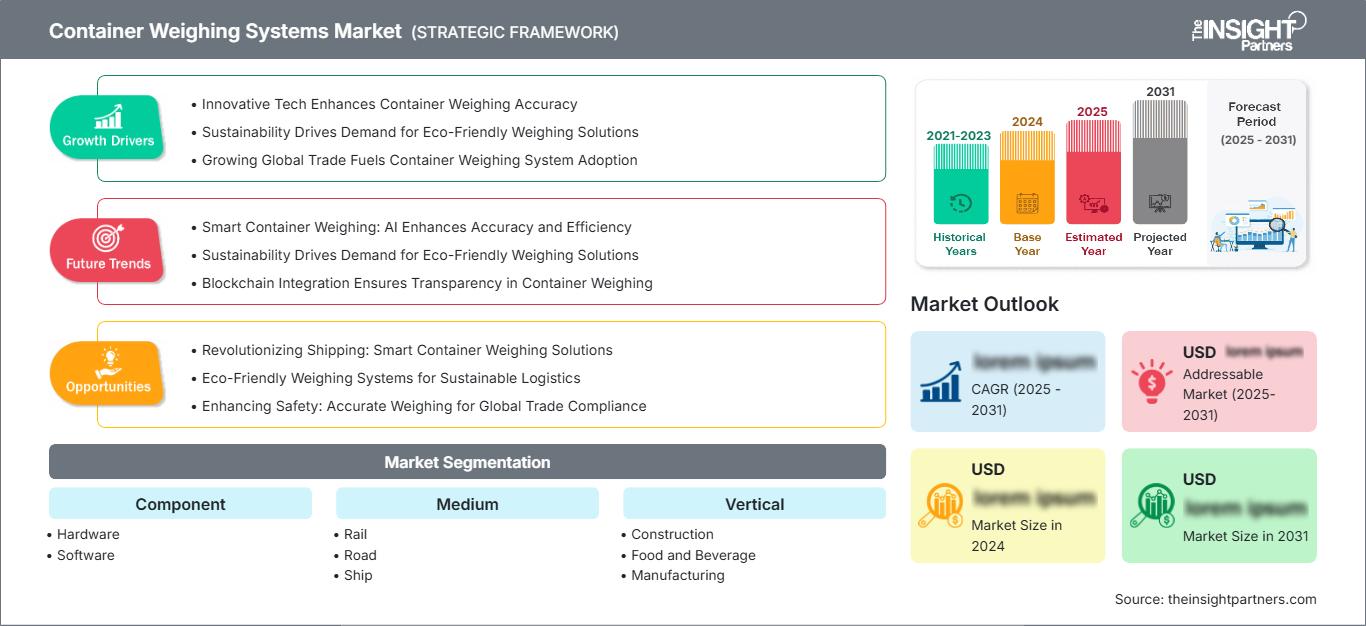
The Container Weighing System Market is expected to have a market value at US$ 4.19 Billion in 2025 growing to a valuation of US$ 6.24 Billion by 2034 with a 4.42% CAGR between 2026 and 2034. Factors driving demand for the market include the requirement for adherence to gross mass compliance, port automation, intermodal logistics accuracy, and the reduction of cargo safety risks in international freight transport.
In the North American region, Container Weighing System Market size is driven by high container handling volume, SOLAS-related verified gross mass requirements, rail yard modernization, and the deployment of terminal operating systems. The market is anticipated to grow at a 4.0–4.6% CAGR between 2026 and 2034.
Container Weighing System Market Assessment and Insights
- North America: The region is estimated to hold 25–29% share in 2025 and grow at a CAGR of 4.0–4.6% during 2026–2034, supported by port automation, rail intermodal upgrades, and shipper compliance systems.
- US: The country represents 76–80% of North America in 2025 and is projected to grow at a CAGR of 4.1–4.7% during 2026–2034.
- Europe: Europe accounts for 23–27% share in 2025 and is expected to grow at a CAGR of 3.8–4.4% during 2026–2034, led by Germany, the UK, France, Italy, and Spain.
- Asia Pacific: Asia Pacific represents 34–38% share in 2025 and is forecast to grow at a CAGR of 4.8–5.4% during 2026–2034, with China, Japan, South Korea, India, and Australia anchoring adoption.
- Largest Segment: Hardware holds 68–72% market share in 2025 and is expected to grow at a CAGR of 3.9–4.5% during 2026–2034.
- High Growth Segment: Software holds 28–32% market share in 2025 and is expected to grow at a CAGR of 5.3–5.9% during 2026–2034.
- Key companies analyzed in detail: Mettler-Toledo International Inc.; Avery Weigh-Tronix, LLC; Bromma Conquip AB; Fairbanks Scales Inc.; Flintec Inc.; Hottinger Brüel & Kjær GmbH; Rice Lake Weighing Systems; Strainstall UK Limited; Tamtron Group Oyj; Weightron Bilanciai Limited.
Source: The Insight Partners' analysis based on proprietary research, government publications, company annual reports, investor presentations, industry databases, and expert interviews.
The Container Weighing System Market has changed from weighbridges to fully integrated systems that involve load cells, hydraulic weighing, crane-based scales, on-weighing modules, and terminal software capturing verified gross mass through routine handling processes. The production factors that are currently influencing this industry include robust electronic equipment, calibration stability, conformity with OIML, wireless communications, and integration with APIs since the ports and inland container depots require the weighing events to feed automatically into the yards', customs', and carriers' documentation systems.
The Container Weighing System Market report indicates that future demand will be influenced by port development in Asia, investment in rail transport in North America, stricter regulations in Europe, and logistics-zone development in the Middle East. The change from manual tickets to digital weighing is occurring in view of container misdeclaration which impacts ship stability, axle weights on trucks, and terminal efficiency.
Container Weighing System Market Report Scope
| Report Attribute | Details |
|---|---|
| Market size in 2025 | US$ 4.19 Billion |
| Market Size by 2034 | US$ 6.24 Billion |
| Global CAGR (2026 - 2034) | 4.42% |
| Historical Data | 2021-2024 |
| Forecast period | 2026-2034 |
Container Weighing System Market Analysis
The Container Weighing System Market growth drivers include SOLAS verified gross mass, increased container volumes, automated terminal processes, and shippers’ requirement of reliable and verifiable data. The supply chain consists of load cell manufacturers, scale manufacturers, crane/spreader original equipment manufacturers, indicator manufacturers, weighing software providers, system integrators, certification authorities, port companies, logistic companies, and industrial shippers.
The supply dynamics give an advantage to vendors with capability to prove the accuracy of their solution during vibrations, eccentric loads, weather conditions, and high cycle applications. The Container Weighing System Market research suggests that buyers evaluate certification, calibration capabilities, retrofit capabilities, data security, availability, software capabilities, and services before making their purchase decisions.
The competition encompasses Mettler-Toledo International Inc., Avery Weigh-Tronix, LLC, Bromma Conquip AB, Fairbanks Scales Inc., Flintec Inc., Hottinger Brüel & Kjær GmbH, Rice Lake Weighing Systems, Strainstall UK Limited, Tamtron Group Oyj, and Weightron Bilanciai Limited. Competitive advantage derives from weighing precision, robustness for heavy industry applications, terminal compatibility, certifications, and worldwide services.
Capital expenditure will go into crane-scale combination systems, reach-stacker weighing solutions, rail-mounted weighing, and software solutions linking the weighing information with terminal operating systems. The strategy depends on whether the supplier aims at serving ports, manufacturing plants, food processing industries, construction logistics, or inland transportation hubs.
● REPORT CUSTOMIZATION
Tailor This Report To Align With Your Specific Business Requirements
This report can be customized to align precisely with your business objectives, scope, and target markets. Customization options include tailored segmentation, geography, competitive analysis, and strategic insights to support informed decision-making.
Customize This Report →WHAT YOU CAN ADJUST
- ● Segmentations
- ● Geography
- ● Competitive Analysis
- ● Language Preferences
Container Weighing System Market: Strategic Insights
Regional Insights
North America Container Weighing System Market
North America holds 25–29% share in 2025 and is projected to expand at a CAGR of 4.0–4.6% during 2026–2034. Container Weighing System Market share is supported by automated marine terminals, rail intermodal corridors, truck scale replacement, and shipper-side verified gross mass workflows.
Demand benefits from Class I rail investments, port gate digitization, and food, manufacturing, and construction cargo moving through inland depots. Mettler-Toledo International Inc., Avery Weigh-Tronix, LLC, Fairbanks Scales Inc., Rice Lake Weighing Systems, and Flintec Inc. remain important through scale networks, calibration services, and industrial channel access.
U.S. Container Weighing System Market
North America consists of the U.S., which contributes 76-80% to the demand share and is anticipated to register a CAGR of 4.1-4.7% over 2026-2034. The technology is used in and around marine ports, rail ramps, distribution parks, construction materials yards, and manufacturing facilities requiring certified weight of the load.
Mettler-Toledo International Inc., Avery Weigh-Tronix, LLC, Fairbanks Scales Inc., Rice Lake Weighing Systems, Flintec Inc., and Hottinger Brüel & Kjær GmbH bolster the market presence of the companies. The application trend includes weighbridge upgradation, vehicle scales automation, reach stackers, and integration with TMS solutions.
Europe Container Weighing System Market
Europe holds 23-27% market share in 2025 and is anticipated to witness a CAGR of 3.8-4.4% in 2026-2034. Germany is leading via logistics centers, machinery exports, rail transport, and production facilities. United Kingdom boosts demand due to automation of ports, road transportation regulations, and container food cargo.
The French, Italian, and Spanish contribution comes from Mediterranean ports, automotive logistics, and public infrastructure cargo. European consumers are interested in MID certifications, calibration traceability, sustainability-related efficiency of terminals, and compatibility with rail and customs data. Bromma Conquip AB, Weightron Bilanciai Limited, Strainstall UK Limited, and Hottinger Brüel & Kjær GmbH provide installations.
APAC Container Weighing System Market
APAC accounts for 34–38% share in 2025 and is expected to grow at a CAGR of 4.8–5.4% during 2026–2034. China leads through high-volume ports, export manufacturing, and yard automation. Japan and South Korea add precision demand through advanced terminals and electronics supply chains.
India and Australia support expansion through dedicated freight corridors, port privatization, mining logistics, and food export chains. Policy-led trade infrastructure, smart-port programs, and rising containerized manufacturing push Container Weighing System Market adoption toward connected hardware and software-based compliance records.
Middle East & Africa Container Weighing System Market
Middle East & Africa is projected to grow at a CAGR of 4.2–4.8% during 2026–2034. Saudi Arabia is the leading country, supported by logistics zones, port investments, construction imports, and energy-sector cargo. The UAE adds demand from transshipment hubs and bonded logistics parks.
South Africa and Rest of MEA adoption is concentrated in ports, mining-linked exports, municipal weighbridges, and industrial corridors. Demand remains project-led, but certified weighing, axle-load control, and traceable container records benefit from infrastructure, energy, and regional trade programs.
Segmentation Analysis
Component
The Component segment is projected to grow at a CAGR of 4.3–4.9% during 2026–2034. Container Weighing System Market scope covers physical weighing infrastructure and software layers that convert certified measurements into operational records. Adoption depends on accuracy, ruggedness, calibration, integration with terminal systems, and the ability to support auditable verified gross mass documentation.
- Hardware remains the largest sub-segment because load cells, weighbridges, sensors, indicators, and crane-mounted modules are essential for certified weighing under demanding port, road, and rail operating conditions.
- Software is gaining importance as operators require automatic data capture, verification workflows, equipment diagnostics, reporting, and integration with terminal operating, customs, ERP, and transport management platforms.
Medium
The Medium segment is estimated to grow at a CAGR of 4.1–4.7% during 2026–2034 as weighing shifts closer to the point of movement. Rail, road, and ship applications require different installation designs, but all prioritize validated measurements, throughput protection, and seamless data exchange across intermodal cargo chains.
- Rail demand is tied to intermodal yards, axle-load management, and freight corridor efficiency where weighing supports safety, billing accuracy, and smooth transfer between inland terminals and ports.
- Road applications rely on weighbridges, truck scales, and gate systems to verify container weights before port entry, reduce overloading risk, and improve documentation for carriers.
- Ship applications benefit from crane, spreader, and terminal-side weighing that supports verified gross mass compliance, vessel stability planning, and faster cargo handling during loading cycles.
Vertical
The Vertical segment is forecast to grow at a CAGR of 4.4–5.0% during 2026–2034 as regulated cargo owners and logistics operators invest in traceable weighing. Construction, food and beverage, manufacturing, transport and logistics, and ports each use container weight data to reduce risk, improve billing, and streamline cargo release.
- Construction uses container weighing for heavy materials, machinery, and modular cargo where load control protects road safety, lifting equipment, and project logistics.
- Food and Beverage adoption is linked to export documentation, cold-chain logistics, bulk ingredient movement, and weight traceability across regulated supply chains.
- Manufacturing relies on accurate outbound and inbound weights for components, finished goods, customs records, and production-linked logistics planning.
- Transport and Logistics represents a high-revenue opportunity because freight forwarders, depots, and carriers need fast verification, billing accuracy, and digital data exchange.
- Ports remain strategically central because terminal operators must combine safe lifting, vessel planning, SOLAS compliance, and high-throughput container handling.
Opportunity Snapshot
| Vertical | Revenue Contribution | Trend Tag | Adoption Stage |
| Construction | Medium | Heavy Loads | Scaling |
| Food and Beverage | Medium | Cold Chain | Scaling |
| Manufacturing | Medium | Export Trace | Mature |
| Transport and Logistics | High | Intermodal Data | Scaling |
| Ports | High | VGM Automation | Mature |
Container Weighing System Market Growth Drivers and Impact Analysis
Verified Gross Mass Compliance Across Shipping Chains
Requirements for verified gross mass require a need to have accurate and reliable certified information about container weights prior to its loading. It is impossible to use manual declarations when issues like ship stability, cranes' capacity, road restrictions, and liability from insurance are at stake. This will ensure continuous replacing of outdated scales with calibrated systems measuring weight at gate, yard, spreader, reach stacker, or rail facility. It will benefit vendors whose systems are capable of minimizing disruptions in work process and creating verifiable data.
Automation of Ports and Intermodal Terminals
The terminal automation trend gives more importance to weighing devices working in normal cargo handling operations. Sensors embedded in cranes, load measuring systems in spreaders, and weighbridges are less prone to manual errors and allow terminal operations systems to collect correct information without impacting container handling speed. Market effects include increased productivity, reduced paperwork errors, and improved safety of the equipment due to detection of eccentric loads and overweight containers. Manufacturers having APIs, robust sensors, and technical assistance are in good position to succeed in new and brownfield terminals.
Digital Freight Visibility and Auditability
There is a growing requirement for weighing information that can provide support with invoicing, customs, security, and shipment visibility. As paper tickets and isolated measurement readings are replaced by more connected solutions interfacing with ERP systems and transportation and warehouse management tools, this factor will influence procurement as software stability, security, data ownership, and automated reporting become relevant in addition to scale accuracy. The practical implications of this include improved gate efficiency, decreased disputes, and planning in regard to truck, rail, shipping, and warehouse containers.
Container Weighing System Market Future Trends
Embedded Intelligence in Weighing Hardware
The Container Weighing System market trends are likely to revolve around embedded diagnostics, sensors' self-tests, overload alarms, eccentricity checks, and calibration advice. The future systems will not just weigh containers but assess the working environment that can influence the accuracy and safety of weighing equipment. This trend will benefit suppliers who will integrate mechanical toughness with electronics, software, and analysis. The ports and depots will take advantage of this trend by minimizing downtime and preventing improper lifting.
Cloud-Linked Compliance Records
The use of cloud-based weight data logging will grow as shippers, terminals, carriers, and freight forwarders search for a single version of the truth for confirmed container weights. Rather than logging the data on site, future systems will sync the ticket numbers, times, equipment numbers, calibrations, and ship information on secure platforms. This will ensure improved audit readiness and fewer disputes among all the parties involved. It will benefit those vendors who have capabilities in cyber security and role-based access.
Container Weighing System Market Opportunities
Retrofit Programs for Existing Port Equipment
Container Weighing System Market Forecasts point to attractive retrofit opportunities because many terminals operate cranes, spreaders, reach stackers, and weighbridges with long service lives. Operators can improve compliance and productivity without replacing entire equipment fleets by adding certified sensors, controllers, displays, gateways, and software interfaces. Vendors that offer phased installation, minimal downtime, calibration support, and integration with terminal operating systems can capture upgrade budgets. The best targets are ports with rising throughput but limited land for new weighing lanes. Retrofitting also allows operators to extend the operational life of valuable assets while meeting evolving regulatory requirements and customer expectations. Flexible upgrade packages can be tailored to different equipment types, reducing capital expenditure and ensuring smoother implementation. As digital monitoring becomes more common, retrofit solutions that support real-time data sharing, predictive maintenance, and centralized fleet management will provide additional value to terminal operators seeking long-term operational efficiency.
Integrated Weighing Services for Inland Logistics
Inland depots, rail yards, manufacturing plants, and distribution parks offer a growing opportunity for managed weighing services. Customers often need certified equipment, scheduled calibration, software maintenance, operator training, and reporting support but may not have specialist teams. Suppliers can package hardware, software, service contracts, and compliance documentation into recurring revenue models. This opportunity is strongest where shippers want verified weight data before containers reach congested ports, reducing gate delays and improving carrier coordination. Service providers can further strengthen customer relationships by offering remote diagnostics, preventive maintenance schedules, regulatory updates, and cloud-based reporting platforms that simplify compliance management. Integrated solutions also improve visibility across supply chains by ensuring consistent weight verification at multiple logistics points. This helps reduce documentation errors, optimize cargo planning, enhance transport safety, and support more efficient coordination among manufacturers, freight forwarders, rail operators, and port authorities.
Recent Developments
- July 2026: Kanawha Scales & Systems (KSS) acquired Strack Scale Service, a Cincinnati-based provider of industrial scale calibration, maintenance, and repair services. The acquisition expands KSS’s service network across the Midwest, strengthens its presence in the Ohio–Kentucky–Indiana tri-state region, and adds Strack’s experienced service technicians and established customer base while extending KSS’s employee ownership program to the acquired team.
- March 2026: Michelli Weighing & Measurement acquired Florida Industrial Scale Co. (FISC), a Florida-based provider of industrial scale services, calibration, and weighing equipment solutions. The acquisition expands Michelli’s service network across Florida and the Southeast, strengthens its technical capabilities, and integrates FISC’s experienced workforce and long-standing customer relationships under the Michelli brand to enhance regional service coverage.
- December 2025: WeighPack Systems unveiled its High-Speed Rigid Container Weigh Filling System, integrating a 24-head PrimoCombi multi-head weigher with the SpinDexer HS rotary filler. Designed for food, cannabis, snack, nutraceutical, hardware, and specialty product manufacturers, the system delivers filling speeds of up to 150 rigid containers per minute while ensuring precise weight accuracy, gentle product handling, and seamless line integration for high-throughput packaging operations.
Frequently Asked Questions

- Comprehensive Market Sizing and Forecast Analysis
- Detailed Segmentation Analysis
- In-Depth Market Dynamics Assessment
- Regional and Country-Level Insights
- Competitive Landscape and Company Benchmarking
- Strategic Business Intelligence
Recent Reports
Testimonials

The Insight Partners' SCADA System Market report is comprehensive, with valuable insights on current trends and future forecasts. The team was highly professional, responsive, and supportive throughout. We are very satisfied and highly recommend their services.
RAN KEDEM Partner, Reali Technologies LTDs
I requested a report on a very specific software market and the team produced the report in a few days. The information was very relevant and well presented. I then requested some changes and additions to the report. The team was again very responsive and I got the final report in less than a week.
JEAN-HERVE JENN Chairman, Future Analytica
We worked with The Insight Partners for an important market study and forecast. They gave us clear insights into opportunities and risks, which helped shape our plans. Their research was easy to use and based on solid data. It helped us make smart, confident decisions. We highly recommend them.
PIYUSH NAGPAL Sr. Vice President, High Beam Global
The Insight Partners delivered insightful, well-structured market research with strong domain expertise. Their team was professional and responsive throughout. The user-friendly website made accessing industry reports seamless. We highly recommend them for reliable, high-quality research services
YUKIHIKO ADACHI CEO, Deep Blue, LLC.
This is the first time I have purchased a market report from The Insight Partners.While I was unsure at first, I visited their web site and felt more comfortable to take the risk and purchase a market report.I am completely satisfied with the quality of the report and customer service. I had several questions and comments with the initial report, but after a couple of dialogs over email with their analyst I believe I have a report that I can use as input to our strategic planning process.Thank you so much for taking the extra time and making this a positive experience.I will definitely recommend your service to others and you will be my first call when we need further market data.
JOHN SUZUKI President and Chief Executive Officer, Board Director, BK Technologies
I wish to appreciate your support and the professionalism you displayed in the course of attending to my request for information regarding to infectious disease IVD market in Nigeria. I appreciate your patience, your guidance, and the fact that you were willing to offer a discount, which eventually made it possible for us to close a deal. I look forward to engaging The Insight Partners in the future, all thanks to the impression you have created in me as a result of this first encounter.
DR CHIJIOKE ONYIA MANAGING DIRECTOR, PineCrest Healthcare Ltd.Reason to Buy
- Informed Decision-Making
- Understanding Market Dynamics
- Competitive Analysis
- Identifying Emerging Markets
- Customer Insights
- Market Forecasts
- Risk Mitigation
- Boosting Operational Efficiency
- Strategic Planning
- Investment Justification
- Tracking Industry Innovations
- Aligning with Regulatory Trends





 Get Free Sample for