
Conveyor Monitoring Market Size, Share & Demand by 2034
Coverage: By Technology (Vibration Monitoring, Thermography, Corrosion Monitoring, Ultrasound Emission Monitoring, Motor Current Analysis); Offering (Hardware, Software); Industry (Mining, Power Generation); Geography () , and Geography (North America, Europe, Asia Pacific, and South and Central America)
- Status : Data Released
- Report Code : TIPRE00005258
- Category : Electronics and Semiconductor
- No. of Pages : 150
- Available Report Formats :


- Last update date : August 04, 2026


2025 Market Size
US$ 283.51 Mn
Base year value
2034 Forecast
US$ 357.93 Mn
Projected by 2034
CAGR 2026-2034
2.62 %
Growth rate
Addressable Market
US$ 2,910.31 Mn
(2026-2034)
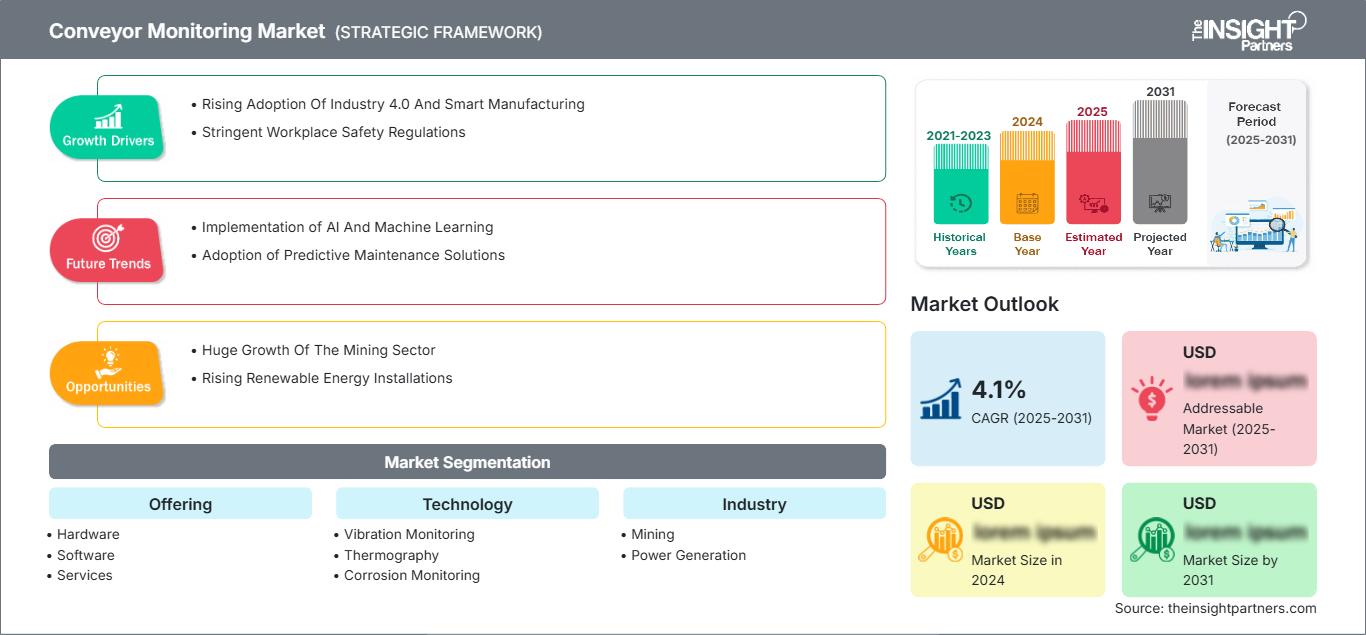
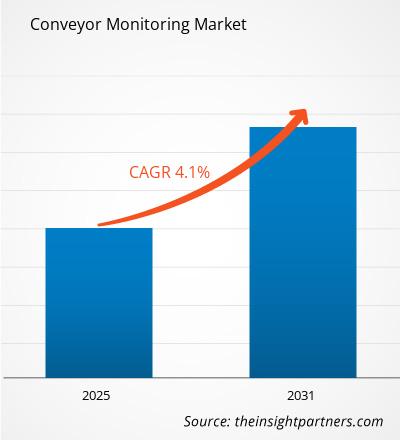
The global Conveyor Monitoring market was valued at US$ 283.51 million in 2025 and is expected to reach US$ 357.93 million by 2034; it is estimated to record a CAGR of 2.62% during 2026-2034.
Conveyor Monitoring Market Assessment and Insights
- North America held 33–36% Conveyor Monitoring Market share in 2025 and is projected to grow at 2.7–3.2% CAGR between 2026–2034, supported by mining automation, OSHA-aligned safety investments, and aging conveyor replacement cycles.
- US represented 72–76% of North America in 2025 and is expected to grow at 2.8–3.3% CAGR between 2026–2034 through mine digitalization and coal-handling reliability upgrades.
- Europe accounted for 22–25% share in 2025 and is forecast to grow at 2.3–2.8% CAGR between 2026–2034, led by Germany, the UK, France, Italy, and Spain.
- Asia Pacific captured 28–31% share in 2025 and is estimated to expand at 3.2–3.8% CAGR between 2026–2034, led by China, India, Australia, Japan, and South Korea.
- Largest Segment Hardware held 58–62% market share in 2025 and is expected to grow at 2.4–2.9% CAGR between 2026–2034 due to sensor, scanner, and controller replacement demand.
- High Growth Segment Software held 22–26% market share in 2025 and is projected to grow at 3.6–4.2% CAGR between 2026–2034 as analytics and remote diagnostics scale.
- Key companies analyzed in detail: Beltscan Systems Pty Ltd, Conveyor Belt Gateway Pty Ltd, ContiTech AG, Emerson Electric Co., Fenner Dunlop, Honeywell International Inc., PHOENIX Conveyor Belt Systems GmbH, Trolex Ltd, Vayeron Pty Ltd., and Yellow Technical Services (Pty) Ltd.
Source: The Insight Partners' analysis based on proprietary research, government publications, company annual reports, investor presentations, industry databases, and expert interviews.
Whereas monitoring technologies used to be periodic, conveyor systems today have evolved towards real-time tracking in order to minimize shut downs, ensure safe transport of materials, and longevity of conveyor belts. This transition is most pronounced in mines and power plants where there is frequent operation in conditions of wear, dust, moisture, and heat. Hardware still plays an important role since sensors, scanners, cameras, and current analyzers provide the data basis while software translates raw data into recommendations for maintenance.
From 2024 to 2034, the investment will focus on retrofitting conveyor systems rather than installing new ones. In the mining industries of Asia Pacific, North America, as well as some parts of the Middle East and Africa, there will be increased use of monitoring systems as a result of high volume of ore, coal, and minerals which present the material downtime problem.
Conveyor Monitoring Market Report Scope
| Report Attribute | Details |
|---|---|
| Market size in 2025 | US$ 283.51 Million |
| Market Size by 2034 | US$ 357.93 Million |
| Global CAGR (2026 - 2034) | 2.62% |
| Historical Data | 2021-2024 |
| Forecast period | 2026-2034 |
Conveyor Monitoring Market Analysis
Demand for the Conveyor Monitoring Market growth comes from operators’ need to change their reactive walkdowns to more proactive fault detection. Mistracking, splice failure, idler lockup, corrosion, overheating, and motor current faults must be detected earlier in mines, coal handling sites, and power stations. The value chain consists of sensors suppliers, belt manufacturers, industrial automation companies, analytics providers, system integrators, and maintenance crews responsible for translating alarms into work orders.
The supply of such products is determined by vendors’ capability to integrate ruggedized field devices with diagnostics that withstand severe conditions. Hardware availability is dependent on industrial electronics, imaging hardware, and special belt scanning systems. The software differentiation can come through alarm prioritization, remote dashboards, and historical benchmarks for operators dealing with many conveyors in different geographically distributed mines or generation facilities.
The Conveyor Monitoring Market shows a moderately concentrated industry structure, with competition based on installed base and diagnostics. Companies such as ContiTech AG, Fenner Dunlop, PHOENIX Conveyor Belt Systems GmbH, Beltscan Systems Pty Ltd, Vayeron Pty Ltd. and Trolex Ltd target the belt health market segment whereas Emerson Electric Co. and Honeywell International Inc. are improving their motor and vibration and process monitoring segments.
There is a shift of focus from individual devices to platforms. Companies such as Conveyor Belt Gateway Pty Ltd and Yellow Technical Services (Pty) Ltd cater to specialized needs with local knowledge of mining important. Positioning will have increasing emphasis on ease of installation and integration of the system with plant infrastructure, with a proven record of reducing stops.
● REPORT CUSTOMIZATION
Tailor This Report To Align With Your Specific Business Requirements
This report can be customized to align precisely with your business objectives, scope, and target markets. Customization options include tailored segmentation, geography, competitive analysis, and strategic insights to support informed decision-making.
Customize This Report →WHAT YOU CAN ADJUST
- ● Segmentations
- ● Geography
- ● Competitive Analysis
- ● Language Preferences
Conveyor Monitoring Market: Strategic Insights
Regional Insights
North America Conveyor Monitoring Market
North America accounted for 33-36% of 2025 revenue and is predicted to register a 2.7-3.2% CAGR from 2026 to 2034. The market share in North America is due to the existence of premium mining sites, the presence of an efficient coal handling system, and a greater inclination towards investing in predictive maintenance because one broken conveyor belt could hinder both production operations and worker safety initiatives.
Furthermore, regional acceptance is attributed to the International Energy Agency’s revelation that despite coal losing ground to other fuels, it continues to be the dominant source of energy throughout the world along with the emphasis of North American mining companies on automation. Upgrades include priority to vibration monitoring, thermography, and motor current analysis.
U.S. Conveyor Monitoring Market
The US accounted for 72-76% of North America in 2025 and is projected to grow at 2.8-3.3% during the forecast period of 2034. This is driven by coal mines, aggregates, ports, and power plants where the conveyor system runs continuously and needs an accurate condition report for scheduled downtime instead of emergency maintenance.
Market presence is broad, as Emerson Electric Co. and Honeywell International Inc. provide industrial monitoring solutions, while experts in belts deliver specific applications. In the US, end-users use sensors along with mobile inspection and thermal images for reporting purposes. Major applications include overland mining conveyors, coal yards, crusher feeds, and highly utilized transfer points.
Europe Conveyor Monitoring Market
Market share in Europe was estimated at 22–25% in 2025 and will see a CAGR of 2.3–2.8% from 2026 to 2034. German presence dominates due to high levels of industrial automation, brownfield plant upgrades, and extensive use of conveyors in production processes. The market in the UK focuses on quarrying, ports, and energy transition logistics, where reliability monitoring helps to achieve lean maintenance staff and meet safety requirements.
Demand in France, Italy, and Spain comes from cement, aggregates, metals handling, and power generation. Adoption in Europe tends to be in favor of diagnostic systems compatible with comprehensive digital maintenance solutions. Purchasers value proven benefits in terms of extending service life, lower risks for inspectors, and compatibility with industrial automation.
APAC Conveyor Monitoring Market
The APAC region was responsible for 28–31% market share in 2025 and will grow at a CAGR of 3.2–3.8%. China dominates the regional demand owing to its huge coal, metal and power generation infrastructure. India and Australia contribute with mining use cases, whereas Japan and South Korea focus on reliability in industrial automation.
The policies of industry, mineral security and power supply affect regional procurement. The IEA stated that Developing Asia accounts for almost four-fifths of global coal consumption in 2024. Hence, the monitoring efforts focus on high-capacity conveyors in which an early warning system helps to minimize production constraints and energy-consuming restarts.
Middle East & Africa Conveyor Monitoring Market
Middle East and Africa is projected to grow at a 2.9–3.5% CAGR during 2026–2034, with Saudi Arabia leading regional investment. Demand is linked to mining diversification, cement production, ports, and energy infrastructure. The UAE emphasizes logistics and industrial handling, while South Africa remains mining-driven.
Rest of MEA adoption is selective because project budgets and technical capability vary widely. Monitoring is most attractive where conveyors serve high-value minerals, coal handling, or export terminals. Harsh operating conditions, dust, heat, and remote locations increase the value of rugged sensors, remote diagnostics, and planned maintenance scheduling.
Segmentation Analysis
Offering
The offering segment is expected to grow at a 2.8–3.4% CAGR during 2026–2034. The Conveyor Monitoring Market scope across offerings reflects a layered purchasing model where field hardware establishes visibility, software converts signals into diagnostics, and services support installation, calibration, and maintenance strategy. Buyers increasingly evaluate total lifecycle value instead of device-level pricing.
- Hardware remains the largest sub-segment because scanners, vibration sensors, thermal devices, cameras, and motor-current analyzers form the primary detection layer across harsh conveyor environments.
- Software is gaining strategic importance as operators need dashboards, alert logic, historical trending, and integration with maintenance platforms to convert monitoring data into actionable decisions.
- Services support deployment quality through site audits, commissioning, calibration, training, and periodic system reviews, especially where mines lack specialized internal diagnostics teams.
Technology
The technology segment is projected to expand at a 2.9–3.5% CAGR through 2034. Adoption is increasingly multi-modal because no single technique captures every failure mode. Vibration monitoring identifies mechanical deterioration, thermography detects heat signatures, corrosion monitoring protects exposed assets, ultrasound supports early defect recognition, and motor-current analysis reveals electrical or load abnormalities.
- Vibration Monitoring is widely used for bearings, idlers, pulleys, and drives because vibration signatures often indicate degradation before visible damage or catastrophic failure occurs.
- Thermography supports heat-based inspection of motors, bearings, seized rollers, electrical panels, and friction points, making it valuable in dusty and high-load environments.
- Corrosion Monitoring is important for outdoor conveyors, coastal terminals, and wet mining operations where structural weakening and component degradation can raise safety risks.
- Ultrasound Emission Monitoring helps detect friction, bearing distress, leaks, and early mechanical defects where audible inspection is unreliable in noisy industrial locations.
- Motor Current Analysis enables non-intrusive assessment of drive health, loading variation, electrical imbalance, and mechanical resistance across conveyor motors and associated equipment.
Industry
The industry segment is anticipated to grow at a 2.7–3.3% CAGR between 2026–2034. Mining remains the principal demand center because conveyors transport ore, coal, and aggregates across long distances under continuous stress. Power generation adds stable demand where coal-handling reliability affects fuel supply continuity, plant availability, and maintenance planning.
- Mining dominates adoption because conveyor failure can halt extraction, crushing, and processing flows, making belt condition visibility essential for productivity, safety, and cost control.
- Power Generation uses monitoring mainly in coal and bulk-fuel handling lines where conveyor stoppages can disrupt bunker supply, plant scheduling, and maintenance coordination.
Opportunity Snapshot
| Industry | Revenue Contribution | Trend Tag | Adoption Stage |
| Mining | High | Smart Mining | Scaling |
| Power Generation | Medium | Coal Reliability | Mature |
Conveyor Monitoring Market Growth Drivers and Impact Analysis
Predictive Maintenance Becomes an Operating Requirement
There is pressure on mining and power generation businesses to avoid unplanned conveyor stops, as such disruptions can interfere with activities such as mining, crushing, fuel transportation, and dispatching. Predictive maintenance alters the economics by making it possible to identify any problems before emergencies. Sensors for detecting vibration levels, temperatures, belt wear, and patterns in the current of motors provide maintenance staff with the grounds for making planned maintenance. This is a key factor driving the Conveyor Monitoring Market since customers demand improvements in reliability, reduced risks of inspections, and improved spare parts management.
Harsh Material Handling Conditions Accelerate Monitoring Demand
The conveying of bulk materials entails harsh conditions, including abrasive ores, coal dust, moisture, heat, and varying loads and impacts at transfer points. All the above contribute to reduced lifespan of belts, idlers, bearings, pulleys and motors and make condition monitoring a more useful approach than the calendar-based one. One instance of belt breakage in a mining operation may cause processing problems, and in a power generation facility, it limits the availability of fuel. Condition monitoring minimizes the possibility of such instances by detecting signs of wear, deteriorated splices, seized rollers and overheating components.
Digital Integration Improves Maintenance Accountability
Connected monitoring is becoming more attractive as operators link field devices with computerized maintenance management systems, dashboards, and remote expert support. This improves accountability because alarms can be ranked by severity, converted into work orders, and reviewed against historical failure data. The driver is not only technology adoption but also organizational discipline, since maintenance teams need consistent evidence to justify shutdown windows and capital replacement. Vendors that provide interoperable data, practical alert thresholds, and integration support are positioned to win multi-site deployments. This impact gradually shifts spending from standalone inspection tools toward lifecycle monitoring platforms.
Conveyor Monitoring Market Future Trends
AI-Assisted Fault Prioritization
Conveyor Monitoring Market trends will increasingly center on AI-assisted prioritization rather than simple alarm generation. Large sites already receive more sensor data than maintenance teams can review manually, so future systems will classify anomalies by failure probability, operating context, and production consequence. The practical value will come from reducing false alarms and identifying which conveyor, splice, idler bank, or drive needs action first. Vendors with labeled field data and transparent models will gain credibility because operators must trust recommendations before allowing automated scheduling influence. This trend will also raise demand for explainable diagnostics and consistent data governance across mines and plants.
Portable and Fixed Monitoring Convergence
A second future trend is the convergence of portable inspection tools with permanently installed monitoring networks. Operators will use fixed sensors for continuous risk surveillance and mobile scanners, thermal devices, or robotic inspection units for targeted verification. This hybrid model fits budget realities because not every conveyor point justifies permanent instrumentation. It also supports phased adoption, allowing companies to monitor critical belts first and expand after proving downtime reduction. Over time, shared data formats will become important as maintenance teams compare mobile inspection findings with fixed-system baselines, improving confidence in repair timing and asset replacement decisions.
Conveyor Monitoring Market Opportunities
Retrofit Programs for Aging Conveyor Fleets
The largest near-term opportunity lies in retrofitting aging conveyor fleets that were designed before continuous diagnostics became standard. Many mines and power plants cannot replace complete systems, but they can add sensors, belt scanners, edge devices, and analytics to critical lines. Conveyor Monitoring Market Forecasts therefore favor modular packages that deliver measurable reliability benefits without major process redesign. Suppliers should target conveyors with high tonnage, long restart times, or difficult manual access. Financing models tied to uptime improvement, service contracts, and staged deployment can reduce buyer hesitation and create recurring revenue beyond initial hardware installation.
Mining Digitization in Emerging Resource Economies
Emerging resource economies present an opportunity as mining companies expand output while facing labor, safety, and productivity constraints. Conveyor monitoring can be positioned as part of smart-mining modernization, especially where remote sites depend on long overland belts and limited maintenance windows. Suppliers that combine rugged equipment with local service capability, training, and multilingual dashboards can improve adoption. Partnerships with EPC firms, belt suppliers, and automation integrators will matter because new mines often specify monitoring during design. This opportunity is strongest in copper, coal, iron ore, bauxite, and critical-mineral operations requiring predictable high-volume movement.
Recent Developments
- June 2026: Carolina Handling and TinMan Systems announced a strategic partnership to provide advanced conveyor health monitoring solutions aimed at improving equipment reliability and operational performance. The collaboration combines Carolina Handling’s material handling expertise with TinMan Systems’ Mobile Conveyor Inspection System (MCIS), a diagnostic platform that captures real-time equipment data through video, thermal imaging, audio monitoring, and vibration analysis.
- January 2026: Jota Machinery highlighted the growing role of artificial intelligence in conveyor belt monitoring systems, focusing on how AI-based technologies can improve equipment reliability, reduce downtime, and support predictive maintenance in industrial operations. AI-powered monitoring solutions use advanced sensors, image recognition, and data analysis to detect issues such as belt damage, misalignment, material blockages, and abnormal operating conditions before they lead to major failures.
- June 2025: REMA TIP TOP and Terra15 partnered to introduce the Automated Roller Monitoring System (ARMS), a conveyor monitoring solution designed to improve reliability, safety, and maintenance efficiency in mining and material handling operations. The system uses Distributed Acoustic Sensing technology with fiber optic cables to continuously monitor conveyor rollers and detect early signs of faults, helping operators identify issues before they cause unexpected failures.
Frequently Asked Questions

- Comprehensive Market Sizing and Forecast Analysis
- Detailed Segmentation Analysis
- In-Depth Market Dynamics Assessment
- Regional and Country-Level Insights
- Competitive Landscape and Company Benchmarking
- Strategic Business Intelligence
Recent Reports
Testimonials

The Insight Partners provided valuable market intelligence that supported our global go-to-market strategy. Their team was professional, responsive, and attentive to our feedback, providing thoughtful analysis and helpful methodological clarifications throughout the project.
Junmo Kim Chief Financial Officer (CFO), Enertech Co., Ltd.
The Insight Partners' SCADA System Market report is comprehensive, with valuable insights on current trends and future forecasts. The team was highly professional, responsive, and supportive throughout. We are very satisfied and highly recommend their services.
RAN KEDEM Partner, Reali Technologies LTDs
I requested a report on a very specific software market and the team produced the report in a few days. The information was very relevant and well presented. I then requested some changes and additions to the report. The team was again very responsive and I got the final report in less than a week.
JEAN-HERVE JENN Chairman, Future Analytica
We worked with The Insight Partners for an important market study and forecast. They gave us clear insights into opportunities and risks, which helped shape our plans. Their research was easy to use and based on solid data. It helped us make smart, confident decisions. We highly recommend them.
PIYUSH NAGPAL Sr. Vice President, High Beam Global
The Insight Partners delivered insightful, well-structured market research with strong domain expertise. Their team was professional and responsive throughout. The user-friendly website made accessing industry reports seamless. We highly recommend them for reliable, high-quality research services
YUKIHIKO ADACHI CEO, Deep Blue, LLC.
This is the first time I have purchased a market report from The Insight Partners.While I was unsure at first, I visited their web site and felt more comfortable to take the risk and purchase a market report.I am completely satisfied with the quality of the report and customer service. I had several questions and comments with the initial report, but after a couple of dialogs over email with their analyst I believe I have a report that I can use as input to our strategic planning process.Thank you so much for taking the extra time and making this a positive experience.I will definitely recommend your service to others and you will be my first call when we need further market data.
JOHN SUZUKI President and Chief Executive Officer, Board Director, BK Technologies
I wish to appreciate your support and the professionalism you displayed in the course of attending to my request for information regarding to infectious disease IVD market in Nigeria. I appreciate your patience, your guidance, and the fact that you were willing to offer a discount, which eventually made it possible for us to close a deal. I look forward to engaging The Insight Partners in the future, all thanks to the impression you have created in me as a result of this first encounter.
DR CHIJIOKE ONYIA MANAGING DIRECTOR, PineCrest Healthcare Ltd.Reason to Buy
- Informed Decision-Making
- Understanding Market Dynamics
- Competitive Analysis
- Identifying Emerging Markets
- Customer Insights
- Market Forecasts
- Risk Mitigation
- Boosting Operational Efficiency
- Strategic Planning
- Investment Justification
- Tracking Industry Innovations
- Aligning with Regulatory Trends





 Get Free Sample for